
Maintaining ISO Class 5 cleanliness is a volumetric challenge, not merely a filtration one. Many cleanroom managers focus on HEPA filter efficiency, assuming a 99.97% rating guarantees compliance. This overlooks the critical role of airflow density. Without sufficient air changes per hour (ACH) to sweep away internally generated particles, even perfect filtration fails. The particulate count standard is a dynamic equilibrium between generation and removal, dictated by the collective output of your ceiling array.
This distinction is crucial for capital planning and operational integrity. Under-sizing a Fan Filter Unit (FFU) grid leads to certification failure and production risk. Over-specifying can create excessive noise and energy waste. The decision pivots on precise airflow calculation and strategic component selection, where motor technology and maintenance design lock in decades of operational cost and control flexibility.
The Core Principles of Laminar Airflow in Cleanrooms
Defining Laminar vs. Turbulent Flow
Laminar airflow describes air moving in uniform, parallel streams with minimal lateral mixing. In cleanroom design, this is typically a vertical downflow from ceiling to floor. This controlled, unidirectional motion acts as a particle barrier, sweeping contaminants away from critical zones toward designated exhaust. Turbulent flow, characterized by chaotic eddies and recirculation, allows particles to remain suspended and settle unpredictably. The primary function of an FFU array is to generate and maintain this laminar condition by providing a consistent, high-volume supply of ultra-clean air.
The Role of Airflow Density in Contamination Control
Achieving ISO Class 5 is a function of system design, not just component specification. The HEPA filter removes incoming particles, but the required air change rate—often several hundred per hour—dilutes and removes contaminants generated by personnel, equipment, and processes within the room. This required airflow density is calculated from room volume and target ACH. A common oversight is specifying FFUs based solely on filter size without verifying the total cubic feet per minute (CFM) output meets the volumetric demand. Insufficient airflow density is a direct path to non-compliance.
Strategic System Implications
This principle creates a direct link between FFU array density and particulate count. Each FFU module contributes a fixed CFM; the required quantity is a simple but non-negotiable calculation. Furthermore, the clean laminar air must have a defined, low-resistance exit path through raised floor or low-wall returns to complete the sweeping flow. Disregarding this balance between supply and return airflow can induce turbulence at the perimeter, undermining the laminar flow field. In our experience, validating the return air path is as critical as sizing the supply array.
Key Components of a Fan Filter Unit (FFU)
The Filtration Cascade
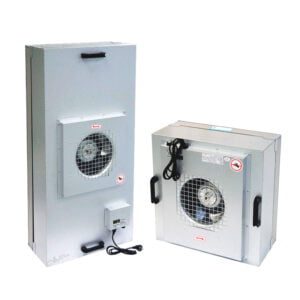
At its core, an FFU is a self-contained air recirculation module. Ambient air is drawn through a prefilter, which captures larger particulates to protect and extend the service life of the primary HEPA filter. The HEPA filter is the critical component, rated per IEST-RP-CC001.6 to remove at least 99.97% of particles 0.3 microns in diameter. For ISO Class 5 environments, HEPA is the standard, though ULPA filters may be specified for stricter applications. The housing integrates these components and includes a face screen or diffuser to promote uniform airflow discharge.
Motor and Drive Assembly
The motorized fan creates the pressure differential to move air through the increasing resistance of the filter stack. The choice between permanent split capacitor (PSC) and electronically commutated (EC) motor technology is a fundamental design decision with long-term operational consequences. This choice dictates energy efficiency, control methodology, and airflow consistency over the filter’s lifespan. The motor is the primary driver of both performance and lifetime cost.
Maintenance-Oriented Design Features
A critical feature for high-class cleanrooms is the non-room-side replaceable (Non-RSR) filter design. This allows filter maintenance to be performed from the plenum space above the cleanroom ceiling, eliminating the need to breach the cleanroom environment. This design drastically reduces the risk of introducing contamination during the high-risk procedure of filter changeouts, a detail often overlooked in procurement but vital for operational integrity.
How FFUs Achieve ISO Class 5 Air Purity Standards
Meeting the Particulate Count Threshold
The ISO 14644-1 standard defines ISO Class 5 as containing no more than 3,520 particles (≥0.5 µm) per cubic meter. FFUs enable compliance through a dual mechanism: supply air filtration and contaminant dilution. The HEPA filter ensures the air introduced is virtually particle-free. Simultaneously, the high air change rate facilitated by the FFU array constantly replaces room air, capturing and removing internally generated particles before they can accumulate to non-compliant levels.
The Scalability of Modular Deployment
Modular FFU sizes, such as 2’x4′ or 22.6″x22.6″, enable a scalable, grid-based deployment to meet precise volumetric airflow requirements. The required number of units is not arbitrary; it is derived from dividing the total required CFM (based on room volume and target ACH) by the CFM output of a single unit. This calculation ensures the necessary airflow density is achieved across the entire cleanroom footprint.
Verification and Compliance
Achieving the standard requires verification through testing per ISO 14644-3, which outlines methods for particle count testing and airflow measurement. The following table summarizes the key parameters FFU systems must deliver to meet ISO Class 5.
| Parameter | ISO-Klasse 5 Grenzwert | Typical FFU Contribution |
|---|---|---|
| Particle Count (≥0.5 µm) | ≤ 3,520 per m³ | HEPA-Filter-Effizienz |
| Filter-Effizienz | ≥ 99.97% at 0.3 µm | HEPA- oder ULPA-Filter |
| Air Change Rate (ACH) | Several hundred per hour | Scalable FFU array CFM |
| FFU Module Sizes | 2’x4′, 22.6″x22.6″ | Grid-based ceiling deployment |
Source: ISO 14644-1. This standard defines the maximum allowable particle concentration for an ISO Class 5 cleanroom, which is the primary performance target for FFU systems. The high air change rates (ACH) facilitated by FFU arrays are the operational method to achieve and maintain this particulate count.
Designing an Effective FFU Ceiling Array
Achieving Uniform Airflow Distribution
Effective laminar flow requires a continuous, wall-to-wall downflow. FFUs are installed in a uniform grid pattern to create this seamless coverage, preventing dead zones with low airflow where particles can accumulate. The array layout must be planned in conjunction with the room’s obstructions, such as light fixtures and structural beams, to minimize airflow disruption. The goal is a consistent velocity profile across the entire work plane.
Integrating Supply with Return Air Paths
The clean, laminar air must have a dedicated and low-resistance exit path to establish the desired unidirectional sweep. This is typically achieved through perforated raised floor panels or low-wall return grilles. The return path design must balance the total supply CFM to maintain proper room pressurization. An undersized return path creates static pressure buildup and induces turbulence, compromising the laminar flow.
Mitigating Inherent Acoustic Challenges
A persistent design constraint is noise generation. High airflow rates and multiple fans operating simultaneously create significant acoustic energy. This challenge must be addressed proactively. Selecting FFUs with quieter EC motor technology, specifying acoustic plenums, or incorporating sound attenuators in the ductwork are standard strategies. Retrofitting acoustic treatments after installation is invariably more complex and costly.
Operational Challenges: Noise, Balance, and Maintenance
Sustaining Performance Over Time
Post-installation, the primary challenges are maintaining airflow balance, managing noise, and executing contamination-free maintenance. As HEPA filters load with particles, their resistance increases. In a fixed-speed system, this leads to a gradual decline in CFM, potentially pushing the room out of specification. Variable-speed controls that adjust fan output to maintain a constant airflow or differential pressure setpoint are essential for sustained compliance.
The Strategic Tier Selection
The market segmentation into standard, energy-efficient, high-performance, and advanced-control tiers forces explicit trade-offs. A standard PSC motor unit addresses the basic need for airflow but offers no compensation for filter loading and higher energy costs. Advanced EC motor units with BMS integration provide automation and data but at a higher capital cost. This choice directly impacts daily operational flexibility, control precision, and long-term financial outlay.
Proactive Maintenance Protocols
Operational integrity depends on a proactive maintenance schedule guided by ISO 14644-5:2025. This includes periodic particle count tests, velocity checks at the filter face, and filter integrity testing. Utilizing FFUs with non-room-side replaceable filters is not just a feature but a risk mitigation strategy, allowing scheduled maintenance without shutting down or contaminating the production environment.
Comparing PSC Motors vs. EC Motors for FFU Control
Fundamental Operational Differences
The choice between PSC and EC motors defines the control scheme and efficiency profile of the FFU system. PSC motors are AC induction motors operating at a fixed speed. They are mechanically simple and have a lower upfront cost. However, they cannot automatically adjust for increasing filter pressure drop. EC motors are DC brushless motors with integrated variable-frequency drives. They allow for precise, software-controlled speed adjustment to maintain a constant airflow or pressure setpoint.
Evaluating the Efficiency and Control Trade-Off
The operational divergence has significant financial implications. EC motors are substantially more electrically efficient, often exceeding 80% efficiency compared to PSC motors. This efficiency gap translates into direct energy savings over the unit’s lifespan. Furthermore, the ability of EC motors to maintain constant CFM ensures consistent cleanroom performance without manual intervention, a critical factor for audit readiness and product quality.
The following comparison outlines the key decision factors between these two motor technologies.
| Merkmal | PSC Motor | EC-Motor |
|---|---|---|
| Anfängliche Kosten | Lower capital expenditure | Higher capital expenditure |
| Operative Effizienz | Lower, fixed speed | High, often >80% efficient |
| Geschwindigkeitskontrolle | Fixed, manual adjustment | Automated, variable frequency |
| Konsistenz des Luftstroms | Declines with filter load | Maintains constant CFM |
| Systemintegration | Begrenzt | BMS integration potential |
Source: Technical documentation and industry specifications.
Long-Term Strategic Value
The decision is a classic capital expenditure versus operational expenditure trade-off. PSC motors prioritize low initial investment. EC motors offer superior long-term value through energy savings, automated control, and integration potential with building management systems for centralized monitoring and predictive maintenance. For facilities with continuous operation, the total cost of ownership for EC motors is typically lower.
Critical Factors for FFU Selection and Sizing
The Non-Negotiable Calculations
Selection begins with unambiguous calculations. The total required airflow (CFM) is derived from the cleanroom volume and the target air change rate. This determines the number of FFUs needed. Filter efficiency must meet the application standard—HEPA for ISO Class 5. Physical dimensions must conform to the ceiling grid layout, and the unit’s rated CFM must be achievable against the final filter pressure drop, not just the clean filter state.
Evaluating Key Specifications
Beyond airflow, several specifications are critical for performance and operational risk management. Motor technology choice, as detailed, locks in efficiency and control. The availability of a non-room-side replaceable filter design is essential for high-stakes environments to prevent contamination during maintenance. Noise levels, often reported in sones or decibels, must align with the operational requirements of the space.
The table below organizes the primary selection criteria into a structured decision framework.
| Auswahlfaktor | Wichtigste Überlegung | Typische Spezifikation |
|---|---|---|
| Airflow Requirement | Room volume & target ACH | Total CFM calculation |
| Filter-Effizienz | Particle retention standard | HEPA (99.97% at 0.3µm) |
| Motorentechnik | Control & efficiency trade-off | PSC vs. EC motor choice |
| Physical Constraints | Ceiling grid compatibility | 2’x4′ or 22.6″x22.6″ modules |
| Wartung Zugang | Contamination risk mitigation | Non-room-side replaceable filter |
Source: IEST-RP-CC001.6. This Recommended Practice defines the construction and performance testing for HEPA filters, which is the core component determining the filtration efficiency of an FFU, a primary selection factor.
Navigating the Supply Ecosystem
Procurement must recognize the two-tier supply landscape. Commodity hardware suppliers offer standardized units for simple replacement. Integrated solution providers deliver design support, certification assurance, and customized control integration for strategic projects. The choice depends on whether the need is for a component or a guaranteed performance outcome.
Implementing a Total Cost of Ownership (TCO) Analysis
Moving Beyond Purchase Price
A strategic financial assessment must look beyond the unit price. The upfront cost of an FFU is a minor component of its total lifecycle expense. A comprehensive TCO analysis accounts for all costs incurred over the expected service life, typically 10-15 years. This perspective reveals the true financial impact of specification decisions, particularly the choice between motor technologies.
Quantifying All Cost Components
Key TCO components include capital expenditure (CapEx) for the units themselves, ongoing energy consumption (heavily influenced by motor efficiency), periodic filter replacement costs, maintenance labor for balancing and repairs, and the risk cost of potential downtime. Energy consumption often becomes the dominant cost, especially for facilities operating 24/7.
The following table breaks down the essential components of a thorough TCO analysis for FFUs.
| Kostenkomponente | Beschreibung | Impact Period |
|---|---|---|
| Capital Expenditure (CapEx) | Initial FFU unit price | Upfront investment |
| Energieverbrauch | Dominated by motor efficiency | Ongoing, decades-long |
| Austausch des Filters | Periodic HEPA/prefilter change | Every 3-10 years |
| Wartungsarbeiten | Speed balancing, repairs | Recurring operational cost |
| Risiko von Ausfallzeiten | Production halt during failure | Potential major expense |
Source: Technical documentation and industry specifications.
Anmerkung: A comprehensive TCO analysis contrasts the lower upfront cost of PSC motor units against the significantly higher long-term operational savings of premium EC motor models over a typical lifespan.
Future-Proofing the Investment
A TCO model also future-proofs the decision. Energy efficiency is evolving from a cost-saving measure to a regulatory and corporate sustainability imperative. Specifying high-efficiency EC motors is a strategic hedge against rising energy costs and potential carbon regulations. Similarly, the industry shift toward smart, data-connected FFUs makes selecting platforms with BMS integration capability a wise investment for enabling predictive maintenance and data-driven compliance reporting.
The core decision points for an ISO Class 5 FFU system converge on airflow density, motor technology, and lifecycle cost. First, validate that the total CFM from your selected array meets the volumetric air change requirement, not just the filter rating. Second, treat the PSC versus EC motor choice as a capital vs. operational expenditure lock-in, with EC technology offering control and efficiency that pays dividends over time. Finally, mandate a total cost of ownership analysis to justify specifications financially, ensuring decisions are grounded in decades of operational reality, not just initial budget.
Need professional guidance on specifying and integrating a high-performance Fan Filter Unit (FFU) system for your critical environment? The engineering team at YOUTH provides design validation and product selection to ensure your cleanroom meets its performance and financial targets. Contact us to discuss your project’s specific airflow and contamination control challenges.
Häufig gestellte Fragen
Q: How do you calculate the required number of FFUs for an ISO Class 5 cleanroom?
A: You determine the total required airflow (CFM) based on your cleanroom’s volume and the target air change rate (ACH), which often reaches several hundred changes per hour for this class. The required FFU count is then a volumetric calculation, dividing this total CFM by the output of each modular unit. This means facilities planning new construction must size their ceiling grid and power infrastructure based on this airflow density calculation, not just filter efficiency.
Q: What is the operational impact of choosing PSC motors over EC motors for FFUs?
A: PSC motors offer lower initial cost but operate at fixed speed, causing airflow to decline as the HEPA filter loads with particles. EC motors automatically adjust speed to maintain constant airflow and pressure, and they achieve over 80% electrical efficiency. For projects where long-term energy costs and consistent, automated performance are critical, expect to justify the higher upfront investment in EC technology for substantial operational savings.
Q: Why is a non-room-side replaceable (Non-RSR) filter a critical feature for ISO Class 5 environments?
A: A Non-RSR filter allows maintenance personnel to remove and install the HEPA filter from above the cleanroom ceiling, preventing contamination of the critical zone during this high-risk procedure. This design is essential for sustaining air purity during necessary maintenance. If your operation requires uninterrupted ISO Class 5 conditions, plan for this feature in your FFU specifications to mitigate a major source of particulate ingress.
Q: How does FFU array design balance air purity with acoustic performance?
A: Achieving the necessary high airflow density with a grid of FFUs inherently generates significant noise, creating a persistent design constraint. Effective design integrates acoustic mitigation from the start, using quieter EC motors or plenum attenuators. This means facilities with noise-sensitive processes or long operator dwell times should prioritize acoustic performance in their motor selection and system design, as retrofitting solutions later is complex and costly.
Q: What standards are used to test if an FFU installation meets ISO Class 5?
A: Verification relies on ISO 14644-3, which provides the test methods for airflow, particle counts, and containment leak testing. Furthermore, the HEPA filters within the FFUs should be classified per IEST-RP-CC001.6. This means your qualification protocol must include these standardized tests to provide defensible data for certification and ongoing performance monitoring.
Q: What factors beyond unit price should a Total Cost of Ownership analysis for FFUs include?
A: A strategic TCO model must account for energy consumption (dominated by motor efficiency), periodic filter replacement costs, maintenance labor, and potential downtime. Energy-efficient EC motors often yield lower lifetime costs despite higher capital expenditure. This means procurement teams should model costs over a 10-year horizon, as regulatory trends are making efficiency and smart automation capabilities a strategic hedge, not just an operational cost-saver.
Q: How do you maintain consistent room pressure as FFU filters age?
A: Consistent pressure requires compensating for the increasing airflow resistance of a loading HEPA filter. FFUs with fixed-speed PSC motors cannot adjust, leading to drift, while units with variable-speed EC motors automatically increase fan speed to maintain the set airflow and pressure. If your cleanroom process demands stable environmental conditions, you should select FFUs with automated speed control to minimize manual balancing interventions.
Verwandte Inhalte:
- Die 3 wichtigsten Anwendungen für Gebläsefiltereinheiten in der pharmazeutischen Produktion
- Gebläsefiltereinheiten oder Laminar Flow Hauben: Was soll man wählen?
- Der vollständige Leitfaden für Reinraum-Manager zum Thema Ventilator-Filtereinheiten: Technische Auswahl, Installation und Leistungsoptimierung, Ausgabe 2025
- Bewährte FFU-Wartungstipps zur Verlängerung der Gerätelebensdauer
- Optimierung von Luftstrommustern in Gebläsefilteranlagen
- Aufkommende Trends: Die Zukunft der Technologie für Gebläsefilteranlagen
- Energieeffiziente mobile LAF-Wagen: 2025 Top-Picks
- Spezifikationen der Reinraum-Filtereinheit | Technischer Vergleich
- Was sind die FFU-Anforderungen für verschiedene Reinraumklassen?



 DE
DE  EN
EN  AR
AR  FR
FR  KO
KO  ID
ID  IT
IT  PT
PT  RU
RU  RO
RO  ES
ES  PL
PL  NL
NL  UK
UK  TR
TR