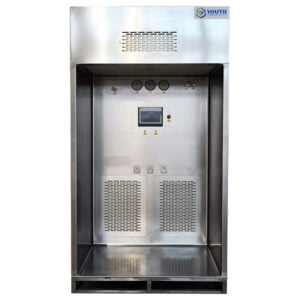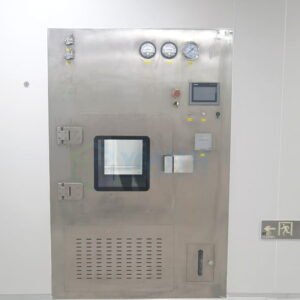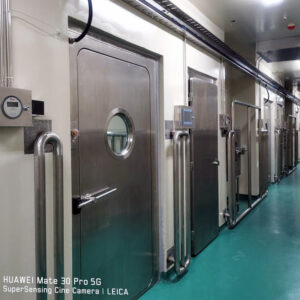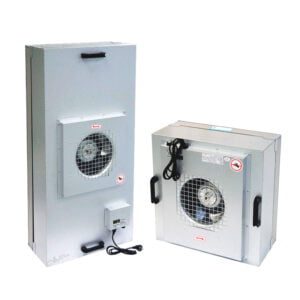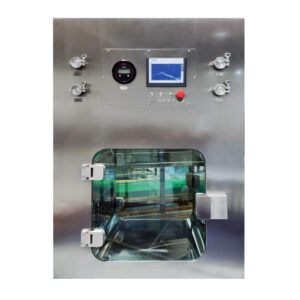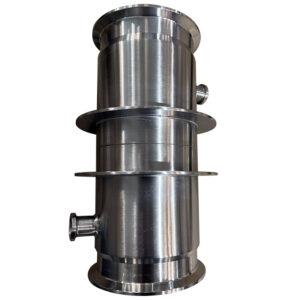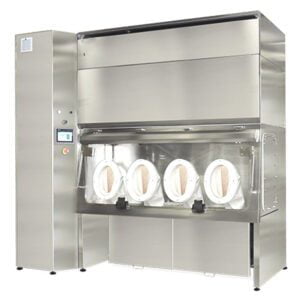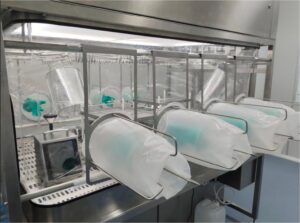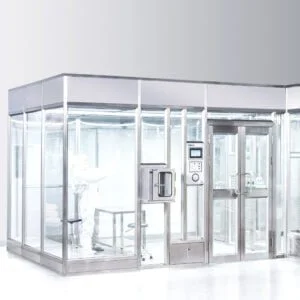
A dispensing booth that meets airflow velocity targets on paper can still fail operator protection if the exhaust is positioned where return turbulence pushes powder back toward the breathing zone. That failure typically surfaces during OQ — after fabrication, installation, and supplier payment — because the URS never required smoke study evidence at the quotation stage. The cost is not just rework: it is a qualification hold while engineering resolves a design problem that should have been closed during the specification phase. The judgment that matters most before comparing supplier quotations is whether the booth specification connects material hazard classification, OEB tier, and operator task to specific containment and airflow evidence requirements.
API Powder Risks That Should Shape the Booth URS
The most consequential framing error in booth procurement is treating the enclosure as a product-cleanliness tool and addressing operator protection separately — or not at all. For API powders, the two are not parallel concerns. They share the same airflow system, and a design optimised exclusively for product ISO class can still create unacceptable operator exposure if the exhaust configuration is wrong.
A documented failure pattern in powder-handling operations is airflow rebound: when exhaust placement is incorrect relative to the work zone, air at an otherwise acceptable velocity bounces off internal surfaces or equipment and re-enters the operator’s breathing zone carrying powder particles. This is not a marginal risk. It is the reason that meeting the 0.36–0.54 m/s velocity range is necessary but not sufficient to confirm containment performance. Airflow speed tells you the fan is running; it does not tell you where the air goes.
The URS should reflect this distinction explicitly. Velocity requirements and directional airflow verification are separate requirements, not interchangeable evidence. If the URS specifies only a velocity band without requiring smoke visualisation evidence to confirm unidirectional flow with no turbulence toward the operator, the rebound risk remains unresolved until OQ — at which point the only solutions are physical redesign or a formal risk acceptance that EHS and QA must both sign off on.
The upstream input that determines how much containment the booth must actually provide is the material hazard profile: MSDS dust generation classification, occupational exposure band (OEB), and the specific operator tasks performed inside the booth during dispensing. A high-potency API dispensed in open containers under downflow alone presents a fundamentally different risk profile from a non-potent excipient decanted in the same enclosure. The URS cannot treat these as equivalent starting points. When material hazard classification and OEB tier are not resolved before the booth specification is written, suppliers receive an underspecified requirement and return quotations that may not be comparable on the dimension that actually matters.
Containment and Operator-Protection Fields to Put in the Checklist
Once material hazard and OEB expectations are defined, the checklist fields that follow are not optional design preferences — they are risk-mitigations tied to specific failure modes. The challenge is that many URS documents list containment fields without specifying when each field is triggered, which leaves the supplier guessing and the buyer exposed to a gap at qualification.
Design Qualification precedes fabrication for a reason. If airflow direction, HEPA filter grade, material construction, and usable working dimensions are not formally verified against the URS before the booth is built, any mismatch discovered at IQ becomes a supplier negotiation rather than a straightforward conformance check. DQ is the point at which the booth design is confirmed on paper — not the point at which it is built to drawing.
For potent compound handling specifically, BIBO filter changeout housings and HEPA after-filters on exhaust are not upgrades to consider at a later stage. They are prerequisites for safe maintenance access and for ensuring that the exhaust stream does not release captured powder into the surrounding environment. Omitting them from the URS to simplify procurement is only defensible when the material genuinely permits it, not as a default cost-reduction measure. The higher documentation and SAT burden these features introduce is a real trade-off, but it is not a trade-off the buyer should resolve informally by leaving them out of the specification.
| URS Field | Tujuan | When It Must Be Specified |
|---|---|---|
| BIBO filter changeout housings | Protects operators during maintenance from potent powder residues | Penanganan senyawa yang kuat |
| HEPA after-filters on exhaust / negative pressure enclosure | Prevents release of hazardous particles and maintains operator protection | Penanganan senyawa yang kuat |
| Design Qualification (DQ) verification of airflow direction, HEPA filter spec, material construction, and working space | Confirms design meets containment and operator protection before fabrication | All dispensing booths |
| Operational Qualification (OQ) airflow visualization (smoke study) | Validates smooth, unidirectional airflow that protects both product and operator | All dispensing booths |
The OQ smoke study deserves particular attention because it is the field most commonly treated as optional. For non-potent excipients in well-established enclosure designs, the argument for deferring it may be defensible. For any API where airflow rebound could produce meaningful operator exposure, it is not. The smoke study provides the only direct evidence that airflow direction inside the working zone behaves as designed — and auditors increasingly treat video recording of that study as expected documentation, not a supplement.
HEPA Filtration and Airflow Evidence the Supplier Should Provide
Requesting performance specifications is not the same as requesting performance evidence. A supplier can state that a booth provides ISO Class 5 conditions and 0.45 m/s face velocity without providing a single test result. The distinction matters at qualification: IQ and OQ require documented evidence against defined acceptance criteria, and if that evidence was never specified in the URS, the supplier has no contractual obligation to produce it.
The air velocity acceptance range of 0.36–0.54 m/s (approximately 90 ± 20 FPM) is a GMP-aligned design figure used widely in pharmaceutical powder-handling applications. It represents the range at which downflow velocity is sufficient to capture and direct airborne particles toward the exhaust without creating turbulence from excessive speed. HEPA filter integrity testing using PAO or DOP aerosol challenge with a leakage limit of ≤ 0.01% is the standard approach to confirming that filter installation has not introduced bypass pathways. Particle count testing for ISO Class 5 cleanliness — ≤ 3520 particles/m³ at ≥ 0.5 µm and ≤ 29 particles/m³ at ≥ 5.0 µm — verifies the working zone classification under ISO 14644-4:2022 construction and test criteria.
Pressure drop monitoring data across the filter stages is not only a commissioning checkpoint. It is the in-service indicator that tells maintenance when a filter is approaching end of life before it begins to fail. Without baseline pressure drop figures recorded at acceptance — HEPA stage at 8–16 mm, intermediate at 3–6 mm, prefilter at 1–6 mm — there is no reference point for interpreting readings taken six or eighteen months later.
| Persyaratan Bukti | Kriteria Penerimaan | Why It’s Required |
|---|---|---|
| Uji kecepatan udara | 0.36–0.54 m/s (90 ± 20 FPM) | Ensures adequate airflow to capture and remove airborne particulates |
| HEPA filter integrity test (PAO/DOP) | Leakage ≤ 0.01% | Confirms filter integrity and containment effectiveness |
| Particle count test (ISO Class 5) | ≥0.5 µm particles ≤ 3520/m³; ≥5.0 µm particles ≤ 29/m³ | Verifies cleanliness level required for API powder handling |
| Pressure drop across filters | HEPA: 8–16 mm; Intermediate: 3–6 mm; Prefilter: 1–6 mm | Monitors filter loading and airflow performance over time |
| Smoke study video recording | Documented unidirectional airflow with no turbulence toward product | Proves airflow direction and containment for auditor review |
If the supplier cannot provide documented test results against these figures for the specific booth being supplied — not generic model data, not catalogue specifications — the qualification package will have a gap at the point where IQ and OQ require equipment-specific evidence. Requesting this documentation at the quotation stage, rather than at delivery, is the only way to confirm that the supplier has the test infrastructure and documentation processes to support it.
For teams evaluating booth suppliers in more detail, the Essential Weighing Booth Performance Specifications for GMP Compliance checklist covers the parameter-level evidence framework that carries directly into OQ acceptance criteria.
Documentation Gaps That Delay Qualification Approval
Site Acceptance Testing is a prerequisite for IQ. A failed or incomplete SAT does not produce a minor delay — it blocks the entire qualification sequence until the deficiencies are resolved, because IQ documents are confirming that the installed equipment matches the design intent, and that confirmation cannot be made against an equipment file that is incomplete or inconsistent.
The failure modes that appear most frequently at SAT are not exotic: incorrect wiring, alarm functions that do not trigger at the correct setpoints, interlock sequences that fail under test conditions, airflow readings outside the accepted range, and pressure differential readings that do not match the design specification. Each of these is individually resolvable, but each one requires a corrective action record, re-test, and updated documentation before the SAT can close. If the supplier’s documentation package is also incomplete at that point — missing calibration certificates, absent P&ID drawings, or an electrical diagram that does not match as-built wiring — the SAT cannot close even after the physical deficiency is corrected.
| Required Document | Purpose (Why It’s Needed) |
|---|---|
| Equipment specifications | Verify design against URS requirements |
| P&ID drawings | Understand process flow, instrumentation, and interconnections |
| Spare parts lists | Plan maintenance and ensure availability of critical components |
| Maintenance instructions | Define routine and preventive maintenance procedures |
| Operating manuals | Train operators and support day-to-day use |
| Sertifikat kalibrasi | Confirm instruments meet accuracy standards before qualification |
| Electrical diagrams | Troubleshoot and validate wiring and control logic |
| Software descriptions | Document control logic and any software configuration |
The practical procurement reality is that equipment suppliers deliver equipment and basic documentation. They do not deliver a qualification-ready package. The IQ/OQ/PQ protocols, the URS traceability matrix, the risk assessments, and the validation master plan are the buyer’s responsibility to produce. Assuming otherwise is the gap that produces the most damaging delays — not because the supplier failed to deliver, but because the buyer’s schedule was built on the assumption that qualification documentation would arrive with the booth.
The deliverables in the table above should be required by purchase order, with delivery timelines and format requirements specified before the order is placed. Receiving an operating manual two weeks after IQ starts, or a calibration certificate that references the wrong instrument serial number, creates a qualification hold that could have been a simple procurement requirement.
Pass-Fail Questions Before Comparing Booth Quotations
Price comparison between booth quotations is premature if the quotations are not responding to the same specification. The purpose of pre-selection review questions is not to eliminate suppliers arbitrarily — it is to confirm that each quotation is addressing the containment requirement the material actually demands, and that the supplier can support the documentation and testing obligations the qualification sequence will require.
These questions are not regulatory pass/fail gates imposed by a named authority. They are defensibility checks: if a supplier cannot answer them at quotation stage, the risk of a qualification gap shifts entirely to the buyer after purchase order.
| Question to Ask the Supplier | Apa yang Harus Diperhatikan | Pass Condition |
|---|---|---|
| Does the booth design include a DQ that verifies airflow direction, HEPA filter spec, material, and working space? | DQ report covering airflow, H14 filter, SS304/316, and working dimensions | DQ confirms all elements meet the URS |
| Does the supplier provide OQ test results for air velocity, HEPA integrity, particle count, noise, and illumination? | Test reports with numerical results | All results are within defined limits (air velocity 0.36–0.54 m/s, HEPA ≤0.01%, ISO 5 particle levels, noise <70 dB, illumination 300–500 lux) |
| Is a smoke study included to verify unidirectional airflow with no turbulence toward the product? | Video recording of smoke study | Video shows smooth, unidirectional airflow and no product-area turbulence |
| Are pressure differentials and alarm/interlock functionalities verified during SAT? | SAT protocol and report | SAT confirms pressure differentials and all alarms/interlocks operate correctly |
| Does the supplier supply SAT plans, checklists, test results, acceptance reports, and calibration certificates? | Complete documentation package | All listed documents are present and correspond to the equipment |
A supplier who provides OQ test results with numerical values, a video-recorded smoke study, a complete SAT documentation package, and a DQ report that traces directly back to the URS is demonstrating the capability to support qualification — not just the capability to manufacture a booth. The difference between those two capabilities is what the pre-selection questions are designed to surface.
One question that does not appear in the table but often determines downstream project risk is whether the supplier’s test results are from the specific unit being supplied or from a representative factory unit of the same model. For standard configurations the distinction may be manageable; for customised or oversized booths, equipment-specific test data is what IQ/OQ require, and that clarification should be made explicit at quotation stage, not at delivery.
For teams specifying containment configuration and airflow type before reaching this stage, the Sampling Booth guide on containment airflow and booth type selection covers the upstream decision logic that should precede URS drafting.
A dispensing booth URS that resolves material hazard classification, OEB expectations, operator task, and exhaust or recirculation concept before it specifies airflow velocity will produce a far more usable procurement document than one that starts from airflow velocity and works backward. The gap between those two approaches does not appear until EHS or QA review the qualification package — at which point the misalignment between the hazard classification and the booth’s stated capability becomes a documentation problem with no simple fix.
Before comparing quotations, confirm that the material risk determination, the containment level it demands, and the specific performance evidence the supplier must provide are all present in the URS. What the supplier can and cannot document at quotation stage — DQ scope, OQ test formats, SAT protocol detail, delivered document list — is the most reliable signal of whether the qualification path will be straightforward or whether it will require rework that the project schedule has not budgeted for.
Pertanyaan yang Sering Diajukan
Q: What if the material being dispensed is a non-potent excipient rather than a high-potency API — does the same checklist still apply?
A: The checklist structure still applies, but several fields become optional rather than mandatory. BIBO filter changeout housings, HEPA after-filters on exhaust, and OQ smoke studies carry a higher documentation and SAT burden that is only justified when the material hazard and OEB tier demand them. For non-potent excipients, a simpler booth configuration may be entirely appropriate — but that conclusion should be reached by formally evaluating the MSDS dust generation classification and operator task profile, not by defaulting to a lower-specification booth and leaving the justification undocumented.
Q: After the URS is finalised and a supplier is selected, what is the first step that determines whether qualification will proceed on schedule?
A: The first step is requiring the supplier to deliver the complete documentation package — calibration certificates, P&ID drawings, electrical diagrams, operating manuals, and SAT plan — by a specified date before SAT begins, not at or after delivery. SAT is a prerequisite for IQ, and if the documentation package is incomplete when SAT is attempted, the SAT cannot close even if the equipment passes all physical checks. Building the document delivery timeline and format requirements into the purchase order, before the order is placed, is what separates a qualification that runs on schedule from one that stalls at the first hold point.
Q: At what point does a standard downflow booth become insufficient for the containment requirement, and a more engineered solution become necessary?
A: A standard downflow configuration becomes insufficient when the material risk cannot be controlled by airflow and routine housekeeping alone — typically when OEB classification indicates operator exposure limits that downflow velocity and standard HEPA filtration cannot reliably achieve, or when the operator task involves prolonged open handling of fine, high-potency powder. At that threshold, exhaust HEPA after-filters, negative pressure enclosures, and BIBO maintenance access are not optional upgrades; they are the minimum containment response the hazard demands. The escalation decision should be driven by the MSDS and OEB determination, not by budget or procurement preference.
Q: Is it better to request equipment-specific test data from the supplier or accept factory model data from a representative unit?
A: Equipment-specific test data is the correct requirement for any customised or non-standard booth configuration. IQ and OQ protocols require evidence tied to the specific unit installed, not to a representative factory model of the same type. For fully standard configurations the distinction is sometimes manageable, but accepting model-level data without clarifying this at quotation stage creates a qualification gap that only surfaces when the IQ package is under review — at which point the supplier has no contractual obligation to produce unit-specific results. This clarification should be written into the URS and confirmed explicitly before purchase order placement.
Q: How should a procurement team weigh the higher documentation burden of a high-containment booth against the simpler qualification path of a lower-specification unit?
A: The trade-off is real but it is not a free choice — it is constrained by the material hazard classification. A lower-specification booth reduces SAT complexity, shortens the delivered document list, and simplifies OQ acceptance criteria, but only when the material genuinely permits it. Choosing a simpler booth to ease procurement when the OEB tier demands higher containment transfers the documentation problem downstream: EHS or QA review will identify the misalignment between hazard classification and stated booth capability, and resolving it after fabrication is substantially more costly than resolving it in the URS. The decision should be driven by OEB and MSDS outputs, with the documentation burden treated as an expected cost of the containment level the material requires.