Packaging areas that fail contamination control rarely fail at the filter—they fail at the workflow. Open product exposure during tray loading, a pass box too narrow for the actual carton size, and staging materials parked directly inside the clean zone without a defined entry route are the decisions that produce particle excursions, rework loops, and qualification retest events. The harder problem is that idle-room particle counts can pass acceptance criteria cleanly while concealing everything a moving operator and a roll of packaging film actually add to the air. Understanding how layout, material flow, and test protocol interact as a connected set—rather than sequential handoffs—is what separates a cleanroom that passes commissioning from one that holds up under routine monitoring and audit.
Open Product Exposure During Clean Packaging
The interval between when product leaves its primary container and when it enters final packaging is the highest-exposure window in the entire handling sequence. Airborne dust during that window is a realistic particle-rejection driver, particularly where packaging lines require manual placement, visual orientation, or position correction before closure. The contamination risk does not have to be catastrophic to be costly; even low-level particle accumulation during open handling can push finished goods into rework or rejection at final inspection.
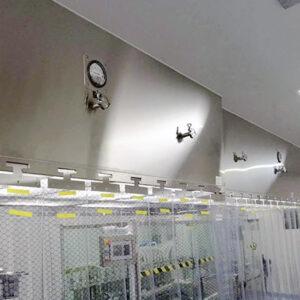
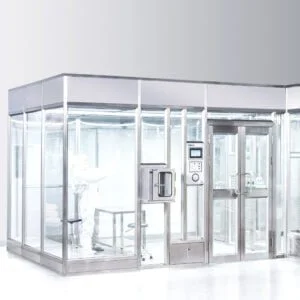
A modular cleanroom configured for this stage needs a ceiling and frame structure that does not generate or trap particles of its own. Flush ceiling construction and tight frame tolerances reduce horizontal ledges where contamination can accumulate between cleaning cycles—a planning criterion for maintainability, not a regulatory classification requirement, but one that becomes operationally significant when shift cleaning is the only practical hygiene interval between production runs. Modular systems that allow fast construction around installed packaging equipment reduce the production disruption associated with environment upgrades; as an illustration of implementation speed, some configurations have been commissioned including ISO classification validation within three days, though project timelines vary with scope and facility constraints.
For procurement and facilities teams, the design question is not just the classification target but the airflow pattern directly over the open product zone. Unidirectional flow at the point of exposure provides a defensible boundary between open product and room air; positioning that flow source relative to operator reach and tray travel path is a layout decision that needs to be resolved before the ceiling grid is fixed, not during commissioning.
Final Inspection Bench and Rework Controls
Final inspection is routinely treated as a read-only activity—visually checking a sealed, finished unit—but rework is not. Sampling, label correction, secondary sealing, and reject-sort operations all involve open handling of goods that have already passed through the packaging process. Without adequate local protection at the bench, that activity can reintroduce contamination to finished product in the last handling step before release.
The operational challenge is that inspection benches are often placed in the residual floor space after packaging equipment has been positioned. That layout logic prioritizes equipment access and line flow, which is reasonable, but it can leave inspection positions in zones where room air recirculation or adjacent operator movement creates intermittent particle exposure. Positioning a bench at the perimeter of a unidirectional flow zone rather than within it is a common compromise that looks acceptable on a layout drawing and becomes a recurring contamination source during normal use.
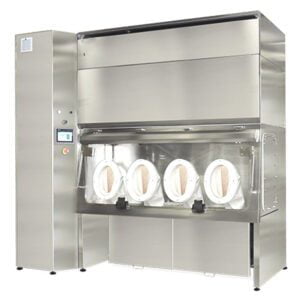
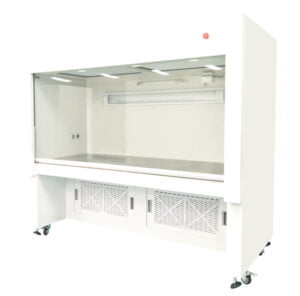
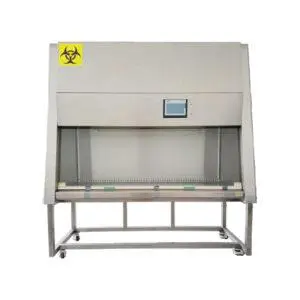
ISO 14644-5:2004, which addresses cleanroom operations, provides a useful operational reference for defining work practice controls at inspection stations—hand discipline, gown protocols, movement constraints—but the standard does not prescribe bench layout or rework procedures. That gap means the inspection bench configuration has to be defined by the facility quality team based on the specific activities being performed there. A Meja Operasi LAF Ruang Bersih provides local unidirectional flow at the work surface, which is a practical method for protecting open product during rework and sampling without requiring the entire room to carry the airflow burden of a critical zone. The important procurement check is whether the bench dimensions and airflow pattern are matched to the actual rework activities—sampling tools, reject bins, container geometry—rather than to a generic work surface specification.
Pass Box Sizing for Trays Cartons and Components
Pass box sizing decisions made at layout stage are difficult and sometimes impossible to reverse once walls are constructed. The failure pattern is consistent: internal clear dimensions are calculated against the average hand-carried item, the box is installed, and then the first time a full tray of nested components or a master carton with extended flaps needs to pass through, the workflow either stalls or forces a non-conforming transfer through an open door or gowned personnel corridor.
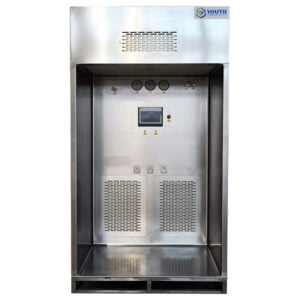
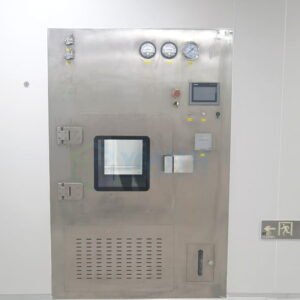
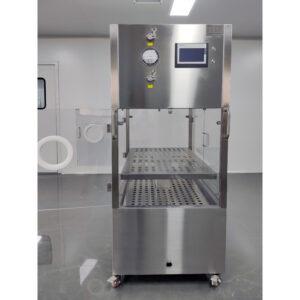
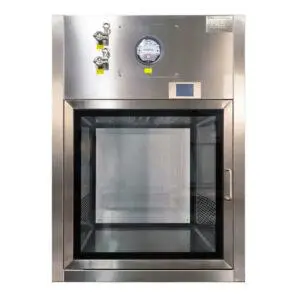
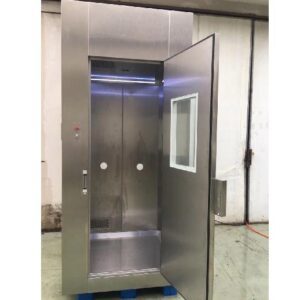
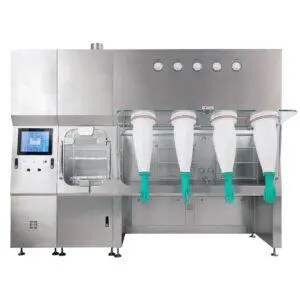
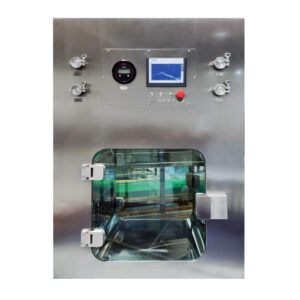
The practical sizing criterion is the largest single item that will move through the transfer at peak production—not the average item, not the most frequent item. For packaging areas, that worst-case item is often a formed shipper carton, a loading tray with a protruding guide rail, or a pallet slip-sheet carried flat. Once identified, the clear internal dimension of the Static Pass Box / Transfer Hatch should accommodate that item with enough margin for two-handed placement by a gloved operator without contact with the door frame or interlock mechanism.
A related configuration consideration is shelf or roller-base arrangement within the box. Flat-shelf pass boxes are adequate for most carton transfers, but where trays are heavy or transfers are frequent, a roller base reduces tipping risk and removes the need for the operator to fully reach into the box to retrieve the item. That detail rarely appears in procurement scope documents but affects both operator ergonomics and contamination risk at the transfer point—specifically, the risk that an operator who overreaches will contact the dirty-side frame with a gloved hand before completing the transfer. Interlocked single-door-open operation is a standard contamination control for pass boxes serving classified spaces; the procurement review should confirm that the interlock configuration matches the pressure differential direction and that no override bypass is accessible to production staff.
Packaging Material Entry and Staging Route
Packaging materials—films, cartons, labels, inserts, desiccants—are particle sources. Corrugated board sheds aggressively; printed films carry release dust; labels accumulate fibers on adhesive edges. The entry route and staging location for these materials are frequently left undefined at layout stage, with the assumption that they will be managed operationally. In practice, when no defined route exists, materials end up staged inside the clean zone because that is the most convenient location for the operator, and the contamination contribution goes unmonitored.
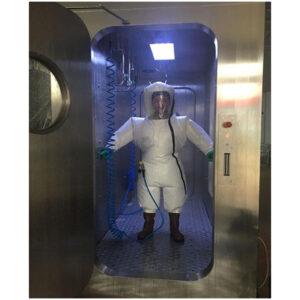
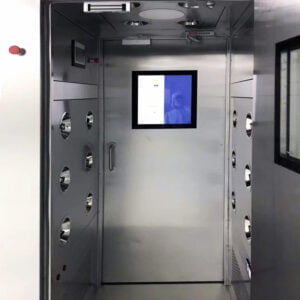
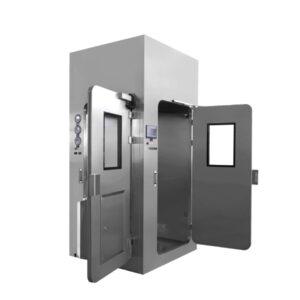
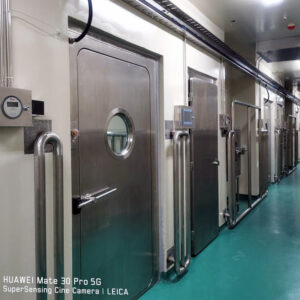
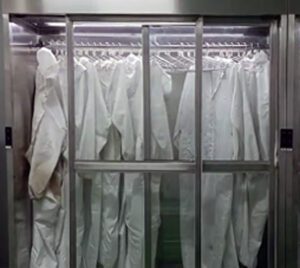
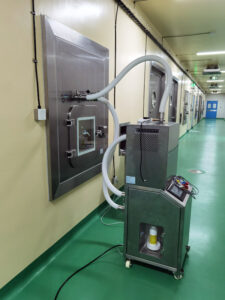
A controlled staging route means the materials have a defined point of entry, a designated staging area that is either outside the classified zone or in a lower-classification anteroom, and a procedure for debulking or wiping before items cross into the packaging environment. A large net passage with a sliding soft-wall divider—as used in some modular packaging line configurations—can support material and equipment movement into and out of the clean zone while maintaining a physical boundary between the staging zone and the production space. This is an operational implementation detail, not a compliance requirement, but it reflects the planning criterion that the entry path for materials should be distinct from the entry path for gowned personnel.
Demising walls between manufacturing zones and packaging areas address a related but distinct problem: particle and noise transfer between adjacent processes. Where a filling line or assembly process operates in an adjacent space, a demising wall with defined transfer points prevents cross-contamination of the packaging environment from upstream activities. This separation is a planning criterion for environmental control, and whether it is implemented as a hard wall or a modular panel assembly affects the flexibility of future layout changes. The decision matters most when material flow volumes are expected to grow; a soft wall or panel system can be reconfigured where a hard demised wall cannot be moved without construction work.
Representative Activity During Particle Testing
Particle classification data collected from an empty or idle room does not reflect the particle load introduced by operating packaging equipment, moving materials, or gowned personnel performing normal tasks. A room can meet ISO 14644-1:2015 classification limits under at-rest conditions and still produce particle excursions during normal operation that would exceed those same limits. The test protocol decision—specifically, whether particle samples are taken under at-rest, in-operation, or representative-activity conditions—determines what the classification result actually certifies.
ISO 14644-1:2015 defines classification conditions including at-rest and in-operation states and provides a testing framework for each. The standard does not specify the particular packaging activities that must be simulated; that determination depends on what operations will actually occur in the space. For a packaging area, in-operation testing should include the activities most likely to generate particles: loading trays, opening packaging film rolls, placing labels, and moving between work positions. If those activities are excluded from the particle sampling period because they are disruptive to the test setup, the resulting data should be treated as at-rest data regardless of what label is applied to it.
The downstream consequence of accepting idle-room data as representative is that the room may be released on misleading evidence. Routine environmental monitoring during production can then surface excursions that the initial classification testing did not detect, triggering investigation cycles, resampling events, and potential holds on finished goods. The validation team should define the representative activity scope before testing begins, document which operations were performed during sampling, and confirm that the particle monitoring location and sample duration reflect worst-case personnel and material positions rather than the most favorable positions available in the room layout.
Room Layout Evidence for Packaging Release
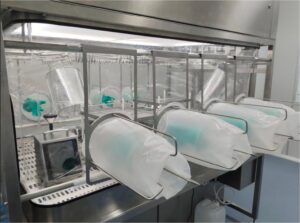
The layout decisions that affect packaging release are made at the design stage but their consequences appear at qualification and audit. An isolated packaging room with external operator oversight—where monitoring is conducted from outside the classified space rather than by personnel moving inside it—provides a layout configuration that limits the contamination variables introduced by observation activity. This is a configuration option relevant where the packaging process allows it, not a universal requirement for packaging release, but it offers a defensible basis for reducing person-generated particle load during qualification and routine monitoring.
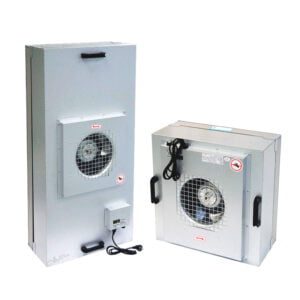
Ceiling clearance above fan filter units is a practical constraint that resolves differently depending on whether the facility is a new build or a retrofit into an existing production space. Insufficient clearance above FFUs restricts both airflow intake and maintenance access, which creates a trade-off between maximizing usable cleanroom height and maintaining serviceable overhead infrastructure. Super-thin FFU configurations recover meaningful clearance in height-constrained spaces, and that recovered height can translate directly into improved equipment access or a taller working zone within the room.
| Clearance Parameter | Required Clearance |
|---|---|
| Airflow intake (minimum) | 200 mm |
| Maintenance access (minimum) | 300 mm |
| Recommended total clearance | 600 mm |
| Space savings with super-thin FFU | Up to 150 mm |
Internal-mounted wall structures allow the cleanroom envelope to be built against existing facility walls without losing floor space to external framing width—a planning criterion relevant for packaging areas that operate within defined footprints inside larger manufacturing buildings. Whether internal mounting is appropriate depends on the condition of the existing walls, the fire and acoustic rating requirements for the installation, and whether the existing structure can carry the load of the panel attachment system. It is a space-maximization option, not the only acceptable approach, and it should be evaluated against the retrofit constraints of the specific facility rather than adopted as a default.
For layout documentation submitted as part of packaging release, the combination of particle monitoring position records, airflow pattern data, equipment placement drawings, and material flow routes constitutes the evidence set that supports the classification claim. A layout drawing alone is insufficient if it does not show where personnel stand during operation, where materials are staged, and where monitoring instruments were placed during classification testing.
For packaging areas that are part of a ruang bersih modular project, the connected review—layout, material flow, and test protocol—should happen before the room design is locked, not during commissioning when changes are expensive. The questions that matter most before fabrication are: what is the largest item that must pass through each transfer point, where will packaging materials be staged before entering the classified zone, what activities will be performed during particle classification testing, and does the ceiling clearance support both operational FFU performance and the access needed for filter changeout without cleanroom shutdown.
Release documentation for a packaging cleanroom should answer what was happening in the room when the particle data was collected. If the answer is nothing, the classification evidence has a gap that may not become visible until routine monitoring or an inspection surfaces the difference between idle-room performance and in-operation reality.
Pertanyaan yang Sering Diajukan
Q: What happens if the room passes ISO classification at rest but then fails during routine monitoring once production starts?
A: Routine excursions after a clean idle-room classification result usually mean the test protocol did not include representative packaging activity, so the classification certified the empty room rather than the working environment. The immediate step is to identify which operations—tray loading, film handling, label placement, personnel movement between positions—were absent during sampling, then conduct a supplemental in-operation particle study with those activities present. If excursions persist, the investigation should check material staging locations, bench positioning relative to the unidirectional flow zone, and whether pass box transfers are being completed without bypassing interlocks. Resampling under representative conditions is more useful than repeating idle-room counts.
Q: Does a LAF operation bench at the inspection station reduce the room classification requirement for the surrounding space?
A: Not automatically, and relying on local bench protection to compensate for a lower room classification carries risk. A LAF bench provides unidirectional flow over the immediate work surface, which protects open product during rework and sampling, but it does not control what happens when product moves off the bench, when reject bins are handled nearby, or when adjacent operator activity disturbs the bench’s protective airflow envelope. The room classification should still reflect the worst-case open product exposure in that space. The bench is a local supplement to room-level control, most defensible when the surrounding environment is already classified and the bench addresses residual exposure during the highest-risk handling steps.
Q: At what point does adding more pass boxes become less effective than changing the material staging approach?
A: When the contamination source is the packaging material itself—shedding from corrugated board, release dust from printed film, fibers from label stock—additional pass boxes address transfer frequency but not material-borne particle load. If staging and debulking are not happening before materials enter the classified zone, each additional transfer point moves contaminated materials into the clean environment more efficiently, not more safely. The staging route should be resolved first: defined entry point, anteroom or lower-classification holding area, and a wiping or debulking step before materials cross the classification boundary. Pass box count and sizing decisions are more meaningful once the material entry discipline is established.
Q: Is a modular panel system appropriate for a packaging area that will need to expand capacity within two or three years?
A: A modular panel system is generally better suited to anticipated expansion than a hard-wall construction, because panels can be reconfigured without the structural work required to move a demised wall. The relevant constraint is whether the initial layout preserves reconfiguration options—specifically, whether equipment positions, FFU grid spacing, and utility connections are placed to allow wall relocation without major infrastructure rework. If the expansion scenario involves adding packaging lines rather than just increasing throughput on existing lines, the ceiling grid, FFU quantity, and material entry route should all be sized or pre-engineered for the larger footprint during the initial build, since overhead infrastructure changes after commissioning are disproportionately disruptive.
Q: How should the layout documentation be structured to hold up under a regulatory inspection rather than just satisfying internal release criteria?
A: Documentation that withstands inspection shows what was happening in the room when the particle data was collected, not just the numerical results. That means the submission should include the specific activities performed during in-operation sampling, the personnel positions and movement patterns during classification testing, the location of monitoring instruments relative to open product zones and material staging areas, and the largest item transferred through each pass box during the test period. A layout drawing without this operational context creates an evidence gap that an inspector can use to question whether the classification result reflects actual production conditions. Connecting the particle data record to the activity record—explicitly, in the release documentation—is what closes that gap.