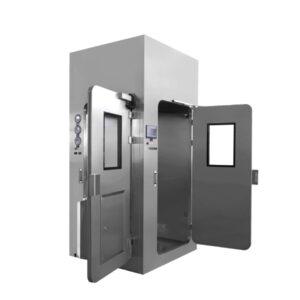
Mist Shower Air Flow Velocity Requirements: Meeting ≥20m³/min Standards for Cleanroom Applications

공유 대상:

Maintaining cleanroom integrity demands precise control over every contamination vector. Personnel and material entry represent one of the highest risks, making the air shower a critical barrier. Yet, specifying this equipment often focuses on superficial features, overlooking the single most critical performance metric: air flow velocity. The ≥20 m/s standard is the definitive benchmark for effective particulate scrubbing, but achieving and sustaining it requires deliberate engineering. Misunderstanding this requirement leads to underperforming systems that jeopardize product yield and regulatory compliance. This analysis moves beyond catalog specs to the technical and operational realities of meeting this non-negotiable standard.

The stakes for contamination control have never been higher. In semiconductor fabrication and aseptic pharmaceutical manufacturing, a single particle can result in catastrophic batch loss or device failure. Regulatory bodies and international standards explicitly govern the design and validation of cleanroom air showers. As processes become more sensitive and audits more stringent, the technical rigor behind your air shower selection is no longer optional—it’s a fundamental component of operational risk management. Ensuring your system delivers verified, sustained performance is essential for protecting capital investment and product integrity.

Why the ≥20 m/s Air Velocity Standard Is Non-Negotiable

The Physics of Particulate Removal

Air velocity is the primary force for dislodging contaminants from clothing and material surfaces. The ≥20 m/s threshold, often specified as 20 ± 2 m/s, represents a calculated balance. It provides sufficient kinetic energy to overcome particle adhesion forces while remaining within practical limits for user comfort and energy consumption. Velocities significantly below this range fail to generate the necessary turbulent scrubbing action, rendering the shower ineffective. This standard is not a suggestion but a proven requirement for protecting high-value processes.

Consequences of Substandard Performance

Installing an air shower that fails to meet this benchmark creates a dangerous false sense of security. Personnel enter the cleanroom believing they are decontaminated, while sub-micron particles remain on their garments. This directly introduces contamination into the critical environment, compromising yields and sterility. The risk extends beyond product loss to include regulatory audit findings and costly remediation efforts. The velocity standard is therefore the first and most critical filter in your procurement process.

Validating the Benchmark

Procurement specifications must explicitly require verification of this parameter. The table below outlines the core parameters that define this non-negotiable standard.

매개변수Standard Value중요도
공기 속도20 ± 2 m/sNon-negotiable benchmark
미립자 제거Proven efficacyProtects high-value processes
Lower Velocity ImpactCompromised scrubbing actionCleanroom integrity risk
Operational BalanceEffective decontamination vs. energy/comfortDesign optimization target

출처: ISO 14644-4: 클린룸 및 관련 제어 환경 - 파트 4: 설계, 시공 및 시운전. This international standard provides the framework for specifying and controlling environmental parameters like airflow, establishing the design principles for achieving required cleanliness levels through controlled air velocity.

How Air Shower Nozzle Design and Placement Affect Velocity

Nozzle Engineering for Jet Focus

Achieving the target velocity is not just about blower power; it’s about efficiently converting that power into focused, high-velocity jets. Nozzles are precision components, typically constructed of stainless steel for durability and cleanability. Their internal geometry and diameter—commonly around 25mm—are engineered to accelerate and direct airflow without excessive pressure drop. In my experience evaluating systems, poorly designed nozzles can dissipate airflow, resulting in a diffuse breeze that never reaches the required scrubbing force, even with a powerful blower.

Strategic Layout for Complete Coverage

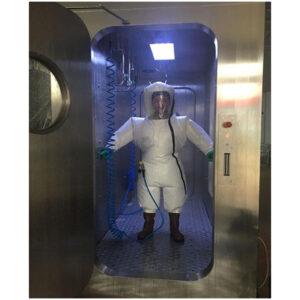
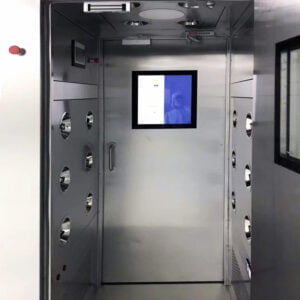
The number and placement of nozzles are calculated to ensure complete coverage of the chamber. A minimum of six nozzles is standard for a single-person unit, while large material pass-through systems may employ thirty-six or more. The layout strategy creates overlapping turbulent zones, ensuring no part of a person or cart avoids the high-velocity air. This calculated placement is what transforms raw airflow into an effective, whole-body decontamination process. The synergy between component design and system integration is what separates a compliant air shower from a truly effective one.

Validating Performance: Testing and Certifying Airflow Standards

On-Site Measurement Protocols

Performance verification is essential. Adherence to the velocity standard is confirmed by measuring the air velocity at the outlet of each nozzle using a calibrated anemometer. This point-by-point check ensures the design intent is met across the entire chamber. Furthermore, the integrity of the closed-loop HEPA filtration system is paramount and is validated via industry-standard Dioctyl Phthalate (DOP) or Poly-Alpha Olefin (PAO) leak tests to ensure no unfiltered air bypasses the filter.

The Role of Third-Party Certification

While factory tests are important, third-party certifications provide an additional layer of assurance. Marks like UL and CE indicate the system has been evaluated for safety and performance against recognized standards. These certifications are becoming market gates, simplifying your validation process during audits and mitigating operational risk by ensuring baseline quality and compliance.

The following table details the key activities for validating an air shower’s performance.

유효성 검사 활동Method/Tool규정 준수 지표
공기 속도 테스트보정된 풍속계≥20 m/s at each nozzle
필터 무결성 테스트DOP/PAO leak testHEPA filter seal verification
Third-Party CertificationUL, CE marksMarket access, risk mitigation
성능 검증Nozzle outlet measurementConfirms design intent

출처: GB/T 25915.4-2010: Cleanrooms and associated controlled environments — Part 4: Design, construction and startup. This standard, equivalent to ISO 14644-4, establishes requirements for the commissioning and performance verification of cleanrooms, including the validation of critical airflow systems like air showers.

Key Design Factors: Blowers, Filters, and Chamber Integrity

The Motive Force: Blower Selection

The sustained generation of ≥20 m/s airflow relies on robust, reliable blowers. Centrifugal blowers from manufacturers like ebm-papst® are preferred for their consistent performance and low vibration. The blower must be correctly sized for the system’s airflow resistance, which includes the filter load and nozzle configuration. An undersized blower will fail to maintain velocity as filters load with particulate.

필터링 캐스케이드

The filtration system is a non-bypassable bottleneck. A pre-filter with 60-90% efficiency protects the primary H14 HEPA filter (99.995% efficient at 0.3µm) from premature loading. This two-stage approach is critical for maintaining airflow and extending the service life of the costly HEPA filter. The entire assembly must be designed for leak-free operation, as any bypass renders the system ineffective.

Chamber Construction and Materials

Chamber integrity ensures the high-velocity air is contained and directed effectively. Construction materials are a lifecycle cost decision. Powder-coated steel offers durability for standard environments. For harsher conditions involving corrosive chemicals or stringent microbial control, 304 or 316L stainless steel is necessary. The material choice directly impacts clean-down protocols, long-term durability, and total cost of ownership.

Subsystem주요 구성 요소성능 사양
블로어Centrifugal (e.g., ebm-papst®)Vibration-free, reliable force
사전 필터Initial filtration stage60-90% efficiency
Primary FilterH14 HEPA filter0.3µm에서 99.995%
Chamber Material (Standard)Powder-coated steelDurability, cost-effectiveness
Chamber Material (Corrosive)304/316L 스테인리스 스틸Microbial resistance, chemical durability

출처: 기술 문서 및 업계 사양.

Beyond Velocity: Critical Maintenance and Calibration Protocols

Sustaining Filter Performance

The closed-loop design means filter integrity is paramount. Differential pressure gauges across the filter bank are not optional; they are essential for predictive maintenance. Monitoring pressure rise schedules pre-filter changes and signals when HEPA replacement is imminent. Operational budgets must account for this maintenance to prevent a sudden loss of velocity and filtration efficacy, which constitutes a system failure.

System Recalibration

Performance degrades over time. Periodic recalibration using certified anemometers verifies that each nozzle still delivers the required velocity. Furthermore, door interlocks and control sequences should be tested regularly to ensure the shower operates only when properly sealed. This proactive approach to maintenance transforms the air shower from a static piece of equipment into a reliably controlled process.

Comparing Single-Sided vs. Double-Sided Air Shower Configurations

Configuration and Capability

The choice between single-sided and double-sided units is a fundamental design decision. Single-sided configurations, with one blower and filter module on a single wall, are suited for space-constrained areas or lower traffic volumes. Double-sided configurations feature modules on opposite walls, providing higher total airflow capacity, more uniform coverage, and faster decontamination cycles, making them ideal for high-throughput facilities.

Selection Based on Flow Dynamics

The decision should be driven by an analysis of personnel and material flow. A high-traffic gowning room serving a large cleanroom may necessitate the superior performance of a double-sided unit to maintain throughput without creating a bottleneck. The goal is to match the system’s physical and operational footprint to your specific traffic patterns and contamination control requirements.

The table below compares the core characteristics of each configuration to guide this decision.

구성Key Characteristic최상의 대상
Single-SidedOne blower/filter moduleSpace-constrained areas
Single-SidedLower airflow capacityLower traffic volumes
Double-SidedTwo blower/filter modulesHigher airflow, uniform coverage
Double-SidedFaster decontamination cycles높은 처리량 시설
선택 드라이버Personnel/material flow analysisOptimizing capex & throughput

출처: 기술 문서 및 업계 사양.

Integrating Air Showers into Your Cleanroom Contamination Control Plan

Programming for Risk Mitigation

An air shower is not a standalone product but a integrated component of a broader strategy. Its control logic must be programmed to address specific cross-contamination vectors. Standard sequences include One-Way (entry only), Two-Way One-Way (separate entry/exit showers), and Two-Way (both entry and exit in the same chamber). In pharmaceutical biocontainment, a Two-Way sequence is critical to contain hazardous agents within the cleanroom.

Aligning with Process Flow

The selection of sequence and placement must be a risk-based decision. It requires mapping the primary direction of contaminant concern—whether it’s particles entering a cleanroom, hazardous powders exiting a containment suite, or both. This analysis ensures the air shower functions as a deliberate barrier within your validated process flow, not just an isolated piece of hardware. For facilities designing this integration, evaluating specialized cleanroom mist shower systems that offer programmable sequencing is a logical step in operationalizing this plan.

Selecting the Right System: A Decision Framework for Buyers

A Multi-Faceted Evaluation

Move beyond catalog specifications. First, explicitly verify the ≥20 m/s velocity standard and demand test data. Second, analyze your traffic flow to determine the optimal configuration—single-sided or double-sided. Third, scrutinize the integration quality of blowers, filters, and nozzles, as this synergy dictates real-world performance. Fourth, model lifecycle costs, including energy consumption, filter replacement schedules, and material durability for your specific environment.

From Commodity to Solution

Leverage the market shift from commodity to solution. Negotiate with suppliers on total cost of integration, seeking customization to solve unique facility challenges like unusual chamber dimensions or specific material compatibility needs. The goal is to procure a system that is a tailored, validated component of your contamination control plan, backed by clear performance data and a support agreement that ensures sustained operation.

The nozzle design table is critical for understanding how the specified velocity is physically achieved.

구성 요소사양디자인 영향력
Nozzle Material스테인리스 스틸내구성, 청소 용이성
Nozzle Diameter~25 mmJet focus and velocity
Minimum Nozzle Count (Single)6 nozzlesBasic coverage
Large System Nozzles36+ nozzlesComplete, overlapping coverage
Layout StrategyCalculated placementCreates turbulent zones

출처: 기술 문서 및 업계 사양.

Specifying a cleanroom air shower begins and ends with the ≥20 m/s velocity standard, but the path to validated, sustained performance involves deliberate choices in design, validation, and integration. Prioritize systems with verifiable test data against recognized standards and clear documentation of component quality. Factor in total lifecycle costs, from energy-efficient blowers to predictable filter maintenance, to avoid hidden operational expenses. Finally, treat the air shower as a programmable process step within your contamination control strategy, not just a door with fans.

Need professional guidance on implementing a validated decontamination barrier for your facility? The engineers at YOUTH specialize in configuring air shower systems that meet stringent technical and regulatory requirements, ensuring your critical environments remain protected.

자주 묻는 질문

Q: Why is the 20 m/s air velocity standard considered non-negotiable for cleanroom air showers?
A: This benchmark of 20 ± 2 m/s is the proven minimum velocity required to generate the turbulent jets needed to dislodge particles from personnel and materials. Velocities below this threshold fail to provide effective scrubbing, directly compromising the integrity of sensitive processes. This means procurement and validation protocols for semiconductor or pharmaceutical applications must prioritize verifying this specification above all other features.

Q: How do you validate that an air shower meets the required airflow and filtration standards?
A: Validation requires measuring air velocity at each nozzle with a calibrated anemometer and performing a leak test on the HEPA filtration system using DOP or PAO aerosol. Third-party certifications like UL or CE are increasingly critical for compliance and audit readiness. For facility planners, this transforms validation from a simple checkpoint into a strategic risk mitigation step that should be planned during procurement.

Q: What are the key design factors that ensure sustained high-velocity airflow?
A: Sustained performance relies on three integrated subsystems: high-quality centrifugal blowers for motive force, a protected H14 HEPA filter cascade, and a chamber constructed from durable, cleanable materials like stainless steel. The design principles for such integrated airflow systems are outlined in standards like ISO 14644-4. This integration means evaluating a supplier’s technical expertise in component synergy is as important as reviewing the final velocity specification on paper.

Q: When should a facility choose a double-sided air shower configuration over a single-sided one?
A: Choose a double-sided configuration when you require higher airflow capacity, more uniform personnel coverage, and faster decontamination cycles, as it uses blower/filter modules on both walls. A single-sided unit is suitable only for space-constrained areas with lower traffic. This decision requires analyzing your specific personnel flow dynamics to match the system’s physical footprint and operational throughput to your cleanroom’s traffic patterns.

Q: What maintenance is critical for an air shower after installation to ensure ongoing performance?
A: Critical ongoing maintenance includes monitoring differential pressure across the filter bank to schedule pre-filter changes and HEPA replacements, and periodically recalibrating airflow measurement instruments. The closed-loop design makes filter integrity paramount to prevent system failure. This means operational budgets must explicitly account for these recurring costs to protect the initial capital investment and ensure continuous contamination control.

Q: How should an air shower’s operational sequence be integrated into a broader contamination control plan?
A: The shower must be programmed with a deliberate sequence—such as One-Way or Two-Way—that mitigates your specific cross-contamination vectors, like containing hazardous egress in biocontainment. This selection is a risk-based decision aligned with the primary direction of contaminant flow for your application. Consequently, the system should be selected and configured as a tailored component of your facility’s strategy, not as a standalone commodity product.

Q: What framework should buyers use to select the right air shower system beyond basic specifications?
A: Move beyond catalog specs with a five-point framework: verify the ≥20 m/s velocity and certifications, analyze traffic flow for configuration, evaluate blower-filter-nozzle integration quality, model lifecycle costs including energy and maintenance, and negotiate for customization to solve unique facility challenges. This approach ensures you select a solution integrated into your contamination control plan, aligning with the market shift from commodity to configurable systems.

Last Updated: 1월 24, 2026

배리 리우 사진

배리 리우

제약, 생명공학 및 실험실 산업을 위한 클린룸 여과 시스템 및 오염 제어를 전문으로 하는 Youth Clean Tech의 영업 엔지니어입니다. 패스 박스 시스템, 폐수 오염 제거에 대한 전문 지식을 갖추고 있으며 고객이 ISO, GMP 및 FDA 규정 준수 요건을 충족하도록 지원합니다. 클린룸 설계 및 업계 모범 사례에 대해 정기적으로 글을 씁니다.

링크드인에서 나를 찾기
위로 스크롤

문의하기

직접 문의하세요: [email protected]

자유롭게 질문하기

자유롭게 질문하기

직접 문의하세요: [email protected]