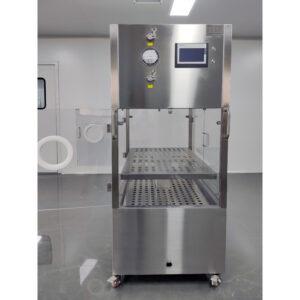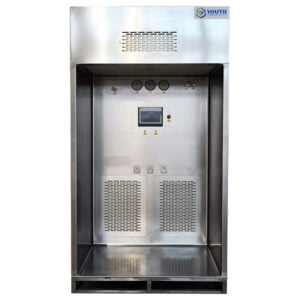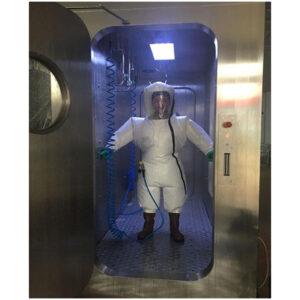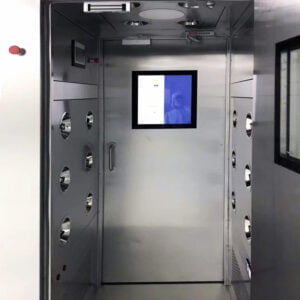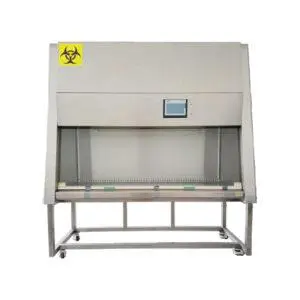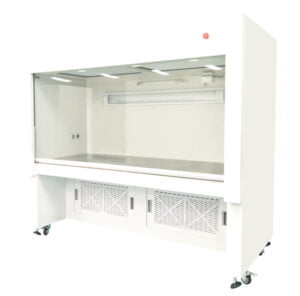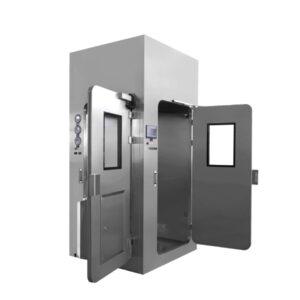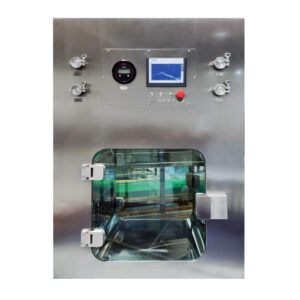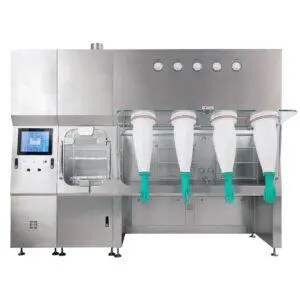
Selecting a more powerful containment system than the process actually requires sounds like a conservative decision, but it often creates the most expensive operational problems. Teams that specify a Class III cabinet in response to a hazard label — rather than a genuine containment objective — typically discover the real cost during commissioning: dedicated exhaust systems that were never scoped, decontamination support infrastructure that was never budgeted, and glove-port ergonomics that slow every manipulation task in ways that did not appear on any specification drawing. By the time those constraints surface, the facility is already committed. The decision that resolves this is not about which cabinet type is safer in the abstract — it is about whether the process genuinely requires sealed, gas-tight isolation with controlled transfer, or whether a correctly specified Class II strategy delivers adequate containment with far less operational friction. What follows will help you identify which containment conditions actually cross that threshold and what the downstream consequences look like when the wrong choice is made.
Which containment scenarios justify moving beyond open-front cabinet design
The case for a gas-tight, fully enclosed system is not built on hazard severity alone. It is built on whether the containment objective fundamentally cannot be met by an enhanced open-front design, regardless of how that design is configured. Most containment requirements in pharmaceutical and biotech environments — including a substantial range of BSL-3 work — can be addressed through a well-specified Class II cabinet placed within a controlled room environment, supported by appropriate personal protective equipment and procedural controls. The threshold that genuinely changes the design logic is work involving BSL-4 microbiological agents, where the combination of transmission risk, lack of available treatment, and regulatory expectation makes an open-front approach structurally inadequate rather than merely sub-optimal.
The distinction matters because it is a design-level decision, not a precautionary upgrade. Specifying a Class III cabinet because the work sounds dangerous enough to warrant maximum protection is a category error. The gas-tight enclosure solves a specific problem: it eliminates the possibility of exposure pathways that exist in any open-front system, including aerosol generation at the face opening, operator error during PPE transitions, and room-air interaction during high-agitation procedures. When those pathways represent an unacceptable risk — specifically because the agent involved has the transmission and severity profile that defines BSL-4 — the enclosed system is the correct solution. When they do not, the enclosure creates operational constraints that serve no protective purpose.
| 기준 | 중요한 이유 |
|---|---|
| Is the work with BSL-4 microbiological agents? | BSL-4 is the primary regulatory and risk threshold that definitively justifies moving to a gas-tight, fully enclosed Class III cabinet. |
| Does the containment objective require a gas-tight, fully enclosed system for maximum protection? | This is the core design feature that solves the containment problem for extreme-risk work, moving beyond enhanced open-front containment. |
The practical planning question is whether the containment objective requires the gas-tight enclosure as a functional necessity or whether it is being added as a risk-reduction gesture. Facilities that make this distinction clearly before procurement avoid a significant category of over-specification problems that are difficult and costly to reverse after installation.
What Class III changes in access transfer and enclosure logic
Moving from a Class II to a Class III cabinet is not an incremental improvement in the same system — it is a different operating model. The three structural changes that define Class III operation do not simply add protection; they replace the entire access and transfer logic that an operator relies on in a Class II environment.
| Change in Logic | 운영 영향 |
|---|---|
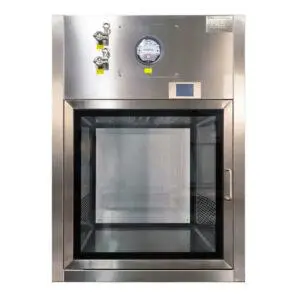
| Material access via double-door pass-through interchange box | Requires decontamination cycles between uses, directly impacting workflow speed and throughput. |
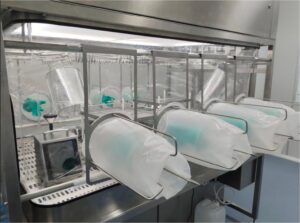
| Operator access via heavy-duty rubber gloves | Prevents direct user contact but inherently restricts movement and dexterity for material manipulation inside the cabinet. |
| Cabinet and ducting under negative pressure | Requires a dedicated exhaust system and defines the enclosure’s security logic, demanding specialized facility support. |
Taken individually, each of these changes is manageable. Taken together, they impose a cumulative operational consequence that must be evaluated as a system. An operator working through heavy-duty gloves in a gas-tight port has significantly reduced dexterity compared to working through the open front of a Class II cabinet — the gloves are long, the range of motion is constrained, and fine manipulation tasks take more time and effort. That alone would be a manageable trade-off for genuinely hazardous work. But every material that enters or leaves the enclosure must pass through a double-door interchange box that requires a decontamination cycle between uses. That cycle is not optional and cannot be accelerated beyond its validated parameters. The result is that the two friction points — glove-port dexterity loss and decontamination cycle time — compound across every procedure, not just occasionally.
The negative-pressure requirement (approximately 0.5 inches of water gauge is a representative operational value, not a universal codified specification) adds a third layer of facility dependency. The cabinet must be connected to a dedicated exhaust system capable of maintaining that differential consistently, and that system must be designed, commissioned, and validated as part of the installation. The WHO Laboratory Biosafety Manual 4th Edition establishes the access-control and enclosure principles underlying this design logic, reinforcing that the system’s integrity depends on the facility infrastructure supporting it, not just the cabinet itself. Facilities that treat the cabinet as a standalone purchase and address the exhaust and decontamination infrastructure as a secondary concern routinely encounter commissioning delays and qualification failures that would have been avoidable with earlier planning.
Why the highest barrier can still be the wrong operational choice
A Class III cabinet does not fail by being inadequate — it fails by being the wrong fit for the process it is meant to support. The glove-port interface is the clearest example of a design feature that is simultaneously the system’s primary protection mechanism and its most significant operational liability. Restricting operator access to thick rubber gloves attached in a gas-tight seal is not a minor inconvenience; it is a meaningful reduction in the speed, precision, and consistency with which tasks can be performed. For procedures that require fine manipulation, instrument handling, or high-volume throughput, that restriction translates directly into slower execution, higher operator fatigue, and increased procedural error risk — none of which are acceptable trade-offs when a correctly specified Class II system would have delivered adequate containment without them.
The infrastructure requirement compounds this problem for facilities that have not designed for it from the outset. Class III cabinets require dedicated exhaust systems, support for decontamination procedures (including in some configurations steam sterilization capability), and facility tie-ins that are substantially more complex than those required for Class II installation. These are not optional enhancements — they are structural dependencies. A facility that adds a Class III cabinet to an existing space without first confirming that these systems can be properly integrated will face a commissioning process that reveals the gap only after the capital commitment has already been made.
The question that planners often avoid asking explicitly is: what does this additional containment level cost operationally per procedure, and is that cost justified by the actual hazard profile? For BSL-4 work or a biosafety program that genuinely requires maximum containment, the answer is clearly yes. For work that was specified as Class III because the hazard label triggered a precautionary response, the answer is almost always no — and the operational evidence of that over-specification accumulates slowly but persistently throughout the product’s working life.
How glove ports transfer ports and decontamination shape throughput
The throughput impact of a Class III cabinet is most accurately understood not at the level of individual tasks, but at the level of the full procedure cycle — from material preparation outside the cabinet to completion and safe removal of finished work. Every step in that cycle is affected by the enclosure’s access design, and the compounding effect across a full working day is what distinguishes theoretical throughput from actual operational capacity.
Decontamination cycles at the interchange box are the most predictable bottleneck. Each transfer — whether moving materials in or completed work out — triggers a mandatory cycle that cannot be compressed without compromising the containment rationale for using the system in the first place. If a process requires frequent material transfers, those cycles accumulate into a measurable fraction of available working time. This is not a compliance concern; it is a process-design constraint that must be mapped out before installation, not after. Facilities that model their throughput based on Class II transfer assumptions and then switch to a Class III system without recalculating cycle time often find that their actual output capacity is significantly lower than projected.
Glove replacement is a less frequently discussed but operationally important maintenance consideration. Replacing gloves on a Class III cabinet without compromising containment integrity requires a defined procedure that must be built into the system design and validated before the cabinet enters service. This is a review check that belongs in the procurement and design phase — specifying whether the cabinet supports continuous liner glove systems, how glove integrity testing is conducted, and what the replacement procedure entails — not a retrofit problem to solve after installation. Procurement teams that treat glove replacement as a generic maintenance item rather than a system-design parameter may find themselves with a cabinet that cannot be safely maintained without interrupting operations or triggering a full decontamination cycle.
When isolators or barrier systems may be better alternatives
Not every application that needs more than a Class II cabinet needs a Class III cabinet. The space between open-front containment and full BSL-4 enclosure includes a range of isolator and barrier system configurations that may address the actual containment objective with fewer operational constraints and lower facility integration costs.
Pharmaceutical isolators, for example, are designed around product protection and aseptic processing objectives rather than personnel protection from extreme biological hazards. For sterility testing and aseptic fill-finish work, an isolator system may provide the necessary environmental separation without the full infrastructure burden of a Class III biological cabinet. Similarly, for containment applications that require barrier protection but not gas-tight sealing against BSL-4 agents, open RABS configurations offer an intermediate level of separation that preserves more operational flexibility than a fully sealed system. For a detailed comparison of when these designs are appropriate relative to each other, the distinction between RABS and isolator platforms is worth reviewing separately before committing to either path.
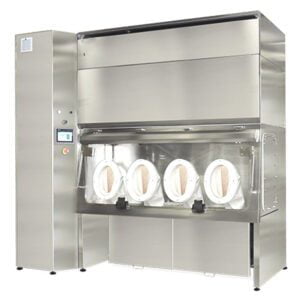
The critical procurement check when evaluating any glovebox workstation or isolator as a potential Class III alternative is whether it carries certification appropriate for the intended use classification. Not all barrier systems meet the stringent requirements for Class III biological safety applications, and ISO 14644-7 provides a relevant reference framework for evaluating separative device design principles — though it is not itself the governing standard for biological safety classification. Presenting a glovebox workstation as a Class III equivalent without verifying the certification basis is a specification error with real regulatory and safety consequences. The right evaluation sequence is to define the containment objective precisely, identify the classification requirement that maps to it, and then verify that candidate systems meet that classification — not the reverse.
Which threshold justifies moving from Class II to Class III
The move from a Class II to a Class III system should be driven by two co-equal signals: the hazard level of the work, and the containment program’s defined objective. Neither signal alone is sufficient to make the decision automatically, and neither should be treated as more decisive than the other in all cases.
| Threshold Question | Justification for Class III |
|---|---|
| Is the work with BSL-4 agents, or does the biosafety program require maximum protection consistent with advanced containment? | The move is justified by the highest hazard level (BSL-4) or a containment objective aligned with maximum protection, not just a reactive response to a hazard label. |
BSL-4 work is the clearest trigger because the agent profile — extreme transmission risk, severe disease outcome, no available treatment — directly maps to the containment logic that a gas-tight, fully enclosed system provides. But a biosafety program that defines maximum containment as an objective for agents or procedures outside the formal BSL-4 classification may reach the same conclusion through a different reasoning path. What both signals share is specificity: they are grounded in a defined hazard assessment and a containment objective that has been articulated at the program level, not in a precautionary response to a hazard label that sounds severe.
The mistake pattern that this threshold is meant to prevent is reactive over-specification. A facility encounters an agent or a regulatory review that raises concern, and the response is to escalate the containment system level without completing the hazard analysis that would define what level is actually required. That escalation then sets off a cascade of infrastructure commitments — exhaust systems, decontamination support, specialized facility integration — that were scoped for a Class II environment and must now be reworked. By the time the over-specification is visible, the facility is already committed to a system that penalizes operational throughput, dexterity, and maintenance access in ways that serve no protective purpose for the actual hazard being managed. The threshold question is not “is this work dangerous enough to warrant maximum protection?” It is “does the hazard profile and containment program objective specifically require sealed operation and controlled transfer?” That distinction is where the decision should be made.
The most useful pre-procurement confirmation for any facility evaluating a Class III system is a written containment objective that specifies what the system must achieve — not what hazard triggered the evaluation. If that objective can be met by a correctly specified Class II biosafety cabinet with appropriate room controls and procedural support, the Class III system adds infrastructure cost, throughput loss, and maintenance complexity without adding meaningful protection. If the objective genuinely requires gas-tight enclosure, sealed transfer, and independent exhaust — because the work involves BSL-4 agents or a containment program that formally requires maximum isolation — then Class III is the correct answer and the operational constraints are the price of appropriate protection, not a reason to avoid it.
Before committing to either path, map the full procedure cycle against the enclosure’s access and transfer design. Glove-port ergonomics, interchange box cycle time, and glove replacement procedures are not secondary details — they are the operational interface between the containment system and the process it is meant to support. A system that cannot support the process at the required throughput has not solved the containment problem; it has replaced it with an operational one.
자주 묻는 질문
Q: Does BSL-3 work ever justify specifying a Class III cabinet, or is the threshold strictly BSL-4?
A: For the vast majority of BSL-3 work, a Class III cabinet is not the appropriate choice. The article’s containment logic is grounded in agent profiles that make an open-front design structurally inadequate — not merely sub-optimal — and that condition is specific to BSL-4. BSL-3 work can typically be addressed through a well-specified Class II cabinet combined with controlled room conditions, PPE, and procedural controls. The exception would be a formally documented biosafety program that defines maximum containment as a program-level objective for a specific BSL-3 agent or procedure — but that determination must come from a completed hazard assessment, not from the BSL-3 designation itself.
Q: After confirming that Class III is the right choice, what should be scoped before procurement is finalized?
A: The immediate next step is mapping the full procedure cycle against the cabinet’s access and transfer design before any capital commitment is made. That means calculating interchange box decontamination cycle frequency across a full working day, confirming the facility can support a dedicated negative-pressure exhaust system at the required differential, verifying that steam or chemical decontamination support infrastructure is either already in place or can be designed in, and reviewing glove replacement procedures to confirm they are compatible with the intended maintenance model. These are not post-installation discoveries — they are pre-procurement design inputs that determine whether the specified system can actually support the process at the required throughput.
Q: At what point does glove-port dexterity loss become a reason to reconsider Class III rather than just a constraint to manage?
A: When the process depends on fine manipulation, instrument handling, or high-volume transfer frequency, glove-port dexterity loss shifts from an accepted trade-off to a procedural risk. The threshold is not about operator comfort — it is about whether the restriction increases procedural error risk or reduces output capacity to a point where the process cannot be reliably executed as designed. If the answer is yes, and if the hazard profile does not genuinely require gas-tight enclosure, the correct response is to revisit the containment specification rather than attempt to engineer around an ergonomic constraint that is inherent to the system’s design.
Q: How does a pharmaceutical isolator compare to a Class III cabinet for containment applications that don’t involve BSL-4 agents?
A: A pharmaceutical isolator is optimized for product protection and aseptic processing, not personnel protection from extreme biological hazards, which makes it a meaningfully different solution rather than a direct substitute. For sterility testing or aseptic fill-finish work, an isolator may deliver the necessary environmental separation with lower infrastructure burden and more operational flexibility than a Class III biological cabinet. However, the critical distinction is certification: not all isolator or glovebox configurations meet the requirements for Class III biological safety classification, and presenting one as equivalent without verifying the certification basis is a specification error with regulatory consequences. The evaluation should start from the containment objective and required classification, then confirm whether the candidate system meets it — not the reverse.
Q: Is a Class III cabinet worth the infrastructure cost for a facility that handles extreme-risk work only occasionally rather than as a routine operation?
A: For genuinely BSL-4 work, infrequent use does not reduce the justification — the hazard profile that requires gas-tight enclosure exists regardless of procedure frequency, so the containment requirement stands. The worth question becomes more relevant when the work is being considered for Class III on precautionary grounds rather than a defined hazard assessment. In that case, occasional use amplifies the cost-per-procedure calculation significantly: dedicated exhaust systems, decontamination infrastructure, and specialized maintenance commitments are fixed costs that do not scale down with lower utilization. A facility in this position should confirm whether the containment objective can be met through a correctly specified Class II strategy with enhanced procedural controls before committing to the full Class III infrastructure.