
For facility managers and engineers designing controlled environments, the choice between Fan Filter Unit (FFU) downward airflow and traditional HVAC systems presents a critical technical and financial decision. The wrong selection can lead to compromised particle control, spiraling operational costs, and an inflexible facility that cannot adapt to future needs. This decision hinges on more than just initial price; it requires a deep understanding of how each system’s architecture fundamentally dictates performance, efficiency, and long-term viability.
The increasing stringency of global standards and the economic pressure to optimize total cost of ownership make this analysis essential. In industries from pharmaceuticals to microelectronics, the ability to maintain a certified cleanliness class with operational resilience is non-negotiable. This comparison moves beyond basic specifications to examine the strategic implications of your airflow strategy.
FFU vs. HVAC: Defining the Core Airflow Difference
Architectural Foundations
The fundamental divergence lies in system architecture. A traditional HVAC system is centralized. A single air handling unit conditions and filters air remotely, then pushes it through an extensive network of ducts to ceiling diffusers. This design relies on balanced supply and return to maintain pressure and cleanliness, often resulting in mixed, less uniform airflow patterns. The system treats the entire room as a single zone.
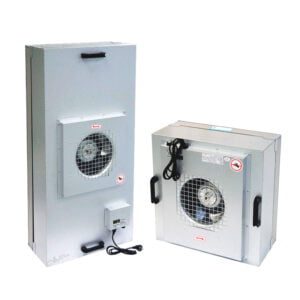
In contrast, an FFU system is decentralized and modular. Each unit is a self-contained device installed in the ceiling grid, integrating a fan and a HEPA or ULPA filter. It draws air from the ceiling plenum and discharges it in a unidirectional, laminar flow directly over the critical work zone below. This creates a consistent “piston” of clean air at the point of use.
Impact on Particle Control Strategy
This architectural difference dictates the particle control strategy. The laminar downward flow from an FFU minimizes turbulence, sweeping particles away from the product and toward the floor returns. It provides a predictable, high-velocity barrier against contamination. The centralized HVAC approach, while effective for general ventilation and thermal control, can struggle to achieve the same level of uniform, low-turbulence airflow required for the most stringent cleanliness classes. Industry experts note that the modular FFU design inherently supports strategic scalability, enabling phased expansion without major structural changes—a key advantage for aligning capacity with project growth.
Cost Comparison: Capital, Operational, and Total Cost of Ownership
Breaking Down Capital Expenditure
A superficial analysis often cites traditional HVAC as the lower-cost option. This can be true for large, open spaces targeting lower cleanliness classes (e.g., ISO Class 7 or 8), where a single system’s economies of scale apply. The initial unit cost for multiple FFUs can appear higher. However, this view ignores installation complexity. Ductwork for traditional systems requires significant labor, engineering, and space. FFU systems, with their modular plug-and-play design, offer lower installation costs and faster deployment, especially in retrofit scenarios. This can dramatically compress project timelines.
The Operational Cost Equation
The true financial picture emerges in operational costs, dominated by energy consumption. FFUs equipped with Electronically Commutated (EC) motors are game-changers. They auto-adjust fan speed to maintain constant airflow, reacting to filter loading in real-time. Traditional systems with fixed-speed fans must overcome the static pressure of long duct runs and central filters, operating at full capacity regardless of actual need. This leads to energy consumption up to 50% higher. The payback period for premium EC motor technology is often surprisingly short, fundamentally altering the total cost of ownership model.
총 소유 비용 분석
A holistic TCO analysis must capture all factors. We compared the long-term financial footprint of both systems beyond the invoice price.
| 비용 구성 요소 | 기존 HVAC | FFU System |
|---|---|---|
| Initial Capital Cost | Lower for large spaces | Higher unit cost |
| 설치 복잡성 | High, ductwork required | Low, modular grid |
| Operational Energy Use | Up to 50% higher | Lower, EC motor efficiency |
| Scalability Investment | High, disruptive changes | Low, modular addition |
Source: Technical documentation and industry specifications.
The table reveals the critical trade-off. While traditional HVAC may win on initial capital for some applications, the FFU system consistently demonstrates advantages in operational efficiency and future-proofing, reducing long-term financial risk.
Performance Face-Off: Which System Controls Particles Better?
Achieving and Maintaining Cleanliness
For stringent particle control, FFU downward airflow systems generally offer superior performance. Their point-of-use filtration guarantees laminar flow at the discharge point, which is essential for ISO Class 5 and cleaner environments as defined by ISO 14644-1:2015 클린룸 및 관련 통제 환경. This standard’s particle count limits directly inform the required air change rates and airflow uniformity. The unidirectional flow from an FFU provides a more reliable method to meet and maintain these limits in the critical zone.
Redundancy and System Reliability
Reliability is a key differentiator. Each FFU acts as an independent filtration node. The failure of a single unit has only a localized impact, and the system can often maintain room classification while the unit is serviced. A traditional HVAC system presents a single point of failure; a problem with the central air handler or filter can compromise the entire cleanroom, forcing a full production halt. This inherent redundancy in FFU systems is a major advantage for continuous, high-risk processes.
Data Integrity and Compliance
Modern compliance demands auditable proof. Smart, networked FFUs provide real-time monitoring and logging of airflow velocity, pressure drop, and motor performance. This creates a defensible data trail for regulatory audits. Traditional systems often rely on manual, periodic checks. The shift towards data integrity in regulated industries is making intelligent FFU systems a de facto standard for providing continuous, verifiable compliance evidence.
| 성능 지표 | 기존 HVAC | FFU Downward Airflow |
|---|---|---|
| 공기 흐름 패턴 | Less uniform, mixed | 단방향, 층류 |
| Filtration Redundancy | Single point of failure | Inherent, modular units |
| Ideal Cleanliness Class | ISO Class 7/8 | ISO Class 5+ |
| Compliance Data Integrity | Manual logs standard | Smart, auditable logs |
Source: ISO 14644-1:2015 클린룸 및 관련 통제 환경. This standard defines the particle concentration limits for ISO Class 5 and other classifications, which directly informs the suitability of each system’s airflow design for achieving and maintaining these stringent cleanliness levels.
Energy Efficiency Compared: Operating Costs and Sustainability
The Efficiency of Point-of-Use Design
Energy efficiency stems from system design. An FFU uses energy primarily to move air through the final filter at the point of use, with minimal losses. There are no lengthy duct runs with associated friction losses. The EC motors further optimize this by precisely matching energy input to the exact requirement to maintain setpoints, avoiding the waste of constant full-speed operation. In our experience, this direct-drive, localized approach is inherently more efficient for the task of particle control.
Centralized System Losses
Traditional HVAC incurs significant parasitic losses. The central fan must overcome the combined static pressure of the ductwork, dampers, and central filter bank. Energy is expended moving air long distances before it even reaches the room. While these systems can be highly efficient at handling large thermal loads through chilled water or complex heat recovery, their efficiency for pure, high-volume particulate filtration is lower.
Long-Term Sustainability Impact
This efficiency directly translates to operational cost and sustainability metrics. Lower energy consumption reduces the facility’s carbon footprint and utility bills year over year. When evaluating systems, the energy consumption profile must be modeled across the facility’s entire lifecycle. The long-term operating cost advantage of efficient FFU systems often outweighs the initial capital differential, making advanced motor technology a strategic investment.
| 효율성 요소 | 기존 HVAC | FFU System |
|---|---|---|
| 기본 에너지 사용 | Overcoming ductwork losses | Moving air at point-of-use |
| Motor Control | Often fixed-speed | EC motor, auto-adjusting |
| Thermal Load Handling | Efficient for large loads | Secondary consideration |
| Long-Term Operating Cost | Higher energy footprint | Lower TCO |
Source: Technical documentation and industry specifications.
Flexibility and Scalability: Which Adapts Better to Your Facility?
The Modular Advantage
Flexibility is a decisive strategic advantage for FFU systems. Their modular nature allows for easy reconfiguration of cleanroom zones. Benches or equipment can be moved, and the ceiling grid of modular fan filter units can be adjusted by simply adding, removing, or relocating units. This supports agile facility planning and future-proofing. A traditional HVAC system, with its fixed ductwork and diffusers, is inherently inflexible. Any significant layout change requires costly and disruptive construction, new duct runs, and rebalancing of the entire system.
Retrofits and Hybrid Solutions
For facility upgrades, FFUs offer a powerful solution. Hybrid approaches are particularly effective. The existing traditional HVAC can be retained to handle baseline ventilation and thermal loads, while FFUs are installed over critical zones to provide the necessary high-static-pressure, HEPA-filtered laminar flow. This mitigates legacy infrastructure limitations, enabling a facility to reach a higher cleanliness class without a complete and prohibitively expensive overhaul of the mechanical system.
Project Timeline Implications
This adaptability directly impacts project timelines. FFU installations are typically faster-track. The reduced complexity of installation—no extensive ductwork—allows for quicker commissioning and occupancy. For fast-moving R&D environments or production lines that need to adapt quickly to new products, the agility offered by a modular FFU system is a significant operational benefit.
| Adaptability Factor | 기존 HVAC | FFU System |
|---|---|---|
| Layout Reconfiguration | Costly, disruptive construction | Simple unit relocation |
| Expansion/Reduction | Major infrastructure changes | Modular add/remove units |
| 개조 적합성 | Low, fixed infrastructure | High, hybrid solutions possible |
| Project Timeline | Longer, complex install | Fast-track, agile planning |
Source: Technical documentation and industry specifications.
Maintenance, Downtime, and Long-Term Operational Integrity
Minimizing Operational Disruption
Maintenance protocols define operational continuity. FFUs with Room-Side Replaceable (RSR) filters allow maintenance staff to perform filter changes quickly and without tools, from within the cleanroom. There is no need to access the ceiling plenum or shut down the entire airflow system. Servicing an individual unit is a localized event. In a traditional system, replacing the central HEPA bank typically requires a full production shutdown and access to the air handling unit, which may be located in a mechanical room far from the cleanroom.
Housing Material and Contamination Risk
Long-term integrity depends on material selection. FFU housings are available in galvanized steel, aluminum, or 316L stainless steel. This presents a cost-performance continuum. For standard environments, galvanized steel may suffice. For harsh cleaning regimens involving aggressive disinfectants, specifying 316L stainless steel is critical to prevent corrosion, material failure, and the introduction of metallic contaminants. This choice directly impacts the lifecycle and contamination risk profile of the system.
라이프사이클 관리
Easily overlooked details include the long-term availability of spare parts and the mean time between failures for motors. Selecting FFUs from manufacturers with a proven track record and standardized components reduces future operational risk. The simplicity of the modular design often translates to easier troubleshooting and repair compared to the complex interplay of components in a central HVAC system.
| 운영 요소 | 기존 HVAC | FFU System |
|---|---|---|
| Filter Change Access | Central AHU, production halt | Room-side, tool-free (RSR) |
| 다운타임 영향 | Full system shutdown | Localized unit only |
| Housing Material Options | Standard construction materials | Galvanized steel to 316L SS |
| 오염 위험 | Higher during maintenance | Minimal with RSR design |
Source: Technical documentation and industry specifications.
Making the Final Choice: A Decision Framework for Your Project
Prioritizing Technical Drivers
The final selection is not a matter of which technology is universally better, but which is optimal for your specific project drivers. The primary technical driver is always the target cleanliness class. For ISO Class 5 or cleaner environments, the need for guaranteed laminar, uniform airflow makes FFU systems the default choice. For ISO Class 6-8 spaces with high thermal loads and stable, open layouts, a well-designed traditional HVAC system may be technically sufficient and economically favorable.
Evaluating Process and Business Needs
Beyond classification, evaluate process criticality and business flexibility. Processes with high product value or regulatory risk benefit immensely from the redundancy and superior control of FFUs. Similarly, if future expansion, reconfiguration, or a fast project timeline is anticipated, the modularity of an FFU system provides strategic value that outweighs a simple cost-per-square-foot calculation.
Applying the Decision Framework
A structured decision framework forces a holistic analysis. Start with the non-negotiable technical requirement (ISO Class), then layer on operational and business factors.
| Decision Driver | Recommended System | Key Threshold / Reason |
|---|---|---|
| 청결도 등급 | FFU | ISO Class 5 or cleaner |
| Process Criticality | FFU | High-risk, needs redundancy |
| Facility Scalability Plans | FFU | Future expansion expected |
| Thermal Load & Layout | 기존 HVAC | High loads, stable layout |
| Retrofit/Upgrade Project | FFU or Hybrid | Favors FFU in TCO analysis |
Source: ISO 14644-1:2015 클린룸 및 관련 통제 환경. The required ISO classification is the primary technical driver for system selection, as the standard’s particle count limits dictate the necessary airflow control strategy, making it the foundational input for this decision framework.
The framework clarifies that for retrofits and upgrades, the total cost of ownership analysis increasingly favors advanced FFU solutions. Their operational energy savings, minimal downtime, and flexibility often justify the initial investment.
The core decision pivots on your required ISO classification and need for operational agility. For environments at ISO Class 5 or cleaner, or for any facility anticipating change, the performance, redundancy, and modularity of FFU downward airflow systems present a compelling case. When high thermal loads dominate in a stable, lower-classification space, traditional HVAC may suffice. The critical step is conducting a total cost of ownership analysis that fully accounts for energy, maintenance, and future flexibility.
Need professional guidance to specify the right airflow solution for your cleanroom or controlled environment? The engineers at YOUTH can help you apply this decision framework to your specific project parameters, ensuring your investment delivers both technical compliance and long-term operational value. For a detailed consultation, you can also 문의하기.
자주 묻는 질문
Q: How does the airflow design of an FFU system provide better particle control than a traditional HVAC setup?
A: FFUs create superior particle control by generating a unidirectional, laminar “piston” of air directly over the work zone from point-of-use HEPA/ULPA filters. This minimizes turbulence and cross-contamination, which is critical for high-cleanliness environments. In contrast, centralized HVAC relies on ducted air distribution that often results in less uniform flow patterns. This means facilities targeting ISO Class 5 or cleaner environments should prioritize FFU systems for guaranteed laminar flow at the critical process location, as defined by air cleanliness classifications in ISO 14644-1:2015.
Q: What are the key financial considerations when comparing the total cost of ownership between FFU and traditional HVAC?
A: While traditional HVAC may have lower upfront costs for large, low-classification spaces, FFUs with EC motors offer significant operational savings by auto-adjusting speed and reducing ductwork energy losses by up to 50%. You must evaluate the payback period of this premium motor technology against your facility’s expected lifespan. For projects where future expansion or retrofit agility is a priority, the modular FFU approach reduces long-term financial risk by enabling scalable, phased investment.
Q: When should a facility consider a hybrid FFU and traditional HVAC solution?
A: A hybrid approach is particularly effective for retrofits or upgrades where legacy HVAC infrastructure exists. It allows the existing centralized system to manage thermal loads while FFUs provide the high-static-pressure filtration needed for particle control. This strategy modernizes cleanroom performance without a complete and costly infrastructure overhaul. If your operation requires improved cleanliness but has budget or downtime constraints for a full replacement, plan to evaluate a hybrid design to mitigate legacy system limitations.
Q: How does maintenance differ between these systems, and what impact does it have on operational downtime?
A: FFUs with Room-Side Replaceable (RSR) filters enable quick, in-house filter changes without a full shutdown, as servicing one unit has only a localized impact. Traditional HVAC filter replacement typically requires accessing the central air handler, often necessitating a complete production halt. This means facilities with continuous, high-risk processes should prioritize FFU systems to maintain operational integrity and minimize costly downtime during routine maintenance activities.
Q: Which system offers better flexibility for future facility changes or expansions?
A: FFU systems provide clear strategic flexibility due to their modular design, allowing you to reconfigure or expand clean zones by adding or relocating units within a ceiling grid. Traditional HVAC, with its fixed ductwork, requires disruptive and expensive construction for any layout change. For dynamic R&D environments or facilities with uncertain growth plans, you should select FFUs to future-proof your investment and support agile facility planning.
Q: What are the critical decision factors for choosing between an FFU and a traditional HVAC system?
A: Your final choice requires a holistic analysis of four key drivers: the target cleanliness class and regulatory mandates, process criticality and need for system redundancy, facility lifecycle and scalability plans, and a comprehensive total cost of ownership model. For ISO Class 5 or cleaner rooms or processes requiring high redundancy, FFUs are typically optimal. Traditional HVAC may suffice for stable ISO Class 7/8 spaces with significant thermal loads, but the operational advantages of advanced FFUs often outweigh initial cost differences in a full TCO analysis.
관련 콘텐츠:
- 제약 제조 분야의 3대 팬 필터 장치 애플리케이션
- 팬 필터 장치 또는 층류 후드: 어느 것을 선택해야 할까요?
- 팬 필터 유닛 시스템의 공기 흐름 패턴 최적화
- 새로운 트렌드: 팬 필터 유닛 기술의 미래
- 다양한 클린룸 클래스에 대한 FFU 요건은 무엇인가요?
- 클린룸 관리자를 위한 완벽한 팬 필터 장치 가이드: 기술 선택, 설치 및 성능 최적화 2025 에디션
- 장치 수명 연장을 위한 검증된 FFU 유지보수 팁
- FFU와 층류 공기 흐름 장치 비교
- How Fan Filter Units Create Laminar Airflow in ISO Class 5 Cleanrooms






 KO
KO  EN
EN  AR
AR  FR
FR  ID
ID  IT
IT  PT
PT  RU
RU  RO
RO  ES
ES  PL
PL  NL
NL  UK
UK  DE
DE  TR
TR