
Pharmaceutical facilities face a critical decontamination challenge during personnel transitions between controlled and uncontrolled environments. Active pharmaceutical ingredient (API) particles clinging to protective garments can compromise containment integrity during de-gowning procedures. Traditional air shower systems often fail to capture sub-10-micron particles effectively, while conventional wet showers penetrate PPE and create liquid waste disposal complications. Mist shower technology addresses these limitations through precision droplet delivery that encapsulates contaminants without saturating protective equipment.
Regulatory pressures intensify this challenge. The updated Annex 1 requirements for sterile manufacturing demand documented contamination control at every facility transition point. Facilities without validated personnel decontamination systems now face compliance gaps that directly impact manufacturing authorization. This guide examines mist shower system specifications, regulatory alignment strategies, and operational protocols that meet 2025 pharmaceutical industry standards.
Understanding Mist Shower Technology: Core Principles and System Components
Precision Droplet Physics for Surface Decontamination
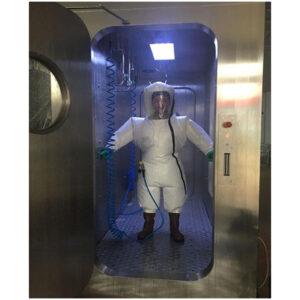
Mist shower systems generate 5 to 10-micron water droplets that encapsulate API particles through controlled surface wetting. This droplet size creates water pearls on cleanroom garments that capture dust particles without penetrating the fabric barrier. The physics differ fundamentally from air shower technology—rather than attempting to blow particles off surfaces, the system creates adhesion forces that bind contaminants to water droplets for drainage removal.
Surface contamination reductions reach up to 800 times below initial levels when operators complete the full decontamination cycle. The rapid saturation strategy floods the shower chamber with precisely sized droplets to ensure complete surface coverage within 30 to 60 seconds. Airborne particle concentrations during de-gowning drop significantly compared to unprotected transitions, preventing propagation of dangerous particulates beyond the isolated area.
Control Architecture and Monitoring Systems
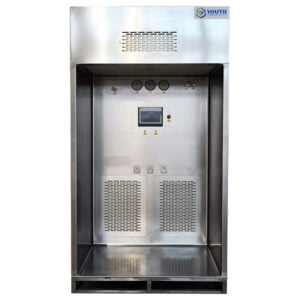
Factory-tested PLC systems manage all decontamination cycle parameters with real-time monitoring of air and water pressure delivery to fogging nozzles. The touch screen interface indicates shower status and alarm conditions, with password-protected access to cycle recipes restricted to nominated supervisors. All cycle stage timers accept user adjustment to accommodate different contamination risk profiles and garment types.
Control cabinet placement options include above-shower mounting or adjacent wall installation, with prewired cables that simplify site electrical integration. Emergency override buttons provide immediate cycle termination capabilities, while safety interlocks prevent simultaneous door operation that would compromise containment. I’ve commissioned installations where the pre-wiring reduced electrical contractor time by 40% compared to custom control panel builds.
Construction Materials and Physical Components
| Component Category | Specyfikacja | Wpływ na wydajność |
|---|---|---|
| Water Droplet Size | 5-10 mikronów | Encapsulates API particles without PPE penetration |
| Surface Contamination Reduction | Up to 800x reduction | Significantly decreases airborne particles during de-gowning |
| System kontroli | Factory-tested PLC with touch screen | Monitors air/water pressure to fogging nozzles |
| Materiały budowlane | Stal nierdzewna 304 lub 316 | Chemical resistance and durability in cleanroom environments |
| Door Configuration | 10mm tempered glass or 16mm phenolic resin | Prevents cross-contamination with interlocking mechanism |
Źródło: ISO 14644-7:2004 Separative Devices
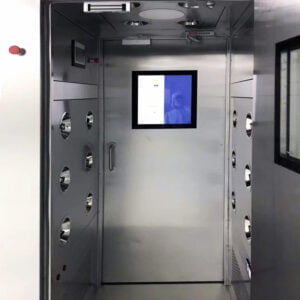
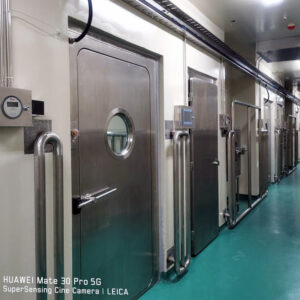
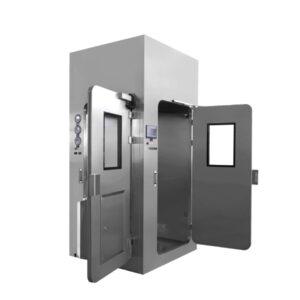
Stainless steel construction in 304 or 316 grades provides chemical resistance for facilities using disinfectant additives in fog water. Door assemblies use either 10mm tempered glass for visibility or 16mm phenolic resin laminate for high-impact applications. Frameless glass door sets with interlocking mechanisms prevent both doors from opening simultaneously—a critical feature for maintaining pressure differentials between contaminated and clean zones.
2025 Industry Standards and Regulatory Compliance for Personnel Decontamination
Regulatory Framework for Separative Devices
ISO 14644-7 establishes design, construction, installation, and approval requirements specifically for cleanroom separative devices including personnel decontamination showers. The standard mandates safety interlocks and emergency stop functions that ensure personnel cannot become trapped during system malfunctions. Compliance verification occurs through consulting firm performance assessments that validate decontamination efficacy under actual operating conditions.
GMP requirements for pharmaceutical cleanroom operations demand quality control throughout sterile medicinal product manufacturing, including personnel transition procedures. Facilities must demonstrate through validation protocols that decontamination systems consistently achieve specified contamination reduction targets. The EMA Annex 1 guidelines now explicitly address contamination control during gowning and de-gowning activities, creating documentation requirements for mist shower performance qualification.
Compliance Features and Safety Systems
| Norma/Regulacje | Application Scope | Kluczowe wymagania |
|---|---|---|
| ISO EN 14644-1 | HEPA filtration and air cleanliness | Particulate concentration limits by cleanroom class |
| ISO 14644-7 | Cleanroom entry decontamination units | Design, construction, installation, and approval of separative devices |
| GMP (Good Manufacturing Practice) | Pharmaceutical cleanroom operations | Quality control for sterile medicinal product manufacturing |
| Firescope Hazardous Materials MEL | Decontamination equipment for hazmat teams | Minimum equipment specifications for personnel decontamination |
Uwaga: Systems must incorporate safety interlocks and emergency stop functions per ISO 14644-7 compliance.
Źródło: ISO 14644-7:2004, EMA GMP Annex 1 Guidelines
HEPA filtration on exhaust air streams meets ISO EN 14644-1 particulate concentration limits for the surrounding cleanroom classification. Coalescent pre-filters protect HEPA media from water droplet damage, with safe-change designs that prevent filter face exposure during replacement. Emergency deluge shower and eyewash station options address facilities handling corrosive or toxic materials where chemical exposure scenarios require immediate response capabilities.
Personnel Flow Study Integration
Equipment design begins with personnel flow studies that quantify transition frequency, peak occupancy periods, and average de-gowning duration. This data determines chamber sizing, door configuration, and cycle timing parameters. Specific software calculates ideal process conditions based on contamination risk assessments and facility throughput requirements. The resulting specifications ensure decontamination capacity matches operational demands without creating bottlenecks during shift changes.
Strategic Facility Planning: Integrating Mist Showers into Your Cleanroom Design
Configuration Options for Space Optimization
| Typ konfiguracji | Physical Layout | Aplikacja podstawowa |
|---|---|---|
| Straight Through | Tunnel between 2 parallel walls | High-traffic corridors with linear personnel flow |
| Right Angled | Mounted at 90º wall junction | Space-constrained areas requiring directional change |
| 2 Door Extended | Increased depth for dual occupancy | Facilities with simultaneous entry/exit requirements |
| 3 Door System | Additional entry/exit point | Multi-directional access for complex workflow patterns |
Uwaga: All configurations designed to fit through single doorway without crane access.
Źródło: ISO 14644-7:2004 Separative Devices
Straight-through configurations create personnel tunnels between parallel walls for linear workflow patterns common in corridor-based facility layouts. Right-angled installations accommodate 90-degree directional changes where space constraints prevent straight-through placement. Three-door systems serve facilities requiring emergency egress capability or bidirectional access to multiple controlled zones from a single decontamination point.
Extended-depth two-door designs allow simultaneous use by two operators, doubling throughput capacity without requiring duplicate equipment installations. This configuration proves valuable during shift changes when multiple personnel exit containment areas simultaneously. Maximum clear entry width with frame finishing flush to internal panels preserves valuable cleanroom space while maintaining structural integrity.
Installation Logistics and Wall Integration
Modular construction with components sized to pass through standard doorways eliminates crane requirements and minimizes installation complexity. The largest sections fit through single-door openings, enabling installation in existing facilities without structural modifications. Installation compatibility extends to pharmaceutical mobile wall systems, masonry construction, and plasterboard partitions through adjustable mounting hardware.
Door positioning accommodates front-facing, corner-mounted, or three-sided access patterns based on facility workflow requirements. I’ve specified corner-mounted configurations for retrofit projects where existing corridor layouts couldn’t accommodate front-facing entry without obstructing traffic flow. Control cabinet locations above or adjacent to the shower chamber provide flexibility for facilities with limited wall space or ceiling height constraints.
Barrier Application for High-Containment Facilities
Mist showers function as critical entry and exit barriers for biosafety laboratories, animal facilities, and controlled contamination areas handling highly potent compounds. The interlocking door mechanism maintains pressure cascade integrity between zones while providing validated decontamination during personnel transitions. For cleanroom mist shower applications in pharmaceutical manufacturing, the system prevents API cross-contamination between product campaigns or during transitions from containment to general manufacturing areas.
Optimizing Decontamination Cycles: Chemical Selection, Concentration, and Contact Time
Cycle Architecture and Timer Programming
| Cycle Component | Specyfikacja techniczna | Operational Control |
|---|---|---|
| Fog Droplet Delivery | 5-10 micron water droplets via nozzles | PLC-monitored air/water pressure |
| Chemical Dosing | Proportional dosing pump with adjustable rate | Password-protected cycle recipes |
| CIP System | 360° spray ball with auto/manual operation | Automated PLC timer or manual override |
| Rinse Cycle | Coarse fog nozzles or water sprays | User-adjustable timers for reusable garments |
| Integracja z prysznicem powietrznym | Programmable duration post-rinse | Custom timing based on facility use-case |
Źródło: ISO 14644-7:2004
Programmable cycle time parameters accommodate custom durations based on contamination risk profiles and garment types. Standard decontamination cycles run 30 to 90 seconds, with timer adjustments available for heavily contaminated scenarios or facilities using reusable cleanroom garments requiring rinse cycles. The pause feature reduces water flow to a trickle while maintaining temperature settings, useful for extended decontamination protocols requiring lathering or manual wiping steps.
Air shower cycles activate after rinse completion to remove residual moisture from garments before personnel enter adjacent clean areas. This sequencing prevents water droplets from compromising cleanroom humidity control or creating particle generation from wet surfaces. Cycle recipes store all parameter combinations with password protection limiting access to validated settings.
Chemical Integration and Dosing Control
Proportional dosing pumps inject disinfectant or cleaning agents into fog water at adjustable concentration ratios. Common additives include quaternary ammonium compounds, hydrogen peroxide solutions, or facility-specific disinfectants validated against target organisms. The dosing rate adjusts to match fog water flow, maintaining consistent chemical concentration throughout the decontamination cycle regardless of pressure fluctuations.
CIP systems with 360-degree spray balls automate chamber cleaning between uses or during scheduled maintenance intervals. Automatic operation from PLC timers enables overnight cleaning cycles, while manual activation provides on-demand cleaning capability. I’ve found the automated CIP particularly valuable in facilities running multiple shifts where cleaning during personnel breaks maintains system readiness without dedicated maintenance windows.
Water Efficiency and Waste Minimization
The 5 to 10-micron droplet size minimizes water consumption compared to conventional shower systems while achieving superior particle capture. Efficient water usage reduces liquid waste volume requiring disposal—a significant consideration for facilities handling hazardous compounds where waste streams require expensive treatment before discharge. The system saturates chamber surfaces quickly, typically using 5 to 15 liters per cycle compared to 50+ liters for traditional wet showers.
Performance Validation and Routine Monitoring: Ensuring Consistent Efficacy
Three-Phase Acceptance Testing Protocol
| Faza testowa | Metodologia | Verification Parameters |
|---|---|---|
| Factory Acceptance Test (FAT) | Pre-shipment testing at manufacturer facility | System functionality and specification compliance |
| Site Acceptance Test (SAT) | On-site testing by supervisor/staff | Installation integrity and operational performance |
| Commissioning | Engineer-led system validation | PLC monitoring of air/water pressure to nozzles |
| Weryfikacja wydajności | Air sampling, surface swabbing, particle counting | Cleanliness levels post-decontamination |
| Filtracja HEPA | Safe-change coalescent pre-filter on HVAC exhaust | Airborne contaminant capture efficiency |
Uwaga: UV-dye-based qualification provides objective assessment of decontamination efficacy.
Źródło: ISO 14644-1 Cleanroom Standards
Factory Acceptance Testing occurs at the manufacturer’s facility before shipment, verifying system functionality against specifications. SAT procedures executed on-site by supervisors and staff confirm installation integrity and operational performance under actual facility conditions. Engineer-led commissioning validates PLC monitoring functions and confirms proper air and water pressure delivery to all fogging nozzles.
Performance verification employs air sampling, surface swabbing, or particle counting to quantify cleanliness levels post-decontamination. Testing protocols measure contamination reduction on representative garment surfaces and in breathing-zone air samples. Validation may require multiple test runs under varying contamination scenarios to demonstrate consistent efficacy across the operational range.
Real-Time Monitoring and Alarm Systems
PLC systems continuously monitor air and water pressures feeding fogging nozzles, triggering alarms when parameters fall outside acceptable ranges. The touch screen displays shower status including current cycle stage, elapsed time, and pressure readings. This real-time feedback enables operators to verify proper system function before entering the decontamination chamber.
HEPA filters with coalescent pre-filters on HVAC exhaust capture aerosolized particles and water droplets before discharge. Safe-change filter designs allow replacement without exposing maintenance personnel to contaminated filter faces—critical for facilities handling potent compounds or biohazardous materials. Filter differential pressure monitoring indicates when replacement becomes necessary before filtration efficiency degrades.
Quality Assurance Through Objective Assessment
UV-dye-based qualification procedures provide objective assessment of decontamination coverage and technique effectiveness. Fluorescent tracers applied to garments before decontamination reveal missed areas under UV illumination after cycle completion. This methodology identifies coverage gaps requiring cycle time extension, additional nozzle placement, or operator technique modification.
Consulting firms conduct periodic performance assessments to verify continued compliance with validation acceptance criteria. These evaluations may occur annually or following significant system modifications, process changes, or contamination control deviations. The documentation generated supports regulatory inspections and demonstrates ongoing commitment to contamination control.
Operational Protocols and Staff Training for Safe and Effective Implementation
Safety System Architecture and Emergency Response
| Protocol Category | Implementation Requirements | Quality Assurance Method |
|---|---|---|
| Systemy awaryjne | Override buttons, interlocking doors, emergency stop functions | Safety interlock verification during SAT |
| Hand Hygiene Training | Enhanced education on washing/disinfection techniques | UV-dye-based assessment for coverage gaps |
| Commonly Missed Areas | Back of hands and thumbs | Objective and measurable quality assessments |
| Dostęp serwisowy | Plug-based component replacement | Minimized downtime with standard parts inventory |
| PPE Protocols | Specialized cleanroom garments, gloves, hygiene practices | Routine monitoring and supervisor oversight |
Uwaga: Personnel effectiveness directly impacts cleanroom sterility maintenance.
Źródło: GMP Good Manufacturing Practice Guidelines
Emergency override buttons provide immediate cycle termination and door release capabilities for personnel experiencing adverse reactions or equipment malfunctions. Safety interlocks prevent door operation sequences that would compromise pressure differentials or expose clean areas to contaminated environments. Emergency stop functions immediately halt all water flow and door actuators, with manual reset requirements preventing inadvertent system restart.
Interlocking door mechanisms ensure only one door opens at any time, maintaining contamination barriers between zones. The PLC monitors door position sensors and prevents conflicting commands that would breach containment integrity. Optional emergency deluge showers and eyewash stations address chemical exposure scenarios requiring immediate high-volume water delivery.
Personnel Training and Competency Assessment
Hand hygiene effectiveness relies on adequate training with objective and measurable quality assessments. Enhanced and repeated education on washing and disinfection techniques addresses commonly missed areas including backs of hands and thumbs. UV-dye-based assessments offer valuable insights for optimizing techniques, with fluorescent residue indicating insufficient coverage or contact time.
Strict protocols for cleanroom personnel include specialized garment donning sequences, glove usage procedures, and hygiene practices executed before entering decontamination chambers. Personnel play a crucial role in maintaining cleanliness and sterility—improper technique negates technological decontamination capabilities. I’ve observed facilities where initial training reduced contamination events by 60%, but performance degraded over six months without refresher sessions and competency verification.
Training programs should cover cycle initiation procedures, emergency response protocols, and recognition of system malfunction indicators. Operators must understand the relationship between decontamination efficacy and proper positioning within the chamber, movement patterns during the cycle, and adequate exposure time before exiting to clean areas.
Maintenance Accessibility and Service Support
All shower components mount on plugs to facilitate rapid replacement in the unlikely event of component failure. This design minimizes downtime by enabling maintenance personnel to swap failed parts without extensive disassembly or specialized tools. Standard components manufactured to specific requirements ensure replacement part availability without long lead times or custom fabrication.
Extensive after-sales support includes planned preventative maintenance programs, routine servicing schedules, and spare parts inventory management. These programs identify wear items before failure and schedule replacements during planned downtime rather than emergency outages. Service contracts typically include annual performance verification testing, filter replacements, and calibration of monitoring sensors.
Successful mist shower implementation requires alignment of equipment specifications, facility design integration, and operational protocols. Focus first on regulatory compliance verification—confirm the system meets ISO 14644-7 requirements and generates documentation supporting GMP inspection readiness. Second, optimize cycle parameters through validation testing that quantifies contamination reduction under your specific operating conditions rather than relying solely on manufacturer claims. Third, establish training programs with objective competency assessments that prevent technique degradation over time.
Need professional personnel decontamination solutions that meet 2025 pharmaceutical industry standards? YOUTH specializes in validated mist shower systems engineered for regulatory compliance and operational reliability. Our factory-tested PLC control systems and modular construction deliver installation simplicity with performance certainty.
Contact our technical team to discuss your facility’s contamination control requirements and receive application-specific configuration recommendations. Kontakt for validation protocol templates and acceptance testing support documentation.
Często zadawane pytania
Q: What are the critical technical specifications for mist shower decontamination efficacy?
A: Efficacy depends on generating 5 to 10-micron water droplets to encapsulate API particles with minimal wetting, achieving up to an 800-fold reduction in surface contamination. The system’s Programmable Logic Controller (PLC) monitors air and water pressures to the fogging nozzles to ensure consistent droplet size and performance, which is critical for validating the decontamination cycle against cleanliness standards.
Q: Which industry standards must a mist shower system comply with for pharmaceutical use?
A: Systems must comply with multiple standards, including ISO EN 14644-1 for HEPA filtration, Dobra praktyka wytwarzania (GMP) for sterile preparations, and ISO 14644-7 for cleanroom entry decontamination units. Compliance also involves safety interlocks, emergency stop functions, and interlocking doors to prevent cross-contamination, ensuring personnel and product safety.
Q: How do you integrate a mist shower into an existing cleanroom layout?
A: Integration is based on a personnel flow study, with configuration options like Straight Through, Right Angled, 3 Door, or 2 Door units to suit facility layout. The largest pieces are designed to fit through a single doorway, and control cabinets can be mounted above or next to the shower. This flexibility allows installation on mobile pharmaceutical walls or traditional masonry without needing cranes or special access.
Q: Can chemical disinfectants be integrated into the mist shower cycle?
A: Yes, an adjustable dosing pump allows for chemical addition to the fog water at a proportional rate. The Clean-in-Place (CIP) system with a 360 spray ball can operate automatically from the PLC timer or manually, and a rinse cycle is available for reusable garments. All cycle stage timers are user-adjustable, and recipes are stored with password-protected access for controlled chemical use.
Q: What protocols are required for validating and monitoring mist shower performance?
A: Validation involves Factory and Site Acceptance Tests (FAT/SAT), with post-decontamination verification via air sampling, surface swabbing, or particle counting. The PLC monitors system parameters and provides status and alarm indications on a touch screen. For ongoing quality assurance, UV-dye-based qualification procedures offer objective, measurable assessments of decontamination efficacy and personnel training effectiveness.
Q: What safety and maintenance features minimize operational downtime?
A: Systems include emergency override buttons, safety interlocks, and emergency stop functions. All shower parts are provided on plugs to facilitate easy replacements, minimizing downtime during component failure. Extensive after-sales support includes planned preventative maintenance programs and spare parts, using standard components built to specific requirements for reliable long-term operation.
Powiązane treści:
- Systemy sterowania PLC dla izolatorów do testów sterylności
- Awaryjne prysznice chemiczne: Przewodnik szybkiego reagowania
- Jakość wody w natryskach chemicznych: Wskazówki dotyczące zarządzania
- Rodzaje pryszniców dekontaminacyjnych | Powietrze vs woda vs systemy chemiczne
- Czujniki aktywacji prysznica chemicznego: Najnowsze innowacje
- Zamknięte prysznice chemiczne: Prywatność i bezpieczeństwo
- Zaopatrzenie w wodę dla natrysków chemicznych: Przewodnik projektowania systemu
- Prysznice chemiczne ze stali nierdzewnej: Przewodnik po trwałości
- Co to jest prysznic dekontaminacyjny do pomieszczeń czystych | Przewodnik bezpieczeństwa personelu



 PL
PL  EN
EN  AR
AR  FR
FR  KO
KO  ID
ID  IT
IT  PT
PT  RU
RU  RO
RO  ES
ES  NL
NL  UK
UK  DE
DE  TR
TR