
Cleanroom designers face a persistent challenge: achieving consistent laminar airflow while maintaining positive pressure differentials across multiple zones. The physics seem straightforward—push filtered air downward at uniform velocity—but practitioners know the reality involves balancing blower capacity, filter resistance, room geometry, and dynamic pressure gradients. Most contamination events trace back not to filter failure but to turbulent disruption zones where velocity falls outside the 0.35-0.55 m/s window. One poorly positioned FFU can create eddy currents that compromise an entire production zone.
This matters more now because regulatory scrutiny has intensified. FDA inspections increasingly focus on documented airflow validation, not just particle counts. ISO 14644 revisions demand tighter velocity uniformity tolerances. Pharmaceutical and semiconductor facilities upgrading to ISO Class 5 specifications need quantifiable evidence that their FFU arrays deliver true laminar performance under operational loading conditions, not just during commissioning tests.
Fundamentals of FFU Airflow: From Blower Dynamics to Uniform Distribution
Self-Contained Module Architecture
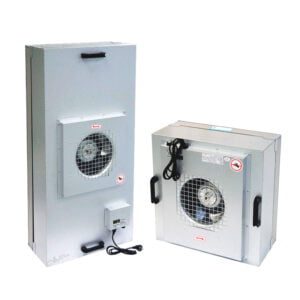
Fan Filter Units operate as autonomous pressurization devices. Each unit draws ambient air through an inlet plenum, accelerates it via centrifugal or axial blower, then forces the stream through staged filtration before discharge. The typical housing measures 1175×575×250 mm or 575×575×250 mm including filter depth. Casing design isolates motor vibration from the filter frame to prevent seal degradation. The blower selection determines pressure capability—centrifugal fans generate higher static pressure for installations requiring long duct runs or multiple filter stages, while axial fans provide greater volumetric flow for direct ceiling-mount applications.
Pre-filters extend primary filter lifespan by capturing particles above 5 microns before they load the HEPA or ULPA media. This staged approach reduces replacement frequency. The final filter mounts downstream of the blower to ensure positive pressure across the media, preventing bypass leakage at frame seals. We’ve observed installations where filter placement upstream of the fan resulted in negative pressure differentials that pulled unfiltered air through gasket gaps.
Achieving Uniform Face Velocity Distribution
The perforated discharge face distributes airflow across the cleanroom ceiling plane. Perforation pattern and open area ratio control exit velocity and direction. Standard designs target 0.45 m/s at the filter face with individual point measurements falling within ±20% of the mean. Achieving this uniformity requires careful diffuser geometry—too few perforations create jet streams, too many reduce effective pressure. Advanced models incorporate adjustable louvers that redirect flow around obstructions like lighting fixtures or process equipment suspended below the ceiling grid.
Operational humidity must stay below 85% RH to prevent condensation on the filter media, which increases resistance and reduces effective filtration area. Temperature differentials between supply air and room conditions also affect velocity profiles. A 5°C gradient can induce convective currents that disrupt the intended unidirectional flow pattern.
Pressure Drop and Volumetric Flow Relationships
Each FFU processes approximately 1,620 m³/h when operating at the standard 0.45 m/s face velocity across a 1 m² filter area. This translates to 1,620 air renewals per hour within a 1-meter vertical zone below the unit—complete air replacement every 2.2 seconds. The blower must overcome filter resistance, typically 150-250 Pa for a clean HEPA filter and 300-400 Pa for ULPA media. As particulate loading increases during operation, pressure drop rises until replacement becomes necessary.
Fan curves define the relationship between flow rate and static pressure. Operating points shift left along the curve as filters load. Variable speed controllers adjust motor RPM to maintain target velocity despite increasing resistance. Fixed-speed units experience gradual velocity decline until filter replacement restores original performance.
Achieving Laminar Flow: The Role of FFU HEPA/ULPA Filters and Face Velocity
Filter Media Performance Specifications
HEPA filters capture 99.97% of 0.3-micron particles—the most penetrating particle size where diffusion and interception mechanisms are least effective. ULPA filters achieve 99.999% efficiency at 0.1 microns, necessary for semiconductor photolithography and aseptic pharmaceutical filling operations. The media consists of submicron glass fibers arranged in a random matrix. Particles deposit via five mechanisms: inertial impaction, interception, diffusion, gravitational settling, and electrostatic attraction.
Filter depth affects both efficiency and pressure drop. Deeper pleats increase media surface area, reducing face velocity through the material and lowering resistance. ISO 14644-1:2015 classifications tie directly to filter selection—ISO Class 5 requires HEPA minimum, Class 3 demands ULPA. Gel-seal mounting technology creates an airtight interface between filter frame and housing, eliminating the bypass leakage common with mechanical clamp systems.
FFU Core Operational Parameters and Specifications
| Parametre | Şartname | Uygulama Bağlamı |
|---|---|---|
| Target laminar flow velocity | 0.45 m/s | Standard operational setpoint |
| Laminar flow velocity range | 0.35 – 0.55 m/s | Tek yönlü akışı korur |
| Turbulent flow threshold | <0.35 m/s or >0.55 m/s | Artan kirlenme riski |
| Standard frame sizes | 1175×575×250 mm, 575×575×250 mm | Includes filter thickness |
| Operational humidity limit | <85% RH | Non-condensing conditions |
Kaynak: ISO 14644-3:2019
Unidirectional Flow Physics
Laminar airflow moves in parallel layers with minimal lateral mixing. Velocity remains constant across each horizontal plane. This creates a piston effect—particles entrained in the airstream cannot move laterally to contaminate adjacent zones. The flow bypasses minor obstacles like equipment edges and reforms downstream, maintaining protective coverage. Velocity uniformity is critical: if one section of the filter face delivers 0.30 m/s while adjacent areas provide 0.50 m/s, the slower zone becomes turbulent and allows particle recirculation.
Face velocity uniformity criteria specify that individual measurements (Vindividual) must fall within Vavg ±20%. Testing involves a grid of measurement points across the filter face, typically at 150 mm spacing. We’ve documented cases where corner measurements deviated by 35% from center values due to inadequate diffuser design, creating contamination pathways along room perimeters.
HEPA vs ULPA Filter Performance Comparison
| Filtre Tipi | Verimlilik Derecesi | Hedef Parçacık Boyutu | Face Velocity Uniformity |
|---|---|---|---|
| HEPA | 99.97% | 0,3 mikron | Vindividual within Vavg ±20% |
| ULPA | 99.999% | 0,1 mikron | Vindividual within Vavg ±20% |
Not: Gel-seal technology ensures airtight installation and prevents bypass leakage.
Kaynak: ISO 14644-1:2015
Optimizing Positive Pressure: Balancing Supply, Return, and Room Air Changes for Contamination Control
Pressure Cascade Design Principles
Positive pressure prevents infiltration from adjacent areas. The cleanroom must receive more air than it exhausts. A typical cascade maintains 15 Pa differential between ISO Class 5 and Class 7 spaces, and 10 Pa between Class 7 and unclassified corridors. FFU quantity determines supply volume—each 1 m² unit contributes 1,620 m³/h at standard velocity. Return air exits through low-wall or floor grilles, creating a downward vertical flow pattern that sweeps particles toward exhaust points.
Door opening disrupts pressure differentials temporarily. Recovery time depends on air change rate. Higher ACH values restore pressure faster but increase energy consumption. The balance point varies by application—pharmaceutical filling rooms prioritize rapid recovery over energy efficiency, while electronics assembly areas may accept longer recovery periods.
Calculating Required FFU Density
Room volume and target ISO classification determine FFU array size. ISO Class 5 typically requires 60-90 air changes per hour. A 100 m³ cleanroom needing 70 ACH requires 7,000 m³/h total supply. Dividing by 1,620 m³/h per FFU yields 4.3 units—round up to 5 for safety margin. Ceiling coverage percentage affects both air change rate and velocity uniformity. Full coverage (100% of ceiling area) provides maximum laminar flow but costs more. Partial coverage (40-60%) reduces capital expense but creates non-laminar zones between units.
Specialized fan filter units with variable speed control allow post-installation optimization. We’ve adjusted arrays initially designed for ISO Class 5 to achieve Class 3 performance by increasing fan speed and adding supplemental units in critical zones.
Cleanroom Air Change Rates and Volume Processing
| Hava Akış Hızı | Filtration Surface Area | Air Volume Processed | Complete Air Renewal Cycle |
|---|---|---|---|
| 0.45 m/s | 1 m² | 1,620 m³/h | Every 2.2 seconds |
| 0.45 m/s | 1 m² below unit | 1,620 TR/h | 1-meter protected volume |
Not: ISO Class 5-9 requirements determine total FFU quantity based on room volume and target ACH.
Kaynak: ISO 14644-1:2015, FDA cGMP
Return Air Configuration Impact
Return air placement affects contamination removal efficiency. Floor returns provide optimal downward sweep for particle-generating processes at work surface height. Low-wall returns work when floor penetrations aren’t feasible but create horizontal flow components near the floor that can spread contamination laterally. Return grille sizing must handle the full supply volume without excessive velocity—above 2 m/s causes turbulence at the grille face that propagates upward into the laminar flow field.
Balancing dampers in return ductwork fine-tune pressure distribution across multiple rooms. We’ve measured installations where inadequate return capacity created positive pressure 8 Pa higher than design intent, causing excessive air leakage through door gaps and compromising the pressure cascade to adjacent spaces.
FFU Performance Metrics: Measuring and Interpreting Airflow Consistency, Velocity Profiles, and Turbulence
Defining Laminar versus Turbulent Flow Regimes
Flow regime determines contamination control effectiveness. Laminar flow maintains parallel streamlines with Reynolds numbers below 2,300. Turbulent flow exhibits chaotic mixing with Reynolds numbers above 4,000. The transition zone between these regimes creates unpredictable behavior. For cleanroom applications, maintaining velocity between 0.35-0.55 m/s ensures laminar conditions across typical room dimensions and obstacle configurations.
Velocity below 0.35 m/s allows buoyancy forces from equipment heat loads and personnel to disrupt vertical flow. Particles follow convective currents instead of the intended downward path. Velocity above 0.55 m/s creates excessive turbulence at obstacles, generating wake zones where flow separates and recirculates. These wake regions trap particles and prevent removal.
Laminar vs Turbulent Flow Regime Classification
| Flow Regime | Hız Aralığı | Flow Characteristics | Kirlenme Riski |
|---|---|---|---|
| Laminar | 0.35 – 0.55 m/s | Unidirectional, parallel layers, piston effect | Minimize edilmiş |
| Çalkantılı | <0.35 m/s or >0.55 m/s | Unpredictable mixing, disrupted layers | Elevated |
| Optimal laminar | 0.45 m/s | Uniform distribution, obstacle bypass capability | En düşük |
Kaynak: ISO 14644-3:2019
Velocity Profile Measurement Protocols
Testing requires thermal anemometers or vane anemometers with ±3% accuracy. Measurement points follow a grid pattern across the filter face, typically 6-12 points per unit depending on size. Each reading averages 30 seconds to account for minor fluctuations. The coefficient of variation (standard deviation divided by mean) should remain below 0.10 for acceptable uniformity.
Vertical velocity profiles measured at multiple heights below the FFU reveal flow development. Ideal installations show constant velocity from filter face to work surface height (typically 750-900 mm). Divergence indicates obstacles disrupting flow or inadequate room pressurization allowing infiltration. We’ve documented pharmaceutical filling line installations where lighting fixtures suspended 600 mm below FFUs reduced downstream velocity by 18%, creating a non-compliant zone.
Interpreting Particle Count Correlation
Velocity uniformity directly affects particle counts. ISO Class 5 permits 3,520 particles ≥0.5 microns per cubic meter. Non-uniform flow creates localized zones exceeding this limit even when average room counts comply. Real-time particle counters positioned at critical locations provide continuous validation. Count spikes during operations indicate flow disruption from personnel movement, door opening, or equipment-generated convection currents.
Smoke visualization tests during commissioning reveal flow patterns not apparent from velocity data alone. Introducing theatrical fog at multiple heights shows streamline development, obstacle wake zones, and return air capture efficiency. This qualitative assessment complements quantitative velocity measurements.
System Integration: Coordinating FFUs with Cleanroom HVAC, Controls, and Monitoring
Standalone versus Integrated HVAC Architectures
FFUs function independently or as components within larger air handling systems. Standalone configurations draw room air through the blower and return it filtered—simple but limited to recirculation. Integrated designs connect FFU inlet plenums to central air handlers providing tempered, dehumidified makeup air. This hybrid approach separates temperature/humidity control from particulate filtration, optimizing each function.
Retrofit applications favor standalone FFUs. Existing facilities upgrade cleanroom classification without major ductwork modifications by installing ceiling grid-mounted units. New construction typically employs integrated systems that coordinate FFU operation with central HVAC controls for better energy management and environmental stability.
Motor Technology and Control Strategies
AC motors provide economical fixed-speed operation. Single-speed models run continuously at design velocity. Multi-tap motors offer 2-3 speed settings selected via switches. EC motors with variable frequency drives enable precise velocity control and reduce energy consumption by 30-40% compared to AC equivalents. Speed adjustment compensates for filter loading, maintaining constant velocity as pressure drop increases.
FFU Motor and Control System Features
| Özellik Kategorisi | AC Motor Configuration | EC Motor Configuration |
|---|---|---|
| Speed control | Fixed or manual adjustment | Variable speed, automated |
| Enerji verimliliği | Standart | High efficiency |
| Monitoring capability | Basic on/off status | Real-time airflow monitoring |
| BMS integration | Sınırlı | Auto-control card optional |
| Power requirement | 120V | 120V |
| Additional options | - | Integrated LED lighting (≥500 lux), optional cooling |
Kaynak: FDA cGMP
Building Management System Integration
Advanced FFU arrays connect to BMS platforms via Modbus, BACnet, or proprietary protocols. Centralized dashboards display real-time status for hundreds of units—velocity, power consumption, filter pressure drop, and alarm conditions. Automated control sequences adjust fan speed based on room pressure sensors, particle counters, or occupancy schedules.
Integrated LED lighting eliminates separate ceiling fixtures. Minimum 500 lux illumination with dimming capability reduces installation complexity. Optional cooling modules mounted in the FFU plenum provide localized temperature control for heat-generating equipment without separate HVAC infrastructure. We’ve implemented these combination units in electronics manufacturing where process tools require stable 20°C ±0.5°C conditions within broader cleanrooms maintained at 22°C ±2°C.
Monitoring and Alert Protocols
Differential pressure sensors across the filter signal when replacement becomes necessary. Typical alarm thresholds trigger at 150% of clean filter pressure drop. Velocity monitoring detects fan degradation or control failures before they compromise room classification. Particle counter integration provides real-time validation—count excursions trigger immediate investigation rather than waiting for scheduled testing to reveal problems.
Predictive maintenance algorithms analyze historical pressure drop trends to forecast filter replacement timing. This prevents unexpected failures and optimizes replacement inventory. Some systems track total operating hours and calculate remaining filter life based on loading rates, automatically generating work orders when thresholds approach.
Maintenance and Validation: Ensuring Sustained Laminar Flow Performance and Regulatory Compliance
Scheduled Maintenance Requirements
HEPA filters require annual replacement under typical loading conditions. ULPA filters last approximately two years. Actual lifespan varies with particle concentration in the ambient air and operating hours. Pressure drop monitoring provides objective replacement criteria—change filters when pressure exceeds 1.5× initial resistance or velocity drops below specification despite maximum fan speed.
Filter replacement procedures follow documented protocols. Tool-free clip-on designs enable in-house teams to swap filters in 10-15 minutes per unit, minimizing downtime. After installation, leak testing with DOP or PAO aerosol verifies seal integrity. Fan guard screws require inspection and tightening three months post-installation as vibration can loosen fasteners during the break-in period.
Filter Replacement and Validation Schedule
| Bakım Faaliyeti | HEPA Filtre | ULPA Filtre | Tetikleyici Durum |
|---|---|---|---|
| Routine replacement interval | Yıllık | Her 2 yılda bir | Standard lifecycle |
| Performance-based replacement | As indicated | As indicated | Velocity drop or damage detected |
| İlk inceleme | 3 months post-installation | 3 months post-installation | Fan guard screw tightening |
| Post-installation validation | Derhal | Derhal | Leakage and sealing integrity tests |
| Ongoing validation testing | Per monitoring plan | Per monitoring plan | Velocity, uniformity, particle counts |
Kaynak: ISO 14644-2:2015, ISO 14644-3:2019
Regulatory Validation Protocols
ISO 14644-2:2015 specifies monitoring requirements for continued compliance. Testing frequency depends on cleanroom classification and regulatory framework. Pharmaceutical facilities under cGMP typically perform quarterly airflow velocity verification and semi-annual particle count mapping. Semiconductor fabs may test monthly or continuously monitor critical zones.
Validation documentation includes velocity measurements at each FFU, particle counts at specified locations, pressure differential readings between rooms, and filter integrity test results. The compilation forms the cleanroom qualification record required for regulatory inspections. Deviations from specifications trigger investigations documented in the quality system.
Yaygın Performans Sorunlarını Giderme
Declining velocity indicates filter loading, fan degradation, or control system malfunction. If pressure drop across the filter remains normal but velocity decreases, suspect fan bearing wear or motor winding failure. If pressure drop increases proportionally with velocity reduction, filter replacement is necessary. Erratic velocity fluctuations point to control board issues or unstable power supply.
Non-uniform velocity across the filter face suggests damaged media or seal leakage. Smoke tests reveal preferential flow paths. Localized high velocity indicates torn filter media allowing bypass. Low velocity zones result from media blockage or frame warping that creates gaps where air takes the path of least resistance around rather than through the filter.
Cost Management Strategies
Total cost of ownership includes capital expense, filter replacements, energy consumption, and maintenance labor. EC motor FFUs cost 25-35% more initially but recover the premium through energy savings in 2-3 years. Extended warranties and service contracts transfer maintenance burden to specialized providers, valuable for facilities without in-house expertise. Bulk filter purchases and multi-year agreements reduce consumable costs by 15-20%.
Cleanroom airflow performance depends on three decision points: selecting FFU configurations that match room geometry and classification requirements, implementing monitoring systems that detect degradation before compliance failures occur, and establishing maintenance protocols that balance replacement costs against downtime risks. Operators who optimize these elements achieve sustained regulatory compliance while minimizing total ownership costs.
Need professional cleanroom air filtration solutions engineered for your specific ISO classification and operational requirements? YOUTH provides comprehensive FFU systems with integrated controls, predictive maintenance capabilities, and full validation support. Our technical team designs arrays that deliver verified laminar flow performance across pharmaceutical, semiconductor, and biotech applications.
Contact our contamination control specialists to discuss your cleanroom pressurization challenges and receive detailed system recommendations: Bize Ulaşın.
Sıkça Sorulan Sorular
Q: What are the critical airflow velocity parameters for maintaining laminar flow from an FFU?
A: Laminar flow requires a face velocity between 0.35 m/s and 0.55 m/s, with a typical target of 0.45 m/s. Velocity below 0.35 m/s or above 0.55 m/s induces turbulent flow, which increases contamination risk by disrupting unidirectional airflow. Performance validation against this specification is a core test method outlined in ISO 14644-3.
Q: How do you calculate the number of Fan Filter Units required for a specific cleanroom application?
A: The quantity is primarily driven by the cleanroom’s ISO classification, size, and required air changes per hour (ACH). As a baseline calculation, a single FFU with a 1 m² filtration area operating at 0.45 m/s supplies approximately 1,620 m³/h. You must then determine the total room volume and the ACH mandated for your target ISO class (e.g., Class 5 vs. Class 8) to define the total supply airflow, which is divided by the output per FFU.
Q: What is the practical difference between selecting HEPA and ULPA filters for an FFU system?
A: The choice hinges on the size of particles you must control. HEPA filters capture 99.97% of particles ≥0.3 microns, while ULPA filters capture 99.999% of particles ≥0.1 microns. ULPA is specified for the most critical environments, like certain semiconductor or advanced pharmaceutical processes. The cleanroom ISO 14644-1 classification based on particle concentration will directly inform which filter efficiency is necessary.
Q: How do electronically commutated (EC) motors in FFUs provide operational advantages over standard AC motors?
A: EC motors enable precise variable speed control, allowing real-time adjustment of airflow to maintain target face velocity or pressure differential. This supports energy efficiency by reducing fan speed when conditions allow and facilitates integration with building management systems for automated monitoring and control, a key consideration for cGMP environments requiring documented environmental control.
Q: What are the key maintenance activities and intervals for sustaining FFU performance and compliance?
A: A disciplined schedule includes replacing HEPA filters typically every year and ULPA filters every two years, or sooner if velocity drops. Perform an initial inspection after 3 months of operation to tighten components. Ongoing compliance requires regular testing of airflow velocity, uniformity, and particle counts as mandated by the monitoring plan in ISO 14644-2.
Q: How is face velocity uniformity measured and what is the acceptance criterion?
A: Velocity is measured at multiple points across the filter face using an anemometer. The individual reading at each point must be within ±20% of the calculated average velocity (V_avg) for the entire unit. This uniformity test is critical to ensure consistent laminar flow and is a standard performance verification method described in ISO 14644-3.
Q: Can FFUs be integrated into an existing facility without a major ceiling retrofit?
A: Yes, a primary application is retrofitting existing rooms. FFUs are designed for standard ceiling grid layouts and are self-contained, requiring only electrical connection and sealant integration. This allows for a modular upgrade to achieve a higher cleanroom classification or create localized laminar flow zones without reconstructing the entire HVAC supply plenum.
İlgili İçerikler:
- Fan Filtre Üniteleri veya Laminer Akış Davlumbazları: Hangisini Seçmeli?
- Temiz Oda Yöneticileri için Eksiksiz Fan Filtre Ünitesi Kılavuzu: Teknik Seçim, Kurulum ve Performans Optimizasyonu 2025 Baskı
- Fan Filtre Ünitesi Sistemlerinde Hava Akışı Modellerinin Optimize Edilmesi
- İlaç Üretiminde En İyi 3 Fan Filtre Ünitesi Uygulaması
- ISO 14644-1 Laminer Hava Akışı Uyumluluğu
- Laminer Akışlı Davlumbaz Hava Akışı: Dinamikleri Anlamak
- Ünite Ömrünü Uzatmak için Kanıtlanmış FFU Bakım İpuçları
- ISO 5 Laminer Akış | Temiz Oda Sınıflandırma Standartları
- Kontaminasyon Kontrolü için Laminer Hava Akış Üniteleri



 TR
TR  EN
EN  AR
AR  FR
FR  KO
KO  ID
ID  IT
IT  PT
PT  RU
RU  RO
RO  ES
ES  PL
PL  NL
NL  UK
UK  DE
DE