
Cross-contamination during material transfer remains the primary breach point in controlled environments. A single compromised transfer event can invalidate entire production batches, trigger regulatory findings, and compromise sterile manufacturing operations. Pass boxes serve as the critical barrier, yet their effectiveness depends entirely on three integrated engineering systems: mechanical interlock design, airflow pattern optimization, and UV-C cycle calibration. Most contamination incidents trace back to misunderstanding how these systems interact during operational sequences.
The gap between equipment specification and actual performance widens when operators lack technical knowledge of underlying mechanisms. Facilities invest in advanced pass box systems but fail validation because interlock timing conflicts with pressure cascade requirements, or UV exposure calculations ignore surface geometry variables. Understanding working principles—not just operational procedures—determines whether your material transfer protocol protects or compromises cleanroom integrity. This technical breakdown examines the engineering logic behind each system component and their integration requirements for GMP and ISO 14644-1:2015 compliance.
The Core of Contamination Control: Understanding Pass Box Interlock Systems
Physical Barrier vs. Control Logic Architecture
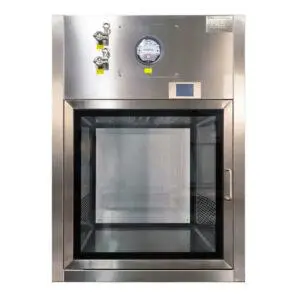
Two distinct engineering approaches prevent simultaneous door operation. Mechanical interlocks use physical linkage mechanisms—when one door opens, a connected rod or cam physically blocks the opposing door’s locking mechanism. The system requires zero electrical input. One door must return to fully closed position before the mechanical barrier disengages from the opposite lock. Electronic interlocks replace physical linkage with electromagnetic locks controlled by integrated circuits. Door position sensors feed status data to a control panel that manages lock activation states. Indicator lights provide real-time feedback on which door is operable.
The choice between systems impacts operational flexibility. Mechanical systems offer simplicity and zero failure risk from power interruptions. Electronic systems enable timed purge cycles—a critical feature where both doors remain locked for a programmed interval after closure, allowing filtered airflow to purge potential contaminants before the opposite door unlocks. In pharmaceutical applications requiring audit trails, electronic systems log each door operation with timestamps.
Pass Box Interlock System Types and Applications
| Kilit Tipi | Mechanism Components | Primary Application Scenario |
|---|---|---|
| Mekanik | Physical barrier linkage | Same-class cleanroom transfers, cost-sensitive installations |
| Elektronik | Electromagnetic locks, control circuits, indicator lights | Cross-grade transfers, pharmaceutical applications requiring audit trails |
Kaynak: ISO 14644-1:2015, İyi Üretim Uygulamaları - Vikipedi
Interlock Role in Pressure Differential Maintenance
Cleanroom pressure cascades create directional airflow from higher to lower cleanliness areas. A 15 Pa differential between adjacent zones prevents contaminant migration. Simultaneous door opening creates a direct air path that equalizes pressure instantaneously. We’ve observed facilities where pressure recovery takes 8-12 minutes after a dual-door breach—during which the protected zone operates without contamination barriers. The interlock system isn’t merely procedural enforcement; it’s the mechanical safeguard preserving the pressure gradient that underpins your entire contamination control strategy.
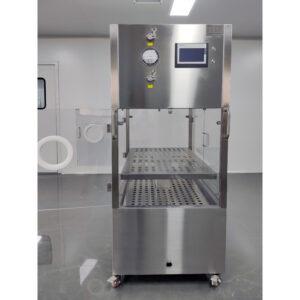
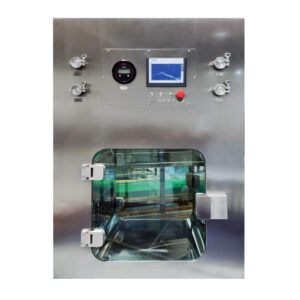
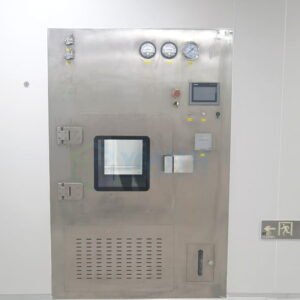
Static pass boxes rely entirely on this principle. The sealed chamber maintains intermediate pressure between connected rooms. Dynamic pass boxes add active airflow but still depend on interlock integrity to prevent bypass of their filtration system during the critical transfer window.
Airflow Dynamics and UV-C Integration for Cleanroom Integrity
Static vs. Dynamic Airflow Classification
Static pass boxes function as sealed transfer chambers. No fans, no filters, no active air movement. Contamination control depends on chamber sealing and the pressure differential between connected spaces. Material placed inside remains in essentially stagnant air until retrieval. This design suits same-grade transfers where both rooms maintain identical cleanliness classifications.
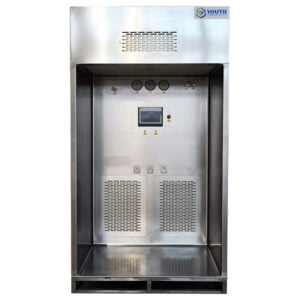
Dynamic pass boxes introduce active contamination control. A fan draws air through a pre-filter cascade (typically G4 arrestance rating) followed by H13 or H14 HEPA filtration. Filtered air enters the chamber at controlled velocity—target specification is 0.45 m/s downflow. This creates an ISO Class 5 environment inside the chamber regardless of surrounding room classifications. The system can operate in recirculating mode (air continuously cycles through the filter and back into the chamber) or single-pass mode (filtered air exhausts after one pass).
Dynamic Pass Box Filtration and Performance Specifications
| Bileşen | Şartname | Performans Standardı |
|---|---|---|
| Ön filtre | G4 (≥90% arrestance) | EN 779:2012 |
| HEPA Filtre | H13 (99.97% @ 0.3µm) or H14 (>99.995% @ MPPS) | EN 1822:2009 |
| UV-C Lamp | 4000 hour service life | User validation required |
| Internal Cleanliness | ISO Class 5 / Grade A during operation | ISO 14644-1, EU GMP Annex 1 |
Kaynak: EN 1822:2009 Filter Classes, ISO 14644-1:2015
UV-C Lamp Integration for Surface Decontamination
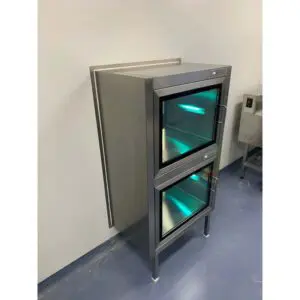
UV-C lamps mount to chamber ceilings for germicidal irradiation of transferred materials. The 254 nm wavelength disrupts microbial DNA, preventing replication. Operational integration ties UV activation to the interlock system—lamps only activate when both doors confirm closed and locked status. This prevents operator exposure. Standard cycles run 15-30 minutes depending on validated dose requirements for specific material types.
UV effectiveness depends on direct line-of-sight exposure. Shadowed surfaces receive reduced dosage. Complex geometry items require rotation or multiple lamp positions. The 4000-hour lamp service life means output degrades over time; facilities must validate irradiance levels remain above required thresholds throughout the service interval. Some operations replace lamps at 3000 hours to maintain consistent dose delivery.
Laminar Flow Pattern Design in Dynamic Chambers
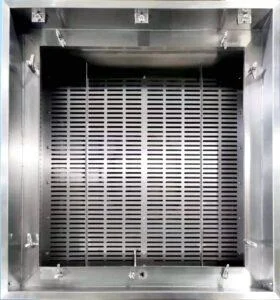
Unidirectional vertical downflow minimizes particle residence time. Air enters through a ceiling-mounted HEPA diffuser, flows downward across the material, and exits through perforated side grills or floor returns. This sweeping action continuously removes particles generated during door opening or from material surfaces. Recirculation systems route return air back through the filter; some designs include a high-velocity nozzle option that replaces the standard diffuser to blast particles from material surfaces before normal laminar flow resumes.
Ensuring Safe Material Transfer: A Deep Dive into Mechanical vs. Electronic Interlock Mechanisms and Their Role in Maintaining Pressure Cascades
Mechanical Interlock Operating Principles
Physical interlocks use lever arms, rotating cams, or sliding rods connecting both door lock mechanisms. Opening Door A moves a mechanical element that physically obstructs Door B’s lock from disengaging. The barrier remains in place until Door A returns to closed position and its latch fully engages. The design is inherently fail-safe—mechanical failure typically results in both doors locking, not both unlocking.
Installation requires precise alignment. Misalignment causes incomplete engagement, creating scenarios where sufficient force can bypass the interlock. Quarterly function testing should include attempting forced opening of the locked door while the opposite door stands open. Any movement indicates adjustment needs.
Electronic Interlock Control Sequences
Electronic systems use magnetic reed switches or proximity sensors to detect door position. When Door A opens, its sensor signals the control board to energize the electromagnetic lock on Door B. The lock remains energized until Door A’s sensor confirms closure. Only then does the control logic de-energize Lock B and illuminate the indicator showing Door B is available for opening.
Mechanical vs. Electronic Interlock Functional Comparison
| Özellik | Mekanik Kilit | Elektronik Kilit |
|---|---|---|
| Locking Method | Physical barrier engagement | Electromagnetic lock with control logic |
| Operator Feedback | None (tactile resistance only) | Indicator lights, status display |
| Purge Cycle Integration | Mevcut değil | Programmable timed purge before unlock |
| Cost Profile | Daha düşük ilk yatırım | Higher cost, enhanced control capability |
Not: Electronic systems enable integration with UV cycles and airflow timers per Revised Annex 1 AB GMP.
Kaynak: AB GMP Kılavuzu Bölüm 1
Purge Cycle Integration with Pressure Management
Advanced electronic interlocks include programmable purge timers. After Door A closes, both locks remain engaged for a preset interval—typically 30-120 seconds. During this period, the dynamic pass box fan operates at full capacity, exchanging chamber air through HEPA filtration multiple times. This purges particles introduced when Door A opened. Only after the purge completes does Lock B disengage, allowing Door B to open into the cleaner space.
This timed sequence directly supports pressure cascade integrity. The purge period allows the cleanroom’s air handling system to recover pressure differentials disrupted by Door A’s opening. We’ve implemented purge cycles synchronized with room pressure recovery times measured during commissioning—this prevents Door B from opening before the protected zone re-establishes its pressure barrier.
Optimizing Airflow Design: Unidirectional Flow, Recirculation, and Air Exchange Rates for Particle Control in Pass-Through Chambers
Unidirectional Flow Velocity Specifications
Target downflow velocity of 0.45 m/s represents the balance between particle removal effectiveness and turbulence minimization. Lower velocities reduce particle sweeping efficiency. Higher velocities create turbulent eddies that suspend particles rather than removing them. Velocity uniformity across the chamber cross-section matters as much as average velocity—variations exceeding ±20% create dead zones where particles accumulate.
Fan speed controllers maintain velocity despite filter loading. As the HEPA filter captures particles, resistance increases. Without compensation, airflow velocity drops. Variable frequency drives (VFDs) automatically increase fan speed to maintain target velocity as filter resistance builds. Differential pressure gauges monitor filter loading; readings approaching 200-250 Pa indicate replacement needs.
Airflow Configuration Parameters for Pass-Through Chambers
| Yapılandırma Türü | Hava Akış Hızı | Hava Akışı Deseni | Filter Sequence |
|---|---|---|---|
| Statik Geçiş Kutusu | 0 m/s (passive) | Pressure differential only | None (sealed chamber) |
| Dynamic Recirculating | 0.45 m/s target downflow | Vertical unidirectional with side/base return | G4 pre-filter → H13/H14 HEPA |
| Dynamic Single-Pass | 0.45 m/s target downflow | Vertical unidirectional with exhaust | G4 pre-filter → H13/H14 HEPA |
Kaynak: ISO 14644-1:2015, AB GMP Kılavuzu Bölüm 1
Recirculation vs. Single-Pass Air Management
Recirculating systems draw return air from chamber bottom or sides back to the fan inlet. The same air continuously cycles through filtration. This design operates as a standalone unit requiring only electrical connection—no ducting to facility exhaust systems. Energy consumption remains moderate since the system only conditions chamber volume. Most pharmaceutical applications use recirculating designs for material airlocks between classified spaces.
Single-pass systems exhaust filtered air after one chamber pass. This requires connection to facility exhaust ducting. Applications include transfer of materials generating fumes, volatile compounds, or heat that must be removed rather than recirculated. The design provides maximum contamination removal but increases energy costs and requires HVAC system integration.
Air Change Rate and Particle Clearance Calculations
ISO Class 5 requires ≤3,520 particles/m³ at ≥0.5 µm. Achieving this in a pass box chamber depends on air change rates sufficient to dilute and remove particle bursts from door openings. A typical 0.9m × 0.6m × 0.6m chamber (0.324 m³ volume) with 0.45 m/s airflow through a 0.6m × 0.6m (0.36 m²) filter face delivers 0.162 m³/s or 583 m³/h. This yields 1,800 air changes per hour—providing particle clearance within seconds of contamination events.
We calculate recovery time using exponential decay formulas. At 1,800 ACH, particle concentration drops to 1% of initial levels in approximately 2.5 minutes. This rapid recovery allows short cycle times between material transfers while maintaining classification.
UV Sterilization Cycle Engineering: Calculating Dose (mJ/cm²), Cycle Timing, and Safety Protocols for Effective Surface Decontamination
UV-C Dose Calculation Fundamentals
UV dose equals irradiance (power per unit area) multiplied by exposure time. A lamp delivering 1000 µW/cm² for 15 minutes provides 900 mJ/cm² (1000 µW/cm² × 900 seconds ÷ 1000). Required doses vary by target organism—bacterial spores require significantly higher doses than vegetative bacteria. Most pharmaceutical applications target 99.9% (3-log) reduction requiring validated doses typically ranging from 400-2000 mJ/cm² depending on the organism.
Irradiance decreases with distance following inverse square law. Surface position relative to lamp mounting affects delivered dose dramatically. Items placed 30 cm from a lamp receive one-quarter the irradiance of items at 15 cm. Chamber geometry must ensure all surfaces requiring decontamination fall within validated distance ranges where dose calculations apply.
UV-C Sterilization Cycle Parameters and Safety Features
| Parametre | Standard Cycle Value | Güvenlik Protokolü | Doğrulama Gereksinimi |
|---|---|---|---|
| Maruz Kalma Süresi | 15-30 dakika | Interlock prevents door opening during cycle | Irradiance measurement (mJ/cm²) |
| Lamp Position | Fixed ceiling mount | UV-active indicator light visible externally | Dose calculation per surface geometry |
| Operational Trigger | Both doors closed and locked | Automatic shutoff on door sensor activation | Lamp output verification after 4000 hours |
Kaynak: ISO 14644-1:2015
Cycle Timing and Interlock Safety Integration
UV cycles activate only after both door sensors confirm closed and locked status. The control system prevents any door unlocking while UV lamps operate. External indicator lights—often amber or red—signal active UV operation. Operators attempting to open either door during the cycle find both locks engaged regardless of normal interlock sequencing.
Emergency stop buttons provide immediate lamp shutoff and unlock capability for trapped personnel scenarios, though proper operation should never create such situations. The safety circuit design follows fail-safe principles—any sensor fault, power interruption, or control board error defaults to lamps off and doors unlocked.
Lamp Output Degradation and Maintenance Scheduling
UV-C output declines throughout lamp service life. A lamp rated 4000 hours may deliver 80-85% of initial output at end-of-life. Facilities face a decision: extend cycle times to compensate for reduced output, or replace lamps before 4000 hours to maintain consistent cycles. We’ve found replacing lamps at 3500-hour intervals maintains dose consistency without requiring cycle time adjustments or revalidation.
Irradiance measurement using calibrated radiometers should occur after installation, after lamp replacement, and annually. Measurements at multiple chamber positions verify the entire transfer area receives adequate dose. Declining readings between lamp replacements inform maintenance scheduling adjustments before output falls below effective levels.
Integrating Pass Box Operations: Aligning Interlock Sequences, Airflow Patterns, and UV Cycles with Cleanroom SOPs and Material Workflows
SOP Requirements for Sequential Door Operation
The fundamental rule: doors never open simultaneously. Material workflow defines opening sequence. Items enter from the less clean side, undergo decontamination processes (UV exposure, airflow purging), then retrieve from the cleaner side. Door A (dirty side) opens to place material, closes to seal chamber, processes run to completion, then Door B (clean side) opens for retrieval. Reversing this sequence introduces contamination directly into the protected environment.
Written procedures must specify exact timing for each step. Electronic interlock systems with purge cycles require operators to wait for indicator lights signaling completion before attempting door opening. Static pass boxes with UV cycles need clearly posted exposure times. Operators rushing the sequence create the most common protocol deviations.
Sequential Pass Box Operation Workflow Integration
| Adım | Kapı Durumu | System Action | SOP Requirement |
|---|---|---|---|
| 1. Material Entry | Outer door open | Inner door locked | Pre-disinfect items before placement |
| 2. Processing | Both doors closed | UV cycle (15-30 min) and/or purge timer active | Document cycle completion |
| 3. Airflow Stabilization | Both doors closed | Fan continues, pressure equalizes | Wait for indicator signal |
| 4. Material Retrieval | Inner door open | Outer door locked | Personnel hand hygiene, log transfer |
Not: Separate pass boxes should be designated for incoming materials and outgoing waste per GMP contamination control principles.
Kaynak: ISO 14644 - Vikipedi, İyi Üretim Uygulamaları - Vikipedi
Material Flow Segregation Strategies
Unidirectional material flow prevents cross-contamination between incoming supplies and outgoing products or waste. Dedicated pass boxes serve specific transfer categories: raw materials inbound, finished products outbound, waste removal, equipment transfer. Color-coding and clear labeling prevent misuse. A pass box used for waste removal should never transfer incoming materials—even after cleaning, the contamination risk remains unacceptable.
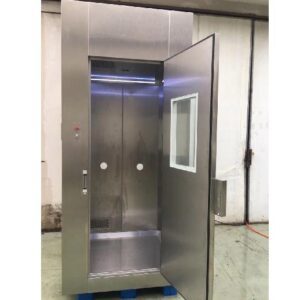
High-volume operations implement pass-through rooms or airlocks rather than simple pass boxes, but the same principles apply. Material never reverses direction through the same transfer point.
Interior Cleaning and Disinfection Protocols
Pass box interior surfaces require regular cleaning separate from UV cycles. UV provides surface disinfection but doesn’t remove particulate contamination or residues. Cleaning protocols typically specify 0.5% peroxyacetic acid or 5% iodophor solutions applied to all interior surfaces daily or between transfer campaigns. Cleaning occurs from the dirty side to avoid introducing cleaning materials into the clean environment.
Dynamic pass boxes need additional attention to air grills and filter faces. Pre-filters require replacement every 6 months; HEPA filters need replacement every 6-12 months based on differential pressure readings. We maintain filters on preventive replacement schedules rather than running to failure—unexpected filter breach creates immediate contamination risks.
Performance Validation and Compliance: Testing Protocols for Interlock Functionality, Airflow Visualization, and UV Irradiance to Meet ISO 14644 and GMP Standards
Interlock Function Testing Procedures
Quarterly testing verifies simultaneous door opening remains impossible. Test protocol: Open Door A fully, attempt to open Door B using normal force. Door B should not move. Attempt to disengage Door B’s lock mechanism manually—it should resist disengagement. Close Door A, verify Lock A engages, then confirm Door B now opens freely. Repeat sequence in reverse. Any movement of the locked door during testing indicates interlock failure requiring immediate repair before returning the pass box to service.
Electronic interlocks require additional verification of indicator lights, electromagnetic lock engagement, and purge timer function. Timer accuracy testing ensures programmed purge duration matches actual lockout period. Deviations exceeding ±5 seconds require control board recalibration.
HEPA Filter Integrity and Airflow Verification
DOP (dioctyl phthalate) or PAO (polyalphaolefin) aerosol testing validates filter integrity after installation and annually thereafter. Aerosol introduced through the upstream test port should show zero downstream penetration when scanning the filter face and frame seal with a photometer. Penetration exceeding 0.01% indicates leak paths requiring filter replacement or seal repair.
Airflow velocity measurement uses anemometer grids covering the filter face. Readings at 9-16 points (depending on chamber size) verify average velocity meets 0.45 m/s specification and uniformity stays within ±20%. We’ve identified installations where corner velocities measured 40% below center values—indicating inadequate diffuser design or filter gasket compression issues creating preferential flow paths.
Validation Testing Protocols and Compliance Intervals
| Test Parametresi | Test Yöntemi | Kabul Kriterleri | Test Frekansı |
|---|---|---|---|
| İnterlok Fonksiyonu | Manual actuation attempt on both doors | Simultaneous opening impossible | Üç Aylık |
| HEPA Filtre Bütünlüğü | DOP/PAO aerosol scan at test port | Zero leaks >0.01% penetration | Her 6-12 ayda bir |
| Hava Akış Hızı | Anemometre ızgara ölçümü | 0.45 m/s ±20% uniformity | Altı ayda bir |
| Parçacık Sayısı | ISO 14644-3 sampling protocol | ≤3520 particles/m³ @ ≥0.5µm for ISO 5 | Annually or post-filter change |
| UV Irradiance | Radiometer measurement at surface plane | Meets calculated dose requirement (mJ/cm²) | After lamp replacement, annually |
| Diferansiyel Basınç | Magnehelic gauge reading | <250 pa across hepa; replace if>200 Pa | Sürekli izleme |
Kaynak: ISO 14644-1:2015, EN 1822:2009 Filter Classes
Particle Count Classification Verification
Airborne particle counting validates the pass box achieves its specified cleanliness class during operation. For ISO Class 5 verification, sampling locations include chamber center and corners. The pass box operates with airflow active for at least 15 minutes before sampling begins. Sample volume and duration follow ISO 14644-3 protocols—typically 28.3 liters minimum per location for 0.5 µm particles.
Results must show ≤3,520 particles/m³ at ≥0.5 µm. Counts exceeding this threshold indicate filter compromise, inadequate airflow, or particle sources within the chamber. Investigations examine filter integrity, gasket seals, velocity profiles, and interior surface cleanliness before considering the unit acceptable for continued use.
Documentation and Audit Trail Requirements
Validation reports document all testing results, deviations, corrective actions, and equipment calibration certificates for measuring instruments. GMP requires this documentation remain available for inspection throughout equipment service life. Electronic interlock systems with data logging capabilities provide automatic records of door operations, cycle completions, and alarm conditions—creating audit trails that support investigations of potential contamination events.
Pass box contamination control depends on three synchronized systems working in precise coordination. Interlock mechanisms prevent pressure cascade collapse. Airflow systems provide active particle removal. UV cycles deliver surface decontamination. Each system follows specific engineering principles that determine effectiveness. Implementation requires understanding not just operational procedures but the technical logic governing component function, system interaction, and validation requirements. Material transfer protocol failures trace back to gaps in this understanding—where timing sequences conflict with purge requirements, or cycle durations fail to deliver validated doses.
Need engineered contamination control solutions that integrate interlock sequencing, HEPA filtration, and validated UV cycles into fan filter unit systems for critical material transfer applications? YOUTH delivers technically validated temi̇z oda eki̇pmanlari engineered for GMP compliance and ISO classification verification. Visit youthfilter.com for technical specifications and application engineering support.
Questions about validation protocols, airflow optimization, or system integration with existing cleanroom infrastructure? Bize ulaşın for technical consultation on pass box selection and performance qualification strategies.
Sıkça Sorulan Sorular
Q: What are the key operational and compliance differences between mechanical and electronic interlock systems for pass boxes?
A: Mechanical interlocks use a physical barrier to prevent simultaneous door opening, offering simple, cost-effective reliability for lower-risk transfers. Electronic interlocks use electromagnetic locks with control logic and indicator lights, providing enhanced procedural control, operator guidance, and integration with timed purge cycles to protect pressure cascades, which is critical for higher-risk applications under GMP standards.
Q: How is the internal ISO Class 5 environment achieved and validated in a dynamic pass box?
A: A dynamic pass box creates an ISO Class 5 (Grade A) environment using a fan to draw air through a G4 pre-filter and an H13 (99.97%) or H14 (>99.995%) HEPA filter, producing vertical unidirectional downflow at a target velocity of 0.45 m/s. Validation requires particle counting per ISO 14644-3 methods and regular HEPA filter integrity testing via DOP/PAO ports to confirm the classified cleanliness level is maintained during operation.
Q: Why is a UV cycle time alone insufficient for validating surface decontamination, and what must be measured instead?
A: UV effectiveness depends on the delivered dose (mJ/cm²), which is the product of irradiance and exposure time. A 15-minute cycle with a degraded lamp may not deliver a lethal dose. Performance qualification should measure UV irradiance at the material surface with a meter to calculate the actual dose, ensuring it meets the user’s validated requirement for the specific bio-burden.
Q: What is the recommended maintenance and testing schedule for critical pass box components to ensure ongoing compliance?
A: A compliant maintenance schedule includes daily interlock function checks, monitoring the HEPA filter differential pressure gauge, and replacing UV lamps after their 4000-hour service life. Periodic tasks involve replacing G4 pre-filters every 6 months, performing annual HEPA filter leak tests (PAO/DOP), and quarterly re-validation of airflow velocity and particle counts to meet AB GMP Annex 1 monitoring requirements.
Q: When should a recirculating airflow design be used versus a single-pass design in a dynamic pass box?
A: Use a recirculating (closed-loop) design for standalone applications where energy conservation and maintaining a stable, filtered environment are priorities. A single-pass design, which exhausts air externally, may be specified when transferring materials that off-gas or generate particulates, preventing recirculation of contaminants within the chamber. The choice impacts ducting requirements and filter load.
Q: How does the integration of a timed purge cycle within an electronic interlock sequence enhance contamination control?
A: The purge cycle activates after a door is closed, keeping both doors electromagnetically locked for a set duration. This allows the internal fan and HEPA filtration system to flush the chamber with clean air, removing particles introduced during loading. This function is critical for maintaining the integrity of the pressure cascade and aligns with the Revised Annex 1 EU GMP guidance on using Material Airlocks (MAL) with effective flushing.
İlgili İçerikler:
- Temiz Oda Kontaminasyon Kontrolü için Eksiksiz Geçiş Kutusu Seçim ve Uygulama Kılavuzu: GMP ve ISO 14644 Uyumluluk Çerçevesi ile 2025 Baskısı
- VHP Geçiş Kutusu Basınç Kontrolü: ISO 14644 Uyumluluğu
- VHP Geçiş Kutusu Pazar Tahmini: 2025-2030 Büyüme Analizi
- Temiz Oda Malzeme Transferi: En İyi Uygulamalar
- VHP vs Geleneksel Geçiş Kutuları: Temel Farklılıklar Karşılaştırıldı
- VHP Geçiş Kutusu Havalandırma Sistemleri: Eksiksiz Teknoloji Kılavuzu
- Laboratuvar VHP Geçiş Kutusu Uygulamaları: En İyi Araştırma Uygulamaları
- VHP Geçiş Kutusu: Tanım ve Temel İşlevler Açıklandı
- VHP Geçiş Kutusu Doğrulaması: IQ/OQ/PQ Uyumluluk Kontrol Listesi



 TR
TR  EN
EN  AR
AR  FR
FR  KO
KO  ID
ID  IT
IT  PT
PT  RU
RU  RO
RO  ES
ES  PL
PL  NL
NL  UK
UK  DE
DE