
Equipment certification failures cost pharmaceutical manufacturers an average of 3-6 months in project delays and hundreds of thousands in remediation expenses. The root cause isn’t inadequate technology—it’s the complexity of navigating two parallel compliance frameworks. ISO 14644 provides the technical benchmarks for particle control and airflow performance. GMP regulations demand a quality management system that wraps around those technical standards with documentation rigor, validation protocols, and contamination control strategies. Most organizations understand one framework deeply but struggle at the intersection where technical performance must satisfy procedural quality requirements.
The stakes have escalated significantly. Regulatory inspections increasingly focus on data integrity, contamination control strategies, and the complete audit trail from equipment design through ongoing monitoring. The 2022 revision of EU GMP Annex 1 tightened requirements for barrier systems and science-based contamination control, while FDA guidance continues emphasizing a lifecycle approach to validation. Обладнання для чистих приміщень now operates under scrutiny that extends beyond initial certification to every calibration record, pressure differential reading, and change control decision throughout its operational life.
Understanding ISO 14644 Classes and GMP Grade Requirements
Technical Classification Framework
ISO 14644-1 establishes nine cleanliness classes based on maximum allowable particle concentrations at specified sizes. ISO 5 permits 3,520 particles ≥0.5 µm per cubic meter at rest. ISO 7 allows 352,000 particles at the same threshold. ISO 8 permits 3,520,000. These are objective, measurable thresholds verified through particle counting protocols. The classification system provides a universal language for cleanroom performance across industries—from semiconductor manufacturing to aerospace to pharmaceuticals.
| Класифікація ISO | Max Particles (≥0.5 µm/m³) | GMP Grade Equivalent |
|---|---|---|
| ISO 5 | 3,520 at rest | Grade A critical zone |
| ISO 7 | 352,000 at rest | Grade B background area |
| ISO 8 | 3,520,000 at rest | Grade C supporting zone |
| ISO 9 | Не вказано | Grade D general area |
Source: ISO 14644-1:2015 і Додаток 1 до GMP ЄС. ISO 14644-1 defines the nine cleanliness classes by particle concentration thresholds, while EU GMP Annex 1 maps these technical classifications to pharmaceutical manufacturing grade requirements for sterile products.
Pharmaceutical Quality Layer
Додаток 1 до GMP ЄС maps ISO classes to pharmaceutical manufacturing grades, but adds critical requirements. Grade A (ISO 5) designates critical zones where product or containers contact the environment. Grade B (ISO 7 at rest) serves as the background for aseptic operations. The GMP framework doesn’t merely reference ISO classifications—it embeds them within a Contamination Control Strategy that integrates equipment performance with personnel controls, facility design, sterilization processes, and material transfer protocols. Achieving ISO 5 particle counts means nothing if your documentation lacks integrity or your change control process has gaps.
Strategic Compliance Integration
We’ve observed facilities pass ISO classification testing yet fail GMP inspections due to inadequate viable monitoring programs or incomplete validation documentation. The distinction matters: ISO provides technical pass/fail criteria for equipment performance. GMP requires that performance be maintained within a quality system featuring calibration schedules, operator training records, deviation investigations, and periodic review. Your certification strategy must address both dimensions simultaneously from project inception, not sequentially during commissioning.
Complete Equipment Qualification Lifecycle: DQ, IQ, OQ, PQ
Design and Installation Phases
Design Qualification verifies that equipment specifications align with user requirements and regulatory standards before fabrication begins. This front-loaded verification prevents costly mid-project redesigns. Vendor selection becomes critical—manufacturers providing pre-validated designs with comprehensive documentation packages accelerate DQ completion. Installation Qualification follows, confirming the equipment arrives on-site as specified, utilities connect properly, and installation complies with approved drawings. IQ documentation includes calibration certificates for instruments, material certifications for construction materials, and verification that software versions match specifications.
| Кваліфікаційний етап | Primary Verification Activity | Critical Deliverable |
|---|---|---|
| DQ | Design meets user requirements | Design specification documents |
| IQ | Equipment installed per specs | Installation records traceable |
| OQ | Functions across operational ranges | Performance test protocols |
| PQ | Consistent environmental performance | ISO 14644-3 validation data |
Source: ISO 14644-3:2019 і Додаток 1 до GMP ЄС. ISO 14644-3 provides the test methods executed during PQ to validate cleanroom performance, while GMP Annex 1 mandates the complete qualification lifecycle as part of equipment validation for sterile manufacturing.
Operational and Performance Validation
Operational Qualification tests each function across its operating range—airflow from minimum to maximum setpoints, alarm functions under simulated fault conditions, pressure differential response to door opening cycles. OQ protocols must challenge the system, not simply demonstrate nominal performance. Performance Qualification executes ISO 14644-3 test methods in the actual manufacturing environment with representative personnel and processes. PQ confirms the equipment maintains its ISO classification during typical operations, not just in controlled test conditions with minimal activity.
Sequential Dependencies and Risk
Each qualification stage builds on the previous. IQ cannot begin until DQ approval. OQ requires completed IQ. PQ depends on successful OQ. A single failed test can cascade backwards, requiring re-execution of prior stages. The sequential nature creates schedule risk that compounds with complexity. A six-zone cleanroom with multiple barrier systems might require 8-12 weeks just for qualification execution, assuming first-pass success. Factor in inevitable protocol revisions and equipment adjustments—realistic timelines often reach 16-20 weeks from IQ start to PQ completion.
ISO 14644-3 Testing Protocols: Particle Count to Filter Integrity
Airborne Particle Counting Verification
Particle counting validates ISO classification by measuring airborne particles at specified sizes across the controlled zone. Sampling locations, volumes, and duration follow standardized protocols. At-rest testing occurs with systems operational but no personnel or processes present. In-operation testing includes normal activity levels. The protocols are rigorous—ISO 5 classification might require 20+ sampling locations with multiple samples per location. Results must demonstrate statistical confidence that particle concentrations remain below class limits across the entire zone, not just at favorable locations.
| Метод випробування | Measurement Parameter | Типова частота |
|---|---|---|
| Підрахунок частинок | ≥0.5 µm concentration | 6-12 months periodic |
| Швидкість повітряного потоку | Unidirectional flow uniformity | 6-12 months periodic |
| Перепад тиску | Cascade integrity verification | Continuous monitoring recommended |
| Цілісність HEPA-фільтра | Aerosol challenge leak detection | 6-12 months periodic |
| Час відновлення | Post-contamination return rate | Щорічна валідація |
Source: ISO 14644-3:2019 і ISO 14644-2:2021. ISO 14644-3 defines the standardized test methods and procedures for cleanroom characterization, while ISO 14644-2 specifies the maximum intervals for periodic re-testing to demonstrate continued compliance.
Critical System Parameter Testing
Airflow velocity testing verifies unidirectional flow equipment maintains consistent velocity across the work zone—typically 0.36-0.54 m/s (70-107 fpm) with ≤20% variation. Velocity uniformity directly impacts particle sweep and contamination control effectiveness. Pressure differential testing confirms proper cascade relationships between adjacent zones. Grade A zones maintain positive pressure relative to Grade B backgrounds. Grade B maintains positive pressure relative to Grade C. Differential pressure monitoring must be continuous—brief excursions during material transfer or personnel movement can compromise contamination control.
Filter Integrity and Recovery Assessment
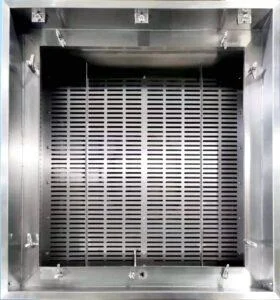
HEPA filter integrity testing uses aerosol challenge methods—typically PAO (polyalphaolefin) or thermal generation—to detect leaks through filter media or bypass around gaskets. Downstream scanning identifies leak locations for remediation. A single 0.003-inch pinhole can pass thousands of particles, compromising ISO 5 classification. Recovery testing measures the time required for particle counts to return to classification limits after a simulated contamination event. Fast recovery indicates robust airflow and filtration capacity. I’ve witnessed units that technically met ISO 5 at rest but required 45+ minutes to recover after brief activity—operationally unacceptable for aseptic processing with continuous product exposure.
GMP Annex 1 and FDA Requirements for Sterile Manufacturing
Contamination Control Strategy Foundation
The 2022 revision of EU GMP Annex 1 mandates a comprehensive, science-based Contamination Control Strategy as the overarching framework for sterile manufacturing. The CCS isn’t a document—it’s an integrated system encompassing facility design, equipment qualification, environmental monitoring, personnel controls, material flow, and microbiological programs. Equipment performance represents one element within this holistic approach. Your isolators and laminar flow systems must demonstrate not only ISO classification compliance but also integration with surrounding controls including sterilization procedures, gowning protocols, and aseptic technique validation.
| Елемент відповідності | Вимоги GMP | Strategic Impact |
|---|---|---|
| Стратегія контролю забруднення | Science-based holistic framework | Mandatory integration required |
| Удосконалені бар'єрні системи | Isolators/RABS strongly endorsed | Minimizes human intervention |
| Навчання персоналу | Rigorous recurrent programs | Addresses highest risk vector |
| Валідація процесу | Aseptic qualification integrated | Equipment within broader controls |
Source: Додаток 1 до GMP ЄС. This guideline mandates a comprehensive Contamination Control Strategy where equipment performance is integrated with sterilization, personnel controls, and material transfer, treating cleanroom equipment as a critical element within the broader quality management system.
Barrier System Emphasis
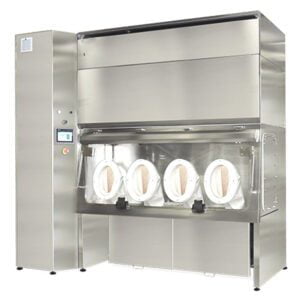
Both Annex 1 and FDA guidance strongly endorse advanced barrier technologies—isolators and Restricted Access Barrier Systems—to minimize human intervention in critical zones. Regulators recognize personnel as the highest contamination risk. Isolators provide physical separation between operators and critical zone. RABS limit access while maintaining partial openness. The regulatory preference is clear: demonstrate robust justification if not implementing barrier technology for aseptic processing. Barrier systems shift the compliance burden toward containment integrity testing and glove/gauntlet qualification, but dramatically reduce viable contamination risk from personnel.
Data Integrity and Audit Readiness
GMP compliance extends beyond technical performance to data integrity. Every particle count, pressure differential reading, calibration record, and change control decision must be recorded with complete traceability. Regulators scrutinize the audit trail—who recorded data, when, using what method, with what review and approval. Electronic records require Part 11 compliant systems. Paper records demand controlled forms and secure storage. The documentation burden often exceeds the technical testing burden. Factor adequate resources for record generation, review, and retention when planning your compliance program.
Ongoing Monitoring Frequencies and Periodic Re-testing Schedules
Continuous Versus Periodic Requirements
ISO 14644-2 specifies maximum intervals for periodic re-testing—typically 6-12 months depending on ISO class and risk. Filter integrity testing occurs at 6-12 month intervals. Airflow velocity verification follows annual schedules. These periodic tests provide snapshots of performance at specific moments. GMP requirements add continuous environmental monitoring—real-time particle counting in Grade A zones, continuous pressure differential recording, and routine viable monitoring through active air and surface sampling. The dual requirement means ongoing operational costs significantly exceed initial qualification expenses.
| Тип параметра | Monitoring Mode | Re-test Interval |
|---|---|---|
| Кількість частинок | Routine environmental monitoring | 6-12 місяців |
| Цілісність фільтра | Periodic aerosol challenge | 6-12 місяців |
| Перепад тиску | Continuous sensor monitoring | Real-time verification |
| Viable monitoring | Active/passive sampling | Per contamination risk |
| Швидкість повітряного потоку | Periodic verification testing | 12 months maximum |
Source: ISO 14644-2:2021. This standard specifies the requirements and maximum intervals for demonstrating continued compliance of cleanrooms, including the monitoring plan and periodic test procedures necessary to prove consistent air cleanliness classification.
Risk-Based Monitoring Programs
Not all zones require identical monitoring intensity. Grade A critical zones demand continuous particle monitoring with frequent viable sampling. Grade C supporting areas might require only daily particle counts and weekly viable monitoring. Risk assessment drives the program design—higher product exposure risk mandates more intensive monitoring. Media fill studies, process simulations, and contamination investigations inform risk understanding. The monitoring program must adapt as processes change, new products launch, or equipment modifications occur.
Predictive Analytics Evolution
Traditional periodic testing creates windows of unknown equipment status between scheduled events. We’re implementing sensor networks with continuous data streams feeding predictive analytics platforms. Machine learning algorithms detect subtle performance degradation before classification failures occur. Pressure differential trends, airflow velocity patterns, and particle count variations provide early warning of filter loading, seal deterioration, or system imbalance. This transition transforms compliance from reactive testing to proactive assurance, reducing unplanned downtime and extending equipment operational life.
Equipment-Specific Compliance: Isolators, RABS, and Laminar Flow
Unidirectional Flow Equipment Testing
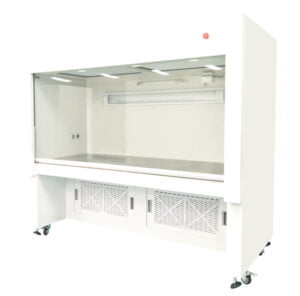
Laminar Flow Cabinets and Biological Safety Cabinets rely on unidirectional airflow to sweep particles away from critical work zones. Compliance testing verifies velocity uniformity across the work surface—typically 0.36-0.54 m/s with ≤20% deviation. Smoke pattern visualization confirms proper airflow direction without turbulence or dead zones. Containment testing for BSCs validates that contaminated air doesn’t escape the cabinet through the front opening. These units require careful placement—adjacent air currents from HVAC diffusers, personnel movement, or doorways can disrupt the laminar flow pattern and compromise protection.
| Тип обладнання | Unique Test Requirement | Регуляторний стандарт |
|---|---|---|
| Ламінарні шафи | Unidirectional airflow verification | ISO 14644-3 methods |
| Bio Safety Cabinets | Containment performance validation | ISO 14644-3 methods |
| Ізолятори | Glove/gauntlet integrity testing | ISO 14644-7 requirements |
| RABS | Enclosure leak detection | ISO 14644-7 requirements |
Source: ISO 14644-3:2019 and ISO 14644-7. ISO 14644-3 provides the general test methods for cleanroom equipment, while ISO 14644-7 specifically governs the additional containment and leak testing requirements for isolators and Restricted Access Barrier Systems used in pharmaceutical manufacturing.
Isolator and RABS Qualification
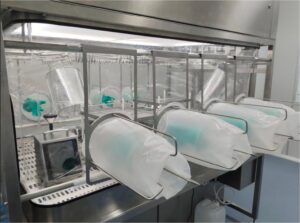
Isolators require containment leak testing to verify physical integrity of the enclosure, glove/gauntlet ports, and material transfer systems. Pressure decay testing quantifies leak rates—typically ≤0.5% volume per hour at specified pressure differential. Glove integrity testing occurs before each use through visual inspection and periodic pressure/vacuum testing. Bio-decontamination validation proves the effectiveness of hydrogen peroxide vapor or other sterilization methods. RABS share similar containment testing requirements but with less stringent specifications given their semi-open design.
Technology Selection Impact
Equipment choice directly impacts compliance complexity and operational burden. Traditional cleanrooms require extensive environmental monitoring and intensive personnel controls. Isolators demand rigorous containment validation and decontamination qualification but reduce environmental monitoring requirements. RABS provide middle-ground protection with moderate testing obligations. Each technology presents distinct advantages—cleanroom flexibility, isolator containment, RABS accessibility. The selection decision must weigh compliance costs against operational needs and contamination risk tolerance.
Calibration, Documentation, and Change Control Obligations
Instrument Calibration Requirements
All monitoring and control instruments require documented calibration traceable to national standards—NIST in the US, NPL in the UK, or equivalent national metrology institutes. Particle counters calibrate annually using NIST-traceable polystyrene latex spheres. Pressure gauges calibrate against deadweight testers or precision standards. Airflow meters calibrate using certified calibration tunnels. Temperature and humidity sensors calibrate against reference standards. The calibration schedule must account for equipment criticality—instruments directly verifying ISO classification might require more frequent calibration than supporting instruments.
| Compliance Obligation | Вимоги GMP | Audit Focus Area |
|---|---|---|
| Instrument calibration | Traceable to national standards | Documented schedule adherence |
| Цілісність даних | Complete audit trail | Generation to retention |
| Record retention | Every action documented | Regulatory inspection readiness |
| Change control | Impact assessment mandatory | Validation status preservation |
Source: Додаток 1 до GMP ЄС. This guideline mandates rigorous quality system processes including calibration schedules, comprehensive documentation, and formal change control to ensure technical equipment performance is anchored within an auditable quality management system.
Documentation Architecture
Every test execution, calibration event, maintenance activity, and operational parameter requires documentation with complete traceability. Protocol-based testing demands pre-approved procedures specifying acceptance criteria, sampling locations, and test methods. Executed protocols include raw data, calculations, deviations, and conclusions. Calibration records document as-found and as-left conditions, standards used, and next due date. Maintenance logs track filter changes, seal replacements, and corrective actions. The document hierarchy—from validation master plan through individual test records—must link clearly for regulatory review.
Change Control Process
Any modification to equipment, operating parameters, or monitoring programs triggers formal change control. The process assesses contamination risk impact and determines whether requalification is necessary. Software version updates might require validation testing. Filter changes require integrity testing. Pressure setpoint adjustments might demand airflow reverification. I’ve seen facilities operate for years with undocumented modifications that invalidated original qualification—a critical finding during regulatory inspection. The change control system preserves validation status and ensures modifications receive proper evaluation, approval, and documentation before implementation.
Building a Contamination Control Strategy for Certification
Integrated Framework Components
A robust Contamination Control Strategy integrates multiple elements into a cohesive system. Equipment qualification provides the foundation—documented proof that facilities and systems perform as designed. Environmental monitoring supplies ongoing verification—real-time and periodic data confirming continued control. Personnel training addresses the human factor—ensuring operators understand aseptic technique, gowning requirements, and contamination risks. Facility design establishes physical controls—pressure cascades, material airlocks, and segregated zones. Process validation proves the manufacturing procedure itself maintains sterility.
| CCS Component | Вимоги до інтеграції | Підхід до реалізації |
|---|---|---|
| Equipment qualification | DQ through PQ lifecycle | Risk-based validation protocol |
| Моніторинг навколишнього середовища | Continuous viable/particle data | Real-time sensor networks |
| Personnel controls | Training and gowning | Recurrent competency assessment |
| Проектування об'єктів | Pressure cascades verified | ISO class zoning |
| Risk assessment | Science-based framework | Holistic quality system |
Source: Додаток 1 до GMP ЄС. Annex 1 mandates a comprehensive, science-based Contamination Control Strategy that integrates equipment qualification with environmental monitoring, personnel training, facility design, and utilities as a holistic framework for sterile manufacturing compliance.
Risk Assessment Methodology
Effective CCS development starts with formal risk assessment identifying contamination pathways and control points. Failure Mode and Effects Analysis maps potential failure mechanisms and their consequences. Risk ranking prioritizes controls based on likelihood and severity. The assessment drives decisions about equipment selection, monitoring intensity, and procedural controls. High-risk operations demand advanced barrier systems, continuous monitoring, and redundant controls. Lower-risk areas might accept less intensive measures. The science-based approach provides defensible justification for your contamination control decisions during regulatory review.
Implementation and Maintenance Strategy
CCS implementation requires cross-functional coordination—engineering provides qualified equipment, quality establishes monitoring programs, operations executes procedures, and training ensures competency. The strategy document itself requires periodic review and update as processes evolve, equipment changes, or contamination events occur. We’ve found that facilities treating CCS as a living system rather than a static document achieve better compliance outcomes and more efficient operations. Consider engaging specialized compliance service providers who can integrate technical qualification with quality system requirements, accelerating your certification timeline while ensuring regulatory readiness.
Equipment certification under ISO 14644 and GMP standards demands dual competency in technical performance validation and quality system integration. Successful programs start with risk-based CCS development, select equipment compatible with your contamination control strategy, execute qualification lifecycles with comprehensive documentation, and maintain ongoing monitoring programs with proper calibration and change control. The recurring costs of periodic testing, continuous monitoring, and documentation maintenance typically exceed initial qualification expenses over equipment operational life. Factor these long-term obligations into selection decisions.
Need professional contamination control solutions that arrive with comprehensive qualification documentation and ongoing compliance support? YOUTH specializes in cleanroom equipment engineered for seamless ISO 14644 and GMP certification, backed by validation packages that accelerate your qualification timeline.
Our team provides technical consultation on equipment selection, qualification protocol development, and contamination control strategy integration. Зв'яжіться з нами to discuss your specific certification requirements and explore how pre-validated equipment solutions can reduce your time to operational compliance.
Поширені запитання
Q: How do ISO 14644 classes and GMP Grade requirements differ for sterile manufacturing?
A: ISO 14644-1 provides the technical baseline for airborne particle limits, defining nine classes from ISO 1 to 9. GMP standards like Додаток 1 до GMP ЄС integrate these classes but add a mandatory quality system layer, requiring viable monitoring, comprehensive documentation, and a formal Contamination Control Strategy. This means your equipment must achieve the technical ISO 5 target for critical zones while also satisfying GMP’s procedural demands for sterility assurance, effectively embedding the ISO standard within a quality management framework.
Q: What is the correct sequence for qualifying cleanroom equipment, and why is it critical?
A: The mandatory sequence is Design Qualification (DQ), Installation Qualification (IQ), Operational Qualification (OQ), and Performance Qualification (PQ). This lifecycle ensures each stage’s documented verification is complete before the next begins, with PQ executing the final ISO 14644-3 tests to validate the controlled environment. For projects with tight timelines, you must plan and document each phase meticulously from the outset, as failure at any point causes costly project delays and rework.
Q: Beyond particle counting, which ISO 14644-3 tests are essential for true contamination control?
A: Critical foundational tests include airflow velocity and uniformity checks for unidirectional flow, air pressure differential measurements, and HEPA/ULPA filter integrity testing via aerosol challenge. These methods, detailed in ISO 14644-3, validate the engineering controls that govern particle count. If your operational budget is a constraint, plan for the recurring costs and downtime associated with the required frequency of these more complex tests, as they define long-term ownership expenses.
Q: How does GMP Annex 1 change the approach to equipment and personnel in aseptic processing?
A: Annex 1 mandates a holistic Contamination Control Strategy where equipment qualification is just one element, integrated with sterilization, gowning, and material transfer controls. It strongly endorses advanced barriers like isolators to minimize human intervention, identifying personnel as the highest contamination risk. This means your investment in sophisticated equipment must be matched by an uncompromising, recurrent investment in rigorous personnel training and procedural controls.
Q: What are the ongoing monitoring obligations after initial cleanroom certification?
A: You must adhere to continuous environmental monitoring for particles and viable organisms per GMP, plus periodic re-testing per ISO 14644-2, which sets maximum intervals for tests like filter integrity (e.g., 6-12 months). This creates operational windows of risk between scheduled tests. Facilities aiming for proactive quality assurance should therefore evaluate investments in continuous sensor networks and predictive analytics to enable real-time compliance monitoring.
Q: What unique compliance challenges do isolators and RABS present compared to laminar flow hoods?
A: While all require airflow and particle count validation, isolators and Restricted Access Barrier Systems (RABS) governed by ISO 14644-7 demand additional containment integrity testing for gloves, gauntlets, and enclosure seals. This choice directly increases the testing burden and operational complexity. When selecting a vendor, prioritize those offering pre-validated systems with comprehensive documentation, as this transforms a regulatory burden into a strategic advantage that can de-risk your entire qualification lifecycle.
Q: Why is data integrity now a critical frontier in GMP compliance for cleanroom equipment?
A: GMP mandates that all monitoring data and calibration records form a complete, auditable trail proving control. Regulators now scrutinize how data is generated, recorded, and retained as evidence of a functioning quality system. This means your technical equipment performance is only as credible as its supporting documentation, requiring you to implement robust electronic systems with audit trails and formal change control for any modification.
Пов'язаний вміст:
- Повітряні фільтри, що відповідають вимогам GMP | Вимоги FDA до чистих приміщень
- Стандарти обладнання для чистих приміщень ISO 14644 | Посібник з дотримання вимог
- Очисне обладнання, що відповідає вимогам GMP з біологічної безпеки | Вимоги FDA | Валідація
- ISO 14644-1 Відповідність ламінарному потоку повітря
- BIBO, що відповідає вимогам GMP | Вимоги та валідація FDA
- Пристрої LAF, що відповідають вимогам GMP | Вимоги та валідація FDA
- Кваліфікація кабінету LAF | Протоколи валідації IQ OQ PQ
- Лабораторне очисне обладнання | Протоколи валідації | Підготовка до аудиту
- Повне керівництво з вибору та впровадження пропускних боксів для контролю забруднення в чистих приміщеннях: видання 2025 року з рамками відповідності GMP та ISO 14644




 UK
UK  EN
EN  AR
AR  FR
FR  KO
KO  ID
ID  IT
IT  PT
PT  RU
RU  RO
RO  ES
ES  PL
PL  NL
NL  DE
DE  TR
TR