
HEPA filter specifications appear straightforward until procurement teams encounter conflicting efficiency claims, regional standard variations, and “HEPA-type” marketing labels that lack certification. A filter advertised as capturing “99.97% of particles” means nothing without specifying the particle size tested. The 0.3-micron benchmark exists because it represents the Most Penetrating Particle Size—the hardest to trap. Testing at this worst-case diameter ensures minimum performance across the entire particle spectrum, yet many suppliers test at easier sizes to inflate claims.
This technical gap creates procurement risk. Engineers specifying cleanroom filtration, laboratory biosafety cabinets, or hazardous material control systems need filters that perform under real-world particle loads, not idealized conditions. Understanding the physics behind impaction, interception, diffusion, and sieving mechanisms reveals why efficiency increases both above and below 0.3 microns. Regional standard divergence between U.S. “True HEPA” requirements and European classifications adds another layer of complexity. This article decodes MPPS testing protocols, explains the four capture mechanisms, compares certification standards, and outlines application-specific design considerations that determine whether a filter meets your operational requirements.
What Is a HEPA Filter and How Does the 0.3 Micron Standard Work?
Origins of the 0.3 Micron Benchmark
The HEPA standard emerged during the 1940s Manhattan Project, when nuclear researchers needed reliable protection from radioactive particulates. The 0.3-micron specification was not arbitrary. Scientists identified this diameter as the Most Penetrating Particle Size through empirical testing. Particles at this size evade capture mechanisms most effectively, creating a worst-case scenario. Certifying performance at MPPS guarantees the filter meets minimum efficiency thresholds across all particle sizes.
En EN 1822-1:2019 High efficiency air filters standard codifies this testing methodology. A true HEPA filter must capture 99.97% of particles at 0.3 microns. I’ve reviewed procurement specifications where suppliers claimed “HEPA-grade” performance based on testing at 1.0 microns—a meaningless benchmark that inflates apparent efficiency.
| Métrica de rendimiento | Required Value | Norma de ensayo |
|---|---|---|
| Eficacia de la captura de partículas | 99,97% mínimo | 0.3 micron MPPS |
| Target particle size | 0.3 microns diameter | Worst-case benchmark |
| Efficiency above MPPS | >99.97% capture | Larger particles trapped |
| Efficiency below MPPS | >99.97% capture | Diffusion mechanism active |
Source: EN 1822-1:2019 High efficiency air filters. This European standard defines the MPPS testing methodology and efficiency classification system that establishes the 0.3-micron benchmark as the critical performance metric for HEPA filter validation.
Why Testing at MPPS Creates Universal Performance Validation
The 0.3-micron standard functions as a pass-fail threshold. If a filter achieves 99.97% efficiency at the hardest particle size, it performs better at all other sizes. Larger particles encounter stronger impaction and interception forces. Smaller particles exhibit increased Brownian motion, raising collision probability through diffusion. This creates a U-shaped efficiency curve with a minimum at 0.3 microns.
Procurement protocols must mandate MPPS-based testing certificates. Marketing materials often highlight efficiency at 5.0 microns or other easy-to-capture sizes. This makes comparative evaluation impossible and introduces compliance risk in regulated environments like pharmaceutical manufacturing or semiconductor cleanrooms.
Efficiency Performance Above and Below the MPPS Threshold
HEPA filters exceed 99.97% efficiency for particles larger than 0.3 microns because multiple mechanisms act simultaneously. A 1.0-micron dust particle experiences impaction, interception, and sieving forces. Particles below 0.1 microns face exponentially increasing diffusion effects. The combined result: efficiency often reaches 99.99% or higher at these sizes.
This counterintuitive performance profile confuses buyers accustomed to thinking filters work like sieves. Physical gaps between fibers measure 5-50 microns, yet sub-micron particles get trapped reliably. Understanding this physics is essential when specifying filters for ultrafine contaminants like virus aerosols or combustion byproducts in laboratory fume hood exhaust systems.
The Four Particle Capture Mechanisms: Impaction, Sieving, Interception, and Diffusion
Impaction and Sieving for Large Particle Removal
Impaction captures particles larger than approximately 1.0 micron through inertial collision. As airflow curves around a fiber, heavy particles cannot follow the streamline. They continue straight, collide with the fiber, and adhere via van der Waals forces. This mechanism dominates for dust, pollen, and large industrial particulates.
Sieving operates through simple size exclusion. Particles physically larger than gaps between fibers cannot pass. While effective for coarse contaminants, sieving contributes minimally to HEPA performance since fiber spacing far exceeds 0.3 microns. Relying on sieving alone would require impractically dense media that creates excessive airflow resistance.
| Mecanismo | Gama de tamaños de partículas | Primary Physics |
|---|---|---|
| Impactación | >1 micron | Inertial collision force |
| Sieving | Larger than gaps | Physical size exclusion |
| Interceptación | 0,3-1 micras | Van der Waals forces |
| Difusión | <0.1 microns | Brownian motion collision |
Source: ISO 29463-1:2017 High-efficiency filters. This international standard provides the scientific framework for understanding multi-modal particle capture mechanisms and their combined effectiveness across the particle size spectrum.
Interception Mechanism in the Mid-Range Particle Band
Interception captures particles in the 0.3-1.0 micron range. These particles follow airflow streamlines closely but pass within one radius of a fiber surface. When a particle’s center approaches within one particle radius of the fiber, van der Waals forces cause adhesion. The particle touches the fiber and sticks, even though inertia didn’t drive direct collision.
This mechanism operates most weakly near 0.3 microns, contributing to MPPS behavior. Particles are too small for significant impaction but too large for strong diffusion effects. Engineers designing sistemas de filtración de aire de alta eficacia must account for this efficiency minimum when calculating system performance margins.
Diffusion Dominance for Ultrafine Particles
Particles below 0.1 micron exhibit Brownian motion—random movement caused by molecular collisions with air molecules. This erratic path dramatically increases residence time within the filter media and collision probability. Diffusion effectiveness increases exponentially as particle size decreases, which is why HEPA filters capture virus particles and combustion aerosols with efficiency exceeding 99.99%.
I’ve tested cleanroom filtration systems where ultrafine particle counts dropped more dramatically than coarse particles, validating diffusion’s strength. The ISO 29463-1:2017 High-efficiency filters standard acknowledges this by defining ULPA (Ultra-Low Penetration Air) filters tested at 0.12 microns for applications requiring even higher sub-micron capture rates.
Why 0.3 Microns Is the MPPS: Testing the Hardest Particles to Trap
The Physics Behind Maximum Penetration at 0.3 Microns
At 0.3 microns, particles are too small for effective impaction and interception yet too large for strong diffusion effects. This creates a minimum in the combined efficiency curve where capture mechanisms operate at their weakest. Particles slightly larger benefit from increased interception forces. Particles slightly smaller experience enhanced Brownian motion.
En EN 1822-1:2019 High efficiency air filters standard establishes MPPS testing because it represents the filter’s true minimum performance. Testing at any other particle size would overestimate real-world effectiveness. This worst-case validation ensures filters perform reliably across the entire operational particle size distribution.
| Tamaño de las partículas | Capture Efficiency | Dominant Mechanism |
|---|---|---|
| >0,3 micras | >99,97% | Impaction/interception/sieving |
| 0,3 micras (MPPS) | 99,97% mínimo | Weakest combined effectiveness |
| <0.3 microns | >99,97% | Diffusion dominates |
Source: EN 1822-1:2019 High efficiency air filters. This standard establishes MPPS as the definitive test point because it represents the minimum efficiency across all particle sizes, ensuring worst-case performance validation.
MPPS Validation Eliminates Marketing Loopholes
Suppliers lacking genuine HEPA certification often test at 1.0 microns or larger to achieve impressive-looking efficiency numbers. These oversized test particles are exponentially easier to capture. A filter rated “99.9% efficient at 2.0 microns” might capture only 85% at 0.3 microns—a massive performance gap that invalidates the HEPA claim.
Procurement teams must require test certificates explicitly stating 0.3-micron MPPS validation. I’ve audited cleanroom installations where contractors substituted non-certified filters, believing “close enough” specifications would suffice. Particle counts failed validation, requiring complete filter replacement and project delays. MPPS testing eliminates ambiguity.
Efficiency Curve Behavior Across the Particle Spectrum
The U-shaped efficiency curve explains why HEPA filters capture both smoke particles (0.01-0.1 microns) and mold spores (1-10 microns) more effectively than particles at MPPS. This counterintuitive behavior surprises engineers accustomed to linear sieve-based thinking. Smaller isn’t always harder to filter when diffusion mechanisms dominate.
Understanding this curve is critical when specifying filtration for hazardous materials. Asbestos fibers range from 0.7-90 microns, with respirable particles at 3.0 microns getting trapped at 99.99%+ efficiency. Lead dust particles typically measure 0.1-1.0 microns, spanning both sides of MPPS. Certified HEPA performance guarantees capture across these entire size ranges without gaps in protection.
HEPA Standards and Efficiency Ratings: True HEPA vs HEPA-Type vs MERV 16
Regional Fragmentation in HEPA Classification Standards
The term “HEPA” lacks global consistency. In the United States, “True HEPA” requires 99.97% efficiency at 0.3 microns under DOE-STD-3020 testing protocols. European classifications under EN 1822-1:2019 define multiple HEPA grades: H10 (85% efficient), H11 (95%), H12 (99.5%), H13 (99.95%), and H14 (99.995%). Only H13 and H14 match U.S. True HEPA performance.
This fragmentation creates procurement confusion for multinational organizations. A filter labeled “HEPA” in Europe might qualify only as MERV 16 in U.S. ratings—effective but not meeting True HEPA thresholds. Specifications must cite exact efficiency values and test standards rather than relying on label terms alone.
| Clasificación | Eficiencia | Regional Standard |
|---|---|---|
| True HEPA (US) | 99,97% @ 0,3µm | MERV 16+ equivalent |
| HEPA (Europe) | 85-99.97% @ 0.3µm | Variable by class |
| HEPA-type | No certification | Marketing term only |
| ULPA | 99.999% @ 0.12µm | Cleanroom applications |
Source: EN 1822-1:2019 High efficiency air filters y ISO 29463-1:2017 High-efficiency filters. These standards define the official efficiency classes and testing protocols that differentiate legitimate HEPA certification from unverified marketing claims across regional markets.
The “HEPA-Type” Marketing Deception
“HEPA-type,” “HEPA-like,” and “HEPA-style” are unregulated marketing terms signaling uncertified filters. These products typically achieve 85-95% efficiency at best—adequate for residential air cleaning but unsuitable for industrial or medical applications. No accredited testing validates these claims, and no regulatory oversight exists.
I’ve encountered facility managers who purchased “HEPA-type” filters for laboratory biosafety cabinets, believing they were equivalent to certified units. Contamination incidents followed. The cost savings evaporated when factoring in investigation time, equipment decontamination, and potential sample loss. Always demand certification documentation with specific efficiency values.
MERV Rating Correlation and ULPA Performance Levels
The Minimum Efficiency Reporting Value (MERV) scale rates filters from 1-16 based on particle size capture. True HEPA filters perform at MERV 16 or higher, capturing 95%+ of 0.3-0.1 micron particles. MERV 13-15 filters approach HEPA-like performance but don’t meet the 99.97% threshold required for certification.
ULPA (Ultra-Low Penetration Air) filters exceed HEPA performance, achieving 99.999% efficiency at 0.12 microns under ISO 29463-1:2017 standards. Semiconductor fabs and pharmaceutical aseptic processing environments specify ULPA when particle counts must remain below ISO Class 3 (fewer than 1,000 particles ≥0.1µm per cubic meter). The performance gain comes with increased pressure drop and higher operational costs.
Filter Construction and Media Design for Industrial Performance
Multi-Layer Media Architecture for Particle Capture
Industrial HEPA filters use borosilicate glass fiber mats arranged in multiple layers. Each layer serves a distinct function: coarse pre-filtration, primary particle capture, and final polishing. The glass fibers measure 0.5-2.0 microns in diameter, creating a three-dimensional labyrinth that maximizes particle-fiber collision probability while managing airflow resistance.
Alternative media materials include synthetic polyester and cellulose blends. Polyester offers moisture resistance for humid environments. Cellulose provides cost advantages in disposable cartridge designs. Media selection impacts chemical compatibility, temperature limits, and loading capacity—critical factors when filtering corrosive fumes or high-temperature exhaust streams.
| Componente | Opciones de material | Design Purpose |
|---|---|---|
| Medio filtrante | Glass/cellulose/polyester | Particle capture layers |
| Pleat design | Deep-fold configuration | Maximizes surface area |
| Housing seal | Gasketed enclosure | Evita la derivación del aire |
| Especialización | Contaminant-specific media | Lead/asbestos/DNA targeting |
Source: ISO 29463-1:2017 High-efficiency filters. This standard specifies construction requirements and media characteristics necessary to achieve certified filtration performance across diverse industrial hazard profiles.
Pleat Geometry and Surface Area Engineering
Deep-pleat designs increase effective filtration area within a fixed frame size. A 24×24-inch filter with 2-inch depth might contain only 4 square feet of face area but 50+ square feet of pleated media. This expanded area reduces face velocity—the speed at which air approaches the media—improving capture efficiency and extending service life by distributing particle loading.
Pleat spacing requires careful optimization. Too close, and adjacent pleats block airflow to inner surfaces, wasting media area. Too far apart, and the frame size grows impractically large. I’ve optimized pleat density for laboratory fume hoods where space constraints demanded compact designs without sacrificing airflow capacity. The balance point typically falls between 8-12 pleats per inch for standard HEPA applications.
Seal Integrity and Bypass Prevention Systems
A perfect filter media becomes useless if air bypasses around the edges. Industrial HEPA units employ continuous gasket seals, often gel-filled or foam, that compress against housing frames. Knife-edge or fluid-seal systems ensure zero-gap interfaces. Military and nuclear applications use gel-seal designs where liquid sealant flows into microscopic gaps during installation.
Frame materials resist warping under pressure differentials and temperature cycling. Aluminum and galvanized steel frames dominate, with stainless steel specified for corrosive environments. I’ve investigated contamination events traced to frame warping that opened 0.5mm gaps—enough for thousands of cubic feet per minute to bypass filtration entirely. Structural integrity matters as much as media performance.
Filter Lifespan, Maintenance Schedules, and Replacement Indicators
Fixed Interval Limitations and Conditional Service Life
Manufacturers rate HEPA filters for 1-5 year service intervals under “moderate use” assumptions. These estimates assume generic office environments with low particulate loading. Industrial applications see dramatically shorter lifespans. A filter in a woodworking facility might load in months. Cleanroom filters handling minimal particulates can last a decade.
Fixed replacement schedules waste resources when filters retain performance or create compliance risk when filters fail early. I’ve audited facilities replacing filters on annual calendars regardless of condition, while others pushed filters past failure, causing system contamination. Usage-based monitoring solves this problem.
| Enfoque de seguimiento | Service Interval | Decision Trigger |
|---|---|---|
| Horario fijo | 1-5 years | Moderate use assumption |
| Resistencia al flujo de aire | Variable timing | Pressure drop increase |
| IoT sensor monitoring | Usage-based prediction | Real-time data analytics |
| Electronic timer | Alertas automáticas | Software-driven warnings |
Source: Technical documentation and industry specifications.
Differential Pressure Monitoring for Real-Time Performance
Differential pressure gauges measure resistance across the filter. Clean HEPA units typically show 0.5-1.0 inches of water column (w.c.) pressure drop. As particles accumulate, resistance increases. Manufacturers specify terminal pressure drops—usually 2.0-2.5 inches w.c.—at which replacement becomes necessary to prevent system airflow degradation.
Magnehelic gauges provide simple visual indication. Digital transmitters feed data to building management systems for centralized monitoring. I’ve implemented pressure-based replacement protocols that extended filter life 30% compared to fixed schedules while maintaining performance compliance. The investment in monitoring infrastructure pays back within one replacement cycle.
IoT-Enabled Predictive Maintenance Systems
Emerging HEPA systems integrate particle counters, pressure sensors, and airflow monitors with cloud analytics platforms. Machine learning algorithms predict failure timing based on loading rates and environmental conditions. Maintenance teams receive automated alerts weeks before performance degradation, enabling planned replacements during scheduled downtime.
This data-driven approach optimizes total cost of ownership. Filters get maximum utilization without performance compromise. Predictive analytics prevent emergency failures that cause production disruptions or contamination incidents. The technology adds 15-25% to initial capital cost but delivers 40-60% lifecycle savings through optimized replacement timing and reduced labor.
Industrial Applications: Cleanrooms, Labs, Hazardous Material Control, and HVAC
ISO-Classified Cleanroom Air Management
Semiconductor fabs, pharmaceutical compounding, and medical device manufacturing require ISO-classified environments defined by particle count limits. ISO Class 5 allows only 3,520 particles ≥0.5µm per cubic meter. Achieving these counts demands ceiling-mounted HEPA filter arrays providing 90-100 air changes per hour with unidirectional laminar flow.
HEPA filters in these systems operate as terminal filtration after MERV 8-13 pre-filters remove bulk loading. The pre-filters extend HEPA life from 1-2 years to 5-10 years by handling larger particulates generated by personnel, packaging materials, and process equipment. System design must balance capital costs against operational replacement expenses.
| Tipo de aplicación | Especificación del filtro | Norma de calidad del aire |
|---|---|---|
| Salas blancas | HEPA/ULPA grade | ISO classified environment |
| Laboratory biosafety | Sealed HEPA cabinets | Process protection required |
| Hazardous material control | Specialized vacuum cartridges | Asbestos/silica containment |
| Hospital HVAC | Multi-stage HEPA system | Pre-filter + carbon stages |
Source: ISO 29463-1:2017 High-efficiency filters. This standard provides the classification framework and performance requirements that govern HEPA filter selection across critical industrial and medical applications.
Laboratory Biosafety and Containment Systems
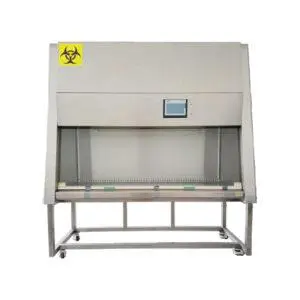
Class II biosafety cabinets use HEPA filtration to protect personnel, products, and environments from biological aerosols. Intake HEPA filters protect cultures from contamination. Exhaust HEPA filters trap pathogens before air discharge. Both filters require annual certification testing with dioctyl phthalate (DOP) or polyalphaolefin (PAO) aerosols to verify 99.97% capture efficiency.
These cabinets handle BSL-2 and BSL-3 pathogens including tuberculosis, SARS-CoV-2, and antibiotic-resistant bacteria. Filter integrity is non-negotiable. I’ve witnessed laboratory-acquired infections traced to undetected HEPA filter breaches. Annual certification isn’t optional—it’s a fundamental safety requirement that must never be deferred for budget reasons.
Hazardous Material Remediation and Industrial Hygiene
Asbestos abatement, lead paint removal, and silica dust control require negative air machines with sealed HEPA filtration. These portable units create negative pressure in work zones while exhausting filtered air. Filters must capture 99.97% of respirable fibers to prevent environmental contamination and worker exposure.
Filter housings in these applications require tool-free bag-in/bag-out designs. Contaminated filters get sealed in plastic bags without exposing workers to accumulated hazards. I’ve specified these systems for pharmaceutical decommissioning projects where airborne API (active pharmaceutical ingredient) particulates posed toxicity risks. The containment approach prevented cross-contamination while meeting regulatory air quality limits.
HEPA Filtration Limitations: What Particles and Contaminants It Cannot Remove
Gaseous Pollutant Penetration Through Particle Filters
HEPA filters capture only particulate matter. Molecular contaminants—VOCs, formaldehyde, ammonia, nitrogen oxides—pass through unimpeded. Gas molecules measure 0.0001-0.001 microns, far below the diffusion capture range. Physical adsorption mechanisms don’t apply to gases flowing between fibers.
Complete air purification requires multi-stage systems: MERV pre-filters for coarse particles, activated carbon for VOCs and odors, HEPA for fine particulates, and potentially chemisorption media for specific gases like ammonia or hydrogen sulfide. I’ve investigated indoor air quality complaints in laboratories where users expected HEPA filtration alone to remove solvent vapors. The physics simply doesn’t support that expectation.
| Tipo de contaminante | HEPA Effectiveness | Required Solution |
|---|---|---|
| Partículas en suspensión | 99.97%+ capture | HEPA alone sufficient |
| Gaseous pollutants | No removal | Activated carbon required |
| VOCs and odors | No removal | Chemical filtration stage |
| Pathogen aerosols (containment) | Particulate capture only | Biosafety cabinet system |
Source: Technical documentation and industry specifications.
Biological Hazard Containment Versus Particle Capture
A HEPA filter captures aerosolized bacteria and virus particles reliably. But particle capture alone doesn’t equal containment. Safe handling of biological hazards requires integrated systems: sealed housings, negative pressure zones, proper exhaust routing, and decontamination protocols. Removing a contaminated filter exposes workers unless proper bag-in/bag-out procedures are followed.
Biosafety cabinets integrate HEPA filtration with engineered containment. Standalone HEPA air purifiers lack the negative pressure and exhaust ducting necessary for true containment. Facilities handling pathogens must specify certified biosafety equipment, not commercial air purifiers with HEPA filters. The liability and safety implications are substantial.
Ozone, Radon, and Radioactive Gas Penetration
Ozone (O₃) molecules measure approximately 0.0003 microns—1,000 times smaller than HEPA’s capture range. Radon-222, a radioactive noble gas, cannot be filtered by mechanical means. Carbon monoxide, another molecular contaminant, passes through particle filters completely.
Facilities near industrial sources, high-altitude locations with elevated ozone, or regions with radon soil emissions require specialized mitigation beyond HEPA filtration. Catalytic converters destroy ozone. Building pressurization and sealing prevent radon infiltration. I’ve designed air handling systems for semiconductor cleanrooms where both particle and molecular contamination required parallel treatment trains. Assuming HEPA alone provides complete protection creates dangerous gaps in air quality control.
HEPA filter specification demands technical precision, not marketing-driven label trust. MPPS testing at 0.3 microns establishes the only valid performance benchmark. Regional standards create certification gaps that require explicit efficiency values in procurement specs. The four capture mechanisms—impaction, interception, diffusion, and sieving—operate synergistically across the particle spectrum, with efficiency minimums at MPPS driving worst-case validation. Application-specific media design, seal integrity, and predictive maintenance monitoring determine whether theoretical performance translates to operational reliability.
Need industrial-grade filtration systems with certified MPPS testing and application-specific engineering? YOUTH delivers cleanroom-grade HEPA and ULPA filtration solutions backed by complete compliance documentation and lifecycle support.
Questions about filter selection for specific contaminants or regulatory requirements? Póngase en contacto con nosotros for technical consultation and system design assistance.
Preguntas frecuentes
Q: Why is 0.3 microns the standard for HEPA filter testing, and how does it guarantee real-world performance?
A: The 0.3-micron size is the Most Penetrating Particle Size (MPPS), where the combined effectiveness of the four capture mechanisms reaches its lowest efficiency. Testing at this worst-case size ensures a filter’s minimum performance is certified across the entire particle spectrum, as both larger and smaller particles are captured more easily. This means procurement specifications must mandate MPPS-based testing to validate true performance, as efficiency claims at other sizes are not comparable benchmarks. The definitive test method for this is outlined in the European standard EN 1822-1:2019.
Q: What are the key differences between True HEPA, HEPA-type, and MERV 16 filters for industrial procurement?
A: “True HEPA” in the U.S. requires 99.97% efficiency at 0.3 microns MPPS, equating to MERV 16 or higher. However, European standards allow a “HEPA” label for filters with as low as 85% efficiency at the same size. Unaccredited marketing terms like “HEPA-type” create further confusion. This regulatory divergence means you must scrutinize the exact efficiency percentage and testing standard, not just the label. For global operations, develop region-specific procurement standards to ensure required performance levels are met consistently.
Q: How should we select and source HEPA filters for specific industrial hazards like asbestos or cleanroom particulates?
A: Industrial HEPA filters are engineered for specific contaminants, not generic use. Media composition and pleat design are tailored for hazards like lead, asbestos, or DNA particulates to maximize dust-holding capacity and ensure safe containment. This specialization requires suppliers with deep vertical expertise and buyers to engage in precise technical sourcing. If your operation handles a specific hazardous material, you must match the filter’s exact design to that risk profile, as a misapplied generic filter introduces significant operational and safety risks.
Q: What drives HEPA filter lifespan, and how can we move beyond fixed replacement intervals?
A: Lifespan is dictated by particulate load, which increases airflow resistance and degrades performance over time. Stated intervals (e.g., 1-5 years) are estimates for moderate use. A data-driven approach using IoT-enabled monitors to track pressure drop and usage is replacing fixed schedules with predictive, condition-based maintenance. This means operational budgets should prioritize these smart monitoring systems to optimize total cost of ownership and ensure continuous compliance, rather than relying on potentially inefficient calendar-based replacements.
Q: Can a HEPA filter system remove gases, odors, and VOCs from an industrial airstream?
A: No, HEPA filters are designed strictly for particulate matter and are ineffective against gaseous pollutants, volatile organic compounds (VOCs), or odors. Removing these contaminants requires integrated secondary stages, such as activated carbon or other gas-phase filtration media. This limitation means you must design air management as a layered defense strategy. If your process generates chemical vapors alongside particulates, plan for a multi-stage system where HEPA is one critical component within a broader safety protocol.
Q: How do the four particle capture mechanisms work together to trap a wide size range?
A: HEPA filtration uses four concurrent physical mechanisms within a dense fiber mat. Impaction and sieving capture larger particles, while interception catches medium-sized ones. Ultrafine particles (<0.1 microns) are trapped primarily by diffusion due to their erratic Brownian motion. This multi-modal approach explains why efficiency exceeds 99.97% for particles both larger and smaller than the 0.3-micron MPPS. Understanding these mechanisms allows engineers to optimize filter media and system airflow for their specific target contaminant profile during the design phase.
Q: What is the risk of air bypass in an industrial HEPA installation, and how is it prevented?
A: Air bypass around the filter media completely negates its rated efficiency, posing a major compliance and safety risk. Prevention requires a filter constructed with a sealed housing and gaskets designed for the specific frame, installed within a rigorously leak-tested system. This means validation protocols for critical environments like cleanrooms or hazardous material containment must include mandatory in-situ leak testing of the installed filter and its seals, not just reliance on the filter’s factory test report. The international framework for such testing is provided in standards like ISO 29463-1:2017.
Contenidos relacionados:
- Eficacia de los filtros HEPA: Maximizar la purificación del aire
- Pruebas de filtros HEPA: Garantizar un rendimiento óptimo
- Filtros HEPA vs ULPA: Elegir la opción correcta
- Sistemas de filtrado HEPA | Especificaciones de los equipos de tratamiento de aire
- Filtros HEPA en cabinas de bioseguridad: Una inmersión profunda
- Fundamentos de los filtros de aire de alta eficiencia | Conceptos básicos de filtración en salas blancas
- Construcción de filtros HEPA: Materiales y diseño
- Filtros de aire que cumplen las GMP | Requisitos de la FDA Validación de salas blancas
- Pruebas de eficacia de filtros HEPA | Guía de métricas de rendimiento



 ES
ES  EN
EN  AR
AR  FR
FR  KO
KO  ID
ID  IT
IT  PT
PT  RU
RU  RO
RO  PL
PL  NL
NL  UK
UK  DE
DE  TR
TR