Procurement teams working in FDA-regulated environments often run into a specific problem late in the equipment selection process: a supplier’s documentation uses language that implies regulatory approval, and no one flags it until commissioning or audit preparation. At that point, the gap between what the supplier can actually certify and what the manufacturer must independently qualify becomes expensive — rework during validation, delays to process qualification timelines, and documentation that is difficult to defend under inspection. The real decision that prevents this is not choosing between suppliers, but defining the evidence boundary before the specification handoff happens. Understanding where supplier documentation ends and manufacturer qualification begins is what allows a regulated buyer to build a defensible quality file from the start.
FDA cGMP context for cleanroom equipment support
The regulatory framework for aseptic processing does not approve specific equipment. What FDA cGMP regulations and 21 CFR Part 211 establish are environmental and procedural conditions under which a manufacturer must demonstrate control — and equipment must perform within those conditions, not substitute for them.
For cleanroom environments, that means continuous monitoring of air quality and particulate contamination, with regular validation and calibration of monitoring systems. These are process obligations that belong to the regulated manufacturer, not the equipment supplier. A supplier can design equipment that supports this environment, but they cannot take responsibility for whether a facility meets its monitoring requirements. That distinction matters because buyers who conflate the two tend to over-rely on supplier documentation during qualification and under-invest in their own environmental validation work.
ISO 5 is the classification threshold for the most stringent cleanroom environments — defined by maximum allowable airborne particle concentration — and it functions as a measurable design input when specifying equipment for the most demanding aseptic processing contexts. It is not a universal mandate that applies to every cleanroom or every piece of equipment within one. Treating it as a blanket specification requirement rather than a context-specific design figure creates unnecessary friction during supplier evaluation and can obscure whether equipment is actually fit for the specific process being run.
The practical implication is that cGMP requirements for monitoring, calibration, and documentation establish the conditions the manufacturer must sustain — and every piece of equipment placed in that environment should be selected and documented in relation to those conditions, not as a stand-alone compliance claim.
Supplier evidence that supports aseptic processing without approval claims
The clearest value a supplier provides in an FDA-regulated procurement is documented evidence of material compatibility, cleanability design, and equipment performance — not a claim that the equipment is approved for aseptic use. No supplier can make that claim, because approval for a specific aseptic process is something the regulated manufacturer earns through qualification and validation, not something that transfers with a purchase order.
What suppliers can document is concrete and useful: compatibility of materials with cleaning and disinfecting procedures, design features that minimize particle generation, maintenance procedures, installation and operational qualification data, and traceability records including device master records and change history. This documentation supports the manufacturer’s qualification work — it does not replace it. The mistake pattern that creates audit exposure is treating strong supplier documentation as evidence that the manufacturer’s own qualification step is either complete or abbreviated. Better supplier evidence actually makes the remaining qualification scope more visible, not less necessary.
| Evidence Area | What a Supplier Can Document | What the Manufacturer Must Qualify |
|---|---|---|
| Materials & Cleanability | Compatibility with cleaning agents, particle-generation design, maintenance procedures | Cleaning effectiveness under actual operating conditions |
| Process Validation Records | Protocols, acceptance criteria, and recorded performance results | Integration into end-to-end aseptic process validation |
| Traceability Documentation | Device master records, device history records, change documentation | Incorporation into the site quality system and change control |
The implication for procurement is that when evaluating suppliers, the right question is not “is this equipment FDA approved?” but rather “what can this supplier document, and does that documentation map to the evidence my quality file requires?” A supplier who can provide traceable material compatibility data, particle-generation design records, and validation-ready documentation reduces procurement risk — but only if the buyer knows what qualification responsibilities remain on their side of the boundary.
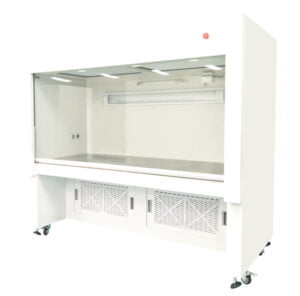
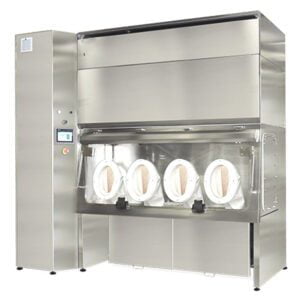
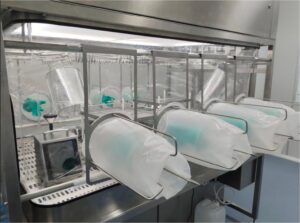
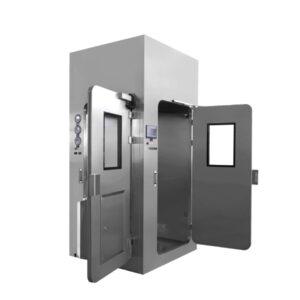
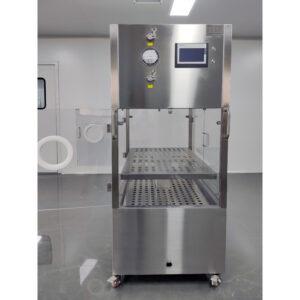
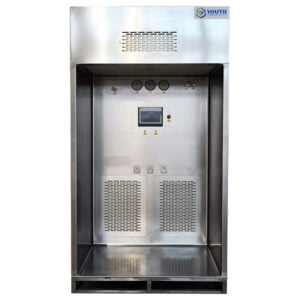
For environments where laminar airflow protection is part of the aseptic strategy, equipment like a dispensing booth or sampling booth should be evaluated against the same documentation standard: what materials, surface finishes, and airflow performance data can the supplier provide, and what does the regulated manufacturer still need to qualify under operating conditions?
Cleanability and records questions for FDA-regulated buyers
Surface design is not an aesthetic specification — it is a cleanability and contamination control decision with direct cGMP consequences. Surfaces in a cleanroom environment should be smooth, non-porous, and compatible with the disinfectants used in the facility’s cleaning validation program. Whether a piece of equipment meets that requirement is something buyers need to confirm with suppliers explicitly, because it determines whether cleaning effectiveness can be validated under actual operating conditions.
Environmental monitoring requirements under cGMP cover airborne particle concentration, temperature, humidity, air pressure differentials, and microbial contamination levels. Equipment that is poorly positioned, improperly sealed, or that introduces turbulence into airflow patterns can create monitoring gaps — areas where required data cannot be reliably collected. This is not a theoretical concern; it surfaces during commissioning when monitoring instruments cannot be positioned as planned, or during audits when continuous records show gaps that cannot be explained by procedure.
| Cleanability & Records Area | What to Confirm with the Equipment Supplier | cGMP Recordkeeping Expectation |
|---|---|---|
| Desain Permukaan | Surfaces are smooth, non-porous, and disinfectant-compatible | Cleaning validation records and contamination control evidence |
| Environmental Monitoring Support | Equipment does not interfere with airborne particle, temperature, humidity, pressure, or microbial monitoring | Continuous monitoring records are required; equipment must not create data gaps |
| Operational Procedure Alignment | Equipment can be operated under written procedures; design changes are documented | Procedure records, change review, and nonconformance investigations must be traceable |
The recordkeeping dimension adds another layer: cGMP requires written procedures, formal review of process changes, and documented investigation of nonconformances. For equipment, this means buyers need to confirm that the equipment can be operated under written procedures, that design changes are formally documented by the supplier, and that those records can be incorporated into the site’s change control system. Gaps in any of these three areas — surface cleanability, monitoring compatibility, or procedure traceability — create the kind of fragmented documentation that is difficult to reconstruct after installation and nearly impossible to defend during an FDA inspection without a clear paper trail from procurement forward.
The GMP Compliant Cleanroom Equipment FDA Requirements Guide covers related documentation expectations in more detail for buyers building their quality file from early procurement stages.
Regulatory risk from unsupported approval language
The most damaging language in a supplier’s documentation is not technical inaccuracy — it is unsupported regulatory framing. Phrases like “FDA approved equipment” or “cGMP certified” attached to cleanroom hardware create a category problem: they imply a regulatory status that does not exist for equipment in the same way it exists for drug products, and they shift the buyer’s attention away from the specific evidence they actually need.
The downstream consequence is not just a language problem. When a regulated manufacturer selects equipment based on an approval claim rather than documented material compatibility, cleanability design, and qualification records, the result is a quality file built on unsupported assertions. Improperly designed or inadequately qualified control systems in aseptic environments increase the risk of contamination events, mix-ups, and the kind of systemic failures that lead to recalls. The language doesn’t cause the problem directly — the absence of adequate evidence behind it does.
What makes this a procurement-stage risk rather than just an audit-stage risk is that the gap is difficult to close retroactively. By the time an auditor asks for supporting evidence behind an approval claim, the equipment is installed, the process is running, and the regulated manufacturer must either produce traceability they should have required at procurement or acknowledge the gap. Requiring suppliers to use accurate, bounded language — describing what the equipment is designed to support, not what it is approved for — is a procurement control that costs nothing upfront and prevents a defensibility problem later.
The practical check is straightforward: if a supplier uses approval or certification language in their documentation, ask specifically what regulatory body issued the approval, for what process, under what conditions, and where that documentation sits. If those questions cannot be answered with traceable evidence, the language should be revised before it enters the quality file.
Specification handoff after evidence and responsibility boundaries are defined
Under FDA regulations, the regulated manufacturer is responsible for evaluating and selecting suppliers based on their demonstrated ability to meet specified quality and regulatory expectations. That is a manufacturer obligation, not a supplier courtesy — and it means the specification handoff is not the end of the buyer’s responsibility, it is where the manufacturer’s qualification obligation formally begins.
FDA’s aseptic processing guidance reinforces that process validation is required when results cannot be fully verified through inspection or testing alone. For peralatan kamar bersih, this means that supplier-provided performance data — airflow test results, surface finish specifications, installation qualification records — establishes a starting point, but it does not satisfy the manufacturer’s obligation to validate the equipment’s performance within the specific aseptic process at the specific site. That validation responsibility does not transfer with the equipment.
| Responsibility Area | Supplier Evidence | Manufacturer Qualification |
|---|---|---|
| Evaluasi Pemasok | Documented capability to meet quality and regulatory expectations | Selection and ongoing oversight based on performance |
| Validasi Proses | Performance data, installation/operational qualification records | Full process validation when results cannot be fully verified by inspection/testing |
| Kontrol Desain | Design requirements, verification records, change notifications | Formal review and approval of design changes within the site control system |
| Inspection Readiness | Equipment documentation for the quality file | Robust aseptic processing compliance records and evidence of adherence |
Design control is the other dimension of the handoff that gets underweighted. Suppliers who issue change notifications for equipment design modifications are providing information that the regulated manufacturer must formally review and approve within their own change control system. Receiving a supplier change notice without processing it through site change control is a documentation gap — one that appears during inspection as a failure of design control oversight, not a supplier oversight. The boundary is clear: the supplier notifies, the manufacturer decides and documents.
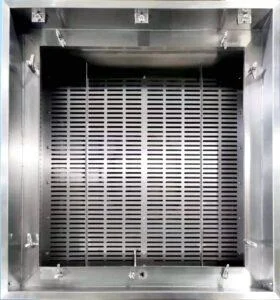
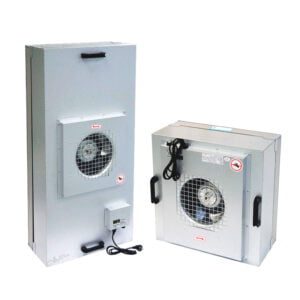
For equipment like a unit filter kipas integrated into cleanroom airflow management, this means the supplier’s installation and performance qualification data enters the manufacturer’s quality system, where it supports — but does not replace — the site-level process validation and ongoing environmental monitoring program. Inspection readiness on aseptic processing compliance belongs to the manufacturer from that point forward.
A more detailed documentation and validation checklist for this handoff stage is available in the GMP-Compliant Cleanroom Equipment Documentation and Validation Checklist for pharmaceutical facilities.
The central judgment that protects a regulated manufacturer in this process is maintaining a clear, documented distinction between what a supplier has characterized and what the manufacturer has qualified under operating conditions. Strong supplier documentation — traceable material data, cleanability design records, performance test results — is genuinely useful, but its value is in clarifying the scope of remaining qualification work, not in shortening or replacing it. Teams that conflate the two evidence sets tend to discover the gap during commissioning or audit preparation, where the cost of rebuilding traceability is high and the absence of a documented rationale for equipment selection is difficult to defend.
Before a specification handoff, the concrete questions to resolve are: what can this supplier provide in writing, does that documentation map to the evidence columns in your quality file, and what validation and monitoring obligations remain with your facility regardless of what the supplier delivers? Answering those three questions before procurement closes is what separates a defensible equipment selection from one that creates downstream exposure.
Pertanyaan yang Sering Diajukan
Q: What happens if a supplier refuses to revise approval language in their documentation before the specification handoff?
A: The regulated manufacturer should not allow unsupported approval or certification language to enter the quality file regardless of supplier pushback. If the supplier cannot produce traceable evidence — a specific regulatory body, a defined process scope, documented conditions — behind the claim, the language is unsupported and the manufacturer assumes the defensibility risk the moment it enters their records. The practical resolution is to require a revised document that describes what the equipment is designed to support rather than what it is approved for. If the supplier declines, that response itself is a supplier qualification signal worth documenting before the procurement decision is finalized.
Q: After the supplier’s documentation is accepted and the equipment is installed, what is the first manufacturer-owned qualification step?
A: The first obligation is processing the supplier’s installation and performance qualification records through the site’s own change control and quality system — formally incorporating them as starting-point evidence, not final proof of compliance. From there, the manufacturer must execute site-level operational qualification under actual process conditions, since supplier-provided performance data reflects equipment behavior in isolation, not within the specific aseptic process and environment where it will operate. Environmental monitoring baseline data collection typically runs in parallel to establish that the installed equipment performs within the facility’s defined acceptable ranges before process validation begins.
Q: Does the ISO 5 classification requirement apply to every piece of equipment inside a cleanroom, or only to the critical zone?
A: ISO 5 applies to the critical zone where sterile product, containers, and closures are exposed — it is not a blanket requirement for every piece of equipment within the same facility. Equipment positioned outside the critical zone but within the same controlled environment may be specified to a less stringent classification depending on its function and proximity to exposed product. Applying ISO 5 as a universal specification threshold across all equipment in a facility typically produces over-engineered procurement criteria that complicate supplier evaluation without improving contamination control where it actually matters.
Q: How does a regulated manufacturer handle a supplier change notice for equipment that is already installed and validated?
A: A supplier change notice for installed equipment must be routed through the manufacturer’s formal change control system — it cannot be received and filed without a documented review and disposition decision. The manufacturer must assess whether the design change affects any validated parameter: surface finish, airflow performance, material compatibility, sealing characteristics, or any other attribute that was part of the original qualification scope. If the change touches a validated parameter, requalification to the affected extent is required before the updated equipment is returned to production use. Receiving the notice without this formal review creates a design control gap that appears during inspection as a failure of manufacturer oversight, regardless of whether the supplier’s change was itself well-justified.
Q: At what point does strong supplier documentation stop reducing procurement risk and become a liability?
A: Supplier documentation creates risk when its quality leads a regulated manufacturer to treat it as a substitute for site-level qualification rather than a foundation for it. The boundary condition is straightforward: no volume of supplier-provided test results, material certificates, or performance records satisfies the manufacturer’s independent obligation to validate equipment performance within their specific aseptic process under their specific operating conditions. Teams that use unusually thorough supplier documentation to compress or justify skipping qualification steps tend to surface the gap during FDA inspection, where the absence of manufacturer-generated validation evidence cannot be remedied by re-presenting the supplier’s records.