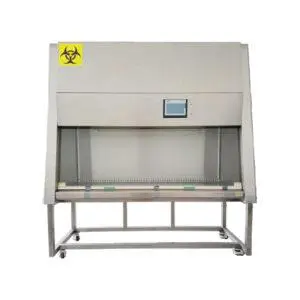
Facilities that select a cart based on HEPA filter grade and airflow class, then leave transfer discipline completely undefined, tend to discover the problem during an internal audit rather than during commissioning. The protected zone that looked adequate on a specification sheet collapses the first time an operator parks an open rack at an elevator queue for six minutes. The cost is not just a contaminated sample batch — it is the credibility of a transfer method that cannot be defended as controlled. What resolves the issue is treating route definition, stop-point rules, and opening discipline as equal selection criteria alongside hardware specifications, before the cart is purchased and before operators are trained on a procedure that does not yet exist.
Sample-transfer questions to settle before cart selection
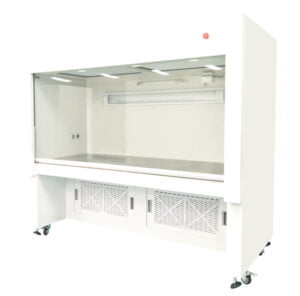
The first question is not which cart to buy — it is whether the cart you are considering matches the physical reality of what is being moved. A working area that is too small for the sample containers forces operators to stack or arrange loads outside the protected zone, which defeats the enclosure before the route begins. Available working-area configurations vary enough that this is a matchable problem, but only if container dimensions and sample volume are confirmed before specifying the unit.
The second question concerns airflow direction relative to sample sensitivity. Vertical unidirectional airflow is the more common configuration for enclosed transfer carts, but horizontal flow may be appropriate for specific sample geometries or handling orientations. Both configurations are designed to achieve ISO Class 5 cleanliness in the working area, and ISO 14644-7:2004 provides the testing and classification framework against which that cleanliness target is verified. Choosing the wrong flow direction does not always produce an immediately visible failure — it produces a protection gap that becomes apparent only when particle counts are taken or when a sample result is anomalous and the transfer chain has to be reconstructed.
Air velocity is the third variable to confirm. A design figure of 0.45 m/s ±20% with three-speed adjustment gives operators some range, but operating outside that band — either too slow to flush particles or too fast to maintain stable laminar flow — may undermine the ISO Class 5 condition regardless of filter efficiency. This is not a regulatory minimum stated by a standards body; it is a design threshold derived from how the airflow system is engineered to function.
Each of these three questions has a downstream consequence if left unresolved at the selection stage. Mismatched size is a procurement problem that becomes a handling problem in practice. Mismatched airflow type is a design decision that is expensive to reverse once the unit is delivered. Incorrect velocity is an operational problem that requires procedure controls to catch.
| Planning Question | Key Details & Options | Mengapa Ini Penting |
|---|---|---|
| Match cart working area to sample volume and container dimensions | Available sizes: 720×580×750 mm, 920×580×750 mm, 1120×680×750 mm | Ensures cart can accommodate sample format without overcrowding or instability |
| Choose vertical or horizontal unidirectional airflow based on sample sensitivity | Working area must achieve ISO Class 5 (Class 100) cleanliness | Wrong airflow direction can compromise sample protection during transfer |
| Set average air velocity | 0.45 m/s ±20% using three‑speed adjustment | Velocity outside this range may fail to maintain ISO 5 cleanliness |
Container closure and stop-point rules during internal movement
Once the cart is in motion, the mechanism that maintains protection is positive pressure inside the enclosure relative to the ambient corridor environment. When the cart is stationary — at a door, a pass-through, or while waiting for an elevator — that pressure differential is what prevents external particles from migrating inward. This is not a passive state; it depends on the airflow system running continuously and the enclosure remaining closed. If power is interrupted, if a door or panel is opened, or if the fan speed drops below the operating range, the pressure advantage is lost and the protected zone is no longer functionally different from an open rack.
The practical rule that follows from this is that containers should remain closed and undisturbed during transit, and the enclosure should not be opened to inspect, adjust, or reposition samples while the cart is moving or stationary in an uncontrolled corridor. The tempered glass door and side windows on enclosed cart designs exist specifically to support visual inspection without breaking closure. This is not an arbitrary design preference — it is the correct operating practice derived from how the enclosure maintains its protection function. An operator who opens the door to check a label at a corridor stop has effectively removed the cart from service for that moment, regardless of what the filter efficiency specification says.
Stop-point discipline is the downstream gap that most transfer procedures fail to define in writing. Operators are typically trained on how to use the cart but not on where the cart may stop, how long it may remain stationary, or under what conditions it may be opened. Without fixed rules for those three questions, every operator makes an individual judgment, and those judgments will not be consistent across shifts or personnel.
Corridor waits that erase the benefit of protected transfer
Corridor holds create a specific risk pattern that is different from transit risk. During movement, the cart is in a transitional state and the protection logic is understood. During a hold — at a locked door, an occupied elevator, a staging area — the cart becomes a static object in an ambient environment, and that is where informal behavior is most likely to substitute for procedure.
The most common failure pattern is not a dramatic breach. It is an operator who cracks the enclosure door slightly to recheck a sample identifier, a cart left at an elevator landing with an unlatch that was not noticed, or an open rack parked adjacent to the enclosed cart while both wait together. None of these look like contamination events in real time. They look like contamination events later, when the sample result does not match expectations and the transfer log offers no record of where the enclosure state was compromised.
Route segments that consistently involve uncontrolled waiting are a qualitative signal that the cart may not be the right transfer method for that specific leg. A cart that is well-matched to a direct, controlled route becomes a liability on a route that includes public traffic, shared corridors, or hold points where the operator has no fixed procedure. The decision to use a different transfer method for those segments — sealed rigid transport containers, dedicated pass-throughs, or rescheduled transfers during low-traffic periods — is a routing decision, not an equipment upgrade.
Sealed-sample carts versus interim-handling work surfaces
These two cart types are often discussed as if they differ only in size, but they differ in the operational burden they place on the facility. A compact sealed-sample cart is designed for movement: samples go in sealed, travel under HEPA-filtered positive-pressure protection, and come out sealed at the destination. The enclosure is the protection mechanism, and as long as closure discipline holds, route control requirements are relatively straightforward.
A larger work-surface cart that supports interim handling — raw material sampling, repackaging, or staging of semi-finished product — carries a different risk profile. Handling operations require the enclosure to be open or partially open while work is performed, which means the cart’s protection depends not just on filter efficiency but on the ambient conditions at the point where the cart is parked when that handling occurs. That is a much stronger requirement than sealed-sample movement, and most facilities do not audit the parking discipline that work-surface handling requires until an external audit forces the question.
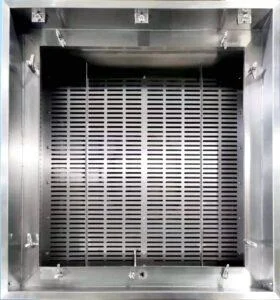
The HEPA filter efficiency used in transfer cart designs — 99.995% at H14 grade with gel-sealed knife-edge installation — is a design specification that supports ISO Class 5 cleanliness in the working area. It is the filtration baseline. But filter efficiency alone does not deliver cleanliness if the cart is open during handling in an uncontrolled location. Procurement teams that select work-surface carts for operational convenience without establishing rigorous parking and handling protocols are effectively accepting a higher contamination risk while paying for higher-specification hardware.
| Aspek | Sealed‑Sample Cart | Work‑Surface Cart |
|---|---|---|
| Penggunaan Utama | Movement of sealed samples only | Movement and interim handling/staging (raw material sampling, semi‑finished product transfer) |
| Sample Handling During Transfer | Limited to movement; no opening or manipulation | Supports interim handling and staging |
| Route Control Required | Standard protection relies on cart enclosure | Requires more rigorous route control to maintain cleanliness during handling |
The trade-off is not resolved by choosing one type over the other in the abstract. It is resolved by defining the intended use case first, then matching the cart type to that use case, then confirming that the route and operating protocols can support the cart type selected.
Parking and opening discipline that operators often miss
The gap between a cart that is technically capable and a cart that is operationally effective usually appears at the moment the cart stops and an operator needs to do something with it. Four verification behaviors consistently separate facilities that maintain transfer integrity from those that discover failures after the fact.
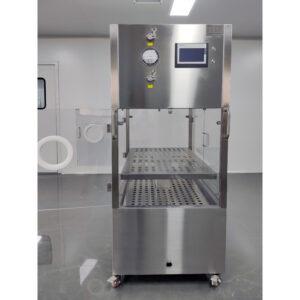
Castor brakes are the most frequently skipped. On a 360° pivoting castor system, the brakes exist to fix the cart’s position during loading and unloading. An unlocked cart that shifts slightly when a sample tray is removed is not just a spill risk — it is a handling disruption that may cause an operator to reach across or reposition inside the enclosure in a way that was not part of the planned procedure.
The differential pressure alarm and fan failure alarm on the control panel are active during cart operation, but operators who are focused on the transfer task tend to treat those panels as background. A DP alarm during an idle period is not background — it is a signal that the airflow system is not maintaining the condition under which the transfer was authorized to proceed. Ignoring it leaves samples in a cart that looks protected but is not performing as specified.
Pressure gauge readings at the HEPA filter — upper and lower wind ends — give a direct indication of filter loading and installation integrity before and after a parking stop. Abnormal readings at this point indicate either filter degradation or a blockage condition that the alarm system may not yet have flagged. For facilities operating under GMP requirements, PAO test ports provide the means to verify HEPA filter installation integrity as a periodic check, not only at commissioning. Untested filter installations may have bypass leaks that are invisible during normal operation but become meaningful during extended idle periods when airflow patterns shift.
| Discipline Check | Apa yang harus diverifikasi | Mengapa Ini Penting |
|---|---|---|
| Engage 360° pivoting castor brakes | Before loading/unloading, lock brakes to fix cart position | Prevents cart movement that could cause sample spill or contamination breach |
| Monitor DP alarm and fan failure alarm | Check control panel for alarms during idle periods | Alarms indicate loss of protective airflow; ignoring them leaves samples exposed |
| Check pointer differential pressure gauge | Verify real‑time pressure at upper and lower wind ends of HEPA filter before and after parking | Abnormal DP indicates filter degradation or blockage that compromises cleanliness |
| Use PAO test ports for HEPA filter integrity | Test filter installation integrity per GMP requirements | Untested filters may have leaks that bypass filtration during long stops |
The failure consequence of skipping any of these checks is the same: a cart that appears to be operating normally but is not maintaining the protection condition the transfer procedure depends on.
Uncontrolled routes that require another transfer method
Battery-powered mobile LAF carts carry a design runtime specification — typically in the range of two to four hours — that sounds sufficient when evaluated against an expected transfer duration. The constraint surfaces when the route includes uncontrolled holds, because battery consumption during stationary idle periods at full airflow is roughly comparable to consumption during transit, and the operator cannot always predict how long a corridor wait will last.
When airflow stops because the battery depletes mid-transfer, no recovery is possible at that point. The filter efficiency does not preserve the clean state inside the enclosure once positive pressure is lost. This is not a scenario that improved operator training can prevent on a route that is structurally unpredictable — it is a route design problem. If a transfer leg consistently includes public-traffic zones, shared elevator banks with variable wait times, or repeated manual repacking steps that extend the total handling time, the cart’s operational window may not reliably cover the full transfer, and a different method should be selected for that leg.
For routes that can be controlled — defined stops, known transit times, low ambient traffic, no handling mid-route — the battery constraint is a manageable operational parameter. For routes that cannot be controlled, the battery runtime is not a solvable problem through SOP revision. The practical threshold is this: if the route conditions cannot be defined in advance with enough certainty that the battery runtime can be confirmed as sufficient, the cart is not the right transfer method for that route. A troli aliran udara laminar bergerak can deliver reliable ISO Class 5 protection on a controlled route, but it cannot compensate for a route that was never designed to support protected transfer. That distinction should be made before the cart is purchased, not after the first failed transfer.
For context on how portable LAF units compare across different facility configurations and transfer use cases, the review of portable LAF units and mobile clean bench solutions provides additional grounding on where mobile protection is operationally viable and where fixed alternatives are stronger.
The most useful pre-procurement step is not comparing filter specifications between models — it is writing down the specific route, the stop-point conditions, and whether the cart will be used strictly for sealed-sample movement or also for interim handling. Those three definitions will determine whether a compact sealed-sample cart is appropriate, whether a work-surface design can be supported with adequate route control, and whether any cart-based approach is the right method for the transfer at all.
Before committing to a specification, confirm that the facility can establish and enforce fixed rules for where the cart stops, how long it may remain stationary, under what conditions the enclosure may be opened, and who is responsible for verifying airflow status before and after each stop. If those rules cannot be written, the gap is not a training gap — it is a route design gap, and addressing it at the equipment-selection stage is substantially less expensive than addressing it during an audit or after a sample integrity event.
Pertanyaan yang Sering Diajukan
Q: Can a mobile LAF cart be used for both sealed-sample movement and interim handling on the same route?
A: It can, but doing so forces a single unit to meet two different operational standards simultaneously, which typically weakens both. A compact sealed-sample cart is engineered around maintaining closure throughout the route; once you open it for interim handling, the protection depends entirely on the ambient conditions at that parking location, which may not be controlled. If both functions are required, the more defensible approach is to define them as separate transfer legs with separate equipment or at minimum separate written protocols, rather than treating one cart as adequate for both without addressing the stricter route-control burden that interim handling imposes.
Q: What should be done immediately after the cart completes a transfer and before it is returned to service?
A: Verify differential pressure gauge readings at the upper and lower wind ends of the HEPA filter before the cart is cleared for its next use. A parking stop — particularly an extended one — can mask filter loading or a blockage condition that the alarm system has not yet flagged. If readings are abnormal, the cart should be taken out of service for inspection rather than cycled back onto the route. This check is a specific post-transfer action the operating procedure should require in writing, separate from the pre-transfer checks.
Q: At what point does adding more operator training stop being the right solution for repeated transfer failures?
A: When the failure pattern is tied to route conditions rather than operator behavior, additional training does not resolve the underlying problem. If samples are consistently compromised at the same corridor hold point, the same elevator bank, or during the same extended wait, the route itself is the variable that needs to change — not the instructions given to operators. Training is effective when operators have fixed rules to follow and the environment can support those rules. When the route is structurally unpredictable, the correct intervention is rerouting, rescheduling, or selecting a different transfer method for that leg.
Q: How does a work-surface LAF cart compare to a fixed laminar flow hood for interim handling tasks that occur mid-route?
A: A fixed laminar flow hood provides a stable, continuously powered, environmentally sited clean workspace that does not depend on battery runtime, route control, or parking discipline to maintain its protection condition. A work-surface cart offers mobility but shifts the burden of maintaining ISO Class 5 cleanliness to wherever the cart happens to be parked when handling occurs. If the interim handling step happens at a fixed, controllable location — a designated staging room or pass-through — a fixed hood is likely to be more defensible and operationally simpler. The mobile option adds value only when the handling location genuinely varies and the facility can enforce the parking and ambient-condition controls that work-surface use requires.
Q: Is a mobile LAF cart a viable option if the facility’s transfer routes have not yet been formally mapped or audited?
A: No — purchasing the cart before the route is defined inverts the selection logic and almost guarantees a gap between what the equipment can do and how it will actually be used. The cart’s suitability depends on whether stop points can be defined, whether battery runtime can be confirmed against the actual transfer duration including holds, and whether opening discipline can be enforced at every point on the route. None of those questions can be answered without a mapped route. Procuring first and defining the route afterward typically results in discovering mid-audit that the cart is being used on conditions it was never evaluated against.