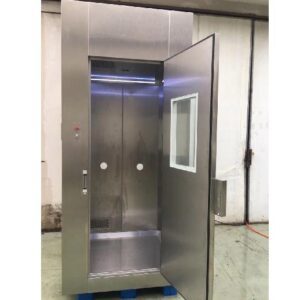
Most teams that commission a cleanroom transfer unit discover the real specification gaps after the equipment arrives — when a door threshold forces an abrupt stop that shifts the load, or when a mid-route battery failure leaves an open product exposed in a corridor. These are not edge cases; they are the predictable result of approving equipment for its operational concept without mapping the actual transfer route first. The difference between a clean commissioning and a costly retrofit usually comes down to four decisions that belong in the pre-RFQ stage: route conditions, load configuration, power duration, and parking infrastructure. What follows gives you a structured basis for making those calls before they become change orders.
Transfer workflow questions to settle before choosing a mobile trolley
The questions that derail mobile trolley procurement rarely involve contamination control theory. They involve the gap between how a transfer was described in the project brief and what the actual route requires. Before the specification is written, four inputs need firm answers.
The first is route type. If the transfer path passes through corridors or airlocks that fall outside the primary cleanroom classification, the trolley must maintain its own ISO 5 zone continuously during movement — it cannot rely on the ambient environment for interim protection. A buyer who assumes the ambient classification covers the transfer gap and selects a lighter unit may find the unit cannot sustain protection through uncontrolled zones.
The second input is airflow orientation relative to load geometry. Vertical laminar flow works well for large or bulk equipment transfers because it sweeps downward across the load surface without the airstream meeting a broad vertical face that would deflect it. Horizontal flow suits smaller items such as vials, where the load profile is low enough that a side-sweeping stream maintains coverage without obstruction. Specifying the wrong orientation for the load type does not produce a minor inefficiency — it produces a systematic gap in first-pass protection that will not be visible until particle counts are taken.
The third input is battery runtime, which is a hard route constraint rather than a comfort specification. Standard UPS configurations typically cover 30 minutes of operation; custom configurations extend that range to approximately 100 minutes or, in some cases, two to four hours. The consequence of underspecifying this is a route failure at the point where runtime runs out, not a gradual degradation — the unit stops protecting at a defined threshold, and any product still in transit at that point is exposed. Route length must be converted to estimated transit time and compared against the battery specification before the RFQ is released.
The fourth input is the pressure mode. Positive-pressure single-pass configurations are designed around aseptic product protection; negative-pressure recirculatory configurations are designed around operator protection from the handled material. These are not interchangeable, and the protective logic of each mode is incompatible with the other’s purpose. Confirming which protection direction is primary determines the airflow architecture and, by extension, the unit class.
| Transfer consideration | Mengapa ini penting | Apa yang harus dikonfirmasi |
|---|---|---|
| Route passes through non-cleanroom areas | Mobile trolley must maintain ISO 5 protection during such moves to prevent contamination. | Confirm unit maintains ISO 5 when moving through uncontrolled zones. |
| Airflow pattern (vertical vs horizontal) | Load dimensions affect laminar flow; vertical suits large equipment, horizontal suits small vials. | Match airflow orientation to load size: vertical for large transfers to avoid blockage, horizontal for small items. |
| Required battery runtime | Route length is capped by battery duration; insufficient runtime disrupts workflow. | Confirm standard UPS offers 30 min; evaluate if custom 100 min to 2–4 hours is needed. |
| Protective mode (positive vs negative pressure) | Product may need aseptic single-pass positive pressure, or operator protection via negative recirculatory. | Determine whether product protection or operator protection is primary, and specify airflow mode accordingly. |
Skipping any of these four questions does not delay the problem — it relocates it to commissioning, where correcting the specification costs significantly more than getting it right at the planning stage.
Load size, route length, and open-product exposure during movement
A reasonable concern when specifying a transfer unit is whether the product needs to be sealed or closed during movement, and the answer depends on the condition the unit maintains, not on a blanket operational rule. When continuous laminar airflow with overpressure is maintained throughout the route, the product can remain open during transport — the airflow creates an active protective envelope that persists as long as the system is running. What breaks that condition is not movement itself; it is a lapse in airflow continuity or a breach of the unit’s door.
The operational implication of this is specific: the door must remain closed during movement to preserve the overpressure that keeps ambient air from infiltrating the protected zone. An open door during transit undermines the very mechanism that justifies leaving the product uncovered. This is an implementation requirement, not a regulatory citation — it is the condition under which the claimed protection holds.
Route length matters beyond battery runtime. A longer route means more accumulated vibration, more threshold crossings, and a greater cumulative exposure to disturbance events. For short transfers through a controlled corridor, these factors may be negligible. For longer routes that cross multiple zones or involve elevation changes, each disturbance accumulates. Teams that evaluate route length only against battery duration often miss the mechanical stress component entirely — a route can be within battery range but still be inappropriate for open-product transfer if it involves repeated jolt events that shift the load relative to the airflow coverage zone.
The practical check is to map the route physically before finalizing the specification, not after. Walk the path with the load dimensions in mind, identify every threshold and turn, note corridor widths against trolley footprint, and flag any point where the trolley would need to stop and restart. That walk-through frequently reveals route conditions that modify the specification in ways no data sheet review would surface.
Thresholds and sudden stops that disturb protected handling
Door thresholds are the most consistently underestimated physical obstacle in cleanroom transfer planning. A threshold that is unremarkable to a person walking through it can produce enough of an abrupt deceleration — when encountered by a loaded trolley — to shift the load relative to the airflow coverage zone, create a momentary gap in the laminar stream, or disturb sensitive materials that were stable during smooth transit. The risk is not dramatic; it is subtle enough to be missed in a visual inspection and only detected in particle count data or, worse, in downstream product quality results.
An optional hydraulic ramp accessory addresses this failure mode directly. Rather than absorbing the impact of a threshold crossing, the ramp creates a gradual incline that allows the trolley to pass over the obstruction without the deceleration spike. This is a site-specific procurement decision — not every installation will need it — but the correct time to evaluate it is during route mapping, not after the first transfer attempt reveals a problem. If the mapped route includes raised thresholds, the accessory should appear on the specification before the RFQ is released.
Locking castors address a different but related failure mode. When a trolley stops — whether at a staging point, a doorway, or a handover position — load momentum does not immediately stop with it. A trolley that can continue rolling after the operator releases it can shift position in a way that disrupts the laminar flow coverage or compromises the alignment between the unit’s protected zone and the handling position. Castors with a locking function hold position when engaged, converting a stop into a stable dwell rather than an uncertain drift. This is a specification point to confirm at the component level, not an assumption that can be deferred to the supplier.
The cumulative pattern here is that physical route disturbances — thresholds, turns, stops — are individually manageable but collectively significant if none of them are addressed at specification. A unit that handles smooth-corridor transit cleanly may fail in a real facility environment where the path includes two threshold crossings, a 90-degree turn into an airlock, and a hold position near a door that the operator cannot lock open.
Mobile flexibility versus fixed-unit stability in qualification
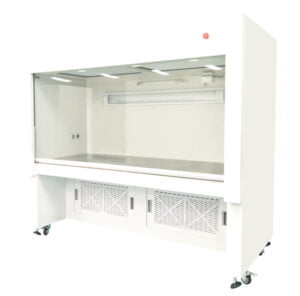
The appeal of a mobile unit is genuine: it provides a self-contained ISO 5 zone without requiring permanent facility infrastructure, it can serve multiple locations within a cleanroom or between adjacent areas, and it offers an operational option for institutions that cannot justify the cost of upgrading fixed cleanroom infrastructure to cGMP standards. For shared-room use, temporary sterile handling needs, or multi-point transfer workflows, that flexibility has direct operational value.
The qualification burden, however, moves with the unit. Under frameworks like ISO 14644-7:2004 for separative devices, a mobile unit must be qualified in the range of conditions under which it will actually operate — which, by definition, includes movement, route variation, and docking configurations that a fixed unit never encounters. A fixed unit is qualified in place, under stable utility connections, in a single mechanical configuration. The mobile unit must demonstrate performance across its operational envelope, and that envelope is harder to bound. This does not make mobile qualification impossible, but it adds a layer of documentation and test-condition management that projects sometimes underestimate when the flexibility argument is made at the procurement stage.
The rigidity comparison reinforces this distinction. A fixed laminar flow unit, anchored to a surface and connected to permanent utilities, has no mechanical variability between uses. A mobile unit operates on castors, relies on battery power, and is handled by operators who may park, reposition, or maneuver it differently on different days. That variability is the price of flexibility, and it means the mobile unit must be more robustly specified — not less — to maintain consistent performance across its full range of use.
For workflows that will ultimately settle at one validated station with permanent utility access, a fixed unit is likely the more defensible long-term choice. The mobile unit introduces qualification complexity without adding operational value if the unit never moves. The decision point is honest: if the route is fixed and the station is permanent, the case for mobility is a sunk cost, not a specification rationale.
A closer comparison of mobile and fixed configurations across different workflow scenarios is covered in Unit Aliran Udara Laminar Portabel vs Tetap.
Power, caster, and parking details that delay procurement
Projects stall at the RFQ stage when procurement treats battery runtime, caster type, and parking location as secondary details rather than primary enablers. Each of these items is a dependency: if any one of them is unresolved at the time of release, the unit may arrive on-site configured in a way that the physical environment cannot support.
The battery runtime question is the one most frequently discovered late. Standard UPS configurations provide approximately 30 minutes of runtime — a figure that is often sufficient for short intra-room transfers but inadequate for longer routes, multi-stop workflows, or transfers that include staging time at intermediate points. The custom upgrade to 100 minutes or two to four hours is available, but it requires specification at the order stage. A team that releases an RFQ without confirming total estimated transfer time against the standard battery ceiling may receive a compliant unit that is operationally insufficient for the route it was procured to cover.
The interconnection between battery management and parking location compounds this. A trolley that is parked without access to a power outlet cannot recharge between uses. If the designated parking area was chosen for physical convenience — an empty corner near the transfer staging point — rather than for outlet proximity, the unit arrives at the next transfer with a partially or fully depleted battery. This converts an operational asset into a liability that the team may not notice until a transfer is already underway.
| Procurement detail | Risk if unclear | Apa yang harus dikonfirmasi |
|---|---|---|
| UPS battery runtime specification | Standard 30-minute runtime may be insufficient for long transfers, causing route failure and RFQ delays. | Required transfer time; if >30 min, request custom UPS (up to 100 min or 2–4 h). |
| Battery charging and recharging process | Battery must be fully charged before use; failure to recharge after use leads to unreadiness. | Confirm workflow includes charging after each use and that main power is accessible. |
| Parking location and power outlet access | Trolley must stay permanently connected to power when not in use; unplanned parking without power outlet leads to discharged battery. | Verify parking location has a dedicated power outlet and the trolley can be connected. |
| Caster swivel and locking function | Wrong caster type compromises maneuverability and secure parking, risking load shift during stops. | Specify 360° swivel castors with locking function for safe positioning and stopping. |
Caster specification deserves the same pre-RFQ attention as battery runtime. A 360-degree swivel caster allows the trolley to be repositioned and aligned precisely at docking points; a fixed-direction caster forces wider turns and risks load disturbance on tight maneuvering. The locking function matters independently of swivel capability — a caster that swivels freely but cannot be locked leaves the trolley unstable at any stop. Confirming both attributes on the same caster avoids a common split where the procurement record specifies swivel but omits locking, and the delivered unit meets the stated spec while failing the unstated one.
For a closer look at the troli aliran udara laminar bergerak configuration, including standard and custom UPS options, the product page consolidates the specification variables discussed here.
Single-station use cases that favor a fixed LAF unit
The mobile trolley argument depends on mobility being operationally necessary. When it is not — when the workflow involves one operator at one position performing the same task repeatedly in the same location — the mobile form factor introduces complexity without contributing value.
A fixed laminar flow unit at a permanent station offers simpler qualification because its operating conditions are stable and repeatable. The unit sits in one position, draws from fixed utilities, and is used in a mechanically consistent configuration on every cycle. Qualification data from one test period can be reasonably expected to remain valid across subsequent use periods, assuming maintenance intervals are met. That stability is difficult to replicate with a mobile unit, where even minor repositioning between uses can shift the unit’s relationship to adjacent surfaces, air returns, or operator positioning in ways that need to be evaluated each time.
The cost of qualification effort matters at the programme level. A mobile unit that requires broader test-condition mapping on initial qualification and requalification after each significant use-case change represents an ongoing qualification overhead that a fixed unit does not. For institutions with limited qualification resources — which includes most mid-sized pharmaceutical and biotech operations — that overhead is a real constraint, not a theoretical one.
Institutions that cannot upgrade their cleanroom environment to cGMP standards sometimes consider mobile trolleys as a lower-cost pathway to compliant material transfer. That is a legitimate practical option for temporary or transitional needs, and it avoids the capital cost of full facility renovation. But it should be evaluated honestly: if the need is permanent and the volume is consistent, a fixed unit with a one-time facility investment will typically offer a more defensible qualification history and lower cumulative operational friction than a mobile unit managed as a long-term workaround.
The practical threshold is whether the workflow is genuinely multi-location or multi-purpose. If the honest answer is that the trolley will live at one bench and rarely move, the flexibility argument does not survive scrutiny, and the fixed unit is the more appropriate specification from the outset.
The strongest decisions in mobile laminar flow trolley procurement are made before the RFQ, not during vendor evaluation. The four pre-specification checks — route type and classification, airflow orientation against load geometry, battery runtime against route duration, and pressure mode against protection purpose — are not optional refinements. Errors at that stage propagate directly into the delivered unit’s fitness for purpose, and correcting them after delivery involves either retrofit costs or workflow compromise.
Before releasing a specification, confirm that the parking location has outlet access, that the caster configuration matches both the corridor layout and the stop stability requirement, and that the battery runtime was calculated against actual transfer time including any staging dwell, not just linear transit distance. If the workflow will ultimately run at a single validated station without mobility requirements, evaluate a tudung aliran laminar or fixed LAF unit as the primary option and treat the mobile form factor as a justified departure from that default rather than the starting assumption.
Pertanyaan yang Sering Diajukan
Q: What happens to qualification status if the trolley is repositioned or used on a different route after initial qualification?
A: Qualification must be re-evaluated whenever the operating conditions change materially. Unlike a fixed unit — where position, utility connections, and mechanical configuration remain constant — a mobile trolley’s qualification is tied to its operational envelope, which includes specific routes, stop points, and docking configurations. Under ISO 14644-7:2004, a separative device must demonstrate performance across the conditions under which it actually operates. A route change, a new parking position, or a modified transfer sequence can shift the unit’s relationship to adjacent surfaces and airflow returns in ways that the original qualification data does not cover. Before committing to a mobile unit for a validated workflow, map the full scope of expected use variation and confirm with your qualification team how that scope will be bounded and documented.
Q: If the standard 30-minute battery is borderline for the planned route, is it better to upgrade the UPS or redesign the route?
A: Redesigning the route is usually the better first step, but only if the redesign does not introduce new mechanical disturbances. A shorter route with fewer threshold crossings and stops is preferable to a longer route supported by a larger battery, because battery capacity solves the runtime constraint while leaving every other route-dependent risk — vibration, threshold impacts, load shift — unchanged or worse. If the route cannot be shortened without creating new corridor or classification problems, then the custom UPS upgrade to 100 minutes or two to four hours is the correct specification decision. The key mistake to avoid is treating the battery upgrade as a general-purpose fix for a route that has not been physically mapped and optimized first.
Q: Can a mobile laminar air flow trolley be shared between two separate cleanroom suites with different ISO classifications?
A: Sharing a trolley between suites of different classifications is operationally possible but introduces contamination and qualification risks that must be managed explicitly. Each time the unit moves from a lower-classification to a higher-classification environment, it carries surface contamination from the lower-class zone into a more controlled area. The trolley’s own ISO 5 zone protects the product inside, but the external surfaces of the unit — including castors, frame, and panels — are subject to the ambient conditions it has traversed. This means decontamination protocols between suite transfers become a required procedural control, not an optional precaution. Qualification documentation must also address cross-suite use as a distinct operating scenario. If the workflow requires regular movement between classified suites at different levels, confirm that the decontamination steps and their impact on transfer cycle time are accounted for before the specification is written.
Q: Is a mobile trolley a practical option for a facility that currently has no cleanroom infrastructure at all?
A: It provides partial protection but not a complete cleanroom substitute. A mobile laminar air flow trolley creates a self-contained ISO 5 zone for the product it carries, which allows compliant point-of-use handling and transfer without upgrading the surrounding room to a controlled classification. However, the trolley itself must be maintained, charged, and operated in conditions that do not compromise its external surfaces or caster-borne contamination load. Facilities with no cleanroom infrastructure at all will also lack the gowning protocols, HVAC controls, and particle monitoring that support a defensible contamination control strategy around the unit. The trolley addresses the transfer and handling step; it does not replace the broader environmental controls that regulated processes require. For transitional or temporary needs it is a legitimate lower-cost pathway, but a permanent programme built entirely around mobile units without any fixed infrastructure is difficult to defend in an audit.
Q: At what point does accumulating multiple mobile trolleys to cover workflow volume make less sense than investing in a fixed installation?
A: The crossover point is typically reached when trolley count, qualification overhead, and battery management logistics begin to consume more operational resource than a fixed unit would require in ongoing maintenance and requalification. Each mobile unit added to a fleet carries its own qualification scope, its own battery charge cycle, and its own parking and power dependency. Two or three units covering the same general workflow area, with overlapping routes and shared staging points, will generate a qualification and maintenance burden that a single well-positioned fixed laminar flow unit with permanent utility access would not. The practical signal is when scheduling battery readiness, coordinating parking, or managing requalification after route changes starts requiring dedicated staff attention. At that threshold, the flexibility argument for mobile units is outweighed by the cumulative operational friction, and a fixed installation with a one-time facility investment becomes the more defensible long-term choice.