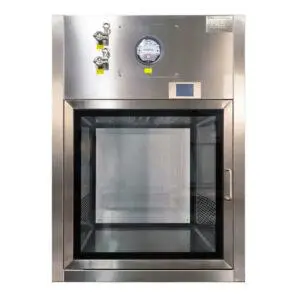
Selecting the wrong clean-air unit for a given operational zone rarely becomes visible during equipment procurement — it surfaces during qualification, when a validation team discovers that the installed housing geometry physically prevents the aerosol injection port from sitting far enough upstream to complete in-place leak testing. At that point, the ceiling plenum is already built, service routes are fixed, and reworking the layout carries both schedule and cost consequences that a correct early decision would have avoided. The more common version of this problem is less dramatic: a unit assigned to the wrong clean-air function — room dilution coverage where local product protection was needed, or terminal filtration where air change rate was the actual objective — produces a compliant-looking installation that fails to support the process it was specified for. What resolves these outcomes is fixing the clean-air objective, the protected zone, and the maintenance access geometry before any equipment model is selected. By the end of this article, you will be better positioned to distinguish between those three decisions and the equipment categories that serve them.
Clean-air function before equipment category selection
Equipment selection in pharmaceutical cleanrooms tends to move faster than the function analysis that should precede it. Ceiling layouts get drafted around module sizes, and HEPA housing models get specified before anyone has confirmed which clean-air objective that housing is actually meant to serve. The result is a layout that fits dimensionally but misaligns operationally — and that misalignment is often only discovered during qualification, when the test protocol exposes a gap between what the equipment can demonstrate and what the process requires.
The correct starting sequence treats cleanroom classification, required air change rate, and room pressure regime as planning inputs that constrain equipment selection — not as outputs that follow from it. ISO 14644-1:2015 provides the classification methodology that defines particle concentration limits by cleanroom class, but the class itself does not determine which equipment type meets it. A target of ISO Class 7 in one room may be achievable through general dilution airflow; the same class in a room with exposed open containers requires a different functional response. The equipment choice follows from that distinction, not from the class number alone.
Pressure differential requirements add a further constraint. A room that must maintain positive pressure relative to adjacent spaces has a fixed supply-to-exhaust relationship that affects where HEPA units can be positioned and how their airflow contributes to the pressure balance. Treating this as a detail to resolve after unit selection regularly creates coordination problems during commissioning. Fan filter units, laminar airflow units, and HEPA housings each interact with room pressure differently — an FFU recirculates room air through a ceiling-mounted filter while a LAF unit delivers unidirectional clean air from a dedicated supply. If pressure control is a constraint, that difference matters before a layout is approved.
FFU, LAF, and HEPA housing roles in pharma cleanrooms
The most persistent equipment-selection mistake is treating fan filter units, laminar airflow units, and HEPA housing boxes as interchangeable options within the same functional category. They are not. Each addresses a distinct clean-air objective, and assigning the wrong unit to the wrong task creates a compliance gap that is difficult to close after installation.
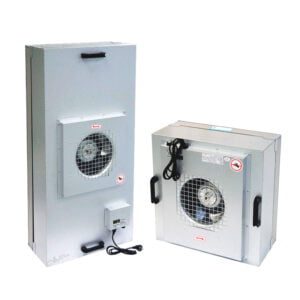
A unit filter kipas integrates a fan and HEPA filter in a single ceiling-mounted module. Its primary function is modular room air delivery — it draws room air through the filter and returns clean air to the space, contributing to the overall air change rate and cleanroom classification. FFUs are well-suited to reconfigurable layouts because individual units can be added, repositioned, or replaced without rebuilding the ceiling plenum. Their limitation is that they serve room-level dilution, not local product protection. Positioning FFUs above an open-fill operation and treating that as equivalent to unidirectional airflow coverage is a misassignment that may not be defensible during a Grade A qualification review.
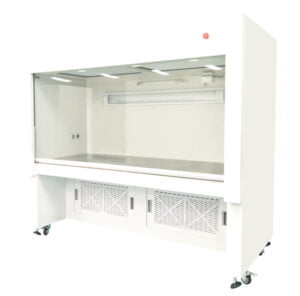
A unit aliran udara laminar delivers HEPA-filtered air in a directed, parallel-stream pattern — either vertically downward or horizontally across the work zone — to create a defined clean-air envelope around a specific operation. LAF units are the standard equipment response when the requirement is ISO Class 5 or EU GMP Grade A local protection over an exposed process. Individual units can be joined to extend the protected zone across a larger work area, which is relevant when filling lines or dispensing operations span multiple positions. The critical planning point is that a LAF unit protects a zone, not a room — its airflow pattern must align precisely with the work position, and any obstruction within the airflow path compromises the protection it provides.
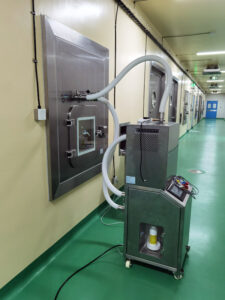
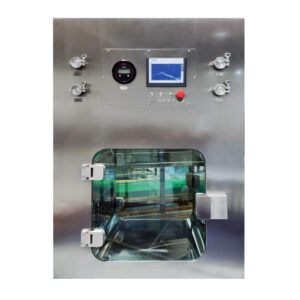
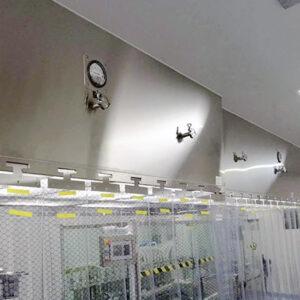
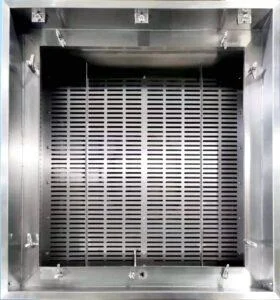
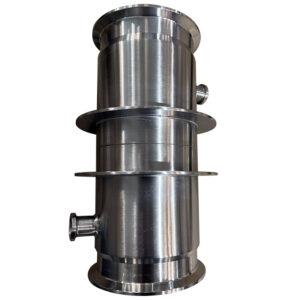
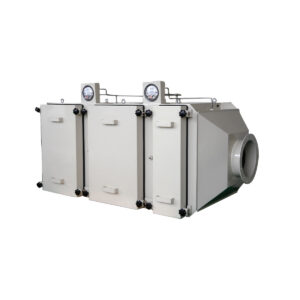
HEPA housing boxes serve a different function again. They are terminal filtration components positioned at the point where supply air enters the cleanroom space, filtering the air delivered by the HVAC system before it reaches the room. Their role is ensuring that duct-side particulate contamination — including anything introduced during duct fabrication, transport, or installation — does not reach the controlled environment. The H13-grade HEPA filter specified under EN 1822 removes 99.97% of 0.3 µm particles at rated face velocity, but that figure should be treated as a design reference rather than a universal regulatory floor; actual filtration performance varies with face velocity, filter loading, and housing seal integrity. HEPA housings carry a qualification burden that FFUs and LAF units do not carry in the same form: in-place leak testing requires physical access geometry that must be designed in, not accommodated after the fact.
Room dilution versus local protection versus terminal filtration
Three distinct mechanisms govern how clean-air equipment addresses contamination risk, and the choice between them depends on where in the process contamination exposure actually occurs — not on which unit fits most conveniently into the ceiling module.
Room dilution operates through turbulent airflow that mixes clean supply air with room air to progressively reduce airborne particle concentration. It is the appropriate mechanism when the risk is background contamination in a space where product is enclosed, personnel movement is the primary particle source, and the requirement is achieving a room-level classification. Air change rate is the primary control variable, and equipment selection focuses on delivering sufficient filtered supply volume to maintain the target particle count under operational conditions. FFUs and HEPA housing-supplied diffusers both serve this function; the distinction between them is one of layout flexibility and maintenance access rather than clean-air mechanism.
Local product protection requires a fundamentally different approach. When product is exposed — during open filling, sampling, dispensing, or component preparation — dilution airflow provides insufficient certainty of protection because turbulent mixing cannot guarantee a consistently clean-air envelope over the specific exposure point. Unidirectional laminar airflow addresses this by moving air in parallel streams across the work zone, sweeping particulate and microbial contamination away from the product rather than diluting it. This is why Grade A conditions in EU GMP Annex 1 are defined by both the particle concentration target and the airflow characteristic — the unidirectional pattern is the mechanism of protection, not merely the means of achieving a particle count. A room that meets ISO Class 5 through turbulent dilution does not provide the same functional protection as a LAF unit delivering unidirectional airflow over an exposed operation, even if the measured particle count at a single point is equivalent.
Terminal filtration does not independently determine the clean-air function of a room; it ensures that the air delivered by the HVAC system arrives at the space without introducing new contamination from the duct network. A HEPA housing box at the terminal position filters the final supply air, but the air distribution pattern downstream — whether turbulent or unidirectional — is determined by the diffuser, the LAF unit, or the FFU that follows it. Treating terminal filtration as the clean-air objective rather than as a prerequisite for it is a category error that affects both equipment selection and the qualification scope.
Coordination friction between ceiling layout and equipment access
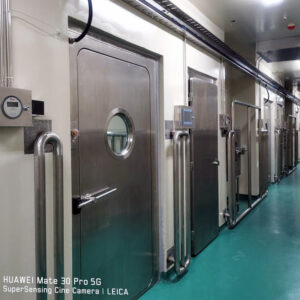
Ceiling layout decisions in pharmaceutical cleanrooms tend to be driven by architectural module sizing and HVAC duct routing rather than by clean-air function, work position, or maintenance access geometry. This sequence creates a specific category of coordination problem: equipment that fits the ceiling layout but cannot support the validation work required to qualify it.
The placement of supply units, extraction points, and any obstructions between them determines whether the airflow pattern actually reaches the work position with the velocity and directionality the process requires. Suboptimal diffuser and extraction placement can create dead zones — areas of low air velocity where particles accumulate — or unnecessary recirculation that pulls contaminated air back through the work zone. Neither problem is always visible in static particle counts taken at a single point during an unoccupied qualification test. CFD modelling can identify these patterns before the layout is fixed; it is a practical planning tool rather than a regulatory requirement, but layouts that skip it often discover the dead-zone problem only when operational particle counts exceed the classification target.
The harder coordination problem involves access for in-place testing. HEPA filter leak testing requires an aerosol injection port upstream of the filter and a sample probe positioned near the filter face for scanning. If the ceiling plenum height, duct configuration, or housing position does not allow those access points to be physically established, leak testing cannot be completed — and a housing that cannot be leak-tested in place cannot be fully qualified regardless of how well the filter performs on a factory test certificate. This constraint needs to be resolved as a layout input, alongside duct routing and module sizing, before the ceiling is closed.
Maintenance access introduces a related but distinct constraint. Filter replacement on ceiling-mounted units requires either top access through a raised plenum or bottom access through the clean-room ceiling. Each approach has different contamination risk profiles and different implications for cleanroom downtime. Top-access housings require a safe, unobstructed route through the plenum that is often incompatible with dense duct layouts. Bottom-access replacement exposes the clean room to the installation process. If the maintenance route is not decided at layout stage, the default is whichever access the installed housing happens to allow — which may not align with the operational model or the contamination-control strategy.
System choice after clean-air objective and maintenance route are defined
Once the clean-air objective is defined and the maintenance route is resolved, the remaining question is whether the selected housing design physically accommodates the qualification geometry the process will require. This is where face velocity choices, housing configuration, and ceiling layout interact in ways that affect both lifecycle cost and validation feasibility.
Increasing face velocity through an H13 HEPA filter to meet air change rate targets raises pressure drop across the filter. Higher pressure drop drives up fan energy consumption and accelerates filter loading, which shortens service intervals and increases replacement frequency. The trade-off is consistent: meeting a higher air change rate through velocity rather than filter coverage area shifts lifecycle cost away from capital price toward maintenance frequency and operational downtime. For a fixed ceiling coverage area, that trade-off is worth quantifying before models are specified — particularly in rooms where filter replacement requires a cleanroom shutdown.
Transport damage is a failure risk that connects directly to system choice. HEPA filters can sustain pinhole-level damage during transit that is not visible on inspection and does not affect the filter’s resistance to bulk airflow. In-place photometer scanning is the method used to detect this kind of leak after installation; the scan detects penetration at the filter face using an upstream aerosol challenge, with a 0.01% downstream concentration threshold serving as a common design reference for pass/fail in in-place testing practice. This threshold should be understood as a figure associated with specific test methods rather than a universal regulatory limit, but the underlying requirement — that installed filters be leak-tested in place — reflects the qualification expectation established by EU GMP Annex 1 for sterile manufacturing environments. Housings that lack the physical geometry to support this testing cannot satisfy that expectation regardless of the filter’s factory certification.
The physical constraints that make in-place leak testing possible are specific and non-negotiable in terms of geometry.
| Constraint | Persyaratan | Why It Matters for System Choice |
|---|---|---|
| Aerosol injection port upstream distance | At least 20 duct diameters from filter | Longer straight duct section needed; housing design and ceiling layout must accommodate it |
| Sample port location | 100 mm from filter face | Access needed near filter; influences placement and serviceability |
| Leak detection threshold | 0.01% concentration | Defines pass/fail for in-place photometer scanning; stricter criteria drive maintenance frequency |
| Transport damage risk | Pinhole leaks only found by in-place scan | Requires leak testing capability; favors equipment with built-in test ports |
Each row in that table represents a constraint that feeds backward into housing selection and ceiling layout design. The 20-duct-diameter upstream distance for the aerosol injection port is not accommodated by housing choice alone — it requires a straight duct section of corresponding length that must be preserved in the duct routing plan. The 100 mm sample port location near the filter face determines whether a service technician can physically scan the filter in the installed position or whether the ceiling design blocks the access path. If these constraints are treated as installation details rather than layout inputs, they surface as qualification failures after the ceiling is built.
Selecting between an FFU, a LAF unit, and a HEPA housing box is not primarily a product decision — it is the downstream output of three prior judgments: what clean-air function the process requires, where contamination exposure actually occurs, and whether the proposed installation geometry supports both qualification testing and ongoing maintenance. Equipment specified before those judgments are made tends to fit the ceiling plan but misalign with the operational or compliance requirement it was meant to serve.
Before confirming any equipment model, confirm that the access geometry for in-place leak testing is preserved in the duct routing, that the maintenance route for filter replacement is consistent with the room’s contamination-control model, and that the face velocity chosen to meet air change targets has been evaluated against its effect on filter loading and service frequency. These are not post-procurement details — they are the conditions under which a compliant, maintainable, and qualifiable installation becomes achievable.
Pertanyaan yang Sering Diajukan
Q: Does this guidance still apply if the cleanroom uses a combined HVAC system that feeds both general dilution zones and Grade A local protection areas from the same supply?
A: Yes, but equipment selection becomes more critical, not less. When a single HVAC system serves zones with different clean-air objectives, the terminal equipment — HEPA housings, FFUs, or LAF units — must each be matched to the objective of the zone they serve, not to the shared supply they draw from. A common supply does not unify the clean-air function downstream of it. Each zone’s equipment still needs to be specified against whether it is delivering room-level dilution, local unidirectional protection, or terminal filtration, and the qualification scope for each zone follows from that function independently.
Q: After the ceiling layout is approved and equipment models are confirmed, what is the first qualification step that should be scheduled before commissioning begins?
A: In-place HEPA filter leak testing should be scheduled as the first post-installation qualification activity, before any room classification testing begins. The reason is sequencing risk: if a filter has sustained transport damage or the housing seal is compromised, particle count data collected during classification testing becomes unreliable and may need to be repeated. Confirming filter integrity first means that all subsequent qualification data is collected against a verified clean-air baseline. Scheduling this step requires confirming that the aerosol injection port and sample port access points are physically available in the installed configuration before the test date is set.
Q: At what room size or air change rate does the lifecycle cost difference between increasing face velocity and increasing filter coverage area become significant enough to affect the equipment decision?
A: There is no fixed threshold, because the crossover point depends on local energy costs, filter unit pricing, cleanroom downtime cost per hour, and the replacement interval at the chosen face velocity. However, the calculation becomes decision-relevant when the room requires more than roughly 20 air changes per hour and filter coverage area is constrained by ceiling module sizing. At that point, the velocity required to compensate for limited coverage area is high enough that pressure drop, fan energy, and shortened filter life each contribute meaningfully to the total cost of ownership over a five-year qualification cycle. Running the lifecycle cost comparison against both options before specifying face velocity is more reliable than treating one approach as the default.
Q: Can a LAF unit delivering unidirectional airflow be used to achieve room-level ISO Class 7 classification across the full space, or is its function strictly limited to the local zone it covers?
A: A LAF unit cannot substitute for room-level classification equipment across the full space. Its function is local zone protection within the footprint its airflow covers; it does not dilute or classify the surrounding room environment. The air outside the unidirectional envelope will reflect the room’s background classification, which depends on supply volume, air change rate, and the dilution equipment serving the broader space. If the room surrounding the LAF zone must also meet a specific ISO class, that requires separate room-level equipment sized to the full room volume. A Grade A LAF zone within a Grade B room is the standard configuration precisely because the two clean-air functions are served by separate equipment.
Q: Is HEPA housing box selection the right approach when the primary goal is retrofitting an existing cleanroom to a higher classification, or does that scenario change which equipment category to consider first?
A: In a retrofit scenario, HEPA housing boxes are rarely the first equipment category to evaluate. The more immediate constraint in most retrofits is whether the existing HVAC system can deliver the supply volume and pressure differential the higher classification requires. If it cannot, adding terminal HEPA housings without addressing supply capacity will not achieve the classification target. The correct starting point is the same as in a new build — confirm the required air change rate, pressure regime, and clean-air function for each zone — then assess whether the existing duct infrastructure, fan capacity, and ceiling geometry can support the equipment those requirements call for. Terminal filtration is a prerequisite for clean air delivery, not a substitute for adequate supply volume.