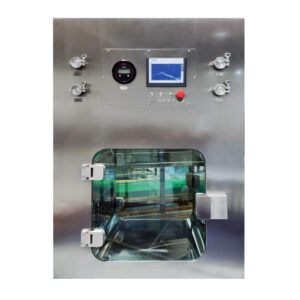
Operators who clean a laminar flow hood between batches and then again at end-of-shift often believe the procedure is being followed twice. The more common reality is that neither cycle is fully executed — the between-batch wipe happens without defined contact time, the end-of-shift clean skips disassembly checks, and neither event is documented in a way that distinguishes one from the other. The downstream cost is not always visible during the shift: surface corrosion from incompletely rinsed bleach, residue films that suppress subsequent disinfection, or micro-scratches from abrasive materials that become contamination harborage sites. What separates a defensible cleaning protocol from a fragile one is whether the SOP defines drying time, work-zone entry rules, restart criteria, and the chemical compatibility of every agent used — and whether every team member is working from the same version of those rules.
Procedure steps that make hood cleaning repeatable
Repeatability in hood cleaning is not about effort; it is about sequence integrity. When an operator cleans in an arbitrary order — work surface first, then sides, then back — any particles dislodged from an uncleaned surface can settle on areas already wiped. The directional logic built into a correct sequence prevents that recontamination from happening systematically, rather than relying on operator judgment each time.
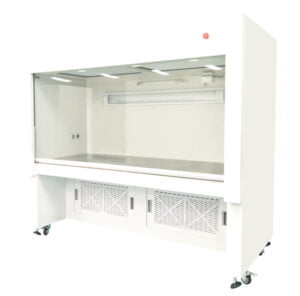
The sequencing principle differs slightly by hood type, and that difference matters during SOP design. In a vertical laminar flow hood, the back wall is the cleanest starting point because airflow moves forward toward the operator; cleaning there first means subsequent wipe strokes carry any dislodged particles in the same direction as the airstream rather than against it. For horizontal flow hoods, the ceiling is the logical starting point for the same reason. Sides are cleaned top to bottom, and the work surface is always cleaned last, moving from back to front. Each section should receive a fresh wiping surface — folding a larger cloth into quarters provides four usable faces before requiring a new cloth, which is a practical way to control cross-contamination without generating excessive material waste.
One planning figure worth building into the SOP is a 25–50% overlap on each wipe stroke. This is a design benchmark, not a regulatory threshold, but it provides operators with a concrete and observable standard for coverage rather than leaving “thorough wiping” open to interpretation.
| Step Order | 액션 | Key Detail & Rationale |
|---|---|---|
| 1 | Power down and clear work zone | Turn off and unplug hood; remove all materials for safe, unobstructed access |
| 2 | Start at cleanest area | Vertical hood: back wall; horizontal hood: ceiling; avoids dragging contaminants over cleaned surfaces |
| 3 | Clean sides top to bottom | Use overlapping strokes (25–50% overlap) to ensure full coverage |
| 4 | Clean work surface back to front | Work from the rear toward the operator; prevents reintroducing particles onto cleaned areas |
| 5 | Rotate cloth or use fresh folded surface for each section | Prevents cross-contamination between hood zones; use lint-free cloth, folded in quarters |
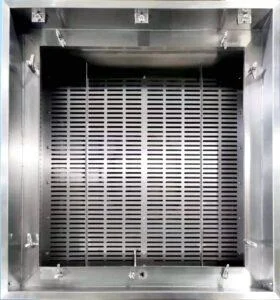
| 6 | Never wipe or clean HEPA filter | Replace per manufacturer schedule (every 3–5 years); wiping damages filter media and compromises integrity |
One prohibition deserves separate emphasis because it is routinely misunderstood: the HEPA filter should never be wiped, vacuumed, or cleaned by the operator under any circumstance. The filter media is fragile, and any contact risks permanent damage that cannot be reversed by subsequent cleaning. Manufacturers typically schedule replacement on a cycle of three to five years depending on operating conditions and load, but that interval is a planning criterion tied to the specific unit and facility context — not a universal rule that can be applied without consulting the manufacturer’s guidance for that model.
Gowning, wipe order, and contact-time controls in the SOP
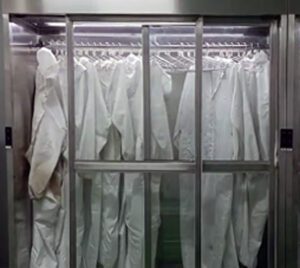
The contamination introduced by the operator is among the most controllable variables in hood cleaning, and it is also among the most frequently undercontrolled. Gowning sequence is not ceremonial; it reflects the order in which contamination from the body is sequentially contained. Shoe covers go on first because they contact the floor. Gloves follow the lab gown so the gown cuffs can be tucked under rather than left as an open contamination path. Face mask, eye protection, and hairnet complete the sequence. Reversing or collapsing steps — pulling on a gown after gloves, for instance — undermines the containment logic even if every individual item is worn correctly.
Contact time is a point where many written SOPs appear complete but function poorly in practice. A disinfectant achieves its intended effect only after the surface has remained wet for the specified dwell period. If an operator wipes a surface and then immediately follows with a dry wipe, the agent has not had sufficient contact time to act, and the clean surface appearance does not reflect actual bioburden reduction. The SOP must state the required contact time for each agent used, not just list the agents. Without that specification, operators will default to the pace that feels efficient, which is almost always shorter than the validated dwell time.
Lint-free cloths folded into quarters provide a practical way to maintain a clean wiping surface across multiple strokes without switching materials mid-section. Sterile gauze is an acceptable alternative for particularly sensitive zones. The folding detail matters because an unfolded cloth used in multiple sweeping passes accumulates particles and redistributes them — which is functionally the same as skipping the wipe entirely for later strokes.
Chemical mixing and poor drying habits that trigger contamination risk
The most damaging chemical habits in hood cleaning are rarely the result of operators ignoring the procedure entirely. They tend to emerge from convenience decisions made in the moment: reaching for bleach because it is available, spraying directly into the hood to speed up application, or assuming that a surface that looks dry is ready for restart. Each of those shortcuts introduces a risk that is difficult to detect during the same cleaning session and may only surface as a compliance finding or equipment fault later.
The consequences of those patterns are worth understanding at the mechanism level, not just as a list of prohibited actions.
| Risk / Poor Habit | 중요한 이유 | What the SOP Should Clarify |
|---|---|---|
| Spraying cleaner directly inside the hood | Aerosol mist can enter HEPA filters, sensors, and outlets; pooled liquid leaves residue | Spray onto a lint-free cloth until damp, never wet or dripping |
| Using corrosive agents (e.g., bleach) on stainless steel | Bleach corrodes stainless steel surfaces, causing pitting and contamination traps | If bleach is required, specify immediate thorough rinse with sterile water or 70% alcohol |
| Over-scrubbing or using abrasive tools | Damages the protective surface layer, creating micro-scratches that harbor microorganisms | Use gentle wiping; avoid harsh scrubbing tools; specify acceptable cloth and pressure |
| Leaving cleaner or disinfectant residues to air-dry | Residues can form a film that protects microbes and interferes with disinfection | After cleaning, remove all residues immediately with 70% isopropanol or sterile water followed by 70% isopropanol |
| Substituting soap and water for alcohol-based disinfectants | Soap and water can leave residues and are not validated for cleanroom disinfection | Require 70% ethanol or isopropyl alcohol as the standard disinfectant |
The bleach-on-stainless problem deserves particular attention because the damage is cumulative and invisible during the cleaning shift itself. Bleach is not prohibited in cleanroom disinfection, but stainless steel surfaces require a thorough rinse with sterile water or 70% alcohol immediately after bleach contact to neutralize the corrosive action. Teams that skip this step — often because it adds time or because the SOP does not explicitly require it — accelerate pitting and surface degradation that creates microscopic harborage sites for microorganisms. By the time that damage becomes visible during an audit or equipment inspection, it has been accumulating across dozens of cleaning cycles.
The residue air-drying problem operates on a similar delayed-consequence pattern. A surface that is not actively wiped to remove disinfectant residue after dwell time can develop a film that paradoxically reduces the effectiveness of the next disinfection cycle. The SOP should specify that residue removal using 70% isopropanol or sterile water followed by 70% isopropanol is a required step — not an optional finishing touch — and that step should be timed, not left to operator judgment.
For more on compatible cleaning agents and safe application methods, 층류식 공기 흐름 장치를 안전하게 청소하는 방법 covers material compatibility and application sequence in greater depth.
Between-batch wipe-downs versus end-of-shift sanitation depth
Calling both events “cleaning” in conversation is where the scheduling problem begins. A between-batch wipe-down and an end-of-shift deep clean are not the same procedure performed at different frequencies — they are structurally different operations that require different steps, different contact times, and different documentation, and conflating them in the SOP creates conditions where operators default to the shorter cycle regardless of context.
A between-batch wipe-down is a targeted surface reset. Its purpose is to remove visible residue and reduce bioburden on contact surfaces between consecutive work segments. It typically does not require disassembly, extended dwell periods, or detailed logging beyond a contemporaneous record of what was done and when. Its scope is limited because the hood has not had time to accumulate the type of contamination load that accrues across a full operational shift.
End-of-shift sanitation operates under a different logic. It should account for all surfaces contacted during the shift, verify that no non-compliant materials were introduced into the work zone, confirm that any accessories or fixtures placed inside the hood meet the entry criteria defined by the SOP, and produce documentation that distinguishes the cleaning type, agents used, and operator identity. That last point matters for audit defensibility: a log that records only “cleaned” without specifying the type of cleaning provides no useful information during a deviation investigation. ISO 14644-3:2019, which governs test methods for cleanrooms and associated controlled environments, provides technical process context for the standards that end-of-shift documentation must support — not because it mandates a specific logging format, but because environmental control integrity depends on being able to reconstruct what happened and when.
The practical planning question for SOP design is whether the frequency of each cycle is defined separately, whether the steps for each are written out independently, and whether operators can distinguish which they are performing at any given time. A single “cleaning procedure” that is expected to cover both contexts will be applied inconsistently.
Training gaps that break restart consistency across teams
A hood cleaning SOP that specifies wipe order, chemical agents, and contact times can still fail in operation if maintenance, QA, and production carry different assumptions about when the hood is ready to restart. That misalignment is not a training intensity problem — it is a content problem in the procedure itself. If the SOP does not state who verifies readiness, what readiness means in observable terms, and what the restart sequence is, each team fills that gap with its own interpretation.
The failure pattern typically surfaces at shift transitions. An operator completes the cleaning cycle and considers the hood ready. A QA reviewer arrives and asks whether the drying time has elapsed. Maintenance notes that a component was replaced and believes a restart interval is required. None of them are wrong in their reasoning — they are each applying a standard that the SOP implies but never states. The result is either inconsistent restart timing or a procedural standoff that delays production without clear resolution criteria.
Rollout training compounds this problem when it focuses on demonstrating the wipe sequence and chemical selection without walking each team through the restart verification step. Operators retain the cleaning mechanics; they do not retain a shared definition of completion. Over time, the cleaning steps become habitual and the restart criteria remain undefined in practice, which means the procedure is executed correctly up to the point where it matters most.
Cross-functional training sessions — where maintenance, QA, and production representatives walk through the same procedure simultaneously and are asked to identify the moment the hood is cleared for use — tend to surface these divergences faster than any audit. The conversation itself generates the alignment that the SOP failed to create on paper.
Missing restart criteria that prove the SOP is incomplete
A cleaning procedure that ends with “wipe surfaces dry” and moves directly to production restart is missing its most operationally consequential section. Drying time, work-zone re-entry rules, and the restart verification check are not administrative additions to the SOP — they are the mechanism that closes the loop between cleaning and confirmed readiness.
Drying time is the most commonly omitted specification. An alcohol-based disinfectant applied at the correct concentration and dwell time needs a defined period to evaporate before the surface can be considered clean and dry. That interval varies by product, application volume, and ambient conditions, and if the SOP does not specify it — at minimum as a range with conditions attached — operators will make their own determination based on surface appearance alone. A surface that appears dry may still carry residue sufficient to affect subsequent work.
Work-zone entry rules address a different gap. The SOP must define what materials, containers, and equipment are permitted inside the hood, and that list must be written in terms that prevent ambiguity at the moment of use. Cardboard is the classic example: it sheds particles and is not compatible with laminar flow work zones, yet it enters routinely because no one has been told explicitly that it is prohibited — or because the prohibition exists in a training deck that was not retained. The same logic applies to packaging materials, personal items, and non-cleanroom-qualified containers.
The restart verification check is what converts the cleaning event from a completed task into a confirmed state. A practical check should include visible surface inspection under appropriate lighting, confirmation that drying time has elapsed, a brief visual scan that no materials remain in the work zone that were not specifically approved for entry, and a signature or electronic record that identifies who performed the check and at what time. For facilities where hood calibration and airflow performance are tracked on a scheduled basis, the 층류 공기 흐름 장치 교정 가이드 2025 provides additional context on verification intervals and what performance data should accompany the readiness record.
An SOP that omits any of these three elements — drying time, work-zone entry criteria, restart verification — is structurally incomplete even if every cleaning step is correctly specified. The gap does not become visible during routine operation; it becomes visible during a deviation investigation when the question is asked: how do you know the hood was ready when work restarted?
The quality of a hood cleaning procedure is ultimately tested not by whether operators can perform the wipe sequence correctly, but by whether the procedure produces a consistent, documented state of readiness that any reviewer can reconstruct after the fact. That requires the SOP to address chemical compatibility, contact time, drying intervals, and restart verification as explicitly as it addresses wipe direction and gowning sequence. If any of those elements are left to convention or assumed knowledge, the procedure is relying on consistency that informal practice cannot reliably sustain across shift changes, personnel turnover, or audits.
Before treating a current SOP as complete, the most useful review question is not whether the steps are present, but whether the document specifies what constitutes a finished clean. If that answer requires interpretation, or if different team members would give different answers, the SOP needs revision before the cleaning procedure does.
자주 묻는 질문
Q: Does this cleaning procedure apply to biological safety cabinets as well as laminar flow hoods?
A: Not directly — the two pieces of equipment serve different purposes and have different airflow configurations, which changes the wipe sequence logic and the safety requirements for the operator. Biological safety cabinets are designed to protect both the product and the operator from exposure, so decontamination steps — including surface treatment before opening sashes and the handling of potentially infectious materials — introduce requirements that a standard laminar flow hood cleaning SOP does not address. If your facility uses both, each type should have its own written procedure rather than a shared document with footnotes.
Q: What should happen if a cleaning agent with an unknown contact time was used during a shift?
A: Treat the cleaning event as unverified and do not restart production until the surface has been re-cleaned with an agent whose dwell time is defined in the SOP. An unknown contact time means there is no basis for confirming that bioburden reduction occurred — surface appearance alone does not substitute for a validated dwell period. The incident should also be documented as a deviation so the source of the incompatible agent can be traced and removed from the work area.
Q: At what point does a between-batch wipe-down no longer substitute for a deeper clean — for example, after an unusually long batch or a process change?
A: A between-batch wipe-down is adequate when the contamination profile of the work zone has not materially changed from the conditions the wipe cycle was designed to address. If a batch ran significantly longer than the validated norm, introduced a new material or chemical not previously used in that hood, or produced visible residue beyond typical surface contact, the end-of-shift sanitation criteria should be applied regardless of timing. The decision rule — what conditions trigger a deeper clean mid-shift — should be written explicitly into the SOP rather than left to operator judgment at the time.
Q: Is a laminar flow hood with surface pitting from repeated bleach exposure still usable, or does corrosion damage require replacement?
A: Pitting creates microscopic harborage sites that cleaning cannot eliminate, so the answer depends on the severity of damage and the regulatory standard governing your process. Shallow surface discoloration may be tolerable in lower-risk environments; visible pitting in a pharmaceutical or sterile manufacturing context is more likely to constitute a compliance risk because it cannot be reliably decontaminated. The determination should be made through a formal equipment assessment rather than a routine cleaning inspection, and the outcome should be documented before continued use is approved.
Q: If the facility already has a general cleanroom cleaning SOP, does a laminar flow hood still need its own separate procedure?
A: Yes — a general cleanroom SOP does not capture the hood-specific variables that determine whether cleaning is effective: the directional wipe sequence tied to airflow type, the HEPA filter prohibition, chemical compatibility with the hood’s interior materials, and the restart verification check that confirms the hood is in a ready state rather than simply wiped down. A general procedure applied to a hood will systematically omit those steps because it was not written with the hood’s operating logic in mind. The hood procedure can reference the facility SOP for shared elements like gowning, but it needs its own document to cover the steps that are unique to the equipment.