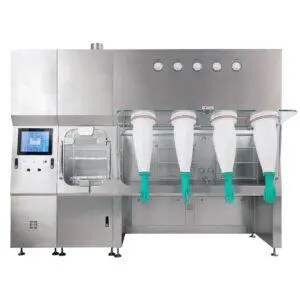
Accepting a supplier’s ISO 5 declaration without examining the test method behind it is one of the more avoidable causes of qualification rework in cleanroom procurement. The problem surfaces late: a hood passes factory inspection, arrives on site, gets loaded with production tools and consumables, and particle counts taken during operational qualification exceed the 3,520 particles/m³ threshold at 0.5 µm that the original certificate claimed to prove. At that point, the certification provides no defensible baseline for the loaded condition, and requalification responsibility — along with its cost and schedule impact — typically falls on the end user. What separates a procurement decision that holds through validation from one that stalls is knowing which specific questions to ask before the purchase order is placed, not after the equipment is installed.
Verification questions behind an ISO 5 claim
An ISO 5 label on a product datasheet tells you the classification target, not whether the equipment actually meets it under conditions that resemble your process. The 3,520 particles/m³ limit at 0.5 µm is the legally recognized threshold drawn from ISO 14644 classification, but a filter rating or a manufacturer’s declaration alone does not satisfy that threshold. What satisfies it is particle count data collected at defined measurement locations, under a defined hood configuration, using a defined test method.
The first verification question is therefore procedural: ask for the actual count data, not the certificate. The data should show measurement locations across the work zone, not a single point near the filter face. It should name the test method and state whether the hood was empty, at-rest, or under any loading condition at the time of measurement. If the supplier cannot produce that level of detail, the ISO 5 claim is unverified regardless of what the product label says.
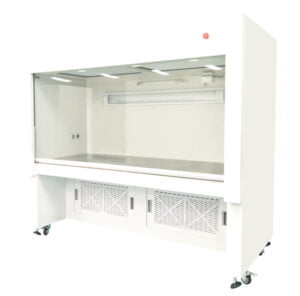
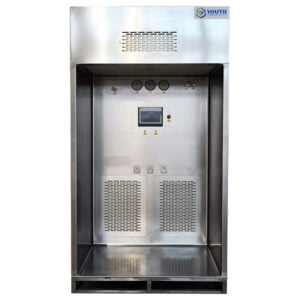
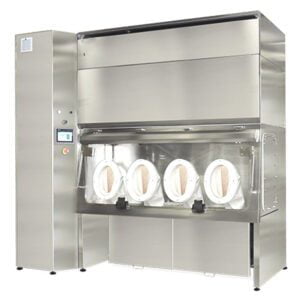
The second question concerns the hood configuration at the time of testing. A horizontal laminar flow hood, a vertical laminar flow hood, and a recirculating unit with different exhaust arrangements can all be labeled ISO 5, yet they behave differently when obstructions are introduced. Understanding which physical configuration was tested — and whether it matches your intended installation — is necessary before the count data becomes relevant to your application. For buyers evaluating laminaire stromingskap options across multiple configurations, that configuration-specific detail should be part of the supplier’s qualification package, not an afterthought.
Test methods that prove particle control at the hood opening
Two measurable parameters anchor meaningful verification at the hood opening: filter integrity and airflow velocity. Neither can be substituted by visual inspection or a supplier assertion, and the absence of either leaves the ISO 5 claim structurally incomplete.
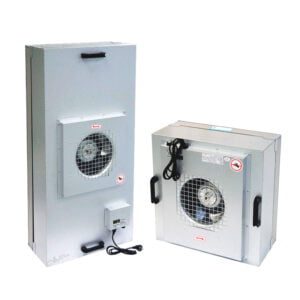
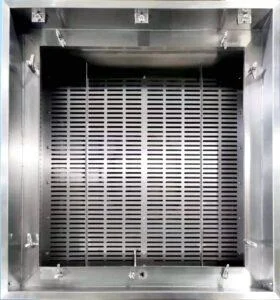
Filter integrity is verified through a leak test — typically a PAO aerosol challenge — using a physical test port at the filter face. A φ8 mm PAO test port provides the access point required to scan the filter and confirm that no bypass leakage is compromising particle control at the hood opening. Where this port is absent from the hood design, the filter cannot be properly challenged in the field, which means post-shipping integrity is effectively untestable without disassembly. That is a meaningful verification gap, particularly for hoods that will be periodically requalified.
Airflow velocity determines whether the flow regime is genuinely laminar. An average velocity in the range of 0.36–0.54 m/s is the design figure associated with unidirectional flow adequate to sweep particles away from the work zone; deviation below this range means particles are not being reliably transported out of the critical area, and the ISO 5 condition is at risk regardless of filter rating. ISO 14644-3:2019 provides the testing framework within which both filter leak and velocity checks should be documented.
| Test Parameter | Measurement / Specification | Wat het verifieert |
|---|---|---|
| PAO filter leak test | φ8 mm test port | HEPA filter integrity at the hood opening; no bypass leakage compromising particle control. |
| Luchtstroomsnelheid | 0.36 – 0.54 m/s average | Unidirectional laminar flow necessary to sweep particles away; deviation risks failing the ISO 5 condition. |
What the table above does not resolve is the consequence of failing either check after installation. A filter that passes PAO testing at the factory may arrive with compromised seal integrity after shipping. A velocity profile that meets specification on the factory test stand may shift when the hood is mounted in ceiling suspension at a different orientation. Both issues are recoverable — but only if the test methods are repeated on site with the same acceptance criteria used at the factory.
Empty-state results that fail under real loading conditions
Empty-state particle count certification is structurally incapable of predicting performance under operational loading. The test is run with no tools, no trays, no containers, and no operator present — conditions that do not exist during production use. That is not a criticism of the certification method; it is a description of its scope. The problem arises when buyers treat the empty-state result as sufficient evidence of operational performance and skip the loaded qualification.
Objects placed inside a laminar flow hood interrupt the unidirectional airflow profile. Tall bottles, equipment frames, and stacked trays create downstream turbulence and particle entrapment zones in areas the empty-state test never interrogated. The cleanliness level in those zones may fall well below ISO 5 while the particle counter positioned at an unobstructed location still returns a passing result. This is not a rare edge case; it is a predictable consequence of introducing physical objects into a flow field, and it is the reason operational qualification must include the hood loaded with a representative configuration of production equipment.
Operator movement adds a second failure mode that empty-state testing cannot detect. Particle displacement from garment shedding, arm motion, and material handling occurs during actual use, and none of those sources are present during static certification.
| Loading Factor | Impact on ISO 5 Performance | Wat verduidelijken |
|---|---|---|
| Objects placed inside the hood | Disrupts unidirectional airflow, creating turbulence and particle entrapment. | Confirm that operational qualification tests include the hood loaded with typical equipment and consumables. |
| Operator movement during use | Displaces particles from garments and actions not present in static certification. | Verify that dynamic testing or in-use particle monitoring forms part of the acceptance evidence. |
The procurement implication is direct: before accepting a hood for production use, confirm that the qualification plan includes at minimum an at-rest test with typical equipment in place and a dynamic or in-use particle monitoring component that reflects actual operator activity. A supplier who offers only empty-state data as final evidence of ISO 5 compliance is offering an incomplete qualification package, even if the particle counts themselves are accurate.
At-rest evidence versus operational evidence during approval
At-rest certification establishes a baseline — it confirms that the hood, empty and undisturbed, can achieve ISO 5 conditions. That baseline is necessary but not sufficient for approval of equipment intended for active production use. The gap between at-rest evidence and operational evidence is where qualification failures tend to cluster.
The core limitation of at-rest certification is that it captures a controlled moment in time under conditions that do not include the variables present during operation. Continuous particle and airflow monitoring during actual use is the mechanism that bridges that gap. Installing particle counters and airflow monitors — and defining acceptance limits for the operational state — converts the at-rest result from a one-time snapshot into a starting condition that can be compared against real use data. Without that monitoring infrastructure, there is no defensible answer to the question of whether the ISO 5 condition was maintained during a production run.
The surrounding environment introduces a second variable that at-rest certification ignores by design. The ISO 5 classification applies inside the hood; ambient cleanliness, personnel gowning, and traffic patterns in the surrounding area all affect whether that internal classification holds when the hood is in use. A poorly controlled surrounding zone and inadequately gowned operators can introduce enough particulate burden to overwhelm the hood’s unidirectional flow, particularly near the opening.
| Approval Aspect | At-Rest Limitation | Operational Requirement |
|---|---|---|
| Continue bewaking | At-rest certification typically does not mandate ongoing particle or airflow monitoring. | Install particle counters and airflow monitors to verify the ISO 5 condition is maintained during actual use. |
| Surrounding cleanliness and personnel | Ignores ambient conditions and shedding from operators; only the empty cabinet environment is measured. | Maintain a clean surrounding area and enforce cleanroom garment protocols to prevent external particle ingress. |
The approval decision should therefore require evidence from at least two states: at-rest with representative equipment loaded, and operational with personnel present and performing typical tasks. Approving equipment on at-rest data alone shifts contamination risk downstream into the production environment, where it is more costly to detect and correct. Guidance on structuring GMP-aligned qualification evidence for LAF units is covered in more detail in GMP-conforme LAF-units | FDA vereisten & validatie.
FAT ownership gaps that delay final qualification
Factory acceptance testing produces a verified performance baseline for the hood as built and assembled under factory conditions. What it does not produce — unless explicitly contracted — is assurance that the same performance exists after the hood has been disassembled for shipping, transported, reassembled on site, and mounted in its final installation orientation. That gap between factory conditions and site reality is where qualification delays most often originate, and the cause is usually undefined responsibility rather than technical failure.
The three areas where ownership gaps most commonly create downstream rework are reassembly integrity, test protocol alignment between FAT and SAT, and site-specific mounting variables. A hood that passes airflow pattern and PAO filter leak checks at the factory can arrive with shifted gasket seals or misaligned filter frames. If the site acceptance test protocol was never written to mirror the factory protocol — same test methods, same measurement locations, same acceptance criteria — there is no valid comparison to make, and the qualification argument collapses. Ceiling-suspension and gantry mounting configurations alter the airflow field relative to the factory test stand, which means velocity uniformity data from the factory is not transferable without on-site verification.
| Gap Area | Risico indien onduidelijk | What to Confirm in Contract / Plan |
|---|---|---|
| Hood reassembly after shipping | Disassembly for transport and on-site reassembly may not replicate factory airflow conditions, leading to qualification rework. | SAT must include full airflow pattern and filter leak tests after reassembly, not just a visual check. |
| Scope of standard tests | If only FAT results exist without a matched SAT protocol, post-shipping integrity is unverified. | Require identical test protocols at FAT and SAT (airflow pattern, noise, PAO) with documented acceptance criteria. |
| Site-specific installation method | Ceiling‑suspension or gantry mounting can alter airflow uniformity compared to the factory test stand. | SAT must verify airflow velocity and pattern at the actual installation orientation, not rely on factory default mounting data. |
None of these failure modes are difficult to prevent. They require the FAT and SAT protocols to be defined in the contract before the order is placed — not negotiated after the hood arrives on site and fails visual or functional inspection. The question to ask during procurement is not whether the supplier performs a FAT, but whether the SAT protocol is documented, who is responsible for executing it, and what happens if the site results do not match the factory data. Leaving those responsibilities undefined is what converts a minor shipping incident into a multi-week requalification delay.
Operator-protection demands that exceed ISO 5 hood verification
ISO 5 verification is a product-protection standard. It confirms that the work zone inside the hood maintains particle cleanliness adequate to protect the product from contamination. It does not address, and was not designed to address, the question of whether the operator is protected from the product or process.
That distinction matters most when the process involves hazardous agents — potent compounds, cytotoxics, biologics with inhalation risk, or any material where operator exposure during manipulation constitutes a health risk. A laminar flow hood directs air from the HEPA filter across the work zone and out toward the operator opening. This airflow pattern is optimal for product protection and directly adverse for operator protection: contaminated air exits the hood toward the person standing at the opening. Recognizing this before procurement rather than during validation review determines whether the equipment is even the correct choice for the intended application.
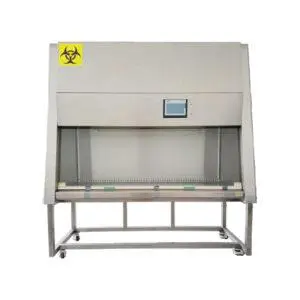
Engineering modifications such as a full-closure sash or a negative-pressure recirculation design can reduce operator exposure compared to an open-front laminar flow hood, and ISO 14644-7:2004 on separative devices provides useful framing for understanding the design boundaries of different containment geometries. However, these modifications do not make a laminar flow hood equivalent to a biosafety cabinet. Biosafety cabinet certification involves inward airflow, exhaust HEPA filtration, and a defined containment barrier — none of which are inherent features of an ISO 5 laminar flow design, regardless of upgrades.
The procurement decision point here is process-risk assessment, not equipment specification. If any part of the intended process involves a hazardous agent, the question of whether an ISO 5 hood is the right piece of equipment should be resolved before the specification is written, not treated as a compliance footnote after the hood is qualified. ISO 5 verification will confirm cleanliness for the product; it will not satisfy a regulatory or safety requirement for operator containment.
The most defensible position before committing to an ISO 5 laminar flow hood purchase is to hold the supplier’s qualification package against the same set of conditions the hood will actually face in use: loaded, operational, and installed in its final mounting configuration. An empty-state particle count and a filter certificate answer a narrow question about the hood’s potential under ideal conditions. What you need to know is whether the particle control holds under your loading pattern, whether the FAT results can be verified on site with a matched SAT protocol, and whether the application requires operator containment that ISO 5 verification was never designed to provide.
For a structured pre-approval review that maps these verification requirements against regulatory expectations, the LAF Unit Audit Checklist | Gids voor naleving van regelgeving offers a practical starting point for identifying gaps before qualification begins.
Veelgestelde vragen
Q: Does the ISO 5 claim still hold if the hood is installed in a room that isn’t itself classified?
A: No — the ISO 5 condition inside the hood is vulnerable to the ambient environment surrounding it. Unclassified surrounding spaces introduce particulate loads and turbulence at the hood opening that unidirectional flow alone cannot fully compensate for. Even a well-verified hood can lose its ISO 5 classification during operation if ambient cleanliness, personnel gowning, and room traffic patterns are left uncontrolled. The ISO 5 rating applies to the work zone, not the room, and maintaining it depends on the surrounding conditions being managed to a level compatible with the hood’s intended classification.
Q: Once the hood passes site acceptance testing, what is the minimum ongoing monitoring needed to keep the ISO 5 status defensible?
A: At minimum, periodic requalification using the same particle count locations, test methods, and acceptance criteria from the original SAT is required to maintain a defensible ISO 5 status. Between formal requalification intervals, continuous or routine airflow monitoring and environmental particle counts during production runs provide the operational evidence that the classification is holding under real conditions. Without this ongoing data, the qualification baseline is a historical snapshot with no mechanism to detect drift — which regulators and auditors will treat as an uncontrolled gap.
Q: At what point does adding equipment inside the hood require a full requalification rather than just a risk assessment?
A: Requalification is warranted whenever new equipment changes the airflow obstruction profile in a way that hasn’t been previously tested — specifically when items are taller than previously qualified configurations, when they occupy a significantly larger footprint within the work zone, or when they redirect flow toward the hood opening. A risk assessment alone is insufficient if the change is physical rather than procedural, because turbulence and particle entrapment zones created by new obstructions cannot be predicted from prior empty-state or differently-loaded test data. The threshold question is whether the loading pattern is materially different from what was present during the last particle count measurement.
Q: How does a vertical laminar flow hood compare to a horizontal one for applications where both configurations are offered at ISO 5?
A: The critical difference is the direction airflow exits relative to the operator and the work zone. A vertical flow hood directs air downward across the work surface and out through front or rear perforated grilles, which reduces the direct sweep of potentially contaminated air toward the operator compared to a horizontal flow design. A horizontal flow hood directs air straight out the front opening toward the operator, optimizing product protection but creating a less favorable exposure profile for any process involving particulates or agents that should not reach the operator. If the application involves any material with inhalation or contact risk, vertical flow geometry reduces — but does not eliminate — operator exposure risk, and neither configuration substitutes for a biosafety cabinet when true operator containment is required.
Q: Is ISO 5 laminar flow hood verification sufficient to satisfy regulatory expectations for sterile compounding or aseptic fill environments?
A: ISO 5 hood verification is a necessary condition but not a complete regulatory submission on its own. Regulatory frameworks for sterile compounding and aseptic processing — including USP <797>, EU GMP Annex 1, and FDA aseptic processing guidance — require documented evidence across multiple qualification states, environmental monitoring programs, personnel qualification, and procedural controls that operate alongside the equipment. An ISO 5 particle count result answers the classification question; it does not address media fill performance, personnel monitoring outcomes, gowning qualification, or the broader contamination control strategy that regulators expect to see documented before approving an aseptic environment for production use.
Gerelateerde inhoud:
- Luchtstroom in laminaire-stroomkappen: De dynamica begrijpen
- Laminaire stroming vs. zuurkasten: Belangrijkste verschillen
- Afzuigkappen met ventilatorfilters of laminaire stroming: Welke kiezen?
- Laminaire-stroomkapcertificering: Kwaliteit verzekeren
- Verticale afzuigkappen met laminaire stroming: Optimale bescherming
- Laminar Flow Hood vs BSC: Verstandig kiezen
- Horizontale afzuigkappen met laminaire stroming: Gebruik en voordelen
- Hoe laminaire luchtstroomunits veilig reinigen
- Koopgids voor laminaire stromingskap voor cleanroom- en laboratoriumprojecten