Selecting equipment before the process risk is clearly mapped to a cleanroom grade is where most pharmaceutical facility projects accumulate their most expensive rework. Teams that skip this step often discover mid-project that exposed-product areas lack adequate clean-air coverage, that transfer controls are mismatched to zone boundaries, or that critical qualification records were never included in the original equipment scope — problems that surface at IQ/OQ and cannot be patched with a late-arriving supplier certificate. The practical resolution is not simply buying better equipment; it is defining the process step, the corresponding grade, the equipment family that serves that step, and the document package that supports it, before any quotation is issued. Readers who work through those four dependencies in order will be in a substantially stronger position to evaluate supplier proposals, challenge scope boundaries, and avoid the commissioning delays that follow from ambiguity left unresolved at the procurement stage.
Equipment families included in a pharmaceutical cleanroom package
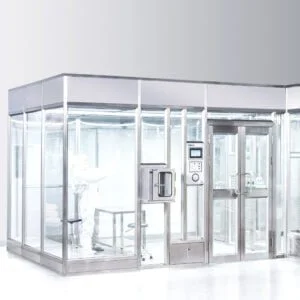
A pharmaceutical cleanroom is not a single piece of equipment — it is a coordinated assembly of several distinct equipment families, each protecting a different aspect of process integrity. Understanding which families belong in a given scope, and why, is a prerequisite to writing a meaningful equipment specification.
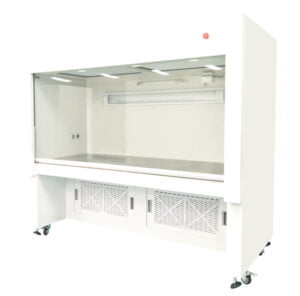
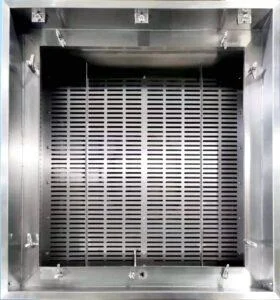
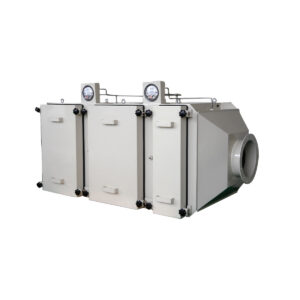
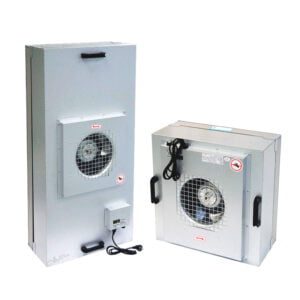
Air-handling equipment forms the first layer: fan filter units (FFUs) and laminar airflow (LAF) units supply HEPA-filtered air to workstations and clean zones, controlling both particulate and microbial exposure at the point of product contact. Блоки фильтров вентиляторов (FFU) are typically integrated into ceiling grids to provide distributed clean-air coverage across a zone, while Единицы LAF are deployed where a localized unidirectional airflow envelope is needed around a specific operation. These are not interchangeable: choosing one where the other is process-appropriate creates an air coverage gap that does not become visible until environmental monitoring starts returning out-of-specification results.
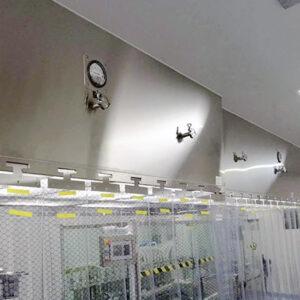
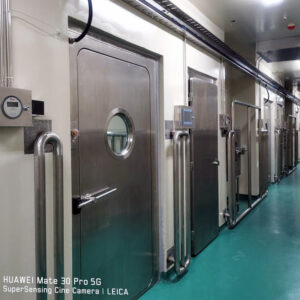
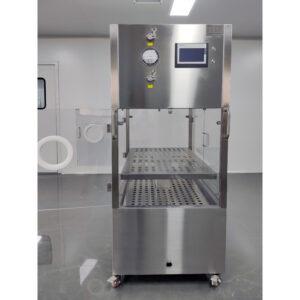
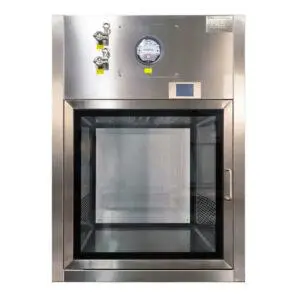
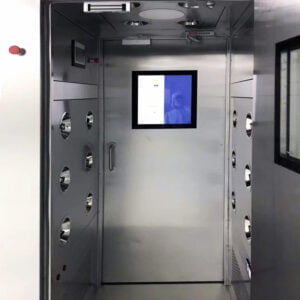
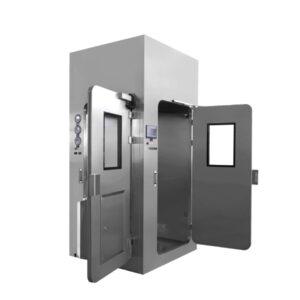
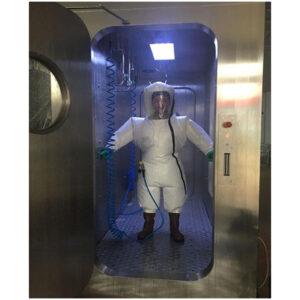
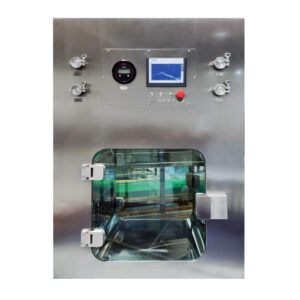
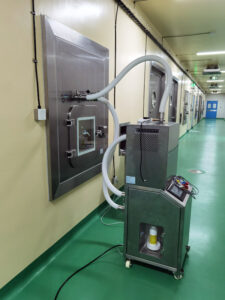
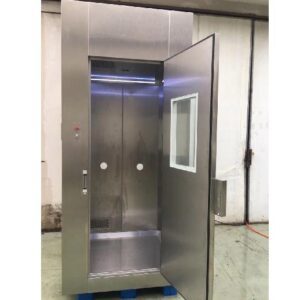
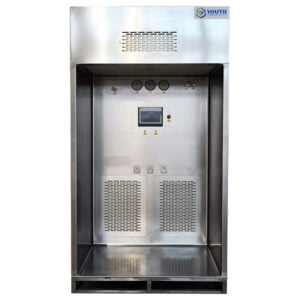
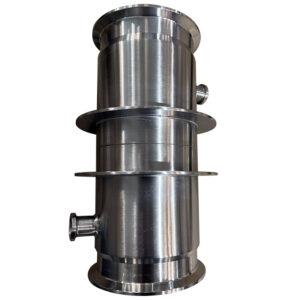
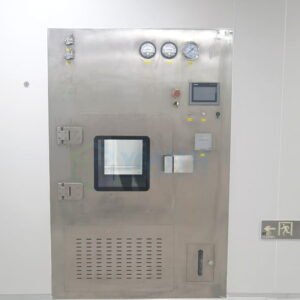
Transfer and entry equipment — airlocks, pass-through chambers, and air showers — manage the movement of materials and personnel across grade boundaries. Where a pressure differential cascade is in place between classified zones, the role of a pass-through or airlock is to maintain that cascade during transfer events rather than allow uncontrolled cross-contamination. This is an operational function that depends on facility grade and process risk: not every facility requires every transfer type, but for any project that includes grade boundaries between zones, the transfer equipment family must be planned alongside the air-handling equipment, not added later when the layout is already fixed.
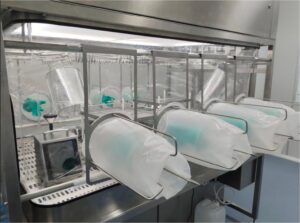
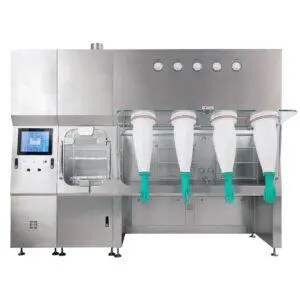
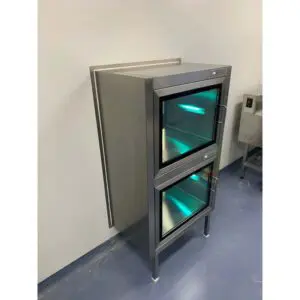
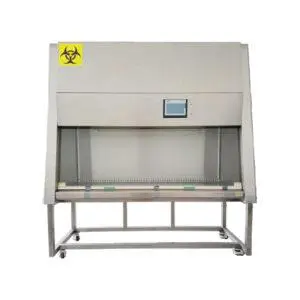
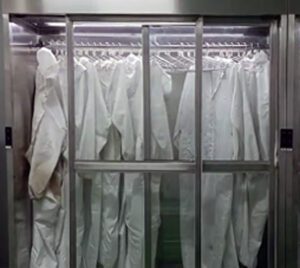
Supporting equipment — gowning room furniture, desiccators, clean benches, and storage solutions — is frequently underweighted in early budget estimates. These items are not passive fixtures; they must be compatible with the cleanroom environment, capable of cleaning validation, and free from material properties that would compromise air quality or introduce contamination. Treating them as a procurement afterthought typically means sourcing from a general catalog without confirming GMP construction standards, which then creates a documentation gap at qualification.
The practical planning discipline here is to treat each equipment family as a protection function tied to a specific process step, and to confirm that every exposed-product area in the layout has an equipment assignment before the design is frozen. A gap at this stage is far cheaper to close on paper than after installation.
GMP standards that shape air, transfer, booth, and entry decisions
Grade assignments are not administrative categories — they are the mechanism by which regulatory expectation is translated into specific equipment performance requirements. Getting the grade-to-process mapping wrong means specifying equipment to the wrong standard, which creates an audit exposure that is difficult to defend once a facility is under review.
The ISO class-to-process-area mapping carries direct implications for equipment selection across every family discussed above.
| Область процесса | Required ISO Class | Risk Level & Equipment Impact |
|---|---|---|
| Sterile Filling | Класс ISO 5 | Highest contamination risk; requires unidirectional airflow and HEPA-filtered supply |
| Supporting Areas (preparation, buffer) | Класс ISO 6 | Reduced background contamination; needs clean air supply and pressure control |
| Secondary Packaging / QC | Класс ISO 7 | Moderate risk; controlled environment with less stringent air requirements |
| Warehouses / Storage | Класс ISO 8 | Low risk; basic filtration and pressure differential to protect adjacent zones |
Two design figures appear repeatedly in GMP guidance and are worth treating carefully. EU GMP Annex 1 and ISO 14644-1 reference HEPA filtration efficiency of at least 99.97% at 0.3 microns as a design input for controlled environments, and a pressure differential of at least 10 Pa between adjacent classified zones as a target for maintaining grade boundary integrity. These figures are useful as specification anchors, but they should be understood as design figures from specific guidance documents — not as universally identical thresholds that apply identically under every regulatory jurisdiction. The practical implication is that equipment specifications should be built from the applicable guidance for the target market, and that buyers should confirm which regulatory framework governs their facility before locking in equipment performance requirements.
Personnel remain the dominant source of microbial contamination in cleanroom environments, which is the core reason that booth and entry equipment — air showers, gowning rooms, interlocked airlocks — carry significant weight in any GMP-compliant facility design. This is not a quantified regulatory threshold; it is a well-established failure pattern that shapes equipment requirements in a direct way. Facilities that treat personnel entry controls as lower-priority than air-handling equipment often find the opposite is true during environmental monitoring reviews.
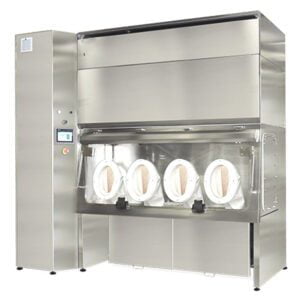
Containment applications introduce an additional configuration decision. Processes involving infectious agents or reactive chemicals may require negative pressure rooms to prevent contaminant escape rather than ingress — an inversion of the standard pressure cascade logic. Equipment specified for a positive-pressure pharmaceutical cleanroom is not automatically suitable for a negative-pressure containment configuration, and that distinction must be resolved at the grade-assignment stage, not at commissioning.
Supplier documents buyers should request before quotation
Requesting a document package before committing to a quotation is not a procedural formality — it is the primary mechanism by which a buyer can verify that a supplier’s equipment will support qualification and withstand regulatory scrutiny.
The five certification record categories most relevant to GMP equipment procurement each confirm a different aspect of cleanroom performance, and reviewing them as a package provides a more complete picture than any single record can.
| Certification Record Item | Что это подтверждает | Why It Matters for GMP |
|---|---|---|
| Air particle counts | Cleanroom meets ISO class particle limits | Validates classification and product exposure risk |
| Схемы воздушных потоков | Proper airflow design (laminar/turbulent) | Ensures no stagnant zones where contamination could accumulate |
| Целостность фильтра | HEPA filter leak-free performance | Prevents bypass of unfiltered air into critical zones |
| Room recovery time | Speed of cleanliness restoration after disturbance | Confirms cleanroom resilience and batch changeover capability |
| Дифференциалы давления | Sustained pressure cascade between zones | Maintains contamination control and grade boundary integrity |
What these records collectively establish is whether a supplier can demonstrate past performance in a form that a quality team can use during IQ/OQ. Air particle counts confirm classification; airflow patterns reveal whether the design avoids stagnant zones; filter integrity records show whether HEPA performance is maintained in actual installation; room recovery time confirms that the environment can restore classification quickly after a disturbance event; and pressure differential records show whether the zone cascade is sustained under operating conditions. A supplier who cannot provide this package from prior installations is a supplier whose equipment introduces qualification risk, regardless of what the data sheet specifies.
For guidance on how these certification requirements connect to broader equipment and cleanroom standards, the Понимание стандартов и требований к оборудованию для чистых помещений reference provides useful background on the classification and testing framework. The important procurement discipline is to request these records before quotation acceptance — not after — because the moment a purchase order is issued without this review, the buyer has accepted the documentation risk.
Scope boundaries between equipment supply and cleanroom EPC
The boundary between what an equipment supplier provides and what falls to the EPC contractor, site HVAC team, or QA function is the most consistently underestimated source of project friction in pharmaceutical cleanroom builds. It rarely appears as a single disputed line item; it accumulates as a series of assumptions that each party believed the other had covered.
A packaged equipment scope — where air-handling, transfer, entry, and supporting equipment are sourced from a single supplier — reduces coordination gaps between families. The trade-off is that it concentrates interface questions into a single negotiation. The buyer must be prepared to define, during that negotiation, exactly where the supplier’s responsibility ends and where EPC installation, site HVAC integration, and QA validation ownership begin. If those boundaries are left ambiguous in the contract, they do not resolve themselves — they resurface as scope disputes at commissioning, when every party has a financial incentive to push responsibility outward.
Isolated vendor purchasing preserves flexibility and may allow best-in-class selection within each equipment family, but it shifts the interface burden entirely to the buyer. That means the buyer — not any individual supplier — is responsible for demonstrating that the interfaces between equipment families meet the performance requirements that GMP standards expect. Proving that a pressure differential cascade is sustained across equipment from three different vendors, with three different installation teams, requires coordination work that a single-source package would have absorbed. Neither approach is inherently superior; the right choice depends on the buyer’s internal capacity to manage interfaces and produce unified qualification evidence.
The practical pre-procurement step is to produce a written scope boundary document — even an informal one — that assigns each interface to a specific party before any quotation is accepted. Interfaces that need explicit assignment typically include: HVAC connection and balancing, electrical supply and controls integration, drain and utility connections, installation qualification ownership, and ongoing filter replacement and certification responsibility. Leaving any of these unassigned does not make them disappear — it makes them contentious.
RFQ readiness after process, grade, interface, and evidence are defined
An RFQ issued before the process step, cleanroom grade, equipment family, interface owner, and document set are all defined will generate supplier responses that are difficult to compare and even harder to hold accountable. The gap between an underspecified RFQ and a qualified cleanroom is not bridged by negotiation — it is bridged by redesign, usually at cost and schedule impact.
The equipment design criteria that need to be locked before an RFQ is issued are not stylistic preferences — they are the properties that determine whether equipment can be cleaned to a validated standard, survive sterilization cycles without degradation, and avoid harboring contamination in manufacturing environments where microbial control is a GMP expectation.
| Критерий проектирования | GMP Justification |
|---|---|
| Чистота | Requires surfaces that are easily cleaned and can be validated to remove residues |
| Возможность стерилизации | Must withstand sterilization methods (e.g., autoclaving, VHP) without material degradation |
| Водоотводная способность | Needs complete liquid evacuation to avoid microbial contamination |
| Crevice-free finishes | Eliminates seams, joints, and rough surfaces that harbor microbes |
These criteria should appear as explicit requirements in the RFQ, not as implied assumptions. A supplier responding to a specification that does not mention crevice-free finishes, drainability, or sterilization compatibility has no obligation to provide equipment that meets those criteria — and demonstrating that equipment meets them after the fact, during cleaning validation or a regulatory inspection, is a significantly harder problem than having specified them at procurement.
The RFQ stage is also the correct point to confirm which certification records and qualification support documents the supplier will deliver with the equipment. A supplier who will not commit at RFQ to providing filter integrity records, airflow pattern documentation, and pressure differential test data is a supplier whose delivery terms need to be renegotiated before a purchase order is issued — or reconsidered entirely. Qualification evidence does not become easier to obtain after equipment is installed and a project is under schedule pressure.
For buyers comparing equipment families and classification requirements in parallel, the Типы оборудования для чистых помещений | Классификация | Руководство по выбору provides a useful reference for matching equipment types to grade and application before finalizing scope. The discipline of RFQ readiness is simply this: every open question at the RFQ stage becomes a supplier assumption in the response, and supplier assumptions that contradict GMP requirements become your validation problem.
The most useful pre-procurement checkpoint is a simple one: for each exposed-product area in the facility layout, confirm that a specific equipment family has been assigned, that the assignment is matched to the correct ISO grade, that the interface owner for that equipment is named, and that the required document package is listed in the RFQ. If any of those four elements is missing for any area, the RFQ is not ready.
The downstream cost of skipping that check is not hypothetical. Pressure differential documentation gaps, filter integrity records that do not cover actual installation conditions, and room recovery data that was never requested create qualification blockers that no supplier certificate issued after installation can fully repair. The decisions that prevent those outcomes are procurement decisions — made before the purchase order, not after.
Часто задаваемые вопросы
Q: Does this equipment selection framework still apply if my facility produces non-sterile pharmaceuticals rather than sterile products?
A: Yes, but the grade requirements and equipment families that apply will differ significantly. The process-to-grade mapping logic holds — you still need to assign an ISO class to each process step and select equipment accordingly — but non-sterile production areas typically operate at ISO Class 7 or 8 rather than the ISO Class 5 environments required for sterile filling. The consequence is that certain equipment families, such as localized LAF units for unidirectional airflow at the point of fill, may not be required, while entry controls and transfer equipment remain relevant wherever grade boundaries exist. Apply the same four-step discipline — process step, grade, equipment family, document package — but anchor it to the guidance documents that govern your specific product category and target market.
Q: Once the RFQ is issued and supplier responses are received, what is the right way to evaluate them against each other?
A: Use the scope boundary document and the document package requirements defined before the RFQ as your comparison framework, not price alone. Evaluate each response against whether the supplier has explicitly committed to delivering the certification records requested — filter integrity, airflow patterns, pressure differential data, room recovery time, and particle counts — and whether their scope statement assigns the same interfaces your pre-RFQ boundary document assigned to the equipment supplier. Responses that are silent on document deliverables or that leave interface ownership ambiguous should be treated as incomplete rather than favorably priced, because the cost of resolving those gaps at IQ/OQ will exceed any procurement saving.
Q: At what point does sourcing equipment from multiple specialist vendors become impractical compared to a packaged scope?
A: The crossover point is typically when the buyer lacks dedicated internal resources to produce unified qualification evidence across vendor boundaries. A multi-vendor approach shifts every interface — HVAC balancing, pressure cascade verification, filter integrity across different installed equipment families — to the buyer’s coordination responsibility. If the project team cannot name a specific person accountable for producing a single qualification dataset that spans all vendors and all interfaces, the coordination burden has already exceeded the team’s realistic capacity. A packaged scope concentrates negotiation effort upfront but eliminates the downstream problem of reconciling qualification evidence from multiple suppliers who have no contractual relationship with each other.
Q: What happens if a supplier provides all the requested certification records but they were generated from a reference installation rather than the buyer’s actual facility?
A: Reference installation records can support supplier qualification and demonstrate design capability, but they cannot substitute for site-specific qualification data. Air particle counts, pressure differential records, and room recovery time are all installation-dependent — the same equipment in a different facility, with different HVAC connections, ceiling heights, or usage patterns, will produce different results. Reference records are useful for evaluating whether a supplier has relevant prior performance, but the IQ/OQ for the buyer’s facility must be based on measurements taken in that facility under the actual installed conditions. Confirm at RFQ that the supplier’s document commitment covers both reference evidence and a commitment to site-specific testing and documentation upon installation.
Q: Is there a meaningful GMP risk to specifying equipment that meets the 99.97% HEPA efficiency threshold if the facility’s target market is the United States rather than the EU?
A: Potentially yes, depending on whether FDA guidance for the specific product type imposes additional or different performance expectations. The 99.97% at 0.3 microns figure originates from specific guidance documents, and while it is widely referenced, FDA aseptic processing guidance and EU GMP Annex 1 are not identical in every requirement. Specifying equipment to a threshold drawn from one regulatory framework without confirming its applicability under the governing framework for your market creates an audit exposure that is difficult to close retrospectively. The practical step is to identify the specific FDA guidance document or applicable USP chapter that governs your product type and use that as the specification anchor, rather than defaulting to a threshold sourced from a different jurisdiction’s guidance.