Specifying the wrong filter housing is rarely caught at the equipment approval stage. It surfaces during the first scheduled filter change, when a maintenance technician opens a standard housing on a contaminated exhaust application and has no safe or compliant way to remove the used filter without exposing themselves and the surrounding area. At that point, the housing cannot be upgraded without partial duct modification and a fresh design review — work that was preventable at initial specification. The decision that separates a serviceable installation from one that creates recurring liability is whether the used filter, at end of service life, can be handled safely without dedicated containment hardware. Understanding where that boundary sits, and what it costs on both sides, is what this article equips you to judge.
Service Condition That Separates BIBO From Standard Housing
The core difference between BIBO and standard housing is not filtration efficiency — both can carry equivalent HEPA or ULPA media — but what happens when that media reaches end of life. In a standard housing, filter replacement means direct access to the used filter and the open housing interior. The contaminated surface of the filter, along with any particles dislodged during removal, are present in the service area. PPE can reduce personal exposure, but it does not contain the area or prevent surface deposition, and it provides no documented containment assurance for regulatory or quality purposes.
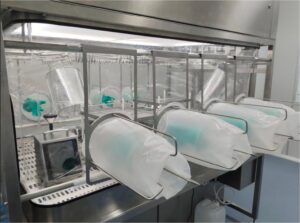
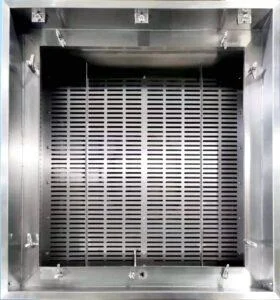
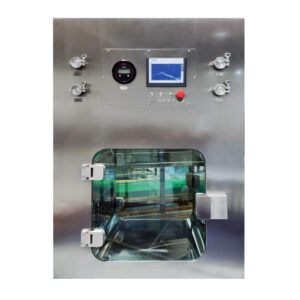
BIBO housings address this condition structurally rather than procedurally. The access door incorporates a positively pressurized bagging port. Before the door is opened, a containment bag is locked and sealed over the port, creating an enclosed environment around the filter cavity. The used filter is then manipulated into the bag without ever entering the open service area. The bag is sealed, detached, and disposed of as a contained waste unit. The service area is never exposed to the filter or the housing interior during the change.
The operational consequence of that difference matters most when the contaminated filter cannot be treated as ordinary solid waste. If the collected material includes pharmaceutical actives, biological agents, toxic dusts, or chemical residues, the absence of containment during filter change creates an exposure pathway that PPE alone is not designed to eliminate. Standard housing in that context is not a lower-cost equivalent — it is a structurally different service condition that carries a different exposure profile.
| الميزة | السكن القياسي | إسكان بيبو |
|---|---|---|
| Containment During Filter Replacement | None; filter and open housing are exposed to the service area | Full containment via locking and bagging mechanism, isolating contaminated components |
| مخاطر تعرض المشغلين للمخاطر | High; PPE required, risk of area contamination | Minimal; sealed bag change-out prevents direct contact and airborne release |
| Change-Out Procedure | Direct access with environmental precautions | Attach containment bag, remove filter inside the bag, seal, and dispose safely |
| الآلية الرئيسية | No dedicated containment hardware | Positively pressurized bagging port built into the access door |
What the table cannot carry is the practical point about verification: BIBO systems also allow filter integrity testing to be performed without breaking containment, which matters in applications where validation testing is part of the maintenance cycle. In standard housing, any pre-removal testing that requires partial access to the housing creates the same open-housing exposure condition as filter removal itself. That limitation is invisible in a specification sheet but becomes operationally significant when a validation protocol requires documented filter testing before and after change-out.
Used-Filter Exposure Risk During Maintenance
The exposure event in a standard housing installation is not a hypothetical edge case — it is the predictable consequence of the design. When a technician opens a standard housing to remove a spent filter, two conditions are simultaneously present: the contaminated filter surface is exposed to ambient air, and the housing interior, which may carry accumulated particle load on walls and baffles, is open to the service space. The degree of risk depends on what the filter has been collecting, but the exposure pathway itself exists in every standard housing change-out regardless of application.
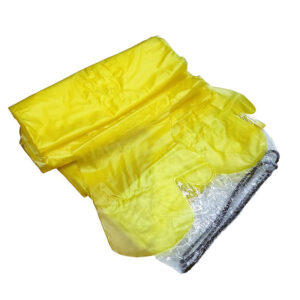
In a BIBO system, the PVC change-out bag is the physical barrier that breaks that pathway. The bag attaches to the housing, the filter is drawn into it under controlled conditions, and the bag is sealed before any disconnection from the housing occurs. The airtight seal is maintained throughout handling and disposal. This is not a procedural enhancement layered on top of a standard housing design — it is a fundamentally different hardware architecture that makes containment independent of technician technique or PPE selection.
That distinction matters for a specific reason: contamination control programs in pharmaceutical, biotech, and regulated manufacturing environments are typically required to demonstrate that exposure controls are engineered, not behavioral. Relying on a technician correctly donning PPE and following an ad hoc removal procedure does not produce the kind of documented, repeatable containment evidence that a quality audit or facility inspection expects to find. A BIBO system, with its integrated bagging port and documented change-out procedure, produces a defensible maintenance record. A standard housing with improvised PPE controls does not.
إن BIBO replacement procedure is worth reviewing before specifying a system, because the workflow requirements — bag attachment, pressurization, filter manipulation, seal verification — represent real operational steps that need to be built into the maintenance program from the outset, not discovered during the first change.
Cost And Complexity Tradeoff Of Safe-Change Containment
BIBO housings carry a higher unit purchase price than comparable standard housings, and that price gap is real and consistent across most procurement comparisons. The contributing factors are material grade — stainless or powder-coated steel versus lighter standard construction — and the containment hardware built into the access door and bagging port. For a budget owner reviewing line items, the purchase price difference between housing types is visible and easy to compare. The downstream cost difference is neither.
What does not appear in a purchase price comparison is the cost of technician training specific to the BIBO bagging procedure. Standard filter change-out is a basic maintenance skill. BIBO change-out requires training in bag attachment, pressurization verification, filter manipulation within the bag, and seal confirmation before disconnection. Facilities that specify a BIBO system without building that training requirement into the maintenance program will encounter it operationally — either through a compromised change-out or through a delay while competency is established after the fact.
The lifecycle side of the trade-off runs the other direction. BIBO housings, based on manufacturer design figures and typical service experience, are commonly cited as capable of 10 to 15 or more years of service with proper maintenance. That figure is a planning input, not a certified lifespan standard, but it affects how the cost comparison should be structured. A higher-upfront BIBO housing amortized over a 12-year service cycle looks different from the same purchase price viewed as a single procurement event. Retrofit feasibility adds another variable: BIBO systems can be adapted into existing HVAC infrastructure, but the integration requires design review and space planning. It is not a direct dimensional swap in most cases, and treating it as one during early project budgeting is a common source of installation cost overruns.
| أسبكت | السكن القياسي | إسكان بيبو |
|---|---|---|
| التكلفة المقدمة | Lower purchase price; simpler construction | Higher purchase price; stainless or powder-coated steel and containment hardware |
| Durability / Lifespan | Typically lower material grade; standard duty cycle | Stainless/coated steel; 10–15+ year service life with proper maintenance |
| تدريب الفنيين | Basic filter change procedure sufficient | Special training required for safe bagging and sealed change-out workflow |
| Retrofit Feasibility | Generally a straightforward swap in standard HVAC | Requires design adjustments and space planning; not always a direct replacement |
The structural problem in most procurement processes is that the budget owner who approves the housing specification is rarely the person who will manage filter changes five years later. The purchase price comparison looks favorable for standard housing right up until the facility team inherits an application where safe filter maintenance is not possible without the containment architecture they were never given. At that point, the cost of the original price saving is a retrofit, a design review, and a period of non-compliant maintenance in the interim.
Facility Acceptance Problems From Under-Specified Housing
The most difficult consequence of selecting standard housing for a contaminated exhaust application is that it stays invisible until the first maintenance event. The installation qualifies, the filters pass initial integrity testing, the system operates normally, and nothing reveals the specification gap until a technician attempts the first filter change under actual working conditions. At that point, the housing type is fixed in the ductwork, the service access geometry is built into the facility, and changing it requires partial decommissioning of the installation.
This is not a low-probability scenario. It follows directly from a procurement process where containment requirements are evaluated at purchase rather than at maintenance. Applications handling pharmaceutical powders, biological exhaust, chemical process air, or toxic dust streams require contamination control during filter replacement that standard housing cannot provide by design. When those applications are equipped with standard housing — often because the purchase-price comparison was the primary selection input — the facility team receives an installation that is mechanically functional but operationally unserviceable under any formal contamination control standard.
The downstream effects compound. A facility that cannot perform filter changes safely cannot maintain the filtration system on schedule, which creates a secondary problem with system performance documentation. If the installation supports a cleanroom or controlled environment, a deferred or procedurally compromised filter change may conflict with the maintenance record requirements that support ongoing qualification. The HEPA filter maintenance considerations relevant to controlled environments make clear that documented, repeatable maintenance procedures are part of the operational record — not an administrative formality. An installation that forces ad hoc workarounds during filter change produces a maintenance record that is difficult to defend in an audit context.
The misalignment between purchase decision and service consequence is not unique to housing selection, but it is particularly acute here because the correction is structural, not procedural. Adding PPE to a standard housing maintenance procedure does not produce containment — it produces a different level of individual protection while leaving the area exposure pathway open. Correcting the specification after installation requires hardware, not protocol.
Selection Boundary Before Choosing Standard Or BIBO Housing
The selection decision is not primarily a feature comparison — it is a hazard assessment. The question that determines which housing type is appropriate is whether the used filter, after it has been in service, can be handled by a technician and removed through the service area without creating an unacceptable exposure condition. If the answer is yes, standard housing is likely appropriate. If the answer is no, or if the application involves materials where that exposure would require contamination control documentation, BIBO is the correct specification.
That boundary is not always defined by a single governing standard that applies uniformly across industries. In pharmaceutical manufacturing, the contamination control requirements that govern filter maintenance are typically embedded in quality management frameworks and facility-specific validation documentation. In biological research environments, biosafety guidelines such as those developed within the CDC’s BMBL framework inform how hazardous exhaust streams should be managed at the equipment level. In semiconductor and precision manufacturing, the driver is more likely particle control during maintenance than personnel protection, but the housing selection logic follows the same structure: what happens to the service environment when the filter is removed? ICH Q9(R1)’s risk management principles are directly applicable here — the decision framework is risk-based, requiring assessment of contaminant type, probability of exposure during maintenance, and the severity of that exposure, rather than a lookup against a single required-equipment list.
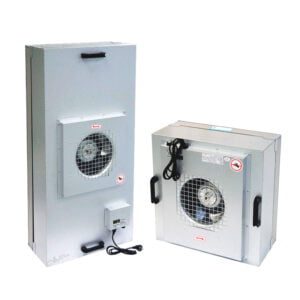
إن Bag-In-Bag-Out BIBO housing serves applications where the contaminant type, regulatory environment, or maintenance exposure conditions place the installation above the standard housing threshold. Standard housing — for example, a HEPA box terminal unit supplying clean supply air in a non-hazardous cleanroom — serves applications where that threshold is not reached and where filter change-out produces no meaningful exposure hazard to the technician or the service area.
| الحالة | Select | Why |
|---|---|---|
| Used filter cannot be exposed directly to technicians or the service area | بيبو | Containment prevents contact and area contamination |
| Handling toxic dust, pharmaceutical powders, biological contaminants, chemical substances, or nuclear particulates | بيبو | Essential for hazardous material applications; standard housing unsafe |
| Filtered air is non‑hazardous and no exposure risk exists | قياسي | Standard filtration sufficient; no safe‑change containment needed |
| Safety regulations or contamination control standards require enclosed filter change | بيبو | Compliance is often mandatory, not optional; systems built to pressure‑integrity and leakage standards |
Selecting incorrectly in either direction carries a real consequence. Specifying BIBO for a non-hazardous application adds cost, training burden, and workflow complexity where none is warranted. Specifying standard housing for an application above the exposure threshold creates the maintenance and compliance problems described throughout this article. The review check before finalizing a specification should cover three questions: what is the application collecting, what exposure condition does filter removal create, and does the regulatory or quality framework governing this installation require documented containment during maintenance? Answering all three before procurement is far less expensive than answering them after installation.
The most important practical implication of this comparison is that housing type determines maintenance serviceability, not just installation cost. A standard housing installed in a contaminated exhaust application will operate correctly until the first filter change — and then create a problem that cannot be resolved without hardware modification. Identifying the service condition before procurement is the only stage at which the correction is straightforward.
Before finalizing a specification, confirm the contaminant profile of the air stream the filter will be handling, verify whether filter change-out in that application requires documented containment, and determine whether the facility has — or can build — the technician competency required to operate a BIBO system correctly. Those three inputs answer the selection question more reliably than any purchase price comparison.
الأسئلة الشائعة
Q: Can a BIBO system be retrofitted into an existing installation that was originally built with standard housing?
A: Retrofitting is possible but rarely straightforward. BIBO housings are not dimensional replacements for standard units — integrating one into an existing duct run requires a design review, space planning for the bagging port access clearance, and potentially partial duct modification. Facilities that budget a retrofit as a simple swap consistently encounter cost overruns. If there is any possibility the application will require containment during maintenance, specifying BIBO at initial installation is significantly less expensive than correcting it later.
Q: Does relying on upgraded PPE during filter changes make standard housing acceptable for contaminated exhaust applications?
A: No. PPE reduces individual exposure but does not contain the service area or prevent surface deposition of hazardous particles. More importantly, it does not produce the documented, engineered containment evidence that pharmaceutical, biotech, and regulated manufacturing facilities are required to demonstrate during audits. Regulatory and quality frameworks expect contamination controls to be built into the hardware, not dependent on technician behavior. Standard housing with PPE controls cannot satisfy that requirement regardless of the PPE specification.
Q: At what point does the higher upfront cost of BIBO housing stop being worth it on a lifecycle basis?
A: The crossover depends on how long the installation will remain in service and whether the application’s hazard profile is stable over time. BIBO housings are commonly designed for 10–15 or more years of service, which substantially changes the per-year cost comparison against standard housing. However, if an application is genuinely non-hazardous now and expected to remain so, the lifecycle math does not justify BIBO — the cost and training burden add no functional value. The lifecycle argument applies only when the hazard threshold that warrants BIBO is already met; it is not a reason to specify BIBO in applications where standard housing is appropriate.
Q: How should a facility approach the selection decision when the contaminant profile of the air stream is not fully characterized at the specification stage?
A: Treat an uncharacterized contaminant profile as a reason to apply the more conservative specification. If the materials being filtered cannot be confirmed as non-hazardous before procurement, the maintenance exposure risk cannot be assessed accurately either. Applying ICH Q9(R1) risk management logic to this scenario — weighing the severity of potential exposure against the cost of containment hardware — typically favors BIBO when uncertainty is present. Reversing a standard housing specification after installation is far more expensive than the cost difference between housing types at procurement.
Q: Who should be involved in the housing selection decision to avoid the misalignment between purchase price and service risk?
A: Both the budget owner and the facility or maintenance team should be part of the specification review before procurement is finalized. The structural problem identified throughout this article is that the person approving the purchase price comparison is rarely the person who will perform filter changes years later. Including the maintenance team at specification stage surfaces the operational questions — contaminant profile, change-out procedure requirements, technician training capacity — before they become hardware problems. The three questions to answer before finalizing any housing specification are: what is the air stream collecting, what does filter removal expose the technician and service area to, and does the governing quality or regulatory framework require documented containment during maintenance?
المحتويات ذات الصلة:
- مبيت مرشح BIBO للاستبدال الآمن لفلتر HEPA في البيئات الحرجة
- فهم BIBO | احتواء المواد الخطرة
- استبدال عادم عادم GMP Cleanroom HEPA: عندما تكون مبيتات BIBO ذات التغيير الآمن جديرة بالمواصفات
- أساسيات نظام BIBO | مبادئ نظام BIBO | مبادئ التصفية بالكيس داخل الكيس
- أنظمة وضع الحقيبة في الحقيبة | شرح أساسيات السلامة
- أنظمة إدخال الأكياس في الأكياس/إخراجها (BIBO): دليل التشغيل والصيانة
- كيف يعمل BIBO | دليل تقنية فلتر الاحتواء | دليل تقنية فلتر الاحتواء
- مبيت مرشح BIBO |مبادئ التصميم والمكونات
- أنظمة BIBO الخاصة بالمستشفيات | احتواء الرعاية الصحية