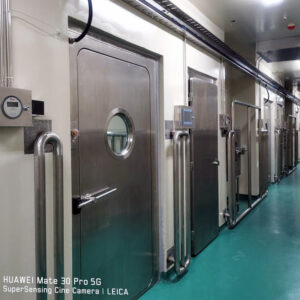
A door that passes dimensional checks at the factory can still fail the first commissioning pressure test on site—not because the door itself is defective, but because nobody tied the seal compression specification to the room’s actual operating pressure class before installation began. A perimeter gap as narrow as 0.5 mm can bleed roughly 0.3 m³/h at 15 Pa, which is enough to destabilize a pressure cascade that HVAC balancing alone cannot recover. The dispute that follows—product defect, installation error, or HVAC symptom—is harder to resolve when acceptance criteria never assigned accountability for that boundary in the first place. Understanding which checks belong to the factory, which belong to the site, and which depend on live pressure conditions is what separates a clean room release from a qualification hold.
Door acceptance starts with frame alignment and seal compression
Frame alignment is the first physical condition that every downstream check depends on. A door mounted out of plane with the interior wall surface creates a sealing geometry that no gasket specification can fully compensate for. Perimeter caulk fills the transition between frame and wall structure, but if the caulk is chemically incompatible with the room’s disinfection regime, it will degrade, crack, and shed—turning what appeared to be a sealed joint into a distributed particle trap that only becomes visible during an audit.
Gasket compression recovery is a procurement and inspection criterion, not a number derived from a specific regulatory clause. A recovery figure of at least 80% over a service life of three to five years functions as a degradation signal: when a gasket falls below that threshold, leakage begins to increase at a rate that compounds with every door cycle. This means the acceptance check at handover is not a one-time pass/fail—it establishes a baseline against which future maintenance inspections should measure.
The threshold choice between raised and flush designs carries consequences that extend well beyond handover. A raised threshold is mechanically simpler and provides a positive physical seal, but it creates a cleaning ledge, a trip hazard, and resistance to wheeled material transport that accumulates friction over the room’s operational life. A flush threshold eliminates those problems but demands an automatic drop seal whose performance depends directly on closer speed calibration—and a drop seal that deploys too slowly or incompletely under operating pressure conditions is functionally equivalent to no bottom seal at all. Neither design is universally correct; the choice must be documented in the acceptance package with the specific sealing consequence of each option acknowledged.
| Acceptance Check | Required Specification | ما أهمية ذلك |
|---|---|---|
| محاذاة الإطار | Installed flush with interior wall; no gaps | Prevents particle traps and supports cleanability |
| Perimeter Sealing | Non-shedding caulk compatible with cleaning agents | Incompatible caulk degrades and creates particle traps |
| Gasket Compression Recovery | ≥80% recovery; 3–5 year service life | Lower recovery leads to increased leakage over time |
| Perimeter Gap Allowance | No continuous gap exceeding 0.5 mm (leaks 0.3 m³/h at 15 Pa) | Disrupts room pressure cascades and contamination control |
| Threshold Type Decision | Raised (trip hazard/transport obstacle) vs. flush (requires more sophisticated sealing) | Affects safety and contamination control; must be documented |
Hardware checks for hinges, closers, tracks and thresholds
Hardware mounting is where a GMP cleanability requirement gets misread as an aesthetic preference during procurement, and that misreading has audit consequences. Under EU GMP Annex 1, surfaces in controlled environments must be smooth, non-shedding, and cleanable—and any hinge recess, closer bracket ledge, or track profile that creates a horizontal surface becomes a particle trap by definition. A recessed hinge that passes visual inspection at handover will almost certainly appear as a finding at the first internal audit, at which point the remediation cost is significantly higher than specifying a flush-mounted alternative from the start.
Closer speed is directly linked to seal integrity under operating pressure. A door that closes too slowly allows pressure equilibration across the opening before the seal engages. A door that closes too fast may rebound, leaving the latch unset. The correct closer speed for a given door must be calibrated against the pressure differential it will operate under—not set to a generic factory default and left. For airlocks and rooms with automatic door sequences, this calibration should be verified as part of operational testing, not assumed from the hardware manufacturer’s data sheet.
For interlocked airlock doors, emergency override is a dual-compliance requirement covering both life safety codes and contamination control. The mechanism must allow egress without requiring the simultaneous defeat of the contamination barrier in a way that cannot be restored. Panic hardware, breakaway features, and exit signage must be integrated without introducing gaps or compressed-seal failures that create permanent leakage paths. Verifying that the emergency release functions correctly while the room is under operating pressure—not just in a depressurized state—is a check that frequently gets deferred and then becomes a handover dispute.
| Hardware Item | معايير القبول | Risk if Not Met |
|---|---|---|
| Hinges, Closers, Tracks | Mounted flush to frame; no recesses or horizontal ledges | Particle accumulation, GMP violation, difficult cleaning |
| Interlock Override Mechanism | Emergency egress without permanently compromising pressure cascade | Safety non-compliance; loss of contamination control during exit |
| Egress Hardware (panic bars, breakaway, signage) | Integrated without breaking door seal integrity | Leakage paths or failure to meet safety codes |
Pressure direction and leakage clues during operation
A door that looks finished and sealed will still reveal its real performance only under the room’s live pressure conditions. The most revealing early-stage field check is smoke visualization at the perimeter: under correct positive pressure, smoke should deflect away from the protected space at every gap location. Visible infiltration—smoke drawn inward at any point—signals either a seal failure or a pressure differential that has not been achieved. This is a screening method, not a formal qualifying test, but it can identify problems before a pressure decay test is set up and before particle count sampling begins.
The pressure differential targets set by FDA guidance (10–15 Pa), EU GMP Annex 1 (minimum 10 Pa), and USP <797> (≥5 Pa) are regulatory design targets for the room environment, not door-specific acceptance limits. Door leakage acceptance is tested against a different framework: leakage thresholds referenced at 50 Pa vary by ISO class, and a pressure decay test that holds within 10% over 15 minutes confirms combined enclosure integrity rather than door performance in isolation. Understanding which metric applies to which question prevents the common mistake of using a room-level pressure reading to declare a door acceptable when the actual leakage at the seal has not been measured.
For ISO 7 environments, particle counts near the door should return to baseline within 30 to 60 seconds of the door closing. Tighter ISO classes require faster recovery. If counts remain elevated beyond that window, the likely explanations are insufficient pressure differential at that point in the cascade, a seal leakage path allowing ingress from an adjacent lower-class space, or a closer that is not completing the cycle reliably. Each explanation points to a different responsible party, which is precisely why pre-agreed acceptance criteria—with leakage limits tied to the room’s pressure class and recovery time expectations documented before testing begins—reduce the scope of that dispute significantly.
| Test / Criterion | Applicable Standard / Class | العتبة |
|---|---|---|
| ISO 5 Air Leakage | ISO 5 | ≤0.1 m³/h at 50 Pa |
| ISO 6–7 Air Leakage | ISO 6–7 | ≤0.3 m³/h at 50 Pa |
| ISO 8 Air Leakage | ISO 8 | ≤0.5 m³/h at 50 Pa |
| Pressure Differential (FDA) | هيئة الغذاء والدواء | 10–15 Pa |
| Pressure Differential (EU GMP) | الملحق 1 لممارسات التصنيع الجيد للاتحاد الأوروبي | Minimum 10 Pa |
| Pressure Differential (USP <797>) | جامعة جنوب المحيط الهادئ <797> | ≥5 Pa |
| اختبار اضمحلال الضغط | Operational (general) | ≤10% drop over 15 minutes |
| Particle Recovery (ISO 7) | Near door vicinity | ≤30–60 seconds return to baseline |
For biosafety and containment applications where door leakage performance must meet more stringent requirements, the leakage classifications in ISO 14644-7 for separative devices provide a structured reference framework—though these apply to separative enclosures rather than conventional cleanroom doors and should be applied with that scope distinction explicit in the acceptance package.
Cleanability, damage and emergency release evidence
Surface roughness is a specification that procurement teams frequently accept on a nominal basis without confirming it against the room’s cleaning regime. A standard cleanroom door surface at Ra ≤0.8 μm supports routine cleaning with common disinfectants. In critical areas—particularly where VHP sterilization cycles are used—Ra ≤0.38 μm is a planning criterion worth specifying, because micro-surface texture that is acceptable under liquid disinfection can trap residuals under vapor-phase sterilization in ways that affect both cleaning validation and material compatibility. These are design specification figures, not universally mandated regulatory thresholds, but failing to specify the tighter value in a critical-area application creates a cleaning validation problem that is difficult to resolve after installation.
Vision panels are a frequently overlooked failure point for surface design. A vision panel that sits proud of the door face or recessed behind it creates a ledge regardless of which direction it protrudes. EU GMP Annex 1’s requirement for cleanable surfaces means flush-mounted panels with continuous, wipe-accessible perimeters are the only geometry that consistently passes audit scrutiny. Any door submitted for acceptance with a proud-mounted or recessed-frame vision panel should be flagged before sign-off, not noted for correction afterward.
Material selection has a binary consequence under GMP: wood and certain plastics are incompatible with controlled environments because porosity and particle shedding cannot be remediated by surface treatment. This is not an aesthetic concern—it is an audit risk grounded in contamination control principles supported by EU GMP Annex 1. If a door arrives on site with a material certification that does not address GMP suitability, or if a material is substituted late in the supply chain without updated certification, the entire acceptance package should be held until material conformance is re-established. Emergency release hardware made from incompatible materials on an otherwise compliant door creates the same risk.
| المتطلبات | المواصفات | ما أهمية ذلك |
|---|---|---|
| Surface Roughness (standard) | Ra ≤0.8 μm | Easier cleaning; less contaminant harboring |
| Surface Roughness (critical) | Ra ≤0.38 μm | Needed in critical areas to minimise micro-contamination |
| التصميم | No horizontal ledges, grooves, or recesses; vision panels flush | Prevents particle traps; meets GMP requirements |
| توافق المواد | Non-porous, non-shedding; resistant to chlorinated disinfectants and VHP | Prevents degradation and particle shedding under cleaning |
| Prohibited Materials | No wood or certain plastics | Porosity and particle shedding incompatible with GMP and sterilization |
Door sign-off criteria before airlock or room release
Sign-off delays cluster around incomplete documentation rather than failed performance tests, and the IQ/OQ/PQ sequence is where that pattern becomes visible. Installation Qualification checks—dimensional conformance, surface Ra values, material certifications, CAD drawing alignment—are verifiable before the HVAC system is commissioned. Operational Qualification checks—interlock sequencing, opening and closing speeds, seal compression under pressure, pressure maintenance during cycling—require the room to be under active pressure conditions. Performance Qualification—particle count studies, continuous pressure monitoring under operational use—requires a functioning, balanced environment. Conflating these phases, or attempting to complete OQ checks before IQ documentation is closed, is the single most common source of room release delays.
The documentation package itself is an acceptance criterion. Mill test reports confirming material composition, surface Ra measurement records, performance test data at multiple pressure differentials, fire rating certificates where required, dimensional drawings, and compliance statements referencing applicable standards—any gap in this set is a valid reason to withhold sign-off. The incomplete document is not a minor administrative omission; it is the evidence record that supports the room’s qualified status through its operational life and through future regulatory inspections.
| مرحلة التحقق من الصحة | ما الذي تتحقق منه | Typical Checks |
|---|---|---|
| تأهيل التركيب (IQ) | Dimensions, surface finish, material documentation | Dimensional conformance, material certificates, surface Ra values |
| التأهيل التشغيلي (OQ) | Interlock sequencing, opening/closing speeds, seal compression, pressure maintenance | Functional tests under no-load and pressure conditions |
| تأهيل الأداء (PQ) | Particle count studies, continuous pressure monitoring | Performance under actual operating conditions |
Several disputes recur at sign-off and are easier to resolve when they are pre-identified in the acceptance criteria rather than discovered during final review. A supplier’s marketed leakage performance may reflect nominal values rather than tested minimums at operational pressure differentials—requesting third-party test data at multiple differential pressures before contract award closes that gap. Fire-rated doors are sometimes specified to meet building code requirements without confirming that the fire-rated assembly maintains cleanroom-compatible surface geometry and seal behavior; both ratings must be confirmed, and the two are not automatically compatible.
| Dispute Area | What Is at Stake | ما الذي يجب توضيحه |
|---|---|---|
| Marketing claims vs ISO compliance | Advertised performance may not reflect tested leakage | Request third‑party performance test data at multiple pressure differentials |
| Low upfront cost vs total lifecycle cost | Cheaper doors may lead to higher maintenance and seal replacement costs | Confirm lifecycle cost estimates and warranty terms |
| Nominal specs vs guaranteed minimums | Nominal leakage values may be misleading | Ask for guaranteed maximum leakage under operational pressures |
| Fire rating vs cleanroom rating | Fire‑rated doors may have features that compromise cleanability | Confirm both fire rating and cleanroom suitability |
Ongoing verification frequency should be established in the acceptance package rather than deferred to the maintenance plan. Annual reverification is generally acceptable for most applications, but ISO 5–6 environments where seal degradation can affect product exposure risk should be scheduled for quarterly re-testing. Setting that interval at handover—rather than leaving it to the facility team to determine later—means the degradation monitoring program starts with the room’s qualification baseline intact.
The clearest pre-procurement action is to write leakage limits, seal compression recovery expectations, and pressure decay criteria into the equipment specification before requesting supplier quotes—not after delivery. A door that arrives without those parameters pre-agreed forces the acceptance team to evaluate performance against criteria nobody committed to, which is how disputes about product defect versus installation problem versus HVAC symptom become unresolvable at commissioning.
Before releasing any airlock or pressure-cascade room, confirm that IQ documentation is closed and complete, that OQ testing was conducted under live pressure conditions rather than in a depressurized state, and that PQ particle recovery times are recorded against the specific ISO class the room is qualified for. For projects where cleanroom doors and windows أو أبواب السلامة البيولوجية محكمة الإغلاق are being specified, the same acceptance logic applies: the specification that matters is the one tied to the room’s operating conditions, not the one that looked adequate on a factory data sheet.
الأسئلة الشائعة
Q: What happens if the HVAC system hasn’t been balanced yet — can door acceptance testing still proceed?
A: IQ-phase checks can proceed, but OQ and PQ testing cannot produce valid results without a balanced, pressurized environment. Seal compression, closer calibration, interlock sequencing, and pressure decay testing all depend on the room operating at its design differential; running those checks in a depressurized or unbalanced state produces data that cannot be used to qualify the room and will need to be repeated, which is one of the most common sources of commissioning delay.
Q: If a door passes the pressure decay test, does that confirm the door seals are performing correctly?
A: Not in isolation. A pressure decay test measures combined enclosure integrity — walls, penetrations, and doors together — not door seal performance as a discrete variable. A door with a measurable leakage path can still allow the room to pass the 10%-over-15-minutes decay criterion if the rest of the enclosure is sufficiently tight. Confirming door seal performance specifically requires leakage measurement at the door perimeter under the operating pressure differential for that ISO class, which is a separate and more targeted test.
Q: At what point does a door problem become the HVAC contractor’s responsibility rather than the door supplier’s?
A: The accountability boundary depends on what was pre-agreed in the acceptance criteria. If leakage limits, seal compression thresholds, and pressure recovery times were specified and assigned before installation, a failure can be traced to its likely cause — seal geometry, installation alignment, or insufficient differential pressure. Without those pre-agreed criteria, a door that leaks under operating conditions generates a three-way dispute between the door supplier, the installer, and the HVAC contractor that has no clean resolution because no party accepted accountability for the boundary condition at contract stage.
Q: Is a fire-rated door automatically compatible with cleanroom seal and surface requirements?
A: No, and this is one of the most commonly deferred conflicts at sign-off. Fire-rated door assemblies are tested and certified under a different performance framework than cleanroom doors; a door that meets fire code may have surface geometry, frame details, or seal configurations that are incompatible with GMP cleanability requirements or the room’s leakage class. Both ratings must be confirmed independently, and any door submitted under a fire rating without accompanying cleanroom compliance documentation should be held for separate surface finish and seal performance verification before sign-off.
Q: How should re-testing intervals be set for doors in ISO 5–6 rooms if the facility’s maintenance plan hasn’t been written yet?
A: Set the interval in the acceptance package itself rather than leaving it to the maintenance planning phase. For ISO 5–6 environments, quarterly re-testing is the appropriate starting frequency given the contamination exposure risk if seal degradation goes undetected. Deferring that decision means the room’s first reverification may happen at an arbitrary interval chosen without reference to the qualification baseline, which weakens the degradation monitoring program and creates a gap in the evidence record that regulators may question during inspection.