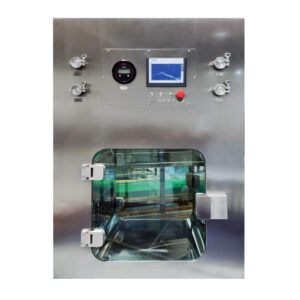
Procurement teams that conflate operator containment with product protection often arrive at commissioning with a booth designed for neither objective clearly. The pressure concept gets specified too early—negative pressure selected by default—before anyone has mapped whether the material is hazardous to operators, sensitive to environmental ingress, or both simultaneously. When the booth is installed and the room’s HVAC cascade is tested, the exhaust path is undersized, adjacent clean zones drop in grade, and the validation schedule absorbs the retrofit cost. The decision that resolves this is not which pressure mode to select, but which protection target takes priority, because that target determines every downstream specification from airflow concept to filter configuration to cleaning validation approach.
Dispensing booth role in product and operator protection
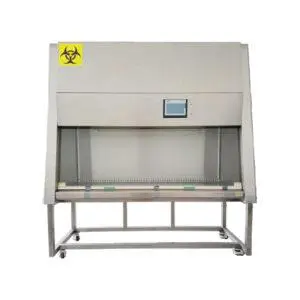
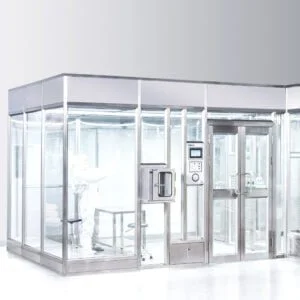
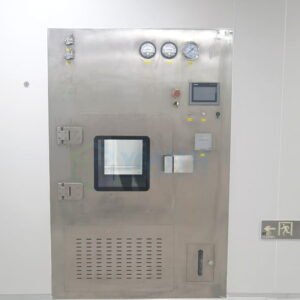
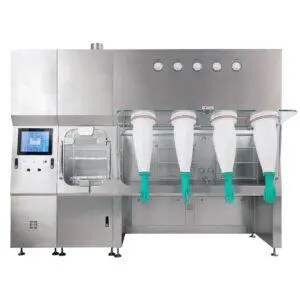
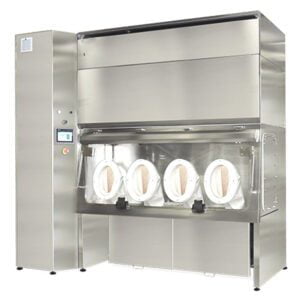
A dispensing booth in a pharmaceutical facility is not a single-purpose enclosure. The operational intent spans four protection directions simultaneously: the material being dispensed is protected from personnel-generated contamination and environmental particle ingress; the surrounding cleanroom environment is protected from dust and particulates generated during dispensing; and the operator is protected from exposure to the material itself. In practice, these objectives can conflict with each other, and a booth designed to optimize one without examining the others will create measurable gaps when the process runs under production conditions.
The most useful way to frame the booth’s role early in a project is to separate which of these protections is driven by product quality risk and which is driven by occupational health or EHS classification. A product-quality argument for a dispensed active pharmaceutical ingredient focuses on preventing cross-contamination and maintaining particle count in the work zone. An occupational health argument for a potent or hazardous API focuses on limiting operator inhalation exposure. These are not interchangeable requirements, and they do not always resolve to the same booth configuration.
Where both are required simultaneously, the design must balance a contained work zone—typically targeting ISO Class 5 conditions in the dispensing area—against a background cleanroom that may operate at a lower classification such as Grade D or an equivalent ISO class. That compatibility between booth performance and background grade is a planning convenience, not a regulatory mandate. It means the booth can, under the right design conditions, provide a substantially cleaner local environment within a less stringently classified room. But claiming that capability requires the booth to actually deliver and maintain the work-zone classification under operational loading, not just at rest after certification.
Negative pressure and downflow decisions for pharma dispensing
The selection between negative pressure, neutral, and positive pressure concepts for a dispensing booth is not a stylistic preference. It is a protection-target decision with direct consequences for operator safety, product exposure risk, and room pressure stability.
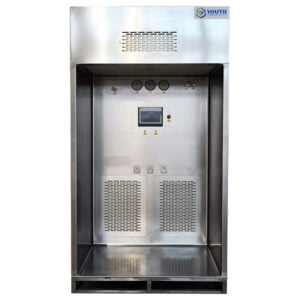
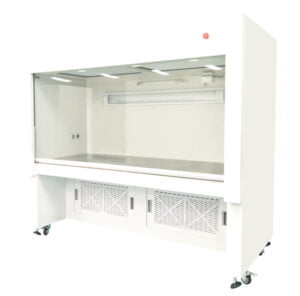
Negative pressure draws airborne particles inward toward the return and exhaust filters, away from the operator’s breathing zone. When combined with HEPA-filtered vertical laminar downflow—a design configuration where a portion of the recirculated air bleeds outward through an exhaust to sustain negative differential—it creates a contained work zone while managing particle dispersal. One manufacturer design approach divides the filtered air supply into approximately 90% recirculated as vertical laminar downflow into the working zone, with 10% bled through the exhaust outlet to maintain the inward pressure differential. A unidirectional downflow velocity of 0.45 m/s ±20% is cited as the design figure for maintaining ISO Class 5 conditions within the work area. These are manufacturer design parameters, not universal regulatory thresholds, and should be verified against the specific process and room conditions during commissioning rather than accepted as given.
الضغط السلبي serves containment, not product protection; mixing the two objectives without separating the pressure logic first creates configurations that satisfy neither.
The failure mode that repeatedly appears during commissioning is that negative pressure, properly maintained inside the booth, creates a net exhaust demand the background cleanroom’s HVAC system was not balanced to absorb. If the exhaust path from the booth is undersized or improperly integrated into the room’s return-air network, the room pressure cascade can shift, compromising the differential between adjacent grades. This is not a hypothetical commissioning risk—it is the predictable result of specifying the booth pressure concept before the room’s pressure relationships and supply/exhaust capacities are mapped.
The table below structures the pressure-concept decision by protection priority. Use it to identify which configuration matches the process risk, and what each configuration leaves exposed.
| Protection Priority | Recommended Pressure Concept | Airflow Justification | الاعتبارات الرئيسية |
|---|---|---|---|
| Operator containment from hazardous dusts | Negative pressure with HEPA-filtered unidirectional downflow | Negative pressure draws airborne particles away from the operator; 0.45 m/s ±20% downflow maintains ISO Class 5 work zone; 10% exhaust bleed sustains inward leakage | May challenge room pressure balance; ensure exhaust path is correctly sized and does not disturb adjacent clean zones |
| Product protection from environmental contamination | Neutral or positive pressure (turbulent or unidirectional, depending on product risk) | Positive pressure prevents ingress of room contaminants; airflow pattern chosen per product exposure sensitivity | Operator may be exposed to product dust; not suitable for potent/hazardous APIs without additional containment measures |
| Both operator and product protection are critical | Negative pressure envelope combined with HEPA unidirectional downflow (recirculating with exhaust bleed) | Creates a contained ISO Class 5 zone: negative pressure contains operator exposure, while vertical laminar downflow protects the product | Requires careful balancing of downflow velocity, return air path, operator movement, and room pressure cascade to avoid cross-contamination |
For processes where both operator and product protection are critical, the combined negative-pressure envelope with HEPA-filtered downflow is the appropriate direction, but it carries the most integration complexity. Operator movement through the booth opening, waste removal paths, and the booth cycling on and off all affect whether the negative differential is stable during actual use—not only under static test conditions. These dynamics should be part of the airflow and pressure verification protocol, not discovered after occupancy.
HEPA filtration and cleaning interfaces that affect GMP operations
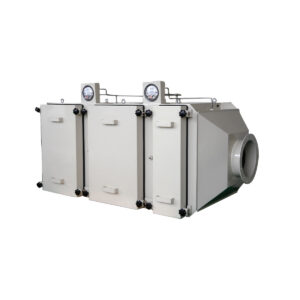
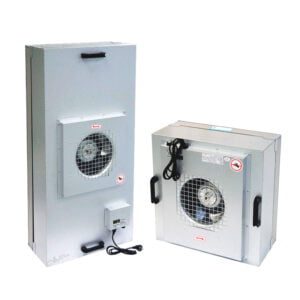
The filtration configuration inside a dispensing booth determines both the air quality delivered to the work zone and the maintenance and verification burden the facility carries across the equipment’s service life. A multi-stage arrangement—typically a coarse pre-filter, an intermediate bag filter, and a final H14 HEPA—protects the HEPA element from premature loading by coarser particles, which extends service life and defers the validation work required at each filter change. The final H14 HEPA filter, gel-sealed and mini-pleated in more demanding configurations, offers efficiency of 99.995% at 0.3 μm as a manufacturer design figure. An ULPA upgrade may be available where the process risk justifies it.
What matters operationally is not the published filter efficiency but whether the installed filter can be tested in place to verify that the seal and media remain intact after installation and after any maintenance event that disturbs the filter housing. This requires aerosol challenge access—stainless steel PAO injection and DOP detection ports built into the booth housing. The presence of these ports enables in-situ leak testing of the installed HEPA filter per relevant test frameworks such as ISO 14644-3. Their presence does not itself satisfy the integrity verification requirement; a test must be conducted and recorded as part of installation qualification and repeated whenever the filter or housing has been disturbed.
Filter integrity test access enables the IQ/OQ evidence needed for GMP review, but only if the access design is compatible with the aerosol injection method being used.
The cleaning interfaces of the booth are as consequential for GMP compliance as the filtration performance. Internal surface geometry determines whether manual cleaning is practical and whether residue accumulates in locations that a GMP audit will examine. Fully welded stainless steel construction—SUS304 or SUS316L depending on chemical exposure and process requirements—with rounded coved corners and seamless interiors eliminates particle traps and makes cleaning validation straightforward. A booth with internal ledges, exposed fasteners, or dissimilar surface finishes at joints will create cleaning validation gaps that are difficult to close without disassembly, which in turn disrupts filter integrity and triggers re-testing.
| ميزة التصميم | المواصفات / التفاصيل | GMP Benefit |
|---|---|---|
| الترشيح المسبق | G4 pre-filter + F8 bag filter | Protects the HEPA final filter from coarse contaminants, extending service life and maintaining air quality |
| HEPA final filter | Gel-sealed mini-pleated H14 HEPA, ≥99.995% efficiency at 0.3 μm; optional ULPA upgrade | Delivers ISO Class 5 (or better) air to the work zone; gel seal ensures leak-free installation |
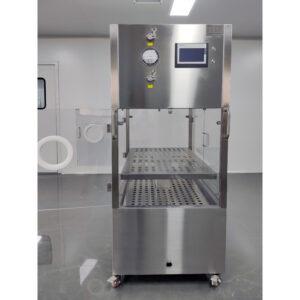
| Filter integrity test access | Stainless steel PAO and DOP detection openings | Enables in-situ aerosol challenge testing of the installed HEPA filter to verify integrity per GMP requirements |
| Chamber material | Fully welded SUS304 or SUS316L stainless steel | Corrosion-resistant, smooth, and chemically compatible; meets GMP material expectations for product-contact and cleanroom use |
| Internal surfaces | Rounded coved corners, seamless interiors | Eliminates particle traps and facilitates effective manual cleaning and disinfection, supporting contamination control |
The table above maps design features to their GMP function. When reviewing a booth specification against your cleaning validation plan, check that the internal drainage concept, disassembly sequence, and surface material are all compatible with the cleaning agents and frequencies your validated cleaning procedure requires before procurement, not after installation.
Pressure-concept risk when containment and product protection are mixed
The booth configurations that attract the most post-commissioning remediation work are those where the specification assumed negative pressure would serve both containment and product protection simultaneously without examining whether the pressure concept could be sustained when the booth cycled between operational states.
One design intent cited for engineered dispensing booths is that the booth’s on/off state should not disturb the airflow pattern or pressure of the background cleanroom. This is a meaningful design claim, but it is a planning criterion requiring verification during IQ/OQ, not a guaranteed outcome. When a negatively pressurized booth shuts down, the exhaust bleed stops. If the room’s supply/return balance was compensating for the booth’s exhaust demand, the room pressure can shift measurably. This shift may be acceptable within the room’s grade tolerances or it may not be—that judgment requires a test with the booth cycling under representative conditions, not an assumption based on the manufacturer’s design intent.
The deeper risk arises when containment and product protection are treated as if they resolve to the same pressure concept by default. A potent API that requires operator containment drives toward negative pressure. A sterile intermediate that requires protection from environmental contamination may be better served by a positive or neutral pressure arrangement. Combining both requirements in a single workstation without explicitly resolving the pressure-concept priority results in a configuration where the pressure differential is compromised in both directions: not negative enough to contain hazardous dust reliably, not positive enough to exclude environmental contamination effectively.
Treating pressure concept as a single-answer decision for mixed protection targets is the source of most booth retrofit findings at OQ.
The practical consequence is that when the booth is operated under production loading—operators reaching into the work zone, containers being opened and closed, waste being removed—the actual airflow behavior may differ substantially from the static test conditions. Operator movement disrupts the unidirectional profile. Waste removal paths introduce pressure momentary breaches. These dynamics must be identified and addressed during the airflow and recovery verification phase, and the results should inform both the SOPs and the operational training, not simply be recorded as “acceptable” against a static acceptance criterion.
Selection trigger after protection target and pressure concept are confirmed
Specifying a dispensing booth before the protection target and pressure concept are confirmed allows procurement to define the process risk rather than the other way around. The booth then arrives on site already committed to dimensions, airflow configuration, filter arrangement, and electrical services that may not match the process hazard, room layout, or validation expectations. Retrofitting a pressure concept after installation typically requires housing modification, new exhaust ducting, and repeat qualification—costs that could be avoided by resolving six items before issuing a URS.
The table below identifies those items, why skipping any of them creates downstream consequences, and what a usable specification entry looks like for each.
| Item to Confirm | ما أهمية ذلك | Example of What to Specify |
|---|---|---|
| Protection target | Determines whether product, operator, or both are the primary concern; wrong target leads to misapplied pressure concept | “ISO Class 5 product zone required, operator exposure limit below x µg/m³” |
| Pressure concept | Commits the booth to negative, neutral, or positive pressure regime and defines the exhaust/recycle ratio needed | “Negative pressure with 10% exhaust bleed, -5 Pa differential to background cleanroom” |
| Material hazard classification | Drives containment level, HEPA exhaust configuration, and waste handling path | “Handling OEB 3 and above powders; requires bag-in/bag-out HEPA exhaust” |
| Cleaning route | Influences booth access, internal drainage, material finish, and compatibility with CIP/WIP methods | “Full daily wipe-down with integrated drainage; no CIP; clean-in-place not required” |
| Acceptance checks | Defines the evidence needed at SAT/IQ/OQ/PQ to verify performance and GMP compliance | “Filter integrity (PAO), airflow velocity (0.45 m/s ±20%), particle count at rest, recovery test” |
| Additional URS details | Ensures the booth fits the facility layout, utility supplies, and monitoring expectations | “Custom width 2000 mm, height 2500 mm, integrated RH/temperature sensors, 230 V 50 Hz sockets” |
The items in the table are not equally weighted. Protection target and pressure concept must be resolved first because every other item depends on them. Material hazard classification determines whether the exhaust configuration needs bag-in/bag-out capability or continuous exhaust to a dedicated HVAC path—a structural decision that cannot be retrofitted cheaply. Cleaning route affects whether the internal drainage, floor slope, and access panels are designed into the booth at fabrication or become a GMP gap at cleaning validation. Acceptance checks must be defined before the SAT so that the factory test protocol uses the same criteria as the IQ/OQ—if they diverge, the factory evidence becomes difficult to use as installation qualification support.
Booth customization per URS is a practical expectation, not a premium option. Dimensions, pressure sensor locations, integrated temperature and humidity monitoring, and electrical outlet configurations all influence whether the booth fits into the facility’s monitoring architecture and whether the qualification evidence maps cleanly onto the site’s validation master plan. The time to define these details is before the URS is issued, when the supplier’s design process can accommodate them. Changes after fabrication begins are expensive, and changes after delivery are often structurally impossible without returning the unit.
Before committing to a dispensing booth specification, the protection target must be stated explicitly and the pressure concept must follow from it—not the reverse. A negative-pressure configuration with HEPA-filtered unidirectional downflow can serve containment objectives, but it introduces exhaust integration demands, room pressure cascade effects, and operational dynamics that must be verified at IQ/OQ rather than assumed from manufacturer design claims. The filter integrity test access, internal surface geometry, and cleaning validation compatibility are not secondary features; they determine whether the booth can be maintained and re-qualified through its service life without interrupting production or accumulating audit findings.
The selection checklist—protection target, pressure concept, material hazard classification, cleaning route, acceptance criteria, and URS details—is the sequence in which a defensible specification is built. Working through it in that order means the booth that arrives on site is sized, configured, and validated to the actual process risk, not to a default that procurement inherited from a previous project.
الأسئلة الشائعة
Q: Our facility already has a dispensing booth that was specified without a defined protection target. Can we retrofit the pressure concept, or is replacement required?
A: Retrofitting is sometimes feasible, but only if the existing housing, exhaust ducting, and room HVAC capacity can accommodate the required pressure relationship. Begin with a gap analysis comparing the installed configuration to the actual process hazard and product protection needs. If the booth structure can be rebalanced—for example, by adding an exhaust bleed or adjusting damper settings—without destabilizing the background room cascade, a retrofit may be viable. When the enclosure cannot create the necessary pressure differential without compromising adjacent clean zones, replacement is typically more cost-effective than attempting to modify a fixed design.
Q: Which IQ/OQ tests should confirm that the dispensing booth’s pressure concept does not disturb the background cleanroom cascade?
A: At a minimum, perform a dynamic pressure differential test with the booth cycling on and off while monitoring adjacent room pressures, plus a smoke visualization study to confirm airflow direction at operator access openings and waste removal paths. Recovery time tests after a simulated operator arm movement or access opening should verify that the booth returns to the target pressure differential within a defined acceptable period. These acceptance criteria must be set before factory acceptance testing so that factory evidence aligns with on-site OQ expectations.
Q: At what material hazard level does negative pressure become a mandatory requirement for a dispensing booth?
A: No single regulatory threshold applies universally, but negative pressure is typically indicated when the material’s occupational exposure limit falls below 10 μg/m³ (often categorized as OEB 3 or higher) or when the product is classified as highly potent by your EHS risk assessment. For materials with higher OELs or no inhalation hazard, a neutral or positive pressure concept may be acceptable if product protection is the primary concern.
Q: When is a dispensing booth a more sensible investment than upgrading the entire cleanroom to a higher classification?
A: A dispensing booth becomes the more economical choice when the high-grade aseptic requirement is confined to a small dispensing station and the surrounding room can remain at a lower classification such as Grade D. The booth consolidates cleanroom infrastructure costs to a localized zone, avoids the HVAC capacity expansion needed for a full-room upgrade, and allows the rest of the facility to operate with less stringent pressure and filtration demands—directly reducing ongoing energy, maintenance, and validation expense.
Q: For a facility performing only low-volume, non-hazardous powder dispensing, is a fully featured negative-pressure dispensing booth worth the cost?
A: Most likely not. If the material poses no operator inhalation risk and product protection is the sole objective, a simpler laminar downflow workstation without negative pressure will typically suffice. Invest in a negative-pressure dispensing booth only when containment of hazardous dust is driven by your EHS assessment or when regulatory requirements for cross-contamination control demand a verified inward pressure differential.