Teams that specify a cleanroom transfer cart by payload weight alone often reach commissioning before discovering the actual problem: the cart cannot complete the route. Tote height exceeds the interior clearance, the operator cannot reach the product at mid-route stops, or the unit fails to turn through the airlock with a full load and a second operator in position. At that point, the specification restarts with a longer lead time, a delayed validation schedule, and a supplier conversation that should have happened three months earlier. The decisions that prevent this are not complex, but they must happen in the right order — route geometry first, cart format second, accessories third.
Configuration questions that shape mobile cart selection
Every selection starts with three questions that need answers before a catalog dimension is meaningful: what is the payload geometry, what airflow direction does the application require, and which optional features must be integrated from the start. Teams that skip any one of these tend to loop back to them after a format decision has already been made — which is the point at which changes become expensive.
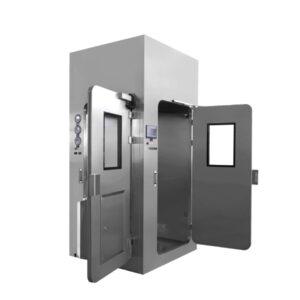
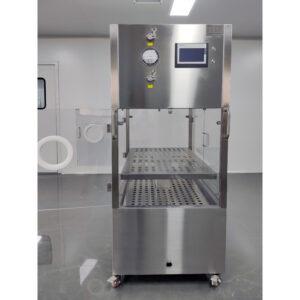
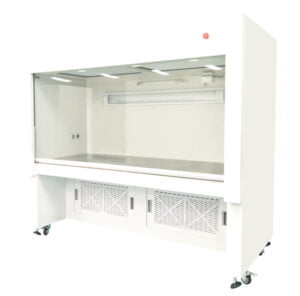
Usable interior dimensions for standard units span from approximately 600×610×670 mm up to 960×1530×1200 mm, with custom sizes available between those extremes. Those figures are manufacturer design parameters, not regulatory minimums, and they matter because payload geometry — not weight — is what determines whether a given cart interior actually fits the application. A vial tray and a filled equipment case may weigh the same; they do not occupy the same space, and they interact with airflow differently.
Airflow direction is an engineering choice with downstream consequences that are difficult to reverse once the unit is ordered. Horizontal flow keeps the working surface clear from the front, which suits smaller materials like vials or syringes where the airstream can sweep across the product plane without obstruction. Vertical flow is appropriate for larger or taller equipment where horizontal flow would be blocked by the load itself — but vertical flow also changes which surfaces the operator can use and where hands can be safely placed during transfers. Choosing the wrong direction does not simply reduce protection; it can create an ergonomic conflict at every stop on the route.
Optional upgrades — UV air purification, H14 filter specification, dual UPS — are the decisions that most reliably slow procurement when they are left open. Each one affects electrical load, filter housing dimensions, and in the case of dual UPS, the battery footprint and recharge logistics. If these are not resolved before the cart format is finalised, a second specification loop becomes almost certain.
| Decision Area | Options / Range to Clarify | التأثير على الاختيار |
|---|---|---|
| Cart dimensions | Standard usable sizes from 600×610×670 mm to 960×1530×1200 mm; custom sizes available | Must match payload geometry and route constraints |
| اتجاه تدفق الهواء | Horizontal (small materials, e.g., vials); Vertical (large equipment) | Wrong choice blocks airflow or limits product placement |
| Optional upgrades | UV air purification, H14 filter, dual UPS | Unresolved choices slow down specification |
Route width, payload geometry, and operator hand positions
Route geometry and operator positioning are planning inputs, not post-selection adjustments. A cart that fits the payload and clears the corridor width can still fail in practice if the handle placement forces operators into positions that are unsafe in tight turns, or if the front panel cannot be opened at a stop without the operator stepping out of the clean zone.
Front and rear handles enable two-operator manoeuvring in the configurations where it is required, but their placement directly affects route clearance. An operator at the rear handle adds body depth behind the cart; an operator at the front adds depth ahead of it. That combined footprint must be considered against every pinch point on the route — not just the widest corridor section but the tightest doorway, the airlock entry, and any right-angle turn.
The hinged or removable front panel matters most at transfer stops where the operator needs interior access without repositioning the cart or breaking workflow. If the panel design forces the operator to reach around or over the cart, the airflow boundary is disrupted at exactly the moment it matters most. The airflow direction selected during configuration determines which surfaces remain unobstructed for that access: horizontal flow leaves the front face as the primary operator interface, while vertical flow opens the top but may constrain lateral reach.
| ميزة التصميم | Impact on Transfer Operations | ما الذي يجب توضيحه |
|---|---|---|
| Front and rear handles | Enable safe two-operator manoeuvring | Affects clearance in tight corridors and turning stance |
| Hinged/removable front panel | Provides quick interior access at stops | Determines whether operators can reach payload without disturbing airflow |
| اتجاه تدفق الهواء | Horizontal flow prioritises different free surfaces than vertical flow | Wrong selection may block operator hand positions or product placement |
Weight-only sizing that misses real transfer constraints
The castor load rating on a standard mobile LAF cart — typically 250 kg per swivel castor — is a structural design figure. It confirms the unit can support the load without mechanical failure. It says nothing about whether the load fits inside the cart, whether the operator can reach it, how far the cart can travel before the battery is depleted, or whether the loaded unit can navigate the actual route.
Tote height is the constraint most often missed. A team confirms that the combined payload is within the weight limit, then discovers during staging that the tallest tote will not clear the interior ceiling of the cart. Internal height must be confirmed against the tallest item in the transfer set, not the average. Similarly, payload geometry affects operator reach: a load positioned at the back of a deep interior on a unit with horizontal airflow may require the operator to reach into the airstream in a way that undermines the protection the cart is intended to provide.
Turning radius is where weight-only sizing most visibly fails. Weight capacity is a static measurement; turning clearance is a dynamic one. The loaded cart, the operator stance, and the direction of approach all interact at each turn, and the result either clears the doorway or it does not. There is no partial credit in a narrow airlock.
Battery autonomy introduces a time-based constraint that weight specifications cannot capture. Standard battery runtime is approximately 30 minutes; extended configurations reach 100 minutes or, with dual UPS, up to 2–4 hours. If the transfer route has multiple stops, involves staging time at each stop, or cannot guarantee a mains connection along the way, the power duration becomes a hard operational limit. A cart sized correctly for weight and geometry will still fail the route if the battery runs out mid-transfer.
| Constraint Overlooked | Why Weight-Only Sizing Misses It | ما الذي يجب تأكيده |
|---|---|---|
| Tote height / payload geometry | Weight limit does not guarantee interior clearance | Internal cart height must accommodate tallest tote or equipment |
| Operator reach and hand position | Weight capacity ignores ergonomics | Handles, access panels and airflow direction must allow safe reach at each stop |
| Turning radius at doorways and airlocks | No route geometry in weight spec | Cart + operator stance must clear all doorways and tight turns |
| Battery autonomy on UPS | Weight rating says nothing about power duration | Transfer time and stops must fit within battery runtime (30 min–4 h) |
Narrow carts versus larger mobile workstations
The central trade-off in format selection is between a cart that moves freely through the route and one that provides enough staging surface to be operationally useful at each stop. Neither format is a default; the right choice is route-dependent, and getting it wrong in either direction creates a problem that cannot be resolved without replacing the unit.
A narrow transfer cart — approximately 800 mm in overall length — handles tight corridors and doorways with significantly more margin. For applications where the transfer involves a single tote or a small number of items that move directly from point A to point B without intermediate staging, the narrower format is the lower-risk choice for route clearance. The limitation is that it offers little working surface at stops, which may force operators to use adjacent surfaces that were not designed or qualified for that purpose.
A larger mobile workstation at approximately 1200 mm length and 960 mm width provides meaningful staging space and can support multi-item transfers or short-term work tasks at destination stops. The cost is reduced turning ability in narrow paths and airlocks. In a facility where corridors were designed for personnel flow rather than equipment transfer, that cost may be prohibitive. The staging capacity advantage of the larger format disappears entirely if the cart cannot complete the route.
| Selection Attribute | Narrow Transfer Cart | Larger Mobile Workstation |
|---|---|---|
| Overall length | approx. 800 mm | approx. 1200 mm |
| العرض | Typically narrower | 960 mm |
| Staging capacity | Limited; suited for single-tote transfer | Greater surface area for staging multiple items |
| Route flexibility | Easier turns in tight corridors and doorways | Turning ability reduced in narrow paths and airlocks |
For a detailed comparison of vertical and horizontal airflow configurations across these form factors, the إتقان التنقل في غرف التنظيف: عربات تدفق الهواء الصفحي العمودية والأفقية من YOUTH article covers the engineering differences that affect staging and route performance.
Brake and power choices that complicate specification
Brake style and power configuration are the two specification decisions most often left unresolved until after the cart format is chosen — at which point they can create a second procurement loop that delays the entire project. Both decisions directly affect how the cart performs at each stop on the route, and both interact with the format and size decisions already made.
The 360° swivel castors with a locking function provide the mobility that makes these carts useful in complex routes, but the locking mechanism must positively secure the cart at every loading and unloading stop. A cart that drifts under load while an operator reaches inside is a safety and contamination risk. Confirming that the brake design is appropriate for the floor surface and load weight on the specific route should happen during specification, not during commissioning.
Power configuration changes the operational logic of the entire transfer. The standard unit draws 220–240 V, 50 Hz, via a 3 m power cable. If the route includes stops near mains outlets and the transfer time is short, the cable may be sufficient. If the route passes through areas without accessible power, the unit must operate on stored UPS power for the full transfer duration. The standard 30-minute battery runtime may be adequate for short routes; longer or more complex routes require the extended 100-minute option or dual UPS configuration. Dual UPS also adds redundancy for safety-critical applications where power interruption during transfer would compromise the load.
The 8-hour full recharge time is an operational constraint that affects scheduling. A cart returned from a long-cycle transfer at the end of a shift may not be available for an early next-day deployment without overnight charging. That constraint should be confirmed against the facility’s transfer schedule before the UPS specification is finalised.
| Specification Decision | Available Options / Key Details | ما الذي يجب تأكيده |
|---|---|---|
| Brake type | 360° swivel castors with locking function | Locking mechanism must secure cart during every loading/unloading stop |
| UPS battery runtime | Standard 30 min; extended 100 min or 2–4 h (dual UPS); recharge 8 h | Battery life must cover maximum transfer time and staging duration without mains |
| Power source during use | Plugs into 220–240 V, 50 Hz, via 3 m cable, or operates on stored UPS | Determine whether route includes power outlets at stops or must stay on UPS |
إن عربة التدفق الهوائي الصفحي المتنقلة product page outlines the available power and brake configurations in detail, which is useful when confirming these choices against route-specific requirements.
Full-route turning limits that disqualify a cart design
A cart that cannot complete the real route under real operating conditions is the wrong cart, regardless of how well it satisfies every other criterion. That statement is not a preference — it is a disqualifying threshold that overrides payload fit, airflow selection, staging capacity, and power configuration.
The full-route turning check is a verification step that must happen before the purchase order is placed. Walking the route with the actual cart dimensions, the full payload, and at least one operator in transfer position is the only way to confirm clearance at every doorway, airlock transition, and right-angle turn. Corridor width at the widest section is not a reliable proxy for the tightest constraint on the route. Airlocks are frequently the binding constraint, particularly where the inner and outer doors reduce the effective turning radius to less than the cart’s own diagonal dimension.
ISO 14644-7:2004, which covers separative devices and their performance in controlled environments, establishes that such devices must function effectively across their intended operating conditions — not only in static configuration but throughout actual use. A cart that maintains valid airflow protection at the bench but disrupts that protection while navigating a difficult turn because the operator must reposition or tilt the unit fails the functional intent of the separative device, not only the mechanical clearance check.
The consequence of skipping this step is not limited to the inconvenience of a returned cart. A disqualified cart discovered after delivery triggers a respecification process, a new lead time, and in validated environments, a delay to the qualification schedule that can push downstream project milestones. The route walk should be documented with dimensions, photographs of tight points, and confirmed operator stance positions so that the specification can be directly defended against the physical constraints of the facility.
The most reliable way to avoid late-stage disqualification is to sequence the decisions correctly: route geometry and payload dimensions come first, then cart format, then airflow direction, then accessories and power configuration. Any cart under consideration should be tested against the tightest point on the actual route — with load in place and operator positioned — before the format is confirmed. That test is not a formality; it is the single check that overrides every other specification criterion.
Before finalising a procurement decision, confirm interior height against the tallest payload item, battery runtime against the longest expected transfer and staging time without mains access, and turning clearance at every airlock and doorway on the route. Those three confirmations will surface most of the specification conflicts that otherwise appear during commissioning, when the cost to correct them is highest.
الأسئلة الشائعة
Q: What happens if the facility’s transfer schedule doesn’t allow eight hours of overnight charging between shifts?
A: A dual UPS configuration is the practical solution, because it provides both extended runtime and redundancy — but it must be specified before the cart format is finalised, since the second battery pack affects the unit’s footprint and electrical load. If dual UPS is not viable, the transfer schedule itself must be restructured so that carts are returned to charge with enough lead time before the next deployment. Discovering this constraint after delivery means revisiting the power specification, which restarts part of the procurement process.
Q: Does the 250 kg per castor load rating change which brake style is appropriate for different floor surfaces?
A: Yes, and this is one of the specification decisions that should be confirmed against the actual facility floor before purchase — not assumed from the castor load rating alone. The 250 kg figure is a structural capacity, not a brake performance guarantee. Floor surface material, condition, and any slope at transfer stops all affect whether the locking mechanism will positively hold the loaded cart during operator reach. A brake that holds adequately on epoxy flooring may not perform the same way on an older raised-access floor or a threshold strip. Confirming brake suitability against the specific floor at each stop should be part of the route walk.
Q: If the route passes through both a narrow corridor and a large staging room, which format — narrow transfer cart or larger workstation — should take priority?
A: The tightest constraint on the route determines the format, not the most convenient one. A larger mobile workstation that cannot clear the narrow corridor is unusable regardless of how much staging space it provides in the destination room. The correct approach is to size the cart to the tightest turning point first, then assess whether the resulting format provides enough staging capacity for the application. If the narrow format genuinely cannot support the staging requirements, the alternative is to qualify a fixed staging surface at the destination stop rather than attempting to force a larger cart through a route it cannot safely complete.
Q: Is a mobile LAF cart appropriate for transfers that involve multiple product types with different contamination risk levels in the same route?
A: The cart’s airflow direction and interior configuration are set at the point of specification and do not change between transfers, so a single unit is not well suited to mixed-risk transfers without a cleaning and changeover protocol between each use. Horizontal flow configured for vials and syringes will not automatically requalify for a different product type or contamination category just because the payload changes. Facilities running mixed-risk transfer programmes typically need either multiple carts configured for specific product streams or a validated changeover procedure that satisfies the contamination control requirements for each use case before redeployment.
Q: At what point does a custom interior size make more sense than selecting from the standard dimension range?
A: Custom sizing becomes justified when the payload geometry consistently falls outside the standard range at both ends — meaning no standard interior is wide or tall enough without leaving so much unused space that airflow uniformity across the product plane is compromised. It also applies when the tightest route constraint requires a cart footprint that no standard format can satisfy without exceeding the turning clearance. The threshold is practical: if two or more standard sizes could technically accommodate the payload but each creates a different operational problem on the actual route, a custom configuration addresses the conflict directly rather than forcing a compromise that will surface during commissioning.