Copying an ISO class from a generic semiconductor reference table and dropping it into an RFQ is one of the most reliable ways to arrive at a failed classification test. The failure mechanism is predictable: the class was defined at rest, the tool heat load and gown-in occupancy push particle counts past the threshold in operation, and the supplier had no basis to size FFU coverage for the actual room state because the buyer never specified it. Resolving that after module construction means either accepting a downgraded classification or retrofitting airflow capacity — both of which carry schedule and cost consequences that dwarf the time required to get the specification right before procurement. The judgment that matters is not which ISO class the semiconductor industry uses in general; it is which class applies to a specific process zone, under which occupancy state, for which particle sizes, and whether local unidirectional protection is required at the tool level or across the full enclosure.
Define The Process Zone Before Choosing The ISO Class
The ISO class target is not a single number for a semiconductor cleanroom — it is a matrix of answers keyed to process zone, process sensitivity, and regulatory mandate. A facility that houses EUV lithography, front-end wafer processing, assembly, and back-end packaging under one roof may legitimately run ISO 1 through ISO 8 in different zones within the same building. The classification error that causes the most downstream damage is not choosing the wrong number by one step; it is treating all process zones as equivalent and applying a single class derived from whichever zone is most prominently mentioned in a product description.
The concentration thresholds in ISO 14644-1:2015 Table 1 are the design anchors. EUV lithography requires ≤10 particles ≥0.1 µm/m³ — ISO Class 1 — because any exceedance at that particle size can produce catastrophic lithography defects at advanced nodes. Front-end fab processes at ISO Class 3 (≤1,000 particles ≥0.1 µm/m³) reflect core wafer processing sensitivity. Moving down the process chain, assembly mold lines are commonly held at ISO 7; relaxing that boundary introduces risk from mold compound particles and humidity variation that can manifest as yield loss rather than as a visible contamination event, making the failure harder to trace. Back-end packaging at ISO 8 is defensible only after the process owner has verified product sensitivity — assuming it is acceptable by default because it is downstream of higher-grade zones is a planning error.
One zone that frequently catches facilities teams off guard is inspection and test. Where MIL-STD-883 governs specific test operations, ISO Class 6 is a regulatory mandate, not a design preference. That requirement must be identified and documented before procurement begins; discovering it during commissioning review after a Class 7 module has been ordered forces either a redesign or a formal deviation request.
| Process Zone / Area | ISO Class Target | Particle Concentration (per m³) | Key Consideration / Risk |
|---|---|---|---|
| الطباعة الحجرية بالأشعة فوق البنفسجية الكهروضوئية | ISO 1 | ≤10 particles ≥0.1 µm | Prevents catastrophic lithography defects |
| Front-End Fab | ISO 3 | ≤1,000 particles ≥0.1 µm | Core wafer processing sensitivity |
| Inspection & Test (MIL‑STD‑883) | ISO 6 (فئة 1,000) | Per ISO 14644-1 Table 1 | Regulatory mandate – must be included in specification |
| Sub-Fab, Gowning, Support Zones | ISO 5 | ≤100,000 particles ≥0.1 µm | Buffer that protects adjacent critical zones |
| Assembly Mold Line | ISO 7 (فئة 10,000) | Per ISO 14644-1 Table 1 | Relaxing risks mold compound particles & humidity |
| Back End / Packaging | ISO 8 (فئة 100,000) | Per ISO 14644-1 Table 1 | Acceptable only after verifying process sensitivity; relaxation risks contamination |
The practical output from this step is not just a list of ISO class targets — it is a zone map that assigns a class to each defined process area, identifies which particle sizes are critical in each zone, and flags any regulatory mandates that impose a floor on the target. Without that map, no supplier can produce a reliable equipment scope or a buildable price.
Match At-Rest And Operational States To The Sampling Plan
The room state is the most consistently omitted field in early semiconductor cleanroom specifications, and it is the field that determines whether the classification target is achievable with the proposed airflow design. ISO 14644-1:2015 defines three room states: as-built, at-rest, and operational. A class that is met at rest with no tools running and no personnel present may not be met in operation once tool exhaust, heat load, and gown-in activity are added. Specifying the class without specifying the state leaves the supplier to make assumptions — and those assumptions will not be conservative.
The practical consequence appears at classification testing. If the qualification protocol tests at rest but the process owner needs operational compliance, the test result is irrelevant to actual production conditions. If the protocol tests in operation but the room was designed for an at-rest target, the classification will likely fail on first measurement. Recovery from that position requires either accepting a weaker certification basis or adding FFU capacity, carbon bypass, or localized protection that was not in the original scope.
Aligning the sampling plan to the operational state requires more than adjusting the measurement schedule. Real-time particle counters positioned at process tool exhausts and at return air ducts provide the continuous evidence needed to confirm that operational cleanliness is being maintained, not just periodically sampled. This placement is an implementation detail that reflects where contamination generation is highest during production, not a formal requirement derived from the monitoring standard — but a sampling plan that ignores those locations will produce data that is difficult to defend if a qualification challenge arises.
Recovery time should be addressed in the validation sampling plan before move-in, not added as a follow-on study after the module is occupied. Following a maintenance event or a simulated contamination disturbance, the plan should confirm that the room returns to its target class within an acceptable interval. ISO 14644-2:2015 provides a testing framework for monitoring and evidence collection that supports the rationale for including recovery assessment; the specific recovery method is a design and validation engineering decision. A room that meets its class under steady-state conditions but takes hours to recover after a filter change or a requalification event creates operational risk that does not appear in the initial certification report.
The procurement implication is direct: until the process owner confirms the target class, the applicable room state, the critical particle sizes, and which zones require local unidirectional protection, supplier sizing cannot begin reliably. An RFQ that goes to market before those decisions are locked will receive responses built on differing assumptions, making quote comparison unreliable and scope alignment difficult.
Translate ISO Class Into FFU And Filter Package Requirements
Once the class target and room state are confirmed, the translation to hardware follows a defined path — but two misreads of that path are common enough to warrant explicit treatment.
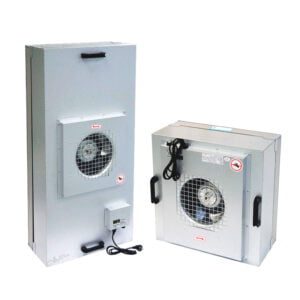
The first is treating air changes per hour (ACH) as a proxy for class without confirming airflow pattern. ISO Class 5 and cleaner require unidirectional (laminar) airflow, where supply air moves in a single, parallel direction across the work zone, typically top-to-bottom from ceiling FFUs to low-wall returns. Achieving 240 to 600 ACH with a turbulent mixing configuration will not produce ISO Class 5 conditions regardless of how many FFUs are installed; the pattern matters as much as the volume. For ISO Class 6 and below, non-unidirectional flow with low-wall returns is acceptable — but that design approach cannot be carried upward into Class 5 zones without layout changes that affect the full ceiling grid.
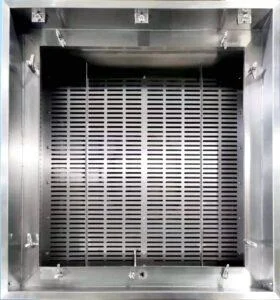
The second misread is treating HEPA and ULPA filters as interchangeable efficiency upgrades. HEPA filters rated at 99.97% efficiency at 0.3 µm cover ISO Classes 2 through 9. ULPA filters at ≥99.9995% efficiency at ≥0.12 µm are the correct specification for ISO Class 1, where the critical particle size drops to 0.1 µm and HEPA penetration at that size is not adequate to maintain the concentration limit. Upgrading to ULPA without adjusting the ACH and airflow pattern to match, or specifying HEPA in an ISO Class 1 zone to reduce filter cost, both produce systems that will not certify.
For teams evaluating FFU coverage requirements by cleanroom class, the ACH ranges below represent planning inputs for translating class targets into equipment sizing — they are design figures, not codified regulatory minimums, and they interact with room geometry, heat load, and airflow pattern in ways that require engineering judgment to apply correctly.
| فئة ISO | Recommended ACH Range | Filter Type (Minimum) | نمط تدفق الهواء |
|---|---|---|---|
| ISO 1 | 500–750 | ULPA (≥99.9995% at ≥0.12 µm) | أحادي الاتجاه (صفحي) |
| ISO 2 | 480–720 | HEPA (99.97% at 0.3 µm) | أحادي الاتجاه |
| ISO 3 | 400–600 | HEPA | أحادي الاتجاه |
| ISO 4 | 400–600 | HEPA | أحادي الاتجاه |
| ISO 5 | 240–600 | HEPA | أحادي الاتجاه |
| ISO 6 | 180–240 | HEPA | Non-unidirectional (low wall returns acceptable) |
| ISO 7 | 60–90 | HEPA | Non-unidirectional |
| ISO 8 | 10–25 | HEPA | Non-unidirectional |
The trade-off that most module procurement teams underestimate is the cost comparison between specifying ISO Class 5 across the full module versus using localized ISO Class 5 minienvironments around critical process tools while holding the surrounding enclosure at a lower class. The minienvironment approach reduces module cost on paper by reducing the FFU ceiling coverage area. In practice, it adds interface complexity at transfer points between the local protection zone and the room environment — the FFU layout boundary, the transfer port configuration, the pressure differential management at each interface — and that engineering load accumulates during commissioning. Teams that choose the local protection approach without budgeting for the additional interface work often find that commissioning schedule slips in exactly the zones where the integration is most complex.
Avoid Common Underspecification In Electronics And Semiconductor Support Areas
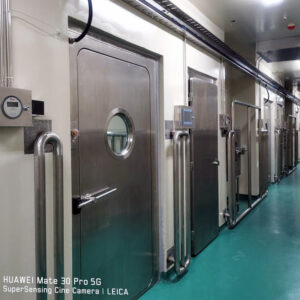
Support zones are the most consistently underspecified areas in semiconductor cleanroom projects, and contamination ingress from those zones is one of the primary mechanisms by which a correctly specified process enclosure fails its operational-state classification after move-in. The failure pattern is not that the process zone was specified incorrectly — it is that the adjacent gowning room, sub-fab corridor, or material pass-through was held to a lower class, the pressure differential was insufficient or inconsistently maintained, and particles migrated into the critical zone through personnel and material transfer paths.
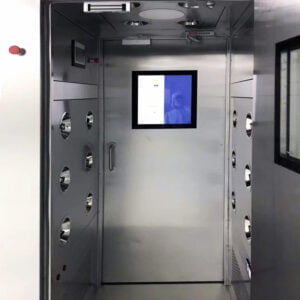
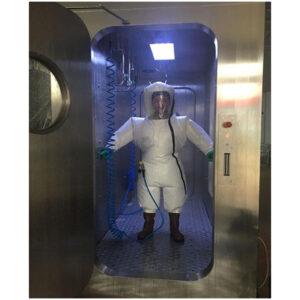
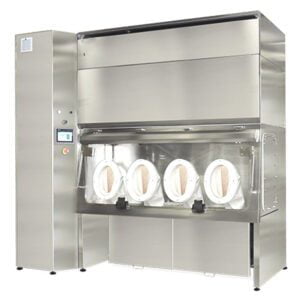
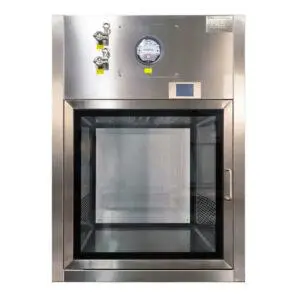
Sub-fab areas, gowning rooms, and buffer transfer zones adjacent to ISO Class 3 or Class 5 process areas are commonly treated as lower-priority in early specification work because they do not directly house process-sensitive tools. The risk of underspecifying those areas is not abstract: a gowning room that does not maintain an appropriate class allows personnel to carry contamination across the transition boundary in their garments and on surfaces. A buffer transfer zone without adequate HEPA-filtered supply and interlocked pass-through chambers provides no active barrier against backstreaming of particles from lower-grade corridors into the clean side.
ISO Class 5 as a planning criterion for sub-fab, gowning, and buffer zones adjacent to critical process areas reflects the contamination control logic of adjacency — not a universal standard requirement that applies regardless of context. The basis for the class target in support zones is the class of the adjacent process area and the transfer frequency between them. A support zone feeding an ISO Class 3 front-end fab has different requirements than one feeding an ISO Class 8 packaging area; conflating them in a single support-zone specification is an underspecification risk on the front-end side and an overengineering cost on the packaging side.
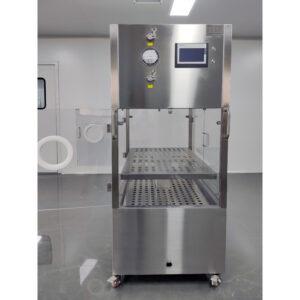
Personnel and material flow controls — interlocking doors, pass-through chambers, pressure cascades — are not optional enhancements to a support zone layout. They are the mechanism by which the class target of the support zone is maintained during actual production activity. A support zone specified at the correct class but built without interlocked transitions will not hold its class during gown-in and material transfer events, which is precisely when the risk of contamination transfer is highest.
| Support Zone Type | Minimum ISO Class | Risk if Underspecified | Flow Control Requirement |
|---|---|---|---|
| Sub-Fab | ISO 5 | Contamination ingress into front-end process areas | Gowning rooms and interlocking pass-through chambers |
| غرفة الملابس | ISO 5 | Personnel cross-contamination to clean zones | Interlocked doors with pressure cascade |
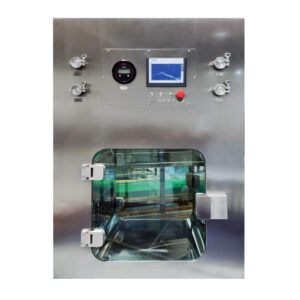
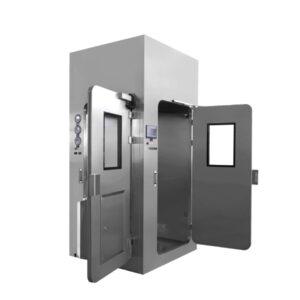
| Buffer / Transfer Zone | ISO 5 | Pressure differential failure; back-streaming of particles | Interlocking pass-through chambers, HEPA-filtered supply |
| Material Pass-Through | ISO 5 | Particulate transfer from materials | Interlocked pass-through with active particle control |
| Packaging / Non-Critical Support | ISO 8 (after sensitivity verification) | Yield loss from unverified relaxation; over-engineering cost | Verify process sensitivity; maintain physical separation from higher-class zones |
The design implication for a semiconductor cleanroom module is that the specification scope must include all interface zones — not just the process enclosure. A module that correctly specifies the primary process area but leaves the adjacent gowning and buffer zones to a generic “lower class” placeholder will require rework to that scope as soon as a contamination risk assessment is applied during detailed design.
RFQ Fields That Confirm The Class Target Is Buildable
A class target on a specification sheet is a design intent. The RFQ is where that intent is tested against what a supplier can actually build, validate, and hand over. The most common procurement bottleneck in semiconductor cleanroom projects is an RFQ that goes to market before the class target is fully defined — missing the room state, the critical particle sizes, or the applicable standards — which produces supplier responses built on different assumptions that are not comparable and often not based on the buyer’s actual requirements.
The RFQ must explicitly state the particle size limits and corresponding maximum concentrations drawn from ISO 14644-1:2015 Table 1. Without that field, the supplier cannot define the filter selection, sampling plan, or classification test protocol. A class number alone — “ISO Class 5” — is insufficient if the critical particle size has not been declared, because the maximum allowable concentration at ISO Class 5 varies by particle size, and the filter and monitoring requirements follow from the particle size, not from the class number in isolation.
Beyond particle sizing, the RFQ must require a defined set of acceptance tests before equipment move-in. No single test is sufficient on its own; the set functions as a minimum verification framework that together confirms the class target is achievable in the as-installed system. For teams reviewing the airflow design and HVAC requirements that underpin classification compliance, the connection between the pre-occupancy acceptance tests and the ongoing monitoring infrastructure is direct — gaps in one create gaps in the other.
| RFQ Field / Requirement | ما الذي يؤكده ذلك | المخاطر في حالة حذفها |
|---|---|---|
| Particle size limits (≥0.1 µm, ≥0.5 µm) and maximum concentrations per ISO 14644-1 class | Classification threshold is correctly defined | Design may not meet the intended standard; classification testing fails |
| Full-scale leak testing of enclosure and ductwork | Enclosure integrity; no bypass of unfiltered air | Particle ingress invalidates cleanroom classification |
| Airborne particle verification (at-rest and/or operational) | Room meets class under sampled state | Class target is unproven before occupancy; disputes arise later |
| Room pressurization checks | Pressure cascade maintained between zones | Cross-contamination between adjacent classes |
| HEPA/ULPA filter integrity testing | Filters are pinhole‑free | Local leaks undermine whole‑room particle control |
| Airflow velocity/volume measurements | FFU output matches design ACH and flow pattern | Insufficient air changes prevent reaching target class |
| Recovery time assessments | Ability to restore class after disturbance | Prolonged downtime following maintenance or contamination events |
| Continuous environmental monitoring system (CEMS) specification | Real‑time tracking of temperature, humidity, pressure, ACH, particles with alarms | Undetected drift between recertification intervals |
A continuous environmental monitoring system (CEMS) requirement in the RFQ is not an operational add-on that can be deferred to fit-out. It is the mechanism by which the cleanroom demonstrates ongoing compliance between formal recertification intervals. A room that meets its class at initial qualification but drifts between monitoring cycles provides no early warning before product exposure or before a formal audit. Specifying CEMS parameters — temperature, humidity, room pressure, ACH, particle count with real-time alarms — in the RFQ ensures the monitoring infrastructure is integrated with the module design rather than retrofitted into a space that was not planned to accommodate it.
The specification sequence that prevents the most common failure modes is also the sequence that creates the most friction when teams are under schedule pressure to get an RFQ into market: define the process zone map with classes and room states before pricing begins, confirm which support zones require active particle control rather than treating them as secondary scope, and lock the critical particle sizes and acceptance test requirements in the RFQ before supplier responses are requested. Each of those steps feels like a delay at the front end. Each omission creates a larger delay at commissioning or classification testing.
Before issuing an RFQ for a semiconductor cleanroom module, the process owner and facilities engineer need to confirm three things jointly: the ISO class target for each zone with the applicable room state declared, the particle sizes that drive classification in each critical area, and whether the module boundary includes the support and transfer zones or leaves them to a separate scope. If any of those three is still open when the RFQ goes out, the responses will not be comparable, and the winning bid will likely carry assumptions that surface as scope gaps during detailed design.
الأسئلة الشائعة
Q: What happens if the process owner and facilities engineer cannot agree on room state before the RFQ deadline?
A: Delay the RFQ rather than issue it with the room state unresolved. Supplier responses built on different state assumptions — one quoting for at-rest compliance, another for operational — are not comparable, and the lower-cost response will almost always reflect the less demanding assumption. The cost of resolving that misalignment after module construction consistently exceeds the schedule cost of holding the RFQ until the room state is confirmed.
Q: Does the local minienvironment approach make sense for a single-tool ISO Class 5 zone inside a larger ISO Class 7 module?
A: It depends on how many transfer events occur between the protected zone and the surrounding room. Local ISO Class 5 protection around a single tool reduces ceiling FFU coverage area and can lower module cost, but each transfer point between the minienvironment and the Class 7 room requires its own pressure differential management, port configuration, and FFU boundary treatment. For a low-transfer, single-tool scenario, the interface engineering is manageable. For a multi-tool layout with frequent material movement, the commissioning complexity at those interfaces often offsets the FFU savings, and specifying the full enclosure at Class 5 becomes the lower-risk path.
Q: At what point does adding ULPA filters to an existing HEPA-based module become inadequate to reach ISO Class 1?
A: Filter substitution alone is insufficient once the airflow pattern and ACH are not matched to Class 1 requirements. ULPA filters address particle penetration at 0.1 µm, but ISO Class 1 also requires airflow volumes in the 500–750 ACH range with true unidirectional laminar flow. A module sized for Class 3 or Class 5 with HEPA filters typically has ceiling coverage area, FFU density, and return air placement that cannot produce Class 1 conditions regardless of filter upgrade — the mechanical and layout changes required effectively constitute a new module design rather than a retrofit.
Q: How should the monitoring specification differ for a support zone compared to the adjacent critical process zone?
A: The monitoring plan for support zones should be driven by transfer frequency and adjacency class, not treated as a simplified version of the process zone plan. A gowning room feeding an ISO Class 3 front-end area needs particle monitoring that captures contamination events during gown-in activity — the highest-risk period — rather than only steady-state sampling. Recovery time after each personnel transition is a relevant metric in support zones that is often omitted from their monitoring plans entirely, even when it is correctly included for the primary process enclosure.
Q: Is ISO Class 8 ever a defensible specification for a semiconductor support area, or does adjacency to higher-grade zones always require a stricter target?
A: ISO Class 8 is defensible in support areas that feed only packaging or other ISO Class 8 process zones, provided a formal process sensitivity review supports it. It is not defensible as a default for any support area adjacent to Class 5 or cleaner without that review. The determining factor is not the support zone’s own process content but the contamination risk it introduces to the adjacent critical zone through personnel, materials, and pressure differential management. Applying Class 8 to a buffer zone feeding a Class 3 front-end fab on the basis that it is “just a support area” is the planning error the specification process is designed to prevent.