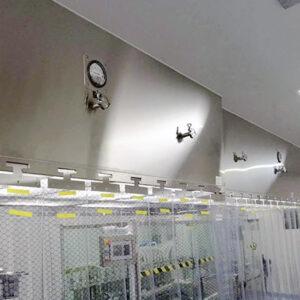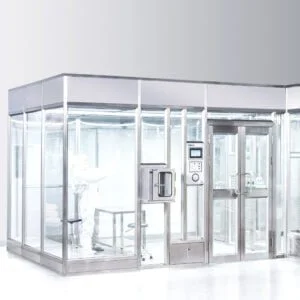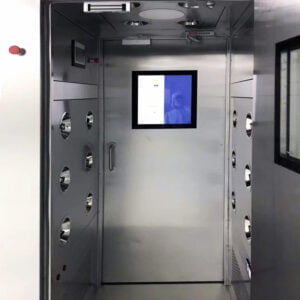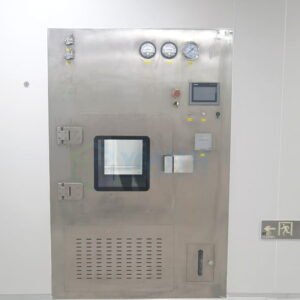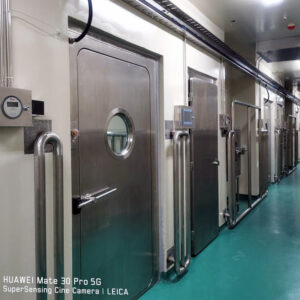
Ceiling layout is usually finalized before anyone asks where the lights go. By the time FFU counts are confirmed and access panel positions are fixed, the ceiling grid is effectively committed—and fixture placement becomes whatever fits in the remaining space. That sequence produces rooms that pass a general illuminance reading at commissioning but fail at the task position: lux levels that look acceptable on paper, reflections from stainless benchtops that wash out fine detail during inspection, and maintenance access routes that require opening a ceiling directly above exposed product. The decisions that prevent those outcomes are not lighting decisions—they are ceiling coordination decisions, qualification protocol decisions, and RFQ timing decisions, and they need to be made before the grid is drawn.
Task-Based Lighting for Assembly Inspection and Testing
Assembly, inspection, and testing often share floor space in modular cleanrooms, but they do not share illuminance requirements. A sealed assembly task may tolerate a moderate general level, while a visual inspection position needs substantially higher illuminance and tighter control over glare angles. Testing areas with instrument displays can introduce a different constraint entirely: too much ambient light creates screen washout rather than insufficient visibility. Applying a single room-wide foot-candle target across all three functions is a planning shortcut that creates qualification problems later, because the requirement that matters—task-position illuminance at the actual working surface—may not have been defined or measured.
The practical correction is to determine foot-candle requirements per area in consultation with cleanroom staff before the ceiling design is finalized, not after. Operators and QA teams know where fine-pitch assembly happens, where color discrimination is critical during inspection, and where instruments set the lighting constraint. That information needs to enter the ceiling layout as a spatial requirement, not as a post-installation note. A fixture position that makes sense for general room coverage may produce a shadow or a hot spot directly at the task position—a condition that only becomes visible when someone sits at the bench and tries to work.
The downstream consequence of deferring this work appears at commissioning, where qualification protocols that measure only grid-average illuminance will pass a room that has real task-position problems. If the inspection step is what drives product release decisions, that gap in the qualification record is a defensibility risk that will not resolve itself until a deviation investigation forces measurement where it actually matters.
Ceiling Coordination Between Lights FFUs and Access Panels
In ISO Class 5 and less restrictive environments, recessed fixtures are often feasible because filter coverage is partial and ceiling panels can accommodate dedicated fixture openings without consuming the entire grid. That feasibility disappears quickly as classification tightens. In ISO Class 4 and cleaner rooms, filter panels occupy most or all of the available ceiling area, leaving no meaningful space for recessed lights. The historical response was teardrop fixtures mounted under grid channels—an approach that avoids ceiling penetration but introduces hanging obstructions that complicate equipment moves and can create turbulence that affects airflow uniformity near the fixture. Modular integral grid lights, built directly into the channel structure, address the obstruction and airflow problems simultaneously, though they represent a more coordinated specification commitment during design.
The coordination problem is not only about fixture type—it is about sequencing. Access panels for HVAC, sprinkler, or electrical service above the ceiling compete for the same ceiling real estate as FFUs and fixtures. If panel positions are fixed independently and lighting is specified afterward, the result is often a fixture layout driven by what ceiling space remains rather than by where task illuminance is needed. That inversion is difficult to correct after fabrication without modifying the ceiling structure.
| نوع التركيب | Suitable Cleanroom Classes | Ceiling Coordination | Laminar Airflow Impact | Illuminance Potential |
|---|---|---|---|---|
| Recessed Fixtures | ISO Class 5 and above (less restrictive) | Requires dedicated ceiling openings; must compete with FFU and access panel layouts | Minimal if properly sealed; can disrupt airflow if not integrated | Varies by design |
| Teardrop Fixtures | ISO Class 4 and cleaner | Mounted under grid channels; no ceiling penetration required | May cause some obstruction; not fully integrated with laminar flow | Not specified; depends on mounting height |
| Modular Integral Grid Lights | All classes, especially high filter coverage | Built into grid channels; no hanging obstructions, frees ceiling for FFUs and access panels | Uninterrupted laminar airflow | Up to 90 fc |
ISO 14644-4:2022 frames the design of cleanroom systems—including ceiling and airflow elements—as an integrated process that should address operational requirements in coordination. That principle applies directly here: lighting cannot be treated as a finishing layer applied after the airflow design is resolved. Where filter coverage is high and access panels are numerous, the ceiling becomes a constrained layout problem, and fixture type selection is one input to that constraint, not a separate specification.
Glare Reflection and Inspection Reliability
High lux levels do not guarantee reliable inspection. Cleanroom surfaces—ceilings, walls, and flooring—are typically bright white with enamel-like finishes, and the combination of high surface reflectance with strong overhead lighting can produce glare that reduces contrast rather than improving it. When stainless steel workstations, bench surfaces, and packaging materials are added to that environment, specular reflections become an additional variable. A luminaire positioned directly above a reflective inspection surface may create a veiling reflection at the inspector’s line of sight, reducing the ability to distinguish defects even when the measured lux at the workplane is within specification.
The planning implication is that illuminance level and lighting geometry are separate inputs. A fixture that delivers adequate lux from a position that generates high-angle reflections on the inspection surface is not performing its design function, regardless of what the light meter reads. This is why glare management should be treated as a design input defined during ceiling coordination, not as a comfort consideration addressed after installation. The geometry of the fixture relative to the task surface, the finish of surrounding surfaces, and the angle of incidence on inspection materials all need to be considered together.
The failure pattern is consistent: rooms are designed to a target illuminance, the target is met on the general grid, and the inspection team identifies reliability problems only after the room is qualified and in use. At that point, repositioning fixtures means revisiting ceiling coordination, potentially moving FFU or access panel positions, and requalifying. Addressing reflectance and geometry during the design stage—when fixture position is still a variable—avoids that sequence entirely.
Fixture Maintenance Without Process Contamination
Recessed fixtures create a specific maintenance risk that teardrop and integral grid configurations do not: the fixture housing sits in or above the ceiling plane, where the air supply plenum above the grid is a particle reservoir. During routine maintenance—relamping, cleaning, or inspection of the fixture—any breach in the housing seal allows plenum air to bypass the filter and enter the cleanroom directly at the task area. The risk is not theoretical; even a microscopic opening in the housing is sufficient for particle ingress during the pressure differential that exists between plenum and room. This makes airtight seals around lens and frames a hard design requirement for recessed fixtures, not an upgrade option.
The maintenance sequence itself deserves early planning attention. The first relamp will happen, and if the only access route requires opening the ceiling above an exposed process area, the maintenance activity becomes a contamination event that seals alone cannot prevent. Fixture selection and access planning need to account for this together: a fixture with an adequate seal that requires an overhead opening above product is not a solved problem. Where ceiling access is unavoidable, the question becomes whether the process area can be cleared and protected, whether the maintenance window aligns with a scheduled shutdown, and whether the qualification protocol addresses the return-to-service condition after ceiling access.
ISO 14644-5 addresses operational requirements for cleanrooms including maintenance activities as part of the controlled environment operating framework. The relevant principle is that maintenance procedures should not compromise the contamination control system—a standard that requires more than seal specification when the maintenance geometry itself is the exposure pathway.
Workstation-Level Illuminance Checks
General room illuminance measurements taken at a standard grid height will not confirm that task positions are adequately lit. The measurement height, the grid spacing, and the averaging method all reflect a room-average condition, not the actual illuminance at a specific bench surface under specific fixture positions with specific surrounding geometry. When the task involves fine assembly or visual inspection, the workstation surface is the functional reference point—and it is affected by fixture angle, bench height, surrounding surface reflectance, and shadow patterns that a general grid reading does not capture.
The check that matters is a task-position measurement taken at the actual working surface with the workstation in its operational configuration. That means furniture in place, reflective surfaces present, and the inspector or operator positioned as they would be during production. This is not a one-time commissioning requirement—it is a verification check that should be part of the qualification protocol and repeated if workstation layout changes. A bench repositioned by half a meter can move a shadow or a reflection hot spot directly into the task field.
The qualification gap this creates is straightforward: if the acceptance criterion in the qualification protocol is defined only as a room-average illuminance at a standard grid height, the protocol can pass a room that has a real task-position problem. Defining task-position checks during protocol development—before commissioning begins—is the control that closes that gap. It also gives the QA team a defensible record if inspection reliability is challenged during an audit or deviation review.
For modular cleanroom builds where the محطة عمل مخصصة لغرف الأبحاث النظيفة configuration is part of the design package, workstation geometry should be confirmed before qualification measurements are scheduled, not after.
Lighting Inputs for Modular Cleanroom RFQs
Lighting specification decisions that appear to be late-stage details are actually early-stage commitments. Fixture material, seal type, mounting method, and ceiling integration approach are all locked in when the ceiling grid is finalized—which in modular cleanroom procurement happens during the design stage, often in direct consultation with the supplier. If lighting is not on the specification list at that stage, what gets supplied is whatever the standard build includes, and retrofitting a different fixture type after the grid is manufactured is expensive and may require structural modification.
The material specification is driven by two distinct criteria. Classification determines the lower boundary: ISO Class 5 through Class 3 environments support powder-coated steel, anodized aluminum, or stainless steel as acceptable fixture materials, with airtight seals required around lens and frames regardless of which material is selected. Application requirements can then tighten that specification: NSF or FDA-regulated processes typically require stainless steel specifically, because chemical resistance and cleanability standards that govern contact and near-contact surfaces in those environments are not met by powder-coated or anodized options.
| Cleanroom Classification / Application | Fixture Material | Airtight Seal Requirement |
|---|---|---|
| ISO Class 5 to ISO Class 3 (general) | Powder-coated steel, anodized aluminum, or stainless steel | Airtight seals around lens and frames |
| NSF / FDA applications | الفولاذ المقاوم للصدأ | Airtight seals around lens and frames |
The procurement mistake is treating fixture material as a value-engineering variable to be resolved during detailed design after the RFQ is frozen. If the application is NSF or FDA-regulated, stainless steel is the requirement, and a supplier who has quoted a standard powder-coated fixture will need to revise. That revision affects ceiling integration, weight loading assumptions, and potentially lead time. Confirming application-driven material requirements before the RFQ is issued prevents that sequence.
إن غرف التنظيف المعيارية configuration and the نظام الجدران والأسقف are the structural context in which lighting inputs need to be resolved—ceiling panel layout, FFU density, and access panel positions are all established through those system specifications, and lighting should be part of the same design conversation rather than a separate procurement stream resolved afterward.
For teams working through component specification at the RFQ stage, the checklist in ميزات غرف التنظيف المعيارية ومواصفات الأداء: قائمة التحقق من المكونات الأساسية للتحكم في التلوث provides a useful cross-reference for confirming that ceiling system inputs are aligned before the specification is frozen.
The concrete implication of this article is sequencing: lighting decisions that feel like finish-stage details are structurally determined at the same stage as FFU layout, access panel position, and ceiling panel configuration. Once that structure is committed, the options narrow significantly—fixture type becomes constrained by available ceiling space, task-position uniformity becomes dependent on whatever placement fits the remaining grid, and maintenance access becomes a function of what was designed for airflow, not for serviceability.
Before issuing an RFQ for a modular cleanroom intended for assembly, inspection, or testing, confirm that task-position illuminance requirements have been defined by area with input from the people doing the work, that fixture type and material are specified to match both classification and application, and that the qualification protocol includes task-position measurements rather than only room-average readings. Those three inputs, resolved early, are what separate a qualification-ready lighting design from one that will require investigation to close.
الأسئلة الشائعة
Q: We have already commissioned our modular cleanroom, but operators are reporting glare and shadow problems at inspection stations. Can we fix this without redesigning the ceiling?
A: Yes. Add cleanroom-rated task lighting directly at the problem workstations—such as articulating or under-shelf fixtures—provided they don’t create particle traps or turbulent airflow. Repositionable baffles or diffusers on existing luminaires can also reduce high-angle reflections without moving fixtures. You will need to re-verify task-position illuminance and glare control with the new setup, and record the change in your qualification documentation.
Q: After mapping area-specific foot-candle targets with our operators, how should we hand those requirements to the modular cleanroom supplier?
A: Create a task-position illuminance schedule as a formal RFQ attachment. For each zone, list the required lux level, working surface height, grid coordinate reference, and a sketch showing inspection-task orientation. Ask the supplier to confirm that the proposed ceiling layout can achieve those values at the specified positions during commissioning, turning operator input into a testable specification before the grid is finalized.
Q: At what ISO classification does recessed lighting stop being practical?
A: Recessed fixtures become impractical in ISO Class 4 and cleaner rooms because filter panels occupy the vast majority of the ceiling, leaving no contiguous space for housings. In ISO Class 5, recessed fixtures are often feasible, but if FFU coverage exceeds roughly 70–80 % or access panels are numerous, the available grid may still be insufficient. In those borderline cases, the ceiling layout must be modeled with fixture positions integrated before any material is ordered.
Q: How do teardrop fixtures compare to integral grid lights for airflow and maintenance in high-classification cleanrooms?
A: Integral grid lights are built into grid channels, maintaining uninterrupted laminar airflow and avoiding hanging obstructions that can trap particles or complicate equipment moves. Teardrop fixtures hang below the grid and can create local turbulence, but they are easier to replace individually without opening ceiling panels. Choose integral grid lights when airflow uniformity and cleanability are the top priorities; teardrops may be acceptable if frequent fixture-level service is expected and temporary airflow perturbation can be managed.
Q: Is the detailed lighting coordination described really necessary for a small cleanroom used only for casual assembly, not inspection?
A: Not always. If the room has no visual inspection step and no operator complaints about visibility, a single room-average illuminance check during qualification may suffice. However, as soon as product acceptance relies on an operator’s ability to see fine detail or color differences—even occasionally—task-position verification becomes the safer approach. For small rooms where the محطة عمل مخصصة لغرف الأبحاث النظيفة configuration is defined early, you can confirm illumination geometry during workstation design, avoiding most coordination headaches.