Electronics cleanrooms fail at commissioning more often than at design — not because engineers misread ISO limits, but because particle control and static control are scoped by different teams who never reconcile their layout assumptions. The rework cost is not abstract: ESD flooring that stops short of a workstation boundary, benches without verified ground continuity, and FFU grids that satisfy average air-change targets while leaving specific handling points turbulent are all findings that surface during qualification, after the room is built. The decision that prevents most of this is not a product choice — it is agreeing early on a single control boundary that covers airborne particle management and electrostatic discharge simultaneously, with one layout that satisfies both. What follows will help engineers, QA teams, and procurement leads identify where those boundaries must be drawn, what each zone demands from equipment placement, and what acceptance evidence needs to be in the handover package before the room is signed off.
Electronics Process Sensitivity and Room Zoning
Zone boundaries in an electronics cleanroom are not defined by ISO class alone. Three sensitivity drivers — particulate contamination, electrostatic discharge, and vibration — each impose spatial constraints, and the mistake is treating them as independent inputs to be resolved by separate disciplines. When zone lines are drawn on particle sensitivity without accounting for ESD exposure or vibration propagation, the resulting layout forces expensive retrofits as those constraints are discovered downstream.
Particulate sensitivity at the leading edge of semiconductor fabrication and fine-pitch PCB assembly is severe. At feature geometries below 5nm or trace widths approaching 25μm, an ISO Class 5 environment targeting fewer than 1,000 particles per cubic meter at ≥0.1μm is often the relevant design threshold — and the consequence of missing it is not incremental. A single 0.3μm particle landing on a wafer or open die during handling can compromise a yield step, and while a 15% yield reduction is a figure that illustrates the consequence rather than a guaranteed rate for all processes, it reflects the magnitude that justifies dedicating discrete floor space to the most sensitive operations rather than treating the whole room uniformly.
ESD sensitivity at modern IC component levels pushes the same logic. Discharge events as low as 10V can damage components that would not register a visible failure until downstream test or field use. This means that the zone boundary for static control cannot be set at the production floor perimeter — it has to be set at the component-handling point, and everything within that boundary (flooring, benches, carts, garments, grounding paths) must be part of a connected control system. Vibration adds a third spatial constraint: levels above 2μm/s can impair photolithography precision, which means tool zones with optical alignment steps may require isolated floor sections that physically interrupt the layout from adjacent production or utility areas.
The practical consequence is that zone planning must begin with a combined sensitivity map rather than an ISO class assignment. Which operations involve open wafers, dies, or bare PCBs? Which involve optical alignment tools with vibration tolerance limits? Where are operators stationed, and what contamination do they generate? Those answers drive the zone boundaries, and the zone boundaries drive the equipment placement decisions that follow.
| Sensitivity Driver | Critical Threshold / Impact | Zoning Requirement |
|---|---|---|
| Particulate Contamination | ISO Class 5: <1,000 particles/m³ at ≥0.1μm; one 0.3μm particle can reduce semiconductor yield by 15% | Dedicated ISO 5 zones for wafer handling, photolithography, and open-component areas |
| Electrostatic Discharge (ESD) | Discharge as low as 10V can damage modern ICs | Static-control zones with grounded flooring, work surfaces, and ionization |
| الاهتزاز | >2μm/s can impair photolithography precision | Vibration-isolated floor sections or isolated tool zones |
ESD Flooring Bench and Grounding Boundary
ESD flooring is specified early and often verified in isolation. The more consequential problem is that the flooring resistance range — typically 10⁶ to 10⁹ ohms per ANSI/ESD S20.20 — only controls charge dissipation if every element within the handling boundary is also part of the grounding path. Flooring that meets spec while adjacent bench surfaces, carts, and garments are unverified does not constitute a control boundary. It constitutes a partially grounded room with undocumented charge exposure at the handling point.
The 10⁶ to 10⁹ ohm resistance range reflects a practical balance: low enough to dissipate static charge before it accumulates to damaging levels, high enough to limit fault-current risk to personnel. Deviating below 10⁶ ohms introduces personnel safety concerns; deviating above 10⁹ ohms allows charge to accumulate faster than it dissipates. Both conditions require documented deviation justification in the ESD control plan. For workstation charge neutrality, static-dissipative bench surfaces combined with overhead ionization systems are commonly applied to maintain charge within ±50V — a target that reflects the sensitivity of modern components rather than a hard threshold universally mandated across all facility types. At 10V damage thresholds for some ICs, even ±50V headroom is a designed tolerance rather than a comfortable margin.
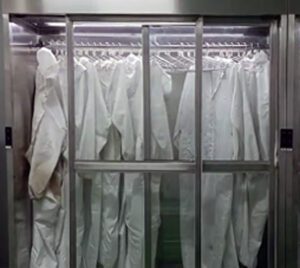
The grounding boundary question becomes a layout decision during design: which floor area is within the ESD-controlled zone, and where does it stop? Transition zones between the ESD-controlled area and adjacent corridors or staging areas need deliberate treatment — personnel and materials crossing the boundary carry charge unless garments, wrist straps, and cart surfaces are included in the program. The common failure pattern is that garment specifications and grounding point locations are finalized after the room is constructed, making it difficult to retrofit adequate grounding infrastructure at cart paths or doorways without disrupting the floor system.
Cleanroom flooring specified for an electronics environment should be evaluated as part of the ESD boundary design, not as a separate procurement item selected purely on cleanability or durability. The resistance verification record for each floor section, bench, and cart path should be in the commissioning package alongside the particle classification evidence — not filed separately by a different trade.
For projects where ESD furniture compliance is being evaluated alongside flooring, the article كيفية التحقق من متطلبات التوصيل ESD في أثاث غرف التنظيف لتصنيع الإلكترونيات covers the workstation-level verification process in detail.
FFU Placement Around Workstations and Heat Sources
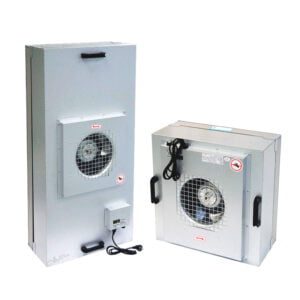
A ceiling grid of fan filter units that delivers the calculated air change rate for ISO Class 5 — typically in the range of 350 to 400 ACH using HEPA filtration at 99.995% efficiency at 0.3μm — can still produce poorly swept airflow at specific handling points. The average performance satisfies the classification model; the local performance at the workstation is what determines contamination exposure during actual operations. These two are not the same thing, and the difference between them is not visible during design review.
The placement problem intensifies around heat-generating equipment. Soldering stations, reflow ovens, curing lamps, and electronics test fixtures all generate thermal plumes that disrupt the downward laminar flow from FFUs positioned directly above them. The plume rises, entrains room air and any particles in that air, and deflects the clean airflow laterally — potentially toward adjacent open-component handling areas rather than down to the return path. Compensating by increasing FFU density above heat sources is one option, but it shifts the turbulence problem rather than eliminating it; the affected zone moves to the boundary between the high-velocity column above the heat source and the normal-velocity region next to it. The more reliable approach is mapping heat source locations before ceiling grid layout is finalized and treating each one as a placement constraint, not a post-installation adjustment.
Operator position adds a related constraint. Personnel standing at benches generate particle loads at shoulder and head height — roughly 1.2 to 1.6 meters above the floor — and an FFU positioned to sweep the bench surface may not produce sufficient velocity at operator breathing zone height to prevent particle entrainment back toward the work surface. Workstation-level airflow qualification, using smoke visualization or similar methods, is the only way to confirm that the ceiling grid is performing as intended at the actual handling point rather than at the sampling height used during ISO classification.
The practical sequencing implication: FFU layout should be finalized after workstation positions, heat-source locations, and operator orientations are confirmed on the floor plan — not before. A grid designed against a blank floor plan may require repositioning during commissioning if those details are resolved later, and repositioning FFUs in an installed ceiling system is significantly more disruptive than adjusting the design at the drawing stage.
إن وحدة تصفية المروحة selection for electronics applications should account for variable speed control, which allows post-installation tuning of velocity at specific workstation zones without disturbing the full ceiling grid.
Inspection Area Airflow and Lighting Stability
Inspection stations carry a constraint that generic ISO class planning does not address: the airflow needed to keep particles away from open components can simultaneously push operator-generated contamination across the inspection surface if the directional relationship between the air supply, the operator, and the component is not resolved explicitly in the layout. This is not a borderline risk — it is a direct consequence of placing a person between the air source and the part being inspected. The standard design response is to position the inspector so that the airflow travels from the component toward the operator rather than from the operator toward the component, but this constrains bench orientation, lighting angle, and the inspector’s working posture in ways that need to be confirmed before the station is built.
Lighting at inspection stations interacts with ceiling integrity in a way that is frequently underweighted during procurement. Fluorescent fixtures embedded in cleanroom ceilings can create particle ingress paths if the sealing and mounting details are not cleanroom-grade. LED alternatives avoid some of the heat and vibration issues associated with fluorescent sources, and the energy reduction they provide — typically 40 to 60 percent compared to fluorescent equivalents — is a secondary benefit. The primary benefit for inspection stations is that sealed LED panels can be integrated into the ceiling grid without the gasket degradation and vibration-induced particle generation that fluorescent fixtures are more prone to over time.
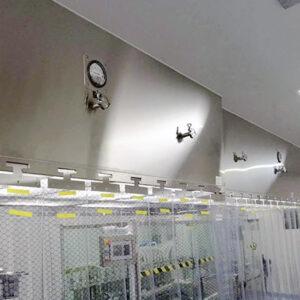
Environmental stability at inspection stations affects both optical accuracy and static exposure. The relevant monitoring parameters — temperature held within ±0.5°C, relative humidity within ±3%, and differential pressure resolved to 0.02 inches water gauge — are not arbitrary tolerances. Thermal drift at the component surface affects optical measurement repeatability. Humidity excursions in either direction affect static charge behavior and particle adhesion. Differential pressure loss, even small and transient, can reverse flow direction locally and pull unfiltered air toward the inspection surface.
| المعلمة | Tolerance / Resolution | Why It Matters for Inspection Stability |
|---|---|---|
| درجة الحرارة | ±0.5°C | Prevents thermal drift in optical inspection and component measurement |
| الرطوبة | ±3% RH | Avoids static build-up and moisture-related particle adhesion |
| الضغط التفاضلي | 0.02″ w.g. resolution | Maintains directional airflow to keep operator-generated particles away from open components |
Particle Classification and Static-Control Acceptance
Acceptance testing for an electronics cleanroom should produce two concurrent verification records: a particle classification result under ISO 14644-1:2015, and an ESD compliance record under ANSI/ESD S20.20. When only one exists in the handover package, the compliance position is structurally incomplete regardless of which one is present. A room that passes ISO Class 5 classification with undocumented flooring resistance and no workstation charge neutrality record carries static risk that will not appear in any particle count data — and will not surface until yield data or a field failure requires a re-audit.
The classification hierarchy matters for scoping acceptance: ISO Class 5 applies to the most sensitive handling operations, but many electronics facilities zone into Classes 6, 7, or 8 for staging, gowning, and sub-assembly areas, each with its own particle count thresholds. The acceptance protocol should reflect actual zone-by-zone requirements rather than applying the most stringent class uniformly across the facility. Applying ISO Class 5 acceptance criteria to a Class 7 staging area is not conservative — it is a resource misallocation that produces no additional protection and obscures the zone-specific compliance status.
One documented semiconductor application achieved consistent particle counts below 100 per cubic meter at 0.1μm with a corresponding yield improvement of approximately 14%. That result is one data point illustrating what disciplined particle control can achieve at the process level, not a generalizable benchmark for all electronics cleanrooms. Its value in this context is confirming that classification performance and production outcomes are linked — which is the same logic that makes the combined particle-plus-ESD verification record a defensible compliance position rather than a documentation formality.
Where an acceptance gap is found — flooring resistance out of range, charge neutrality not demonstrated at workstations, or particle counts borderline against the classification limit — the corrective action sequence matters. Floor resistance failures after installation are among the most constrained to remedy, particularly if remediation requires cutting or replacing sections already under equipment. Identifying those conditions before equipment is loaded and positioned is the practical reason to sequence ESD verification before workstation placement is finalized rather than after.
| Performance Domain | Acceptance Metric | Standard to Verify |
|---|---|---|
| Airborne Particulate | ISO Class 5: ≤1,000 particles/m³ at ≥0.1μm (case study achieved <100/m³) | ISO 14644-1:2015 |
| ESD Flooring Resistance | 10⁶–10⁹ ohms | ANSI/ISD S20.20 |
| Workstation Charge Neutrality | ±50V (via dissipative surfaces and ionization) | ANSI/ISD S20.20 |
| الاهتزاز | <2μm/s | SEMI Standards |
| الرصد البيئي | Temp ±0.5°C, RH ±3%, DP 0.02″ w.g. resolution | IEST-RP-CC001 (testing protocols) |
Supplier Scope Items for Electronics Cleanroom RFQs
The capability gap most likely to create downstream project risk is an ESD control boundary that was designed by the particle-control team rather than by someone with ANSI/ESD S20.20 program experience. Suppliers who can document ISO 14644 compliance for particle classification are common; suppliers who can also produce an ESD control boundary design with verified grounding continuity from flooring through benches, carts, and garments are a narrower subset. An RFQ that does not explicitly ask for both leaves the evaluation unable to distinguish between them.
Vibration analysis is a scope item that electronics cleanroom RFQs frequently omit because it is not visible in the finished room until a precision tool fails to qualify. Suppliers with vibration survey capability can identify propagation paths from HVAC equipment, adjacent production equipment, and building structure before the slab is committed. Without that survey, sensitive photolithography tools or optical measurement stations may require expensive isolation retrofits after installation.
Pre-validated modular designs with documentation packages can reduce the time required to move from construction completion to classification certification. The reduction figures cited in the industry — 40 to 60 percent compared to custom-built rooms — reflect supplier-reported experience rather than a standardized benchmark, but the underlying mechanism is real: a design with tested and documented performance history requires less iterative qualification work than a first-of-type build. When evaluating suppliers on this dimension, the question to ask is not whether pre-validated designs exist, but whether the documentation package for that design covers the specific ISO class, ESD zone configuration, and environmental monitoring requirements of your project.
Timeline planning for modular electronics cleanrooms benefits from realistic benchmarks when scoping phased expansion or class upgrades. Supplier-reported figures for common scenarios — new ISO Class 6 construction, footprint expansion, class upgrades in place, and layout reconfiguration — provide a useful RFQ calibration baseline, though these should be treated as ranges to benchmark supplier proposals against rather than specifications to write into a contract without confirmation.
Material outgassing is a scope item relevant to semiconductor and precision-optics applications where airborne molecular contamination (AMC) can degrade process surfaces or optical coatings. Panel, adhesive, and coating materials with outgassing rates below 1×10⁻⁹ g/cm²/sec are commonly specified for AMC-sensitive environments; confirming that a supplier’s standard construction materials meet this threshold — or identifying where substitutions are required — is a procurement decision point that should be resolved before design freeze rather than during commissioning.
| القدرة | ما أهمية ذلك | What to Clarify in RFQ |
|---|---|---|
| ISO 14644 Compliance | Validates particle classification accuracy and system performance | Request documented compliance history and testing reports for similar ISO classes |
| ESD Control Expertise | Prevents yield loss from static discharge | Ask for ANSI/ESD S20.20 certification records and ESD control boundary design approach |
| تحليل الاهتزازات | Protects precision processes from floor-borne vibration | Require vibration survey capability and mitigation design details for sensitive tools |
| تحسين كفاءة الطاقة | Reduces operational costs and supports sustainability targets | Require evidence of energy reduction targets (e.g., 40% total vs. traditional, LED lighting 40–60% savings, HVAC VFDs 25–40% savings) |
The timeline comparison between modular and traditional construction approaches reflects the range of scenarios buyers are most likely to encounter when planning phased or adaptive electronics facilities.
| Project Scenario | Modular Timeline | Traditional Build Comparison |
|---|---|---|
| New 1,000 sq ft ISO Class 6 | 10–12 weeks | 6–9 months |
| 500 sq ft expansion | 3–4 weeks | غير متاح |
| Upgrade ISO 7 to ISO 6 (same footprint) | 2–3 weeks | غير متاح |
| Layout reconfiguration (same ISO class) | 1–2 weeks | غير متاح |
The most useful pre-procurement action for an electronics cleanroom project is confirming that the same layout drawing carries both the ISO zone boundaries and the ESD control boundary, and that a single responsible party has signed off on both. If those two boundaries are on separate drawings owned by separate disciplines, the coordination risk that produces commissioning rework is already present in the project structure. Resolving it at the drawing stage costs hours; resolving it after installation can cost weeks and significant rework scope.
Before issuing an RFQ, procurement teams should define what acceptance evidence is required at handover — specifically whether the package must include concurrent ESD verification records alongside particle classification data, and which zones require which acceptance standard. Suppliers who cannot clearly describe their ESD control boundary design approach, their vibration analysis capability, or the documentation scope included with pre-validated designs are not disqualified, but those gaps need to be priced and scheduled as buyer-side responsibilities if the supplier cannot cover them. That distinction, made before award rather than during commissioning, is what keeps acceptance risk in the project budget rather than outside it.
الأسئلة الشائعة
Q: What if our facility runs mixed-sensitivity operations — some ISO Class 5 zones and some Class 7 or 8 — does the ESD boundary need to cover the entire footprint?
A: No, but the boundary must be continuous within any area where components below the facility’s ESD damage threshold are handled or transported. The ESD control boundary is driven by component exposure risk, not ISO class. A Class 7 staging area that only holds sealed packaged goods may not require the same grounding infrastructure as a Class 5 handling zone — but any cart path, doorway, or transition zone where open components or unsealed assemblies move between areas must be included in the control boundary. The failure mode is assuming that lower ISO class zones are outside the static risk perimeter when materials flow through them.
Q: Once the room passes both particle classification and ESD acceptance, what is the first operational step before production begins?
A: The immediate next step is verifying that personnel garments, wrist straps, and cart surfaces are enrolled in the ESD control program and that grounding point locations are confirmed at every workstation before any components are introduced to the room. Acceptance testing validates the room’s infrastructure — flooring resistance, FFU performance, environmental stability — but it does not validate the human and equipment elements that complete the control boundary. Running a documented personnel grounding verification and a garment compliance check before first production use closes the gap between a compliant room and a compliant operation.
Q: At what point does specifying a tighter ISO class than the process actually requires stop providing yield benefit and start creating unnecessary operational overhead?
A: When the dominant contamination source shifts from airborne particles to operator-generated or process-generated particles that ISO classification testing does not capture, tightening the room class adds cost without proportional protection. ISO classification measures particle counts in the unoccupied or lightly occupied state; if handling practices, tooling design, or chemical process steps are generating contamination at the work surface regardless of room class, the marginal benefit of moving from Class 6 to Class 5 room conditions is limited. The more productive investment at that threshold is workstation-level airflow qualification and contamination source mapping, not room class escalation.
Q: How does a modular electronics cleanroom compare to a stick-built room for a facility that expects frequent layout changes as product lines evolve?
A: Modular construction has a meaningful advantage specifically for reconfiguration scenarios — not just initial build speed. Supplier-reported figures for layout reconfiguration range from one to two weeks, compared to the structural disruption that repositioning fixed walls, ceiling plenums, and embedded utilities requires in a stick-built room. The trade-off is that modular systems carry higher upfront material costs per square foot in some configurations, and the reconfiguration advantage only holds if the original design uses a panel and ceiling grid system that was genuinely engineered for repeated disassembly. Buyers should ask suppliers to document how many reconfiguration cycles the panel system is rated for and whether ESD flooring sections can be repositioned without re-verification of resistance continuity.
Q: If a supplier’s standard construction materials have not been tested against the 1×10⁻⁹ g/cm²/sec outgassing threshold, how late in the procurement process can that gap realistically be resolved?
A: It must be resolved before design freeze — not during commissioning. Once panel, adhesive, and coating materials are procured and installed, substituting non-compliant materials requires partial demolition of completed construction. The practical resolution path is requiring outgassing test data for each proposed material as a submittal deliverable during the design development phase, before any purchase orders for wall or ceiling components are issued. If a supplier cannot produce that data for standard materials, the buyer must either specify alternative materials before award or accept that the room will not meet AMC-sensitive process requirements without a post-installation remediation scope that is difficult to price and schedule in advance.