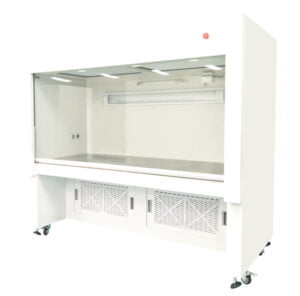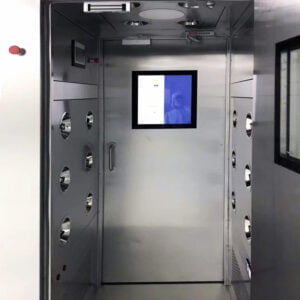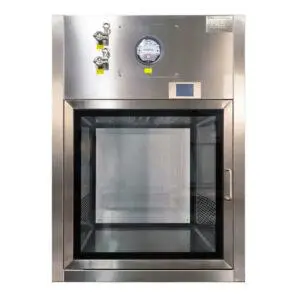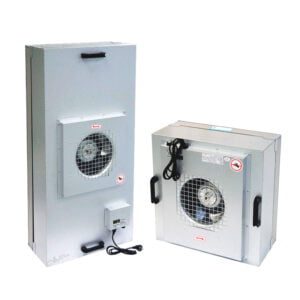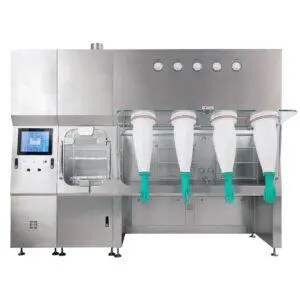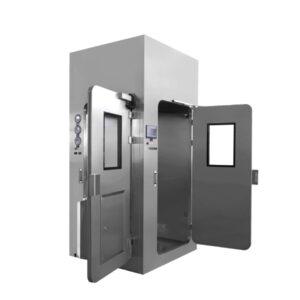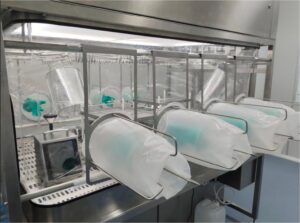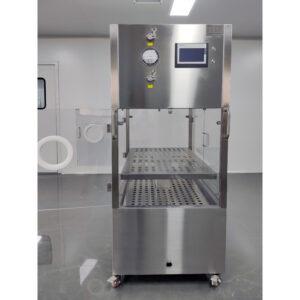
Specifying the wrong containment concept for a powder handling application rarely surfaces during design review — it surfaces during operational qualification, when airflow challenge testing reveals that dust is migrating out of the booth boundary, or into the operator’s breathing zone, under actual handling conditions. By that point, the installation is complete, the pressure cascade assumptions are fixed, and correcting the failure requires deviation documentation, potential re-commissioning, and HVAC rework that nobody budgeted. The decision that prevents this is not a choice between negative pressure and downflow — it is the earlier judgment about whether the process requires environmental containment, operator protection, or both, because those objectives drive different design features, different HVAC obligations, and different qualification tests. Getting that distinction right before the specification is written is what separates a clean OQ from a deviation backlog.
Negative Pressure and Downflow Solve Different Control Problems
Treating these two mechanisms as equivalent options — or as competing alternatives — is the specification error that creates the most downstream rework. They are not interchangeable. Negative pressure controls what escapes from the booth boundary into the surrounding cleanroom. Downflow controls what reaches the operator’s breathing zone inside the booth. Both can be present in the same unit, but each addresses a distinct failure mode, and sizing or validating one as a proxy for the other leaves a gap that open powder handling will expose.
The mechanism for negative pressure is a sustained pressure differential: roughly 10% of the recirculated air is exhausted through the pre-filter and fine filter stages, creating a directional inward airflow at the booth boundary. That inward flow resists the outward migration of dust when the booth is disturbed — by a container opening, a bag transfer, or operator movement. Without a stable pressure gradient, dust that becomes airborne near the booth face has no consistent directional bias, and migration into the room becomes a plausible failure mode rather than a controlled risk.
Downflow addresses a different problem. Vertical HEPA-filtered laminar airflow pushes contaminants downward toward the pre-filter intakes before they can rise to the level of the operator’s face. The protection depends on maintaining a velocity profile that captures settling powder without generating turbulence that would scatter it. If the room pressure cascade surrounding the booth is unstable, the recirculating system’s ability to sustain that laminar profile is compromised — which means the environmental containment problem and the operator protection problem are coupled through the HVAC interface, even though they are distinct in mechanism.
| أسبكت | الضغط السلبي | التدفق الهابط |
|---|---|---|
| هدف الحماية الأساسي | Environmental containment; prevents escape of dust to external areas | Operator protection; prevents powder deposit in breathing zone |
| الآلية | Exhausts ~10% of recirculated air to create a pressure differential, drawing inward airflow at booth boundaries | HEPA-filtered laminar vertical airflow directs contaminants downward toward pre-filter intakes |
| Key design parameter | Stable negative pressure gradient inside working chamber; directional inward airflow | Air velocity profile that captures dust without ejecting reagents (dynamic balance) |
| Principal failure risk if misapplied | Powder migration to external environment; OQ failure and deviation work | Dust ejection into operator zone; failure to protect breathing zone |
When only one mechanism is specified and the process involves open container handling or bulk powder transfers, the unspecified mechanism represents an uncontrolled failure mode. A booth specified purely for negative pressure with no downflow design can still expose the operator to inhalable dust that is captured and directed away from the room but allowed to rise freely within the working zone. The inverse — downflow without a sustained negative pressure differential — may protect the operator under steady-state conditions but provide inadequate containment if the pressure boundary is disrupted. Specifying the combined configuration is appropriate when both failure modes are present; specifying only one is a defensible decision only when the other failure mode has been explicitly assessed and dismissed.
Room Pressure Cascade Interfaces That Affect Booth Performance
The pressure relationships at three distinct boundaries determine whether a booth performs as designed after installation: booth to surrounding room, booth to buffer room, and the internal chamber gradient. Each requires a specific condition to hold, and none of those conditions is self-managing once the booth is placed into a live cleanroom.
The ~10% exhaust bleed figure — used to sustain the negative pressure differential — is a practitioner design parameter, not a codified ISO value. Its practical significance is that it creates a dependency between booth exhaust rate and room pressure stability. If the surrounding room undergoes any modification that shifts its pressure baseline — an exhaust fan replacement, damper recalibration, or an adjacent booth being added to the zone — the booth’s own pressure differential will shift accordingly. Monitoring differential pressure continuously is not optional for this reason; it is the mechanism by which cascade drift is detected before it becomes a containment event.
The booth-to-buffer-room relationship carries a specific operational implication for staff movement. If booth pressure is not maintained below buffer room pressure, personnel entering through the buffer create a momentary pressure equalization event. Under open powder conditions, that event can push contaminated air outward rather than drawing clean air inward. The design assumption is directional inward flow at every boundary transition. Whether that assumption holds under dynamic entry and exit conditions depends on how stable the cascade is — and that stability is a HVAC design commitment that exists outside the booth specification itself.
| الواجهة | Required Condition | معلمة التصميم | Risk if Not Met |
|---|---|---|---|
| Booth to surrounding room | Booth pressure must be negative relative to the room | ~10% of recirculated air exhausted through pre-filter and fine filter to sustain the gradient | Contaminated air escapes into the cleanroom; cross-contamination |
| Booth to buffer room | Booth pressure lower than buffer room to allow safe staff entry | Stable negative pressure differential; directional inward airflow | Contamination spreads into buffer room during entry/exit |
| Inside booth working chamber | Constant negative pressure gradient with inward airflow | Unidirectional airflow locks toxic dust; prevents outward diffusion | Toxic dust escapes the capture zone; loss of containment |
ISO 14644-3:2019 provides the testing framework for verifying pressure differential performance across these interfaces, but it does not define the cascade architecture or the exhaust bleed ratio — those are resolved between the booth supplier, the facility HVAC designer, and the process engineer during design development. The risk of treating them as self-managing outcomes of booth selection is that the cascade is only verified after installation, at which point reconfiguring a duct tie-in or repositioning an exhaust damper is a construction activity rather than a specification adjustment.
Powder Migration Failure Modes During Open Handling
Closed systems — drummed API with sealed transfers, contained split butterfly valves — limit the exposure surface. Open powder handling removes that protection: a drum lid lifted for sampling, a scoop transfer from an open container, a bag being weighted on a balance. Each of these creates a moment where powder is airborne and mobile, and the booth’s control mechanisms are the only barrier between that event and a contamination or exposure outcome.
The velocity relationship is the least intuitive failure mode in this context. Face velocity high enough to reliably capture powder at the work surface is not the same as face velocity optimized for operator protection. Push the velocity too far above the design range and the turbulent boundary created by the excess airflow can eject powder laterally or upward rather than directing it downward toward the pre-filter intakes. The result is that an aggressive attempt to compensate for an unstable pressure differential — by increasing fan speed or reducing recirculation ratio — can worsen powder migration rather than correct it. This is a design calibration problem, not a pass/fail binary, and it requires velocity measurement across the work zone to establish that the capture envelope is functioning within range, not simply operating at maximum output.
| وضع الفشل | Underlying Cause | Design Countermeasure | Verification Focus |
|---|---|---|---|
| Reagent and dust ejection | Air velocity too high, destroying dynamic balance | Airflow velocity set within range that maintains downward capture without turbulence | Airflow velocity measurement and smoke containment testing during OQ |
| Powder billowing upward above drum during sampling | No effective downflow capture at the drum opening | Downflow Class 100 HEPA airflow pushes billowing powder down into pre-filter intakes | Visual airflow pattern test; powder capture at drum level |
| Dust rising into operator breathing zone | Operator not positioned in the protected high-velocity zone | Booth layout places operator in the rear high-velocity zone; exhaust filtration removes dust cloud | Breathing zone air quality measurement; OEL verification |
Open container sampling represents the highest-risk scenario within this category. When a drum is opened inside the booth, powder can billow above the rim before the downflow profile has time to suppress it. The design countermeasure — Class 100 HEPA downflow directed at the container opening — works by pushing that initial billow downward into the pre-filter intake before it can rise to the operator’s face level. Whether it functions reliably depends on where the operator is standing relative to the high-velocity zone at the rear of the booth, and on whether the airflow profile at drum level has been validated rather than assumed. Operational qualification that does not include a powder or smoke challenge at actual container height, with real handling motion, is not testing the failure mode that matters.
بالنسبة لـ dispensing, sampling, and weighing booth applications where open powder handling is routine, the verification scope during OQ should reflect the actual handling sequence — not just steady-state airflow measurement at the booth face.
HVAC and Supplier Coordination Before Installation
The configuration choice between a recirculating booth with bleed-out air and a single-pass downflow system is not primarily a performance decision — it is an HVAC integration decision that carries different sizing obligations, different exhaust ductwork requirements, and different validation coordination structures. Treating it as a late-stage procurement detail is the coordination failure mode most likely to create installation problems that are expensive to correct.
In a recirculating configuration, only the bleed fraction — approximately 10% — is exhausted through the facility ductwork. The room pressure cascade only needs to absorb that fraction. The exhaust tie-in can be a relatively modest connection, but it must be sized and positioned to sustain the pressure differential across operating conditions, including variable occupancy and door cycling. If the facility HVAC designer is not aware that the booth exhaust is a continuous, calibrated bleed rather than an intermittent exhaust event, the duct sizing assumptions will be wrong, and the cascade balance will drift under real operating conditions.
Single-pass downflow moves the entire booth airflow volume through the facility exhaust system. The HVAC obligation is substantially larger, and the facility must be able to provide the corresponding exhaust capacity without disrupting the pressure balance of the surrounding cleanroom zones. Specifying a single-pass booth into a facility designed around recirculating assumptions requires early coordination — not a note in the shop drawings, but an active design conversation between the booth supplier and the facility HVAC engineer before equipment purchase.
| Configuration Option | Airflow and Exhaust Principle | Key HVAC Integration Point | Validation Coordination Requirement |
|---|---|---|---|
| Recirculating with bleed out air | Most air recirculated; ~10% exhausted through filters to maintain negative pressure | Exhaust duct tie‑in sized for bleed air; room pressure cascade must be balanced with exhaust rate | Supplier provides FAT and DQ/IQ/OQ documents; facility confirms exhaust connection and room pressure compatibility |
| Single pass downflow | All supply air passes through the booth once and is exhausted | Full exhaust ductwork sized for total booth airflow; higher facility exhaust capacity needed | Supplier delivers complete validation package; facility verifies duct sizing and exhaust capacity before startup |
The validation coordination requirement follows the same logic. A booth supplier who cannot deliver a complete DQ/IQ/OQ qualification package — including FAT — before installation creates a downstream defensibility problem that the buyer absorbs. This is not a courtesy item; it is a specification requirement that should be confirmed before contract award. The facility team’s ability to execute IQ and OQ on schedule depends on receiving those documents with content that reflects the actual installed configuration, not a generic equipment template. If the booth supplier and the facility HVAC contractor are working from separate scopes with no shared design review, the qualification documents the supplier provides may not match the pressure conditions the HVAC system is actually delivering. That mismatch is typically found during OQ, not before it. A related resource on the airflow design principles that inform this coordination is available in How Weighing Booth Airflow Systems Work.
Specification Check for Product Protection, Operator Protection or Both
No supplier can write a defensible qualification package for a booth specification that has not defined which protection objectives apply. The required design features, filtration sequence, pressure gradient target, material specification, and performance thresholds all follow from whether the process needs product protection, operator protection, environmental containment, or some combination. Leaving that determination to the supplier creates a specification gap that the supplier will fill with assumptions — and those assumptions may not match the regulatory or occupational health obligations that govern the actual process.
Product protection centers on maintaining Grade A cleanliness at the work surface, preventing particulate and microbial contamination of the material being handled. The design requirements include HEPA airflow rated to Class 100, PVC strip curtains to limit the boundary between the controlled zone and the room, and a smooth stainless steel internal structure — SUS304 or SUS316L — with no dead corners or recessed joints that could trap residue between batches. These features are primarily about what reaches the product, not about what reaches the operator.
Operator protection requires a different design focus. The vertical filtered downflow must create a stable breathing zone protection profile, the operator must be positioned within the rear high-velocity zone during open handling, and the booth must meet the OEB level appropriate for the compound being handled. For OEB4 or OEB5 cytotoxic compounds, the containment requirement is not simply a pressure differential — it is a defined performance threshold that drives specific negative pressure gradient targets, exhaust filtration requirements, and the type of challenge testing needed at OQ. An occupational exposure limit target of less than 20 µg/m³ is a design figure used in practitioner and industry contexts as a measurable performance benchmark for containment booths handling potent compounds; whether it applies to a specific process depends on the compound’s occupational exposure banding and the relevant regulatory or health and safety assessment, not on a universal rule.
Environmental protection — preventing contaminated air from escaping the booth boundary — requires the sustained negative pressure differential, the exhaust bleed through pre-filter and HEPA, and continuous differential pressure monitoring as a process control. It is a distinct objective from either product or operator protection, and it must be specified independently if it is required.
| Protection Objective | Required Design Features | Key Performance Target | Specification to Verify |
|---|---|---|---|
| حماية المنتج | Grade A HEPA airflow; PVC strip curtains; smooth stainless steel internal structure (SUS304/316L) without dead corners | Class 100 / Grade A cleanliness at work surface | Airborne particle count; cleanability and surface finish inspection |
| حماية المشغل | Vertical filtered downflow; operator positioned in rear high-velocity zone; OEB4/OEB5 containment level features | OEL < 20 µg/m³; stable negative pressure gradient | Breathing zone air sampling; OEL measurement; negative pressure differential verification |
| حماية البيئة | Constant negative pressure; exhaust through pre‑filter and HEPA filtration; bleed air tie‑in | Booth negative relative to surrounding room; 10% exhaust bleed to sustain cascade | Differential pressure monitoring; smoke containment test across booth boundaries |
The filtration sequence that supports all three objectives — G4 pre-filter, F8 fine dust, H13 HEPA, H14 HEPA for downflow supply, with optional carbon filtration for volatile compounds — is a starting specification framework, not a guaranteed compliance pathway. Each stage serves a specific function in the containment chain, and substituting a lower-rated stage at any point affects the performance of the stages that follow. Procurement teams reviewing supplier proposals should verify the full filter sequence against the protection objectives defined in the specification, not simply confirm that HEPA is present somewhere in the system.
The decision sequence that prevents late-stage OQ failures begins with a single question: what does the process require the booth to protect — the product, the operator, the environment, or all three? That answer determines the filtration specification, the pressure gradient target, the material and finish requirements, and the containment performance threshold that qualification testing must verify. Attempting to specify the equipment before answering that question produces a booth that may be correctly built but incorrectly scoped, and the gap between what was specified and what the process actually requires typically appears during OQ rather than during design review.
Before procurement, confirm that the booth supplier’s scope includes a complete qualification document package aligned with the installed configuration, that the HVAC exhaust capacity and pressure cascade have been jointly reviewed against the booth’s operating requirements, and that the OQ scope includes airflow challenge testing under actual handling conditions — not just static face velocity measurement. Those three confirmations, made before contract award, represent the practical difference between a booth that qualifies predictably and one that generates deviation work during commissioning.
الأسئلة الشائعة
Q: What happens if the surrounding cleanroom pressure is not stable before the booth is installed?
A: An unstable room pressure baseline makes it impossible for the booth to sustain a reliable negative pressure differential, regardless of how the booth itself is configured. The ~10% exhaust bleed that creates the inward pressure gradient is calibrated against a fixed room condition — if that baseline drifts due to fan changes, damper shifts, or zone additions, the booth’s containment boundary drifts with it. Confirm that the facility pressure cascade is stable and documented before the booth is commissioned, not after.
Q: After OQ is completed successfully, what ongoing monitoring is required to ensure the booth continues to perform as qualified?
A: Continuous differential pressure monitoring is the minimum requirement to detect cascade drift before it becomes a containment event. A successful OQ establishes that the pressure gradient and airflow profile were within range at a point in time — it does not guarantee they remain there as the surrounding HVAC system ages or is recalibrated. Periodic requalification intervals, filter replacement schedules, and alarm setpoints for differential pressure deviation should all be defined in the booth’s ongoing maintenance and monitoring plan before the unit enters routine operation.
Q: Does the same booth specification apply when handling both low-potency excipients and high-potency APIs on the same line?
A: No — the specification should be driven by the highest-potency compound handled in that booth, not averaged across products. A booth scoped to an OEB3 compound with an OEL well above 20 µg/m³ may lack the negative pressure gradient targets, exhaust filtration stages, or structural decontamination features required when the same booth is used for an OEB4 or OEB5 cytotoxic compound. If the compound mix is expected to change after installation, the containment performance threshold and qualification scope should be set against the most demanding compound from the outset.
Q: Is a recirculating booth always preferable to single-pass downflow, or does it depend on the application?
A: The choice depends on facility HVAC capacity and process requirements, not on which configuration performs better in isolation. A recirculating booth with a bleed-out fraction places a smaller continuous load on the facility exhaust system, which makes it easier to integrate without disrupting surrounding pressure zones. A single-pass configuration exhausts the full airflow volume through the facility ductwork, which demands substantially greater exhaust capacity but may be required when volatile compounds or highly potent APIs make recirculation inside the booth an unacceptable exposure risk. Resolving this trade-off requires an early joint review between the booth supplier and the facility HVAC engineer — it cannot be treated as a procurement-stage selection.
Q: What specific qualification documents should be confirmed before signing a booth supply contract?
A: At minimum, confirm that the supplier will deliver Factory Acceptance Test records, and a complete DQ/IQ/OQ document package that reflects the actual installed configuration — not a generic equipment template. The critical risk is that a supplier providing generic qualification documents may not account for the specific pressure conditions your HVAC system delivers, and that mismatch surfaces during OQ when rework is most expensive. The document scope, format, and delivery timeline should be written into the contract, not treated as a post-delivery courtesy.