Maintenance teams replacing HEPA filters in a bag-in-bag-out housing typically know the filter class — H14, most commonly — but not the installed module dimensions, the seal interface type, or the exact test certificate format the facility requires. That gap is enough to put a correctly classified filter on a truck, deliver it to a cleanroom, and still fail the changeover: the frame is 305×610×292 mm where the housing expects 610×610×292 mm, or the filter arrives with a knife-edge gasket where the housing relies on a gel seal channel. The physical mismatch only becomes visible at the point of replacement, inside an environment where unplanned downtime carries immediate schedule and compliance consequences. The decisions that prevent this — confirming filter class, frame dimensions, seal type, pressure ratings, and certificate format before order release — are what the sections below are organized around.
Replacement Filter Classification Under EN 1822 And ISO 29463
Classification under EN 1822 and ISO 29463-1:2024 establishes where a filter sits on the efficiency scale, but it does not describe what the filter looks like or how it connects to the installed housing. H14 sets a minimum efficiency of ≥99.995% at 0.3 μm — the most penetrating particle size — and that figure functions as the performance baseline for most pharmaceutical and biotech BIBO applications. Where containment requirements are more stringent, PTFE media can support classifications up to U16, which represents a meaningful step in efficiency but also a step in cost. Whether that upgrade is justified depends on what the installed housing and the application actually demand, not on general preference for higher-rated filters.
The classification grade tells buyers one thing precisely: how well the filter medium performs against a defined particle challenge under standardized test conditions. It carries no information about frame geometry, depth, or sealing interface. Yet procurement decisions are frequently anchored to the efficiency label alone — partly because it is the most visible specification on a data sheet, and partly because maintenance teams ordering replacements often inherit an H14 designation from an earlier commissioning record without the dimensional drawings that accompanied it. The result is that a filter with a valid classification certificate can arrive at site with the wrong footprint for the installed housing.
Standard module sizes for BIBO-compatible HEPA filters include configurations such as 305×610×292 mm and 610×610×292 mm. These are not interchangeable, and the housing was designed around one specific module. Treating classification grade and physical specification as two separate, equally mandatory inputs — rather than treating the efficiency label as a proxy for full specification — is the planning shift that prevents the most common ordering failure at this stage.
Frame, Gasket And Seal Conditions Inside The Installed Housing
The seal interface is where classification grade meets physical reality. A correctly classified filter installed against the wrong seal geometry will leak, regardless of what the efficiency certificate shows. BIBO housings are built around either a gel seal channel, where the filter frame’s peripheral knife edge seats into a continuous trough of viscous sealant, or a traditional knife-edge gasket system that compresses against a flat face. These are not interchangeable interfaces. Ordering a filter with a gel-seal-compatible frame into a housing that uses a compressed gasket system — or vice versa — creates a leakage path at the perimeter that bypasses the filter medium entirely.
Some BIBO housings incorporate self-adjusting sealing mechanisms designed to maintain contact pressure as the gasket ages. That feature affects which replacement filters are compatible: a filter frame that is dimensionally close but not matched to the mechanism’s travel range may seat incompletely, particularly at the corners. This is not a routine installation variable — it is a compatibility condition that must be resolved against the installed housing’s design before the filter is specified.
Housing construction materials also govern whether gasket compression is achievable. A bisulcate flange connection in SUS304 or SUS316L stainless steel provides a different seating surface than an epoxy-coated carbon steel housing, and the gasket material and thickness must be matched to the surface finish and flatness of the actual installed flange. Where the housing includes a test groove for post-installation leak testing — a design feature relevant to ISO 29463-4 scanning procedures — the purchase order should explicitly reference this groove and the seal test protocol associated with it.
Each of these seal-related conditions has a distinct failure mode if left unconfirmed before order release.
| Compatibility Factor | Risiko bei Unklarheit | Was zu bestätigen ist |
|---|---|---|
| Seal interface (gel seal vs knife-edge gasket) | Leakage even with correct filter class | Confirm the installed housing’s seal type |
| Test groove for gasket leak testing | Inadequate test evidence specification | Check if housing includes a test groove; align with PO requirements |
| Self-adjusting sealing mechanism | Seal failure post-installation | Verify if housing has a self-adjusting mechanism and confirm filter compatibility |
| Housing material and flange type | Improper gasket compression | Confirm material (SUS304/316L or carbon steel) and bisulcate flange connection |
The practical constraint is that seal interface information is rarely printed on the filter data sheet or the original commissioning summary. It lives in the housing’s engineering drawings or the original equipment documentation — which maintenance teams frequently do not hold at the time a replacement order is triggered. That gap is what makes seal interface verification a distinct pre-order step rather than a default assumption.
Test Evidence Buyers Should Match To The Purchase Order
Delivering a replacement HEPA filter with the right classification and the right physical dimensions is necessary but not sufficient. The purchase order also needs to specify what test evidence must accompany the filter and what in-situ verification will be performed after installation. Getting this wrong does not cause an immediate failure — it causes a verification gap that surfaces during an audit or a scheduled leak test, at which point the cost is not a filter but a qualification event.
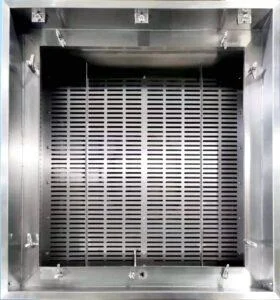
For BIBO housings, the standard post-installation verification method is PAO challenge scanning, where aerosol is introduced upstream and a probe scans the downstream face of the installed filter. The critical procurement detail is whether the housing’s scanning section is configured for automatic or manual scanning. An automatic scanning section routes the probe mechanically along a defined path; a manual section requires hand-scanning with a probe inserted through a port. The scanning equipment on site must match the housing type, and that match should be confirmed as a line item on the purchase order — not assumed based on what was used during the previous filter change.
Housing airtightness is a separate test parameter. A Class 3 airtightness rating, corresponding to a leakage criterion of ≤0.5 Pa as referenced in ISO 10648-2, provides a clear pass/fail threshold for housing integrity independent of filter efficiency. This figure is a design parameter associated with the housing class, not an EN 1822 or ISO 29463 requirement, and it should not be conflated with filter classification. It belongs on the purchase order as a separate housing performance specification.
Differential pressure monitoring — either through fixed gauges or optional pressure sensors with alarm outputs — generates the ongoing performance data that regulators and internal quality systems typically require as continuous test evidence. If the facility’s documentation protocol requires alarmed ΔP data, that sensor configuration needs to be confirmed on the order. Similarly, if the installed housing includes in-place test sections that allow individual filter efficiency testing without shutting down adjacent modules, that capability should be explicitly specified when it is needed, because not all housings include it as standard.
Omitting any one of these from the purchase order creates a verification gap that is difficult to close retroactively.
| Test Requirement | What the PO Should Specify | Warum es wichtig ist |
|---|---|---|
| PAO scanning for HEPA leakage | Automatic or manual scanning method matching the housing | Mismatch prevents a valid leak test |
| Housing airtightness class | ≤0.5 Pa (Class 3 per ISO 10648-2) | Sets a clear pass/fail criterion for housing integrity |
| Continuous differential pressure monitoring | Optional pressure sensors with alarms, if needed | Captures ongoing test data for documentation |
| In-place test sections | Request in-place test capability if non-disruptive verification is required | Allows individual filter efficiency testing without system shutdown |
Procurement Failures From Ordering By Efficiency Label Alone
The efficiency label communicates filter performance. It carries no information about physical interface, sealing geometry, or the consumables required for a safe bag-in-bag-out changeover. Each of those omissions has its own failure mode, and they do not compound gradually — they surface abruptly at the moment the replacement crew opens the housing.
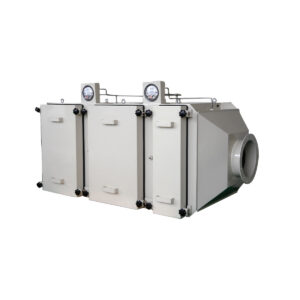
Dimensional mismatch is the most straightforward failure. BIBO housings range considerably in body length and total height — filter body lengths from 1000 mm to 1450 mm, total housing heights from 990 mm to 3240 mm across the product range — and a filter ordered to the wrong module dimensions physically does not fit. This forces a reorder and, in most cleanroom environments, extends a planned maintenance window into unplanned downtime. The efficiency label on the rejected filter is irrelevant.
Module size errors follow the same logic but at a smaller scale. The difference between a 305×610×292 mm and a 610×610×292 mm module may appear marginal when only the depth dimension is considered, but the width difference prevents the filter from seating against the housing’s seal surface. The result is not a marginal seal — it is an open bypass path. This type of error is particularly common when the replacement order is placed from memory or from a handwritten site note rather than from a dimensional drawing.
Seal interface mismatch operates differently. The filter appears to fit, the installation proceeds, and the failure is only detected during the post-installation leak test — or not detected at all if the leak test is skipped or deferred. A filter with a knife-edge gasket installed in a gel seal housing does not produce an obvious physical gap; it produces a perimeter leak path that may not be visible during changeover.
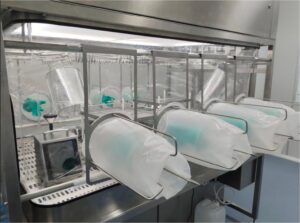
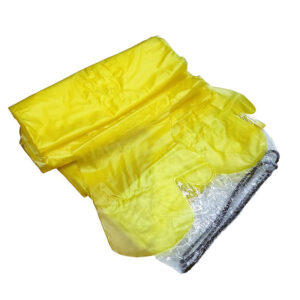
The most underestimated failure is the missing bag kit. Bag-in-bag-out changeover requires matched plastic bags and O-rings sized to the specific module. A 292 mm module and a 100 mm module require different bag kits. Ordering only the filter body leaves the replacement team unable to complete a safe changeover sequence — the used filter cannot be removed and bagged without the correct bag assembly, which means the operation stops at the most hazardous point of the procedure.
| Missing Detail | Potential Failure | Auswirkungen |
|---|---|---|
| Filter dimensions (L×H×D) | Filter physically does not fit the housing | System downtime |
| Standard module size (e.g., 305×610×292 vs 610×610×292) | Seal mismatch, leakage | Cleanroom integrity loss |
| Seal interface (gel seal or knife-edge) | Filter gasket does not seat correctly | Leakage despite correct efficiency label |
| BIBO bag and O-ring kit | Bag-in/bag-out change cannot be performed | Safety risk and compliance failure |
Für BIBO-Systeme handling hazardous exhaust streams, a stopped changeover is not a recoverable inconvenience. It is a safety and compliance event. The systemic cause in all four failure patterns is the same: the efficiency label was treated as a complete specification when it is only one component of one.
Compatibility Checks Before Releasing A Replacement Filter Order
Every item in a pre-order compatibility review exists because it has a specific failure mode if omitted. The purpose of the check is not to generate paperwork — it is to confirm that each physical interface condition between the replacement filter and the installed housing has been verified against the actual equipment, not assumed from a previous order or a generic data sheet.
Dimensions, seal type, housing material, and installation orientation form the first layer of physical compatibility. A filter may be correctly classified and correctly sized but installed in the wrong orientation for the housing design — some BIBO housings are configured for horizontal filter entry, others for vertical, and the filter frame must be matched accordingly. Mini-pleat HEPA filters, for example, may carry different structural constraints under vertical load than separator-style filters, which affects which format is appropriate for a given installation orientation.
| Artikel prüfen | Was zu überprüfen ist | Risiko, wenn es übersehen wird |
|---|---|---|
| Filter dimensions | Width × Height × Depth match the installed housing | Physical non-fit, downtime |
| Seal type | Gel seal or knife-edge gasket | Durchsickern |
| Housing material | SUS304/316L or carbon steel with epoxy coating | Gasket seating/compression failure |
| Installation orientation | Horizontal or vertical | May affect filter integrity under load |
Pressure and temperature limits represent the second layer. A differential pressure range of 0–500 Pa covers normal operating conditions, but the replacement filter must also be confirmed to withstand maximum system resistance — typically 2500 Pa on the positive side and 3000 Pa negative, as design figures for this equipment class. Exceeding either limit risks filter deformation or bypass at the frame seal. The maximum operating temperature of ≤70°C is a material constraint: HEPA media and adhesives in standard filters are not rated for sustained temperatures above this threshold, and exhaust airstream conditions in certain industrial or pharmaceutical processes can approach or exceed it. These are design figures for the equipment class and must be verified against the actual system operating parameters, not assumed to be within range.
Upstream pre-filter and carbon filtration stages — typically G4 or F8 pre-filters plus an activated carbon bed in multi-stage housings — constrain the space available to the HEPA filter and affect the airflow resistance profile across the full housing. A replacement HEPA filter sized correctly for the module may still create an airflow conflict if the pre-filter stage has been modified or if a carbon stage has been added since the original installation. Confirming the current multi-stage configuration before order release prevents this mismatch.
Finally, post-installation leak test capability must be verified before the replacement filter arrives on site. The on-site PAO scanning equipment must be compatible with the housing’s test ports and scanning section type — automatic or manual — as outlined in the testing framework established by ISO 29463-4. If the scanning equipment requires adaptation for the housing type, that adaptation needs to be arranged in advance. Discovering incompatibility after the filter is installed and the housing is closed adds a test delay that extends the period the system operates without verified seal integrity.
| Artikel prüfen | Was zu überprüfen ist | Risiko, wenn es übersehen wird |
|---|---|---|
| Differential pressure range | 0–500 Pa typical; withstands max resistance 2500 Pa positive / 3000 Pa negative | Filter collapse or bypass |
| Max operating temperature | ≤70°C | Premature filter degradation |
| Upstream pre-filter and carbon stages | Confirm presence and type (G4/F8, carbon) | Space conflict, airflow disruption |
| On-site PAO scanning compatibility | Housing test ports and scanning section type (auto/manual) match existing equipment | Unable to perform post-installation leak test |
The practical implication across all of these checks is that a replacement filter order for a BIBO housing is not complete when the efficiency class is confirmed. It is complete when filter class, frame dimensions, seal interface, pressure and temperature ratings, upstream stage configuration, bag kit, and test certificate format have each been verified against the installed equipment — not against a previous order or a remembered specification.
For maintenance teams who hold only the efficiency designation from the original commissioning record, the most direct corrective step is to retrieve the housing’s engineering drawings or contact the original equipment supplier before releasing the order. Stock replacement filters compress lead time, but that advantage disappears immediately if the filter fails the changeover. A project-specific filter matched to the confirmed housing configuration takes longer to procure but eliminates the failure modes that efficiency labeling alone cannot address. The right choice between these paths depends on how well the installed housing is documented — and on whether that documentation has actually been reviewed before the order is placed. For additional guidance on selecting the right filter media and seal format for your application, the gel seal mini-pleat filter selection guide provides useful context on how seal design affects procurement decisions.
Häufig gestellte Fragen
Q: What happens if the housing engineering drawings are unavailable when a replacement order needs to be placed?
A: Contact the original equipment supplier directly before releasing the order — this is the fastest path to recovering the dimensional drawings, seal interface specification, and any housing-specific test requirements. Ordering from the efficiency label alone while those details remain unconfirmed reproduces exactly the failure modes the article describes: a correctly classified filter that cannot complete the changeover because the frame, seal type, or bag kit is wrong.
Q: At what point does specifying a U16 filter instead of H14 become justifiable for a BIBO application?
A: Only when the containment classification of the application genuinely requires it, not as a precautionary upgrade. H14 at ≥99.995% efficiency is the standard baseline for pharmaceutical and biotech BIBO use. U16 carries a higher media cost and may introduce compatibility constraints with housings designed around H14-class frame geometries. Unless the facility’s risk assessment or regulatory submission explicitly requires a higher classification, the additional cost is not offset by a meaningful reduction in operational risk.
Q: Does a stock replacement filter eliminate the compatibility checks, or just the lead time?
A: It eliminates only the lead time. Every physical compatibility condition — dimensions, seal type, pressure ratings, temperature limit, upstream stage configuration, and bag kit — still requires verification against the installed housing before a stock filter is ordered. A stock filter reduces procurement time to near zero if the confirmed specification matches; it offers no advantage if the housing is not first confirmed, because the filter will fail the changeover just as a custom-specified filter would.
Q: If the installed housing includes both automatic and manual scanning sections, which scanning method governs the purchase order test requirement?
A: The method must match how the on-site PAO scanning equipment is actually configured to operate against that housing. The purchase order should specify the scanning section type as it exists in the installed unit — automatic or manual — and the test equipment readiness for that method should be confirmed before the replacement filter arrives. If the housing supports both, the facility’s qualification protocol determines which method is required for the post-installation integrity record.
Q: Can a separator-style HEPA filter and a mini-pleat HEPA filter be used interchangeably in the same BIBO housing if the external dimensions match?
A: Not without verifying structural suitability for the installation orientation. Mini-pleat and separator-style filters carry different structural load characteristics, which affects performance under vertical installation. Even where external frame dimensions are identical, the filter format must be confirmed as appropriate for the housing’s orientation — horizontal or vertical entry — and for the pressure conditions the system generates. Treating dimensional match as sufficient without confirming format suitability is a separate compatibility gap from the dimensional check itself.