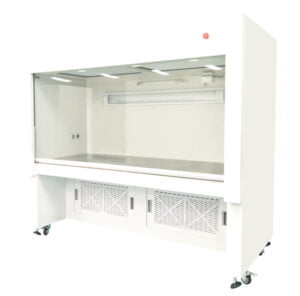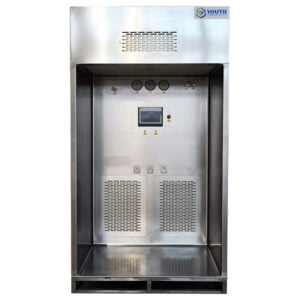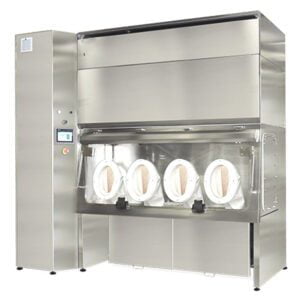
Procurement teams that issue a short-form inquiry and expect a clean, comparable quote on the other end rarely get one. What they get instead is a clarification cycle — questions about door swing clearances, pass-through opening dimensions, ceiling grid positions, interlock requirements — each one answered serially, each one extending the schedule by days or weeks before a revised quote can even be prepared. The more consequential version of this problem surfaces later, during qualification or audit, when acceptance criteria that were never specified in the RFQ become the center of a post-award dispute that no purchase order language can cleanly resolve. The decision that changes this outcome is made before the first supplier question is asked: assembling a complete RFQ package that converts project intent into specifiable inputs across drawings, materials, utilities, controls, and validation documents. What follows gives procurement engineers a structured basis for judging whether their package is ready to send.
RFQ package contents for drawings, materials, controls, and documents
The first failure mode in a Reinraumausrüstung RFQ is not a bad supplier — it is an incomplete specification package that forces the supplier to guess. When area classification, material expectations, and document requirements are absent or vague, the quote returned may look complete but is built on assumptions that will not survive drawing approval or qualification review.
Area classification is the starting point because it drives nearly every downstream equipment decision. Without ISO class, GMP grade, room type, surface coverage scope, and explicit exclusions stated in the RFQ, a supplier has no reliable basis for selecting construction materials, surface finishes, airflow configurations, or filtration ratings. The result is a configuration that may need to be redesigned and requoted entirely once the buyer’s engineering or validation team reviews the drawings against actual room classification requirements.
Material and component documentation carries a similar failure risk, though it tends to surface later. Certificates of conformance, material data sheets, lot traceability records, and chemical compatibility confirmation are not optional post-award deliverables — they are scope items that must be defined in the RFQ so the supplier can price and plan for them. Omitting them at the inquiry stage means they become clarification items after the purchase order is placed, at which point the leverage to define scope cleanly has largely passed.
| What to Include in RFQ | Specification Details | Risk if Omitted |
|---|---|---|
| Area classification & layout | ISO class, GMP grade, room type, surface coverage, exclusions | Configuration fails drawing approval |
| Material & component data | Certificates of conformance, material data, lot traceability, chemical compatibility | Clarification cycles and delays acceptance |
| Quality & compliance documents | Sterilization records, particle data | Prolonged review cycles, delayed acceptance |
| Disposable vs reusable determination | Component lifecycle path (disposable/reusable), supplier qualification needs, reprocessing expectations | Validation failures and rework |
One trade-off that procurement teams often defer too long is the disposable-versus-reusable determination for components. These two paths look interchangeable during early planning but carry materially different supplier qualification burdens. Disposable components require supplier qualification documentation and lot traceability tied to each shipment. Reusable components require validated reprocessing records and cycle-count controls that must be established and maintained throughout the equipment’s service life. Treating the choice as something to decide after the quote comes back creates acceptance delays that are difficult to recover from, because the supplier’s production and documentation infrastructure for each path is not the same.
| Bauteil-Typ | Requirements to Confirm | Risiko bei Unklarheit |
|---|---|---|
| Einwegartikel | Supplier qualification and lot traceability | Validation failures, rework if specs are missing |
| Reusable | Validated reprocessing and cycle-count controls | Validation failures, rework if specs are missing |
Sterilization records and particle data round out the quality and compliance document set. Including these requirements in the RFQ signals to the supplier what the acceptance baseline will be, which allows them to price correctly and flag gaps early rather than during qualification.
Utility and layout constraints that change equipment configuration
Layout constraints are where technically sound equipment choices become physically incompatible with the room. Door swing clearance, pass-through opening dimensions, ceiling grid position, and structural penetration limits are not cosmetic details — they determine whether the equipment the supplier quotes can actually be installed in the location shown on the drawing.
The area classification logic embedded in the layout is particularly consequential for multi-grade facilities. When ISO 5, ISO 7, and ISO 8 environments are treated as interchangeable in the RFQ — using the same equipment specifications or dimensional assumptions across all three — the resulting configuration often cannot be defended during drawing approval. Each grade carries different airflow requirements, pressure differential expectations, and surface finish standards that affect equipment sizing and placement. ISO 14644-4:2022 provides a useful framework for understanding how classification-driven design inputs should feed equipment configuration decisions; the risk of bypassing that logic is a redesign and full requote cycle, not just a minor revision.
Utility interfaces compound this risk when left unspecified. Electrical service location and phase, compressed air supply point and pressure, exhaust connection size and direction, and drain routing all affect whether a piece of equipment can be connected as quoted. If the supplier does not know where utilities terminate, they cannot confirm that the quoted configuration will meet the interface conditions at installation. The consequence is a change order — at best — or a request for a revised layout drawing that restarts the approval sequence.
Shipment and installation access constraints belong in the RFQ for the same reason. Maximum equipment dimensions for building access, elevator capacity, door opening widths, and on-site assembly requirements all affect how equipment is fabricated and packaged. A supplier who does not know these limits may quote a unit that cannot be delivered to the installation point without field modification, which is a cost and schedule problem that is entirely avoidable at the RFQ stage.
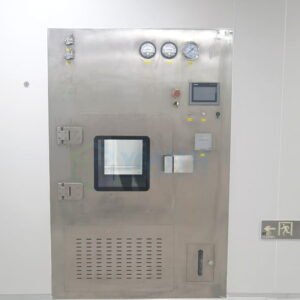
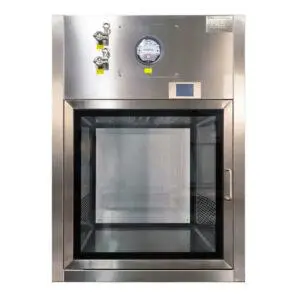
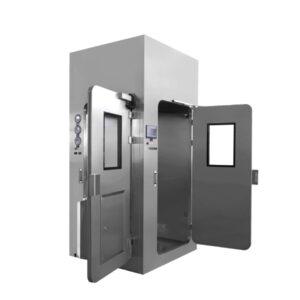
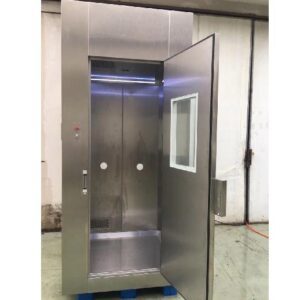
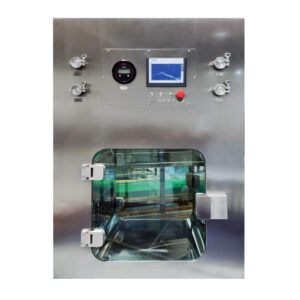
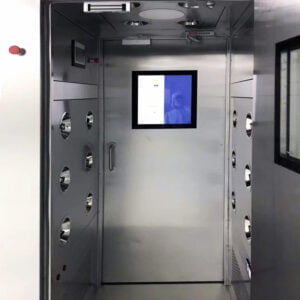
For equipment that operates at the boundary between rooms — such as a Dynamische Passbox installed between a corridor and a classified area — the wall thickness, partition construction type, and opening finish specification must be included in the RFQ. These details determine the unit’s wall-mount design, interlock configuration, and whether the installation will meet the room classification requirements on both sides of the penetration.
Control options and interlocks that need early confirmation
Control requirements that are left for post-award discussion do not stay manageable — they become scope disputes. Interlock logic, access control integration, alarm outputs, and cross-contamination prevention features all affect how equipment is wired, programmed, and validated. Confirming these early is not a project management preference; it is a specification gap that changes the equipment the supplier builds.
The cross-contamination control requirement is where interlock decisions carry the most downstream risk. When components, tools, or materials move between rooms or between GMP grades, the control logic must enforce a boundary: either the item is disposable and does not cross, or it undergoes validated reprocessing before transfer. If the RFQ does not specify which boundary conditions apply and how the equipment should enforce them — through interlocks, visual indicators, alarm states, or procedural controls tied to equipment operation — the supplier will configure the unit to a default that may not match the facility’s contamination control strategy.
Control system integration also needs to be confirmed before the quote is finalized. Whether the equipment communicates with a building management system, requires hardwired interlocks to adjacent HVAC equipment, or needs dedicated alarm outputs for the facility’s monitoring network affects both the electrical design and the control panel specification. A quote built without this information may be priced against a standalone configuration when the buyer’s facility requires integrated operation. Retrofitting the control interface after delivery is technically possible in some cases, but it rarely happens without validation rework that could have been avoided.
PLC versus relay-based control, touchscreen versus switch interfaces, and data logging requirements are additional decision points that change the equipment specification and the associated validation documentation burden. Teams that confirm these in the RFQ stage avoid the post-award scenario where the supplier’s standard control package does not meet the facility’s IQ documentation expectations, which is a particularly expensive clarification to resolve once fabrication has begun.
Quotation delays caused by missing validation and acceptance criteria
The delays most teams attribute to slow suppliers are often caused by specification gaps that force the supplier to ask questions before they can produce a meaningful quote. Four omissions account for the majority of these cycles in practice.
Contact time specification — including dwell time requirements and re-wetting instructions for decontamination or cleaning steps — is one of the most commonly missing inputs. When the RFQ does not state these parameters, the supplier has no basis for confirming compatibility between the equipment’s surface materials, seal types, and finish specifications and the buyer’s actual cleaning or disinfection protocol. The resulting quote may be built around a generic assumption, and when the actual protocol is applied during validation, the compatibility question surfaces as a formal deficiency.
The sterilization pathway for components is a related gap with similar consequences. Whether components are supplied sterile, are autoclavable to a specified cycle count, are single-use disposable, or are validated reusable with a defined reprocessing protocol changes the materials used, the documentation supplied, and the supplier qualification requirements. A quote produced without this clarity is likely incorrect in at least one of those dimensions, and correcting it after award requires rework that could have been avoided.
Verification records — proof of contact time, lot number traceability, and post-treatment status — define what the buyer will need to show during qualification and audit. When the RFQ does not establish these record requirements, the supplier does not build the documentation infrastructure to produce them. The consequence is not always visible until audit preparation begins, at which point the gap becomes a procurement problem retroactively applied to equipment that is already installed.
The overall validation and acceptance criteria gap carries the most serious downstream exposure. FDA enforcement history includes warning letters issued for inadequate cleaning systems where documentation was insufficient to demonstrate control — a consequence that illustrates, by analogy, what happens when equipment specifications are built on undefended assumptions rather than validated acceptance criteria written into the procurement package. The parallel in cleanroom equipment procurement is direct: a quote that is not grounded in specific acceptance criteria cannot be used as a defensible baseline during qualification.
| Omitted Criterion | Consequence for Quotation | Validation/Acceptance Risk |
|---|---|---|
| Contact time specification (dwell time, re-wetting) | Supplier guess, back-and-forth, inaccurate quote | Failure during validation and acceptance |
| Tool sterilization pathway (sterile, autoclavable, disposable, validated reusable) | Incorrect quote, rework | Blocks acceptance, regulatory non-compliance |
| Verification records (contact time proof, lot numbers, post-treatment status) | Repeated RFQs, prolonged clarification | Failed audits, possible regulatory action |
| Overall validation and acceptance criteria | Quote based on assumptions, not defensible specs | Regulatory risk comparable to FDA warning letter for inadequate cleaning system |
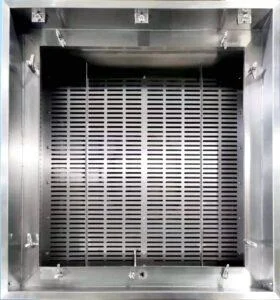
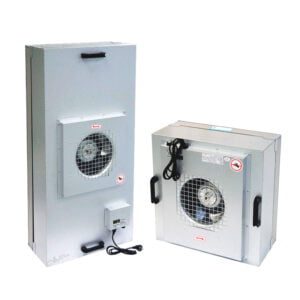
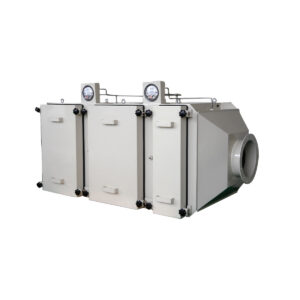
For equipment where airflow performance is part of the acceptance baseline — such as a HEPA-Gehäuse specified against a room’s cleanroom classification — the acceptance criteria must include the test conditions, measurement points, and pass/fail thresholds that will be used during commissioning. Without these, the supplier cannot confirm that the unit’s rated performance maps to the buyer’s actual qualification protocol.
Supplier submission threshold after the RFQ evidence list is complete
Submitting an RFQ before the evidence list is complete does not accelerate procurement — it defers the clarification work into a stage where it costs more time and creates more risk. The threshold for submission is not a formal regulatory gate; it is a practical defensibility check across five input categories: drawing inputs, material expectations, utility needs, control requirements, and acceptance documentation.
Validated acceptance criteria must be in the evidence list before the RFQ is issued. An unvalidated SOP or an equipment specification built on informal assumptions is difficult to defend if the supplier’s quote diverges from expectations and a post-award dispute follows. EudraLex Volume 4 Annex 15 provides a useful reference for understanding what validation documentation logic requires of the procurement process — specifically, that qualification activities should be grounded in defined acceptance criteria established before execution, not derived from what the equipment happens to produce. Applying that logic to the RFQ stage means the acceptance criteria must exist in writing before the supplier is asked to quote against them.
| Evidence Item to Verify | Requirement for Submission | Warum es wichtig ist |
|---|---|---|
| Validated acceptance criteria | Include in RFQ evidence list before submission; unvalidated SOP is hard to defend | Quotes become defensible, reducing post-award validation disputes |
| Supplier qualification documentation for reusable components | No non-validated reprocessing methods; documentation must be part of evidence list | Prevents acceptance delays and ensures traceability |
Supplier qualification documentation for reusable components is the second pre-submission gate that teams most often defer. If the equipment includes reusable components, the supplier must be able to demonstrate that a qualified reprocessing pathway exists and that the documentation for it — cycle validation records, cycle-count limits, traceability requirements — will be part of the deliverable package. Issuing an RFQ without this requirement stated explicitly means the buyer is accepting an unknown documentation burden post-award, which is a traceability gap that surfaces during qualification and is difficult to close retroactively.
A useful self-check before submission is whether every item in the RFQ package could be used by a supplier who has never spoken to the buyer to produce a quote that would survive drawing approval and qualification review. If the answer requires assumptions about classification, material finish, utility location, interlock logic, or acceptance thresholds, those assumptions should be resolved into specifications before the package is sent. Reviewing how other procurement teams structure this process in practice can help identify categories that are commonly underspecified — the cleanroom equipment procurement supplier assessment guide und die cleanroom equipment pricing and cost comparison resource both address how supplier capability and cost structure intersect with specification completeness.
A complete RFQ package is not a bureaucratic formality — it is the mechanism by which procurement teams control their own project schedule. The clarification cycles that extend timelines are almost always traceable to inputs that were available at the RFQ stage but were not included: a ceiling grid position, an interlock requirement, a contact time specification, a sterilization pathway decision. Each omission creates a serial delay that compounds across the project rather than resolving in parallel.
Before the RFQ is sent, the most useful judgment a procurement engineer can make is whether the package contains enough information for a supplier to quote a configuration that will survive drawing approval, pass IQ documentation review, and produce verifiable acceptance records during qualification. If any of those three outcomes depends on a future conversation rather than a current specification, the RFQ is not ready — and sending it early will cost more total time than the delay of completing it correctly.
Häufig gestellte Fragen
Q: What if the facility layout drawings are still in draft form — is it worth waiting for final drawings before issuing the RFQ?
A: Issue the RFQ only when the inputs that drive equipment configuration are stable enough to specify, not when every drawing revision is closed. Ceiling grid position, wall opening dimensions, door swing clearance, and utility termination points need to be fixed to a level where the supplier can quote a configuration that will not need to be redesigned. Sending an RFQ against drawings that are still changing in those specific areas produces a quote built on a moving target — the clarification cycles that follow are longer than the delay of resolving those inputs first.
Q: After the RFQ package is submitted and quotes come back, what is the first thing to verify before comparing suppliers?
A: Confirm that each quote is based on the same classification inputs, material expectations, and acceptance criteria before comparing any line-item pricing. Quotes that look comparable on price often diverge because one supplier made a documented assumption — about ISO class, surface finish, or control configuration — where the RFQ was silent. A quote grounded in an unstated assumption is not comparable to one that priced the specified requirement; treating them as equivalent at the selection stage creates a scope dispute at award.
Q: Does the disposable-versus-reusable decision need to be resolved before the RFQ is sent, or can it be left for the supplier to recommend?
A: It must be resolved before the RFQ is sent. Leaving the choice to the supplier does not defer the decision — it transfers it to a party who does not know the facility’s contamination control strategy, validated reprocessing infrastructure, or audit documentation requirements. The two paths carry different supplier qualification burdens, different traceability requirements, and different validation documentation deliverables. A quote built on the wrong assumption for your facility will require rework after award that is more expensive and slower to resolve than making the determination during RFQ preparation.
Q: At what point does adding more specification detail to the RFQ stop improving quote quality and start creating unnecessary constraints for the supplier?
A: The boundary is between inputs that affect whether the equipment can be installed, qualified, and accepted — which must be specified — and preferences that do not change those outcomes, which can be left to the supplier’s standard design. Classification, utility interface locations, interlock logic, acceptance criteria, and material finish requirements all sit on the must-specify side because a wrong assumption in any of these areas forces a redesign or a post-award dispute. Aesthetic preferences, panel color, or labeling conventions that carry no qualification consequence are reasonable areas to allow supplier discretion without increasing clarification risk.
Q: Is a cleanroom equipment RFQ process materially different for a new facility build versus a retrofit into an existing classified space?
A: A retrofit RFQ carries a higher specification burden, not a lower one. In a new build, layout and utility interfaces are still being designed and can be coordinated with equipment requirements. In a retrofit, the wall construction, ceiling grid, utility termination points, and existing pressure differential logic are fixed constraints that the equipment must fit without modification to the room. Any of these that are omitted from the RFQ will produce a quote based on an assumed interface condition that the supplier cannot verify — and the cost of a configuration mismatch discovered at installation in a live classified space is significantly higher than the same discovery during a greenfield build.