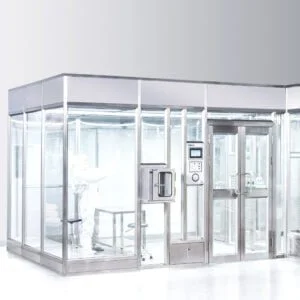
Releasing a modular cleanroom RFQ before grade, pressure cascade, airflow approach, and gowning sequence are fixed tends to produce quotes that look comparable on price but diverge significantly in scope. Hidden exclusions — omitted pass-through validation support, unspecified surface finish, or generic fire-rated panels applied regardless of ISO class — rarely surface until drawing review, at which point correcting them means scope renegotiation with lead time already committed. The single most common specification gap is surface roughness: standard industrial panels are frequently manufactured to Ra ≥3.0 µm, while ISO 5/6 sterile zones require ≤0.8 µm, and the mismatch is not caught until particle count qualification fails or an inspector raises it during audit. Resolving that after installation is a rework event, not a drawing comment. The decision that prevents most of this is converting GMP user requirements into explicit modular supplier inputs — grade, airflow approach, transfer method, utility connections, and document expectations — before a single layout is drawn. What follows is structured to help procurement teams, QA leads, and engineers identify which inputs must be locked before RFQ release and what happens when they are not.
Grade and airflow inputs before GMP modular cleanroom RFQ
Grade is not a project label — it is a set of measurable limits that drive panel specification, airflow design, and acceptance testing simultaneously. Until each room area has a defined ISO class, suppliers cannot reliably price panel material, surface finish, joint type, or HVAC interface. A quote that arrives without these inputs fixed has made assumptions about all of them, and those assumptions may not match your regulatory environment.
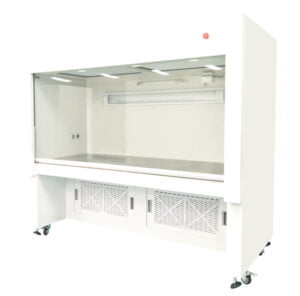
The ISO 14644-1 particle count limits define the cleanliness target the room must achieve in operation, which in turn sets the airflow approach — turbulent dilution for ISO 7/8, unidirectional laminar flow for ISO 5/6 — and the structural performance requirements for the panels that form those rooms. Surface roughness directly affects whether a room can be cleaned to a standard that holds through repeat disinfection cycles. At Ra ≤0.8 µm, aluminum-faced panels support the wipe-down and sporicide contact regimes typical of ISO 5/6 sterile zones; at Ra ≥1.6 µm, surface pitting begins to accumulate residue in ways that complicate environmental monitoring. Standard industrial panels commonly arrive at Ra ≥3.0 µm, which is not a marginal deviation — it changes the qualification outcome.
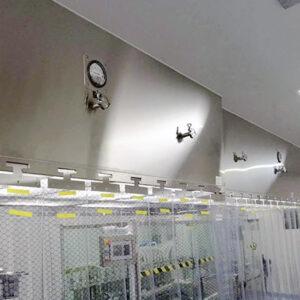
Air tightness is a planning criterion that is frequently treated as an HVAC detail but belongs in the panel specification. For ISO 5/6 rooms, a pressure decay target below 0.25% per hour is commonly applied as a design threshold; achieving it requires cam-lock or gasket joint systems specified at the panel level, not added after installation. If the joint system is not in the RFQ, the supplier will choose one, and it may not match the HVAC designer’s pressure cascade model.
| ISO-Klasse | ≥0.5 µm particle limit per m³ | Max surface roughness (Ra) | Air tightness target | Typical core material |
|---|---|---|---|---|
| ISO 5 | 3,520 | ≤0.8 µm | <0.25 %/hr pressure decay | Aluminum-faced |
| ISO 6 | 35,200 | ≤0.8 µm | <0.25 %/hr pressure decay | Aluminum-faced |
| ISO 7 | 352,000 | ≤1.6 µm | - | Rock wool (perimeter) / PIR (internal) |
| ISO 8 | 3,520,000 | ≤1.6 µm | - | Rock wool (perimeter) / PIR (internal) |
Core material selection compounds the cost impact of leaving grade undefined. Applying aluminum-faced ISO 5/6-grade panels throughout a facility that includes ISO 7/8 areas is technically compliant but inflates panel cost by 30–60% without benefit. The inverse error — applying lower-grade panels to ISO 5/6 rooms — creates a compliance deficit that cannot be corrected with cleaning protocols. Both errors are preventable if grade is mapped by room area before the RFQ is issued.
Transfer, gowning, utilities, and qualification evidence by room area
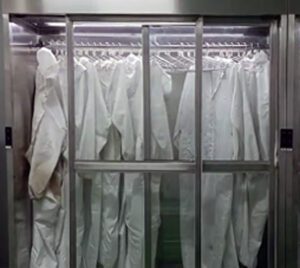
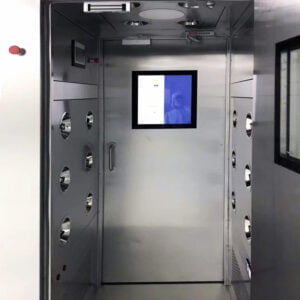
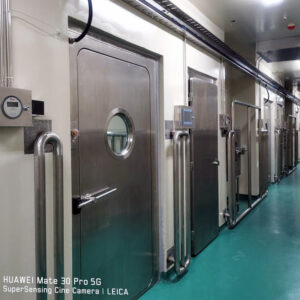
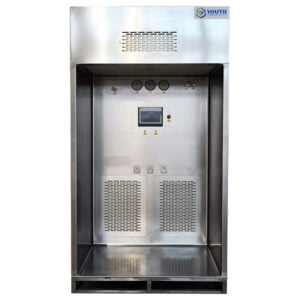
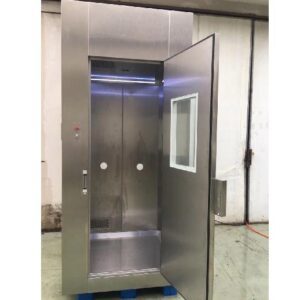
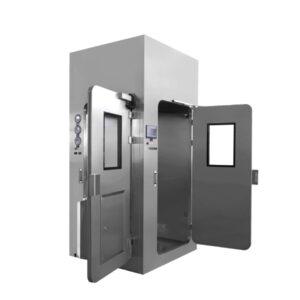
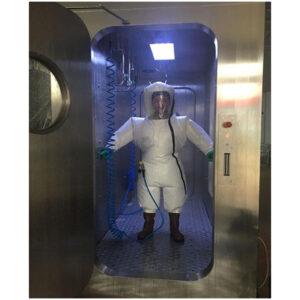
Personnel flow and material transfer are not architectural preferences — they are contamination control mechanisms that must be resolved per room area before a layout can be drawn. Unidirectional personnel flow reduces the probability of higher-grade rooms being accessed from lower-grade corridors without a decontamination step; but whether that means a full gowning anteroom, an air shower, or a graded access control sequence depends on the grade boundary and the process activity in each zone. Suppliers cannot locate doors, interlocks, or pass-throughs correctly until the buyer has defined this sequence room by room.
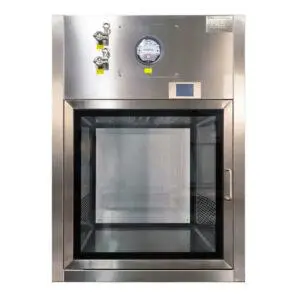
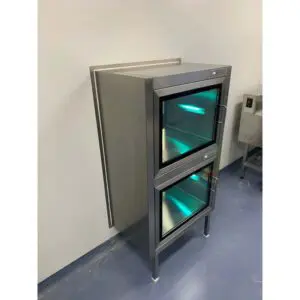
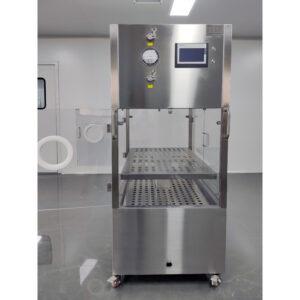
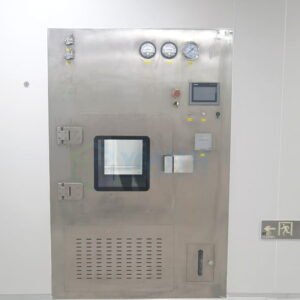
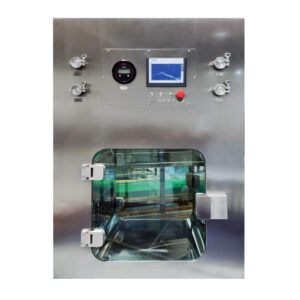
Material transfer specification follows the same logic. A static pass box is appropriate for lower-grade boundaries; a HEPA-filtered Dynamische Passbox with UV cycle is required where active contamination risk exists at the transfer interface. Specifying the wrong type in a layout — or leaving it unspecified — means the supplier may position an opening that cannot accommodate the equipment you need later, or quote a unit that does not match the grade differential across the wall.
Surface chemical resistance belongs in the room-area specification, not in a general materials note. IPA, sodium hypochlorite, hydrogen peroxide, and peracetic acid are all routinely applied in pharmaceutical cleanrooms, but they affect panel surfaces differently. Peracetic acid and hydrogen peroxide vapor are particularly aggressive; panels specified only for IPA resistance may show surface degradation within months of full cleaning operation, which then becomes a contamination risk in itself.
| Input category | Key requirement / options | Why it matters |
|---|---|---|
| Personnel flow & gowning | Unidirectional flow, gowning protocol, air showers, access control | Reduziert das Risiko einer Kreuzkontamination |
| Materialtransfer | Double-door airlock, closed-loop transfer, static or HEPA‑filtered dynamic pass box per classification | Controls contaminant migration between grades |
| Surface chemical resistance | Resistance to IPA, sodium hypochlorite, hydrogen peroxide, peracetic acid on panel surfaces | Prevents surface degradation from repeated exposure |
| Qualification evidence | Documentation review (batch numbers, test certificates, as-built drawings); air tightness test; particle count at simulated conditions; surface swab; joint/seal audit; pressure differential stability check | Provides acceptance evidence required for qualification |
Qualification evidence is not something to request after construction — it is something to require in the URS so that suppliers know what documentation they must generate during manufacture and installation. Batch numbers, material test certificates, as-built drawings, and joint/seal audit records are outputs of supplier process control; they cannot be reconstructed after delivery. The pressure differential stability check and particle count at simulated conditions require the room to be complete and the HVAC to be operating, which means the acceptance framework must be agreed before installation begins, not negotiated during commissioning. This is consistent with the Annex 15 expectation that qualification protocols are prepared and approved before execution — though the buyer, not the panel supplier, is responsible for that protocol.
URS details suppliers need before drawing work
A supplier cannot begin layout or engineering without resolving four specification inputs that are routinely missing from early RFQ packages. Their absence does not stall the quotation — it gets absorbed as an assumption — which is precisely the problem.
Surface roughness is the most frequently overlooked. Ra value must be stated in the URS with a requirement for a certificate of compliance from the supplier, because the surface finish of a delivered panel cannot be reliably verified without a profilometer at incoming inspection. Most procurement teams do not have profilometer access on site, which means the gap between ordered and delivered finish goes undetected until qualification testing or, in some cases, a regulatory inspection. Ra non-compliance at ISO 5/6 rooms has been associated with FDA inspection findings — not as an abstract risk but as a documented pattern with consequences ranging from Form 483 observations to more formal enforcement responses.
Fire rating certification must reference the complete panel configuration as tested, not the core material in isolation. A PIR core may carry a B-s1,d0 rating that is acceptable for internal partitions in many projects, but where A1 non-combustible performance is required for perimeter walls — which is common in pharmaceutical construction — rock wool core is the appropriate choice. Requiring EN 13501-1 or ASTM E84 documentation that matches the delivered configuration prevents the substitution risk that occurs when a supplier changes core material between order and shipment without explicit buyer approval.
| Specification item | What to require | Risk if unclear / omitted |
|---|---|---|
| Surface roughness (Ra) | Specify Ra value and require supplier certificate of compliance (≤0.8 µm for ISO 5/6, ≤1.6 µm for ISO 7/8) | Regulatory inspection failures (e.g., FDA Form 483) |
| Fire rating certification | Require EN 13501‑1 or ASTM E84 certificate for the complete panel configuration; verify it matches delivered material | Project delays and regulatory rejection |
| Joint system & air tightness | Define joint type (tongue‑and‑groove, gasket, cam‑lock) and air tightness target (e.g., pressure decay <0.25 %/hr for ISO 5/6) | Engineering mismatch; pressure instability and increased HVAC load |
| Core material & density | Specify material type, density (kg/m³) and require supplier core material audit on delivery | Material mismatch between order and installation |
Joint system type and air tightness target must be aligned between the panel supplier and the HVAC designer before drawings are issued. If one is specified without the other, the pressure cascade model and the panel joint design may be incompatible — an engineering mismatch that is expensive to resolve after panels are fabricated. Core material density requires the same discipline: specifying material type without density leaves room for substitution that changes both thermal and structural performance without any visible change to the delivered panel.
Quote risk from missing GMP process inputs
The risk is not that an RFQ without defined inputs fails to produce quotes — it is that it produces quotes that look comparable and are not. Each supplier fills the specification gaps with its own assumptions, and those assumptions diverge. The result is a set of quotations that cannot be evaluated against each other because they describe different scopes, and the differences are not visible in the line items.
Grade definition is the input with the broadest pricing consequence. GMP-grade panels carry a 30–60% cost premium over standard industrial panels, with a planning-level range of roughly $40–120/m² depending on surface specification and core material. When grade is left undefined in the RFQ, some suppliers quote GMP-grade panels and others quote standard panels. The lower quote is not more competitive — it reflects a different product. Normalizing pricing requires stating GMP-grade panel requirement, surface finish, and core material as explicit RFQ inputs.
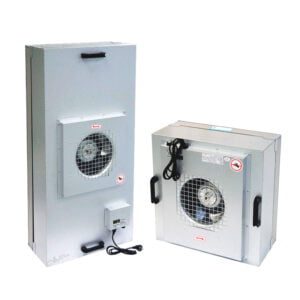
Joint sealing is the hidden operational consequence that appears in maintenance budgets rather than in the original quote. Underspecified joints create pressure instability that increases HVAC energy load by an estimated 20–30% and shortens filter service life — costs that are distributed across years of operation but traceable to a specification decision made at project inception. The Lüfter-Filter-Einheit (FFU) performance in ISO 5/6 ceiling arrays is directly affected by room pressure stability; a room with poor joint sealing creates variable pressure conditions that affect filter loading and airflow uniformity, both of which appear in ongoing particle count monitoring.
| Missing or incomplete input | Consequence / red flag | What to clarify before RFQ |
|---|---|---|
| Grade, airflow approach, pass‑through, gowning, utilities, acceptance evidence not fixed | Non‑comparable room packages; hidden exclusions discovered only during drawing review | Define each room’s ISO class, pressure cascade, transfer method, gowning sequence, utility points, and qualification evidence list |
| Surface roughness (Ra) specification omitted | May lead to FDA Form 483, warning letter, or consent decree | Include Ra value and supplier certificate requirement (≤0.8 µm for ISO 5/6) |
| Panel material mismatched to cleanroom class (e.g., same panel for ISO 5 and ISO 8) | Using ISO 5‑grade panels throughout is compliant but unnecessarily expensive; using standard panels where GMP grade is needed fails qualification | Select core material by grade and wall location; specify separately for ISO 5/6 sterile zones and ISO 7/8 perimeter |
| Joint sealing underestimated | Pressure instability; HVAC energy load +20–30 %; filter service life shortened | Specify joint type and air tightness target, and require joint/seal audit in qualification evidence |
| Non‑fire‑rated core material in perimeter walls (e.g., PIR where A1 is required) | Project delays and regulatory rejection | Require fire rating certificate matching delivered panels; confirm EN 13501‑1 A1/A2 for pharma |
| Generic panel quotation without GMP‑grade specification | Quotes vary by 30–60 %, roughly $40–120/m², undermining comparability | State GMP‑grade panel requirement, surface finish, and core material in RFQ to normalize pricing |
Non-fire-rated core material in perimeter walls is a compliance failure that cannot be corrected by documentation after installation. PIR core in a position where A1 is required means the panel must be replaced, which is a structural rework event during a phase when the project may already be under construction schedule pressure. The risk is preventable with a fire rating requirement matched to wall location in the URS — but only if the URS is detailed enough to distinguish perimeter from internal partitions by room area.
RFQ release after grade map and document needs are complete
RFQ release is a defensibility checkpoint, not a milestone driven by schedule pressure. Once a modular cleanroom RFQ is released, suppliers begin layout work, lead times enter commitments, and the cost of changing grade assignments or panel specifications increases rapidly. The practical condition for release is that each room area has a defined ISO class, activity, airflow approach, utility connection points, and a clear list of document expectations — not because a named authority requires it in that sequence, but because without it, the buyer loses the ability to evaluate and compare what is actually being quoted.
The pre-installation inspection checklist is the document bridge between RFQ requirements and delivery acceptance. It should require visual damage inspection, surface roughness verification by profilometer, fire rating certificate matching delivered material, core material audit, joint profile accuracy check, and edge sealing integrity review. These checks belong in the RFQ scope so that suppliers price them into their delivery process; retrofitting them as incoming inspection requirements after panels arrive typically means the documentation infrastructure was never built.
For projects operating under EU GMP Annex 1 or ISO 14644-4:2022 design and construction expectations, the qualification and document evidence list should be agreed with the validation team before RFQ release, not developed during commissioning. The URS is the instrument that converts GMP user requirements into supplier-addressable inputs; releasing it incomplete shifts risk to the buyer at every subsequent stage — drawing review, factory acceptance, site acceptance, and regulatory inspection. A well-structured RFQ with a complete grade map and document scope does not guarantee a smooth project, but an incomplete one creates identifiable failure conditions that are difficult and costly to recover from once layout drawings are in progress.
Before releasing an RFQ for a pharmaceutical modular cleanroom, confirm that each room area has a defined ISO class, pressure cascade assignment, airflow approach, transfer method, gowning sequence, utility connection list, and explicit qualification evidence requirements. These are not administrative completeness items — they are the inputs that determine whether quotes are comparable, whether panels will qualify, and whether the room can be handed over without rework. Surface roughness specification and fire rating certification by wall location are the two items most frequently missing from early-stage RFQs, and both carry consequences that appear at validation or inspection rather than at drawing review.
The grade map and URS should be reviewed jointly by the engineering lead, QA, and procurement before release. If any room area still has an undefined ISO class or an unresolved transfer method, that is not a detail to resolve with the supplier — it is a buyer decision that the supplier cannot make on the buyer’s behalf without creating scope assumptions that undermine quote comparability and qualification defensibility.
Häufig gestellte Fragen
Q: What should be done if the validation team hasn’t been engaged before the RFQ is ready to release?
A: Delay release until the validation team confirms the qualification evidence list. The URS must reflect what the validation team will require at site acceptance — test certificate formats, as-built drawing standards, pressure differential stability records, and particle count protocol conditions. If these are agreed after RFQ release, suppliers may have already excluded documentation deliverables from their scope, and adding them mid-project carries cost and schedule consequences that are avoidable at the URS stage.
Q: Does the 30–60% GMP panel cost premium apply equally across all room areas, or only to the highest-grade zones?
A: The premium applies selectively based on ISO class per room area, not uniformly across the facility. Aluminum-faced panels with Ra ≤0.8 µm and cam-lock joint systems carry the higher cost and are required for ISO 5/6 zones; ISO 7/8 areas can use lower-specification materials — rock wool core for perimeter walls, PIR for internal partitions — without compliance risk. Applying the same panel specification throughout to avoid complexity is technically compliant but inflates project cost without qualification benefit, making grade-by-room-area mapping a direct cost control mechanism.
Q: At what point does an incomplete URS stop being a manageable gap and become a project risk that can’t be corrected without rework?
A: The threshold is panel fabrication. Once suppliers begin fabricating panels to assumed specifications — surface finish, core material, joint type — changes to those specifications require either panel replacement or a documented deviation that may not survive regulatory scrutiny. Drawing review is the last practical checkpoint before fabrication begins; after that, correcting a surface roughness mismatch or a fire-rated core substitution becomes a structural rework event, not a documentation update.
Q: How should a buyer handle a situation where two suppliers have quoted the same project at significantly different prices without an explanation of scope differences?
A: Treat the price gap as a specification gap, not a competitive signal. When grade, surface finish, joint system, and fire rating are not fixed in the RFQ, each supplier fills those gaps with different assumptions. The lower quote likely reflects standard industrial panels, an unspecified joint type, or excluded documentation deliverables — none of which are visible in the line items. Before any commercial evaluation, require each supplier to confirm in writing the ISO class of panels quoted, Ra value, core material with density, joint system type, and documentation scope. Only then can the quotes be normalized and compared.
Q: Is a dynamic pass box always required at grade boundaries, or are there conditions where a static unit is acceptable?
A: A static pass box is acceptable at lower-grade boundaries where active contamination risk at the transfer interface is limited; a HEPA-filtered Dynamische Passbox with UV cycle is required where the grade differential is significant or where the transferred materials present an active contamination risk. The decision depends on the specific grade boundary, the nature of materials being transferred, and the contamination control strategy defined in the URS — it cannot be resolved generically across all openings. Leaving transfer type unspecified in the RFQ means the supplier may size and position wall openings that cannot later accommodate the unit the process actually requires.