Commissioning a mobile LAF cart looks straightforward until the approval meeting surfaces disagreements nobody anticipated — grid points the buyer assumed were standard, battery-mode performance that was never tested, and velocity readings taken on an empty work surface that don’t hold up when someone asks whether they represent actual operating conditions. Each of those gaps can stall handover by days or weeks, and in regulated environments, a commissioning record that can’t be defended at requalification creates rework far more expensive than the original test. The judgment call that determines whether commissioning data stays defensible is whether the test state at the time of measurement actually represented the cart as it will be used — not an idealized, unloaded configuration that produces the most favorable numbers. By the end of this checklist, you should be able to identify which pre-test conditions matter most, where velocity-only acceptance creates a hidden risk, and how to close the disputes that most often delay approval before they start.
Commissioning checks that define the correct airflow test state
The most common error at this stage is treating the test state as self-evident — assuming that turning on the cart and reading the anemometer constitutes a commissioning check. In practice, the measurement is only as valid as the conditions under which it was taken, and several pre-start checks define whether those conditions are stable enough to produce defensible data.
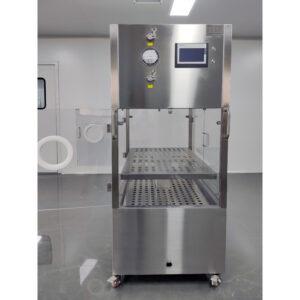
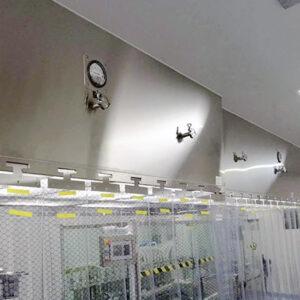
Before the blower starts, confirm that the magnehelic gauge reads zero. A gauge that carries residual pressure from a previous run will produce a false differential pressure baseline, which can mask early signs of filter loading or obscure a real deviation. This is a two-second check that routinely gets skipped, and the consequences surface later when results are questioned.
Once the cart is running, differential pressure across the HEPA filter should fall between 7 and 15 mm WC during operation. These are design figures and SOP-derived acceptance criteria for this equipment type, not universal regulatory thresholds — but within that context, they define whether the filter is performing within its intended loading range. A reading below that range can indicate a seating problem; a reading above it suggests the filter may be partially loaded or that the blower is working harder than expected.
The 30-minute warm-up is a stabilization requirement, not a procedural formality. Airflow in the first few minutes after start-up is transient — the fan speed and internal pressure haven’t reached steady state, and readings taken before stabilization tend to overstate uniformity. That overstating is difficult to defend if it’s later compared against a requalification measurement taken after proper warm-up.
The UPS battery charge condition is less obvious but operationally significant. If the battery is partially depleted when commissioning begins and the test runs long enough to degrade motor voltage, you may record airflow values that reflect a degrading power state rather than nominal performance. Fully charging before testing removes that variable.
| Check | Anforderung | Warum es wichtig ist |
|---|---|---|
| Magnehelic gauge zeroing | Confirm gauge reads zero before starting blower | Prevents false differential pressure baselines that could mask filter issues |
| HEPA filter differential pressure | Verify DP between 7–15 mm WC during operation | Defines pass/fail criterion for filter loading and performance |
| Pre-measurement warm-up | Run mobile LAF cart for 30 minutes before taking airflow measurements | Stabilizes airflow; avoids transient readings that misrepresent steady-state performance |
| UPS/battery charge | Ensure battery is fully charged before testing | Prevents premature battery depletion that could interrupt testing or alter airflow |
Locked-use setup and accessory conditions before measurement
A test configuration that doesn’t match the intended use configuration produces results that answer a question nobody is actually asking. For a mobile LAF cart, three setup conditions carry the most risk if omitted.
Castor locks seem obvious but are frequently overlooked on smooth lab floors where the cart feels stable. Even minor positional drift during a multi-point grid measurement introduces enough variation to create inconsistency across the test record. Locking the castors makes the cart a fixed measurement object, which is what the test protocol assumes.
Accessories represent a more consequential omission. Side panels, sliding panes, and shelves that will be installed during real operation directly affect internal airflow distribution — they change where air accelerates, where it slows, and whether the laminar column maintains its geometry across the work surface. Testing without these accessories and then operating with them means the commissioning record doesn’t describe the equipment as it will be used. That gap becomes a specific problem if an audit challenges whether the original test was representative.
The load pattern condition is the one most consistently rationalized away. Teams often argue that loading the cart with representative products introduces too many variables. The counter-argument is that the whole point of commissioning is to confirm protection under realistic conditions — and an unloaded surface is not a realistic condition for a cart designed to transport products or garments through a controlled environment.
| Setup Condition | Was zu bestätigen ist | Risk if Omitted |
|---|---|---|
| Castor locks | Cart castors are locked to prevent movement | Movement alters test position, invalidating airflow readings |
| Accessories installed | All side panels, sliding panes, and shelves that will be used in actual operation are installed | Missing accessories change internal airflow distribution, leading to non-representative results |
| Load pattern | Cart is loaded with expected items (e.g., products, garments) to represent in-use conditions | Empty-surface readings overstate protection; loading affects airflow uniformity |
Empty-surface readings that misrepresent in-use protection
An empty work surface produces the best-looking airflow data a mobile LAF cart will ever generate. The unobstructed laminar column sweeps across the surface without disruption, velocity readings cluster tightly, and uniformity metrics appear excellent. The problem is that none of that reflects how the cart operates when loaded.
When products, containers, or garments occupy the work surface, they create physical obstructions that redirect airflow, generate wake zones on their downstream side, and can disrupt the laminar column enough to create localized dead zones — areas where air velocity is low enough that particles settle rather than being swept away. The degree of disruption depends on the size, shape, and placement of the load, but the directional effect is consistent: real loads reduce apparent uniformity compared with empty-surface conditions.
This matters beyond the commissioning moment itself. If the original commissioning record was generated with an empty cart, and a later requalification is conducted with the cart loaded as intended, the two data sets will diverge. Explaining that divergence to an auditor — particularly if the requalification result shows elevated particle counts or velocity drop-off — requires arguing that the original test was never intended to represent in-use conditions. That is a difficult position to maintain when the purpose of commissioning is precisely to confirm in-use protection.
The practical correction is straightforward: represent the expected load pattern during commissioning. It doesn’t require loading the cart with actual product — representative forms or placeholders of similar geometry serve the purpose. The goal is to ensure the commissioning airflow record reflects a realistic obstruction pattern, so that future requalification data can be compared against a baseline that was generated under comparable conditions.
Velocity-only checks versus full airflow verification packages
Velocity measurement is necessary but not sufficient. A cart can pass an anemometer-based acceptance check while simultaneously having a pinhole leak in the HEPA filter that allows unfiltered air to bypass the media entirely. The leak won’t show up in average velocity — it will show up in downstream particle counts or in a DOP/PAO integrity scan. Relying on velocity alone means accepting that gap as a known risk.
The distinction between a velocity-only approach and a full verification package is ultimately an engineering trade-off: broader testing costs more time and requires additional equipment, but it closes the failure modes that velocity measurement cannot see. For a mobile LAF cart operating in a pharmaceutical or biotech environment, the cost of missing a filter leak at commissioning is typically higher than the cost of adding integrity testing to the acceptance package. For lower-criticality applications, the judgment may reasonably land differently — but that trade-off should be made deliberately, not by defaulting to whatever is easiest to execute.
Filter integrity testing — DOP or PAO challenge depending on the application — directly confirms that the HEPA filter is seated correctly and free of bypass paths. It is the only method that can confirm filter performance rather than airflow volume. Continuous differential pressure monitoring through the magnehelic gauge or a digital alarm adds a real-time dimension that spot-check velocity measurements can’t provide: it tells you whether filter loading is progressing as expected between formal test intervals.
Airflow uniformity mapping extends the picture further. Confirming that downflow velocity meets specification (commonly 0.45 m/s for unidirectional protection, though this is an equipment-specific design figure rather than a universal rule) at a single point establishes an average, not a distribution. Mapping across the full test grid, and confirming the horizontal laminar flow pattern, identifies whether dead zones exist at the edges or in the wake of obstacles. Non-uniform airflow is not always visible in an average reading.
| Verification Element | Velocity-Only Approach | Full Verification Package | Why Full Verification Matters |
|---|---|---|---|
| Integrität der Filter | Not performed | DOP/PAO-Dichtheitsprüfung | Velocity alone cannot confirm filter performance; integrity testing detects leaks that compromise protection |
| Überwachung des Differenzdrucks | Typically spot-checked or omitted | Continuous monitoring via magnehelic gauge or digital alarm | Real-time indication of filter loading ensures ongoing compliance |
| Downflow velocity | Anemometer check for average velocity at selected points | Confirmation that downflow velocity meets specified value (e.g., 0.45 m/s) across the full test grid | Ensures design airflow for unidirectional protection |
| Airflow uniformity and pattern | May not be characterized | Verification of uniform horizontal laminar flow, mapping of dead zones | Non-uniform airflow creates dead zones where contamination can settle |
Test-Frameworks wie z. B. ISO 14644-3:2019 und IEST-RP-CC002 provide relevant methodology context for unidirectional-flow device testing and grid-based airflow verification — neither directly governs the specific acceptance package for a mobile LAF cart, but both inform what a defensible full-verification approach looks like in practice.
Test-grid disputes that delay commissioning approval
The most avoidable source of commissioning delay is a disagreement that was entirely predictable: the buyer and supplier never agreed on how the test would be conducted before it happened. Grid-point disputes, meter-position arguments, and questions about whether battery-mode performance requires separate confirmation are not technical problems once they appear at the approval stage — they are planning failures that compound into schedule delays.
The grid-point question is where most disputes concentrate. How many measurement locations, at what height above the work surface, and in what arrangement? If the buyer’s quality team expects a grid density consistent with their internal SOP and the supplier’s commissioning technician uses a sparser grid that produces a passing average, the two parties have effectively conducted different tests on the same equipment. Resolving that after the fact usually means repeating the test — the delay cost of not aligning upfront.
Meter position and probe orientation introduce similar friction. An anemometer held at a slightly different angle or distance from the filter face produces readings that differ from a consistently positioned probe, and those differences matter when the result is close to the acceptance threshold. Agreeing on probe positioning as part of the pre-commissioning protocol removes that variable before it becomes a dispute.
Dual-mode testing — confirming performance in both mains-powered and UPS/battery modes — is the condition most often omitted from the pre-agreed scope and most often contested afterward. If the cart is specified for use in areas where mains power may not be available, and battery-mode performance was never formally confirmed during commissioning, the cart’s suitability for those use cases is an open question. Treating dual-mode confirmation as a planning criterion rather than an afterthought is what keeps it from becoming a handover-stage negotiation.
For teams preparing commissioning protocols, the LAF Unit Audit Checklist provides a useful reference framework for structuring what needs pre-agreement versus what can be handled during execution.
Mode-dependent airflow changes that signal a design problem
Mobile LAF carts are designed to operate in two power states, and not all carts handle the transition between them equally. If measured velocity changes materially when the cart switches from mains to UPS operation, that change needs to be interpreted as a design-level signal rather than a documentation variance to explain in the commissioning report.
The first step is understanding which airflow type the cart uses — single-pass or recirculatory. In a single-pass configuration, air drawn from the environment passes once through the HEPA filter and is discharged across the work surface. In a recirculatory configuration, a proportion of air is returned and re-filtered. These two configurations respond differently to changes in motor voltage, which is what a switch from mains to battery operation represents. A recirculatory design may sustain internal pressure more consistently across the transition; a single-pass design may show more sensitivity to voltage variation. Neither is inherently problematic, but the expected behavior profile differs, and commissioning should be conducted with that distinction in mind.
What matters for the commissioning judgment is the magnitude of any velocity change on mode switch. Minor variation attributable to normal motor tolerance is expected. A material drop — one that pushes performance below the specified velocity threshold, changes the uniformity profile, or produces a noticeably different airflow pattern — is not a paperwork problem. It indicates that the cart’s power management design may not be maintaining fan performance adequately under battery load, or that the UPS is undersized for sustained operation at the motor’s demand. Documenting that change as an acceptable deviation and moving to approval defers a design problem into service, where it will eventually surface under less controlled conditions.
If mode-dependent behavior raises questions during commissioning, the appropriate response is to flag it for design review before sign-off — not to average the mains and battery readings and note the difference as within tolerance. A mobile LAF cart whose unidirectional protection degrades when it operates off-grid is not providing the protection its specification claims in those conditions. Commissioning is the last practical point at which that problem is cheap to resolve. For teams evaluating equipment at the specification stage, understanding how a mobiler Wagen für laminare Luftströmung manages dual-mode operation is worth confirming before commissioning begins.
The commissioning record for a mobile LAF cart carries more downstream weight than it appears to at handover. It becomes the baseline against which every future requalification is compared, the reference a quality team reaches for during an audit, and the document that either supports or undermines a claim about in-use protection. Records generated under non-representative conditions — empty work surface, missing accessories, velocity-only acceptance, no dual-mode confirmation — don’t fail at commissioning. They fail later, when conditions change and the original data can’t defend the current claim.
Before approving commissioning, confirm three things explicitly: that the test state matched the intended use configuration, that the acceptance package included integrity testing alongside velocity measurement, and that both power modes were confirmed against the same acceptance criteria. Those three confirmations are what separates a commissioning record that remains defensible through the equipment’s service life from one that creates problems at the first requalification.
Häufig gestellte Fragen
Q: Does the checklist still apply if the mobile LAF cart will only ever be used in a fixed location and never moved between rooms?
A: Yes, but the mode-dependency and castor-lock steps become less critical, while the accessory and load-pattern conditions remain fully relevant. A stationary cart still needs to be commissioned in its actual use configuration — with all installed accessories and a representative load — because the airflow performance risk from missing accessories applies regardless of whether the cart moves. The dual-mode confirmation is less pressing if mains power is always available, but it should still be documented as a deliberate scope decision rather than an unexamined omission.
Q: After commissioning sign-off, what is the correct interval for the first requalification, and does the original test grid have to be repeated exactly?
A: The commissioning record should be used to define the requalification protocol before the first requalification occurs, not after. The grid points, probe positions, power modes, and load conditions used at commissioning should be documented specifically enough to be reproducible — if they are not, the first requalification will face the same disputes the article describes at the approval stage. Industry frameworks such as ISO 14644-3:2019 provide methodology guidance, but the requalification interval itself is typically set by the site’s quality system or the applicable regulatory requirement for the environment in which the cart operates.
Q: At what point does a velocity difference between mains and battery modes become large enough to require design review rather than a noted deviation?
A: The threshold is whether battery-mode performance drops below the specified velocity acceptance criterion or produces a meaningfully different uniformity profile — not whether a numerical difference exists. Minor variation from normal motor tolerance is expected and acceptable. If the battery-mode reading falls outside the acceptance range applied to mains-mode testing, or if the airflow pattern changes enough to create dead zones that were absent under mains power, that is a design-level problem. Documenting it as within tolerance by averaging the two modes is not an acceptable resolution if battery operation is part of the cart’s intended use scope.
Q: Is filter integrity testing genuinely necessary for every mobile LAF cart commissioning, or is it only required for pharmaceutical-grade applications?
A: Integrity testing is justified whenever the cost of missing a filter leak at commissioning exceeds the cost of running the test — and for most controlled-environment applications, that calculation favors testing. For pharmaceutical and biotech use, the case is clear: a pinhole bypass in the HEPA filter is invisible to velocity measurement but directly compromises product protection. For lower-criticality applications such as general electronics handling, the risk calculus may reasonably support a velocity-plus-differential-pressure package without a full DOP/PAO scan. The important point is that the decision should be made deliberately against the application risk, not by defaulting to velocity-only because it is easier to execute.
Q: How should a buyer handle a situation where the supplier’s commissioning technician arrives without a pre-agreed test protocol and wants to proceed using their own standard procedure?
A: Stop and align on the protocol before any measurements are taken. Readings generated under an unreviewed procedure cannot be incorporated into a commissioning record that the buyer’s quality team will need to defend, and repeating the test after the fact costs more time than a pre-test alignment conversation. The specific items to confirm before proceeding are grid density and point locations, probe height and orientation, whether both mains and battery modes will be tested, and which acceptance criteria apply to each measurement type. If the supplier’s standard procedure covers all of those to the buyer’s satisfaction, it can be adopted — but that judgment should be made explicitly, not assumed.