Procurement teams that spec a modular cleanroom for a semiconductor project and later blame it for yield loss are usually looking at the wrong cause. The room often delivered exactly what was contracted — a controlled enclosure at a defined ISO class — while the systems that actually drive yield, vibration isolation, pressure cascade management, chemical exhaust routing, and tool utility distribution, were never part of the modular supplier’s scope and were never separately procured in time. That gap between what the room provides and what the process requires rarely appears in early project documents, which is where the budget exposure and commissioning delays begin. Understanding where the modular scope ends and where facility and process tool infrastructure must begin is the judgment that separates a well-staged semiconductor project from one that stalls at tool qualification.
Where Modular Cleanrooms Fit in Semiconductor Work
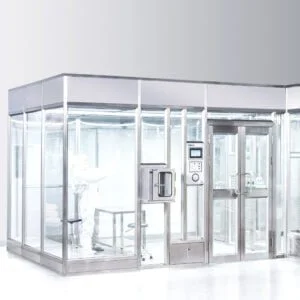
Modular cleanrooms enter semiconductor projects at the edges of the fabrication environment, not at its center. Wafer packaging, incoming and outgoing inspection, subassembly, and support operations all require contamination control, but they do not require the full process infrastructure that lithography, etch, deposition, or diffusion tools demand. A modular room can provide a defined, repeatable enclosure for these tasks — including anti-static wall systems and, with project-specific engineering, multiple ISO classification zones within a single structure to separate gowning from the working area.
The distinction that matters operationally is whether contamination control is needed around selected work zones or across an integrated wafer-processing environment. For the former, a modular room is a legitimate and often efficient fit. For the latter, it is not a substitute for a purpose-designed fab, regardless of the ISO class the room achieves on paper. Buyers who conflate the two categories typically discover the mismatch during commissioning rather than during concept review, when correction is more expensive.
Multi-zone ISO classification within one modular enclosure is a design option, not a standard product feature. It requires upfront layout planning, validated airflow modeling, and confirmation that the room’s HVAC system can maintain classification boundaries between zones under realistic operating conditions. Treating it as a default capability leads to under-specified procurement and validation scope.
Full Fab Infrastructure Outside Modular Room Scope
Full semiconductor fabrication environments are built to specifications that modular construction does not routinely target. ISO Class 5 at or below 3,520 particles per cubic meter, sustained temperature uniformity within ±0.1°C, and relative humidity held between 40 and 50 percent are operational parameters that require purpose-engineered HVAC, structural envelope control, and continuous system monitoring. These are design figures that full fab infrastructure is built to meet; they are not universal regulatory mandates that bind every facility identically, but they represent the performance baseline that wafer-level process steps depend on. Modular rooms are not typically designed or commissioned to these tolerances, and treating them as equivalent creates a gap that surfaces first in process variation, then in yield data.
Ceiling filter coverage is another threshold where the gap between modular and full fab becomes consequential. Full fab environments use 80 to 100 percent HEPA or ULPA ceiling coverage combined with raised perforated floors to sustain continuous laminar downward airflow across the entire work volume. Modular rooms generally achieve lower filter coverage ratios, which is appropriate for the support and inspection tasks they are designed for, but means that air change rates and particle removal uniformity do not match full fab levels. This is not a deficiency in the modular product; it is a scope difference that becomes a problem only when buyers expect fab-level process performance from a modular enclosure.
Material compatibility is a further consideration that often goes unexamined during modular procurement. Fab-grade construction uses non-shedding, non-porous, chemically stable materials throughout — powder-coated aluminum framing, stainless steel surfaces, anti-static epoxy flooring — because particle generation from room materials becomes a contamination source at sub-micron process nodes. Standard modular panel systems may not meet the same material specifications, and buyers integrating modular rooms adjacent to or upstream of process tools should confirm material compatibility before assuming it.
| Infrastructure Element | Full Fab Specification | Modular Room Gap/Concern |
|---|---|---|
| Cleanliness | ISO Class 5, ≤3,520 particles/m³ | May not sustain ISO 5 uniformly; limited to localized contamination control |
| Temperature & Humidity | ±0.1°C, 40–50% RH | Tight control often beyond modular HVAC; risk of static and process variation |
| Airflow & Filtration | 80–100% HEPA/ULPA ceiling coverage, raised floor laminar flow | Modular rooms may have lower filter coverage and lack continuous downward airflow |
| Kompatibilität der Materialien | Non-shedding, non-porous, chemically stable (e.g., SS, anti-static epoxy) | Standard modular panels may not meet semiconductor-grade non-shedding/chemical requirements |
Utility Exhaust Vibration and Chemical Handling Limits
The systems most commonly missing from early modular project scope are also the systems most capable of causing tool qualification failure. Vibration control is the clearest example. Full fab facilities use floating slab floors, vibration-dampening mounts, and isolated structural supports because lithography and metrology tools operate at nanometer-scale tolerances where ambient building vibration is a yield variable, not a secondary concern. Modular room structures do not include these measures, and the modular supplier cannot be expected to provide them. If process tools requiring vibration isolation are planned for a modular enclosure, the vibration control infrastructure must be separately engineered and procured before the room is installed, not retrofitted after qualification fails.
ESD protection and pressure cascade management present similar planning risks. A modular room can be specified with conductive flooring and grounded work surfaces, but full ESD infrastructure, including grounded tool connections, ESD-safe garment protocols, and active humidity regulation, requires coordination across room design, facility systems, and operational procedures. Modular rooms may support parts of this infrastructure, but buyers should not assume that a modular enclosure inherently delivers a complete ESD-controlled environment without verifying what is and is not included in the specification. Pressure cascade design, where the cleanest zones are maintained at higher differential pressure to prevent particle migration toward them, is typically integrated into a full fab’s building management and HVAC control systems. Basic modular configurations do not routinely include automated pressure cascade control; where cross-contamination between zones is a process risk, that system must be separately specified and cannot be assumed to appear by default.
The practical consequence of missing any of these systems is not a cleanroom failure — the room itself may pass ISO qualification — but process tool qualification failures and yield anomalies that are difficult to diagnose after the fact because the room’s certification data appears clean. SEMI S2-0724 provides useful context for ESD and chemical handling safety expectations in semiconductor equipment environments, and project teams reviewing tool integration requirements should use it as a reference for what the process environment must support, independent of what the modular room supplier delivers.
| Utility Factor | Full Fab Implementation | Modular Room Limitation/Risk |
|---|---|---|
| Vibrationskontrolle | Floating slab floors, dampening mounts, isolated supports | Structural vibration measures usually outside modular scope; nanometer misalignment risk leads to yield loss |
| Electrostatic Discharge (ESD) | Conductive flooring, grounded tools, ESD garments, humidity control | Modular rooms may not include full ESD infrastructure; sensitive device damage risk |
| Druckkaskade | Higher pressure in cleanest zones to prevent contaminant migration | Automated pressure cascades not typically integrated in basic modular rooms; cross-contamination risk |
Pilot Inspection Assembly and Support Use Cases
The clearest validated use case for a modular cleanroom in a semiconductor context is a controlled environment around operations that are contamination-sensitive but process-infrastructure-light. Wafer packaging is one such operation: it requires anti-static conditions, particle control, and sometimes separate gowning and working zones, but it does not require lithography-grade HVAC, tool-specific process gas distribution, or vibration isolation. A modular enclosure engineered for this task delivers what the operation needs without the capital and lead time of permanent fab construction.
Incoming and outgoing wafer inspection, device-level assembly, and mechanical integration tasks follow the same logic. These operations need a repeatable contamination-controlled environment; they do not need the full fab’s integrated utility infrastructure. Modular rooms designed for these applications can include removable wall sections to allow transfer of large equipment or tooling without full room disassembly, which matters for inspection stations where the equipment being inspected may be large or infrequently cycled in and out.
Economical gowning area construction is a further point where modular scope aligns well with semiconductor support operations. Gowning requirements for inspection or packaging environments are real but do not need to be engineered to the same standard as a fab gowning suite. Modular systems allow these areas to be built efficiently as part of the same installation, keeping the transition from uncontrolled to controlled space manageable within a reasonable construction budget. The boundary to watch is whether that gowning area is serving a support operation or acting as the anteroom to a full wafer-processing environment — the latter requires gowning suite design that matches the process-side classification, which may exceed what a standard modular gowning configuration provides.
For teams evaluating whether a given semiconductor support function is a legitimate modular fit, the practical test is whether the operation can be fully characterized without reference to fab-level utility systems. If the task list includes tool exhaust connections, process gas supply, chemical drain systems, or vibration-sensitive metrology equipment, those elements are outside the modular room’s scope by default and must be separately accounted for.
Scope Boundaries Between Room and Process Tools
The modular cleanroom and the process tools it houses are separate procurement objects, and that boundary is where project scope gaps most reliably appear. Modular room walls can be designed to interface with raised floor systems, and installation can include personnel ramps as part of the room structure. What the modular supplier does not provide, and should not be expected to provide without explicit contract specification, are the tool-specific utilities: process gas distribution, chemical supply lines, chemical exhaust routing, and point-of-use connections at each tool location. These require separate engineering, separate procurement, and separate commissioning, and they need to be defined before detailed design is complete, not after the room is installed.
Buyers who discover this boundary mid-commissioning face a specific problem: the room is built, the tools are positioned, and the utility connections that were assumed to be part of someone else’s scope are not designed or procured. At that stage, routing gas lines or exhaust ductwork through a completed modular enclosure without disrupting the room’s classification is a constrained engineering problem that adds cost and delay that could have been avoided with earlier scope definition.
Wall type selection carries a parallel planning implication. The achievable ISO class is directly constrained by which modular wall system is specified, and that decision must be made before procurement, not after the room is in use.
| Umfang Artikel | Typically Included with Modular Room? | Anmerkungen |
|---|---|---|
| Integration with raised floor | Ja | Walls designed to interface with raised floor panels |
| Personnel ramps | Ja | Can be included as part of installation |
| Tool-specific gas lines | Nein | Buyer must procure separately |
| Tool-specific chemical supply | Nein | Outside modular supplier scope |
| Tool-specific exhaust | Nein | Requires separate engineering |
| Wandtyp | Achievable ISO Class | Suitability Notes |
|---|---|---|
| Harte Wand | All ISO classes | Suitable for most stringent cleanroom requirements |
| Rigidwall | ISO 5–8 | Good for mid-range cleanliness needs |
| Softwall | ISO 7–8 | Limited to less stringent applications |
The wall type table is particularly relevant for buyers who are not yet certain of their final cleanliness requirement. If ISO Class 5 is a possibility, only a hardwall system preserves that option. Specifying a rigidwall or softwall system to save cost and then discovering the process requires ISO 5 means replacing the room structure, not upgrading the HVAC.
Practical Selection Rules for Semiconductor Buyers
The modular construction advantages most relevant to semiconductor buyers — faster installation from prefabricated ceiling grids, reduced on-site skilled labor demand, and potential classification as tangible personal property with accelerated depreciation — deliver their full value only when the use case genuinely matches modular scope. Under CHIPS Act demand conditions, where both labor availability and project schedules are under pressure, these advantages are real. But they are advantages for pilot environments, inspection rooms, packaging areas, and support spaces — not for core wafer-processing environments where ±0.1°C HVAC control and continuous laminar airflow are non-negotiable operating conditions.
The depreciation distinction is worth verifying with tax counsel for each specific asset configuration, but the general principle — that modular rooms commonly qualify as tangible personal property depreciable over seven years rather than permanent structures depreciable over thirty-nine — represents a meaningful total cost of ownership difference over a project’s operating life. That financial trade-off reinforces the case for modular in contexts where the operational fit is already confirmed.
One procurement risk that consistently erodes the schedule advantage of modular construction is late procurement of air handling units. Lead times for critical AHU components can range from twelve to twenty-four weeks depending on specification and market conditions. A buyer who completes scope definition before placing equipment orders can preserve much of the schedule benefit that made the modular choice attractive. A buyer who sequences procurement after detailed design is complete may find that the AHU lead time determines the project critical path regardless of how fast the modular structure itself can be installed.
Relocation and reconfiguration flexibility are legitimate long-term planning criteria, particularly for organizations that anticipate future facility changes or do not want to commit permanent construction budget to a support function that may evolve. These are lifecycle trade-offs that apply most clearly when the initial use case is a fit and the operational requirements do not require full fab infrastructure.
| Auswahlfaktor | Modularer Reinraum | Stick-Built / Permanent Fab |
|---|---|---|
| Construction Cost | Lower overall | Höher |
| Construction Speed | Faster, especially with prefabricated ceiling grids | Slower, more on-site labor |
| Tax Depreciation | 7-year (tangible personal property) | 39-year (permanent structure) |
| Ease of Modification | Easier to reconfigure or expand | More costly and time-consuming to alter |
| Umsiedlung | Can be disassembled and relocated | Fixed, cannot be moved |
| On-Site Skilled Labor Demand | Reduced offsite fabrication helps mitigate labor shortages | Higher on-site labor demand |
For buyers evaluating a semiconductor cleanroom module for a specific project phase, the most useful early exercise is mapping each planned operation against the scope boundary: what does the room provide, and what must be separately procured and engineered to make that operation viable? If that list of separately procured items is long and complex, the project may be attempting to extend modular scope into territory where permanent fab infrastructure is the more defensible choice.
The consistent failure pattern in modular-versus-fab decisions is not choosing the wrong room — it is failing to define what the room is responsible for before design and procurement begin. A modular cleanroom that meets its specified ISO class and is used for operations within its genuine scope is a well-matched procurement decision. The same room used as the assumed solution for a wafer-processing environment because it was faster and cheaper to buy will create yield and qualification problems that the room’s certification data will not explain.
Before committing to either path, procurement and engineering teams should complete a scope matrix that maps each planned operation to its contamination control requirement, its utility infrastructure requirement, and the party responsible for providing each. The gap between those columns — what the room delivers versus what the process requires — is where the real project risk lives, and it is resolvable at the concept stage in a way it is not once construction is complete.
Häufig gestellte Fragen
Q: Can a modular cleanroom be upgraded later to meet full fab requirements if the project scope expands?
A: No — a modular cleanroom cannot be upgraded to full fab performance through equipment additions alone. The limitations are structural, not just mechanical: full fab environments require floating slab vibration isolation, 80–100% ceiling filter coverage, ±0.1°C HVAC uniformity, and integrated pressure cascade control, none of which can be retrofitted into a modular enclosure economically or without effectively rebuilding the room. If ISO Class 5 wafer-level processing is even a future possibility, that decision must drive the original facility choice, not a later modification order.
Q: What is the first procurement action to take after deciding a modular cleanroom is the right fit for a semiconductor support operation?
A: Place the air handling unit order before detailed room design is finalized. AHU lead times range from 12 to 24 weeks depending on specification and market conditions, and that component — not the modular structure itself — is the most common reason the schedule advantage of modular construction disappears. Scope definition, wall type selection, and ISO class confirmation need to happen early enough to support an AHU order that does not become the project’s critical path.
Q: At what point does cross-contamination risk between zones make a modular room the wrong choice?
A: When cross-contamination prevention depends on automated pressure cascade control between process zones, a standard modular configuration is unlikely to be sufficient. Pressure cascade management — maintaining higher differential pressure in the cleanest zones to block particle migration — is typically integrated into a full fab’s building management system. Basic modular rooms do not include this by default. If the contamination risk is real and the zones being protected are part of active wafer processing rather than support operations, that requirement should be procured as a separately specified system or used as a signal that permanent fab infrastructure is the appropriate choice.
Q: How does the modular versus stick-built decision differ from the modular versus full fab decision?
A: They address different questions. Modular versus stick-built is a construction method trade-off — both can produce a cleanroom of comparable ISO class and operational scope, with modular generally offering faster installation, lower field labor costs, and relocation flexibility. Modular versus full fab is a scope and infrastructure trade-off — a modular room of any construction type does not provide the vibration isolation, process utility distribution, laminar airflow uniformity, or environmental tolerances a wafer-processing fab requires. Conflating the two comparisons leads buyers to assume that choosing modular construction is the same decision as choosing a modular room for a fab-level application, which it is not.
Q: Is the depreciation advantage of modular cleanrooms large enough to justify choosing modular over permanent construction when the operational fit is marginal?
A: No — the depreciation difference should confirm a modular choice that is already operationally justified, not drive it. The potential to depreciate a modular room as tangible personal property over 7 years rather than a permanent structure over 39 years is a meaningful total cost of ownership benefit, but only when the room’s scope matches the work being done inside it. A modular room used in an application that requires full fab infrastructure will generate yield losses, qualification delays, and retrofit costs that far exceed any tax benefit. Verify the operational fit first; treat the depreciation advantage as a reinforcing financial factor, not the deciding one, and confirm the classification with tax counsel for the specific asset configuration.
Verwandte Inhalte:
- Modulare BIBO-Konstruktionen: Flexibilität für Ihre Einrichtung
- Modulare Laminar Air Flow Einheiten für Reinräume
- So legen Sie ISO-Klassenziele für ein Halbleiter-Reinraummodul fest
- Modulare Reinräume der ISO-Klasse 6 im Vergleich zur ISO-Klasse 7 für die Elektronik- und Bauteilmontage
- Wiegekabine vs. Waagenraum: Was ist das Richtige für Sie?
- Leitfaden für modulare Reinräume: Typen, ISO-Klassen, Materialien, Ausstattung und Fragen an Lieferanten
- Mobile LAF-Wagen für die Halbleiterindustrie: Leitfaden
- Spezifikation für Halbleiter-Reinraummodule hinsichtlich ISO-Klassifizierung und AMC-Regelung
- Anbieter modularer Reinräume für Projekte in den Bereichen Pharmazie, Biotechnologie, Halbleiterindustrie und kritische Fertigung