Layouts that look clean on paper routinely fail once operators start moving through them at shift change. The common consequence is a rework cycle that surfaces only after commissioning—benches too narrow to stage clean and used garments without crossing, ESD contact points positioned where operators have already handled components, and crossing routes that generate particle loads no air shower can correct. These are not minor refinements; catching them post-build means cutting into finished panels, relocating furniture anchorages, or accepting chronic particle excursions while a redesign is approved. The decisions that prevent this are made at the layout stage, before fabrication begins, and they depend on treating personnel movement as a sequenced chain of state changes rather than a door-to-door transit problem. What follows will help you identify the specific layout conditions where flow design either holds or breaks down.
Personnel State Changes From Gowning to Exit
Treating the cleanroom entry door as the primary contamination control point is the most persistent planning error in personnel flow design. The door is a physical threshold, not a behavioral one. Contamination risk is distributed across a sequence of state changes—from street clothes to gowned, from gowned to active work posture, from active work to de-gown, from de-gown to exit—and each transition carries its own exposure condition. When layout design does not reflect that sequence spatially, the physical environment forces operators to improvise, and improvised movement is where gowning discipline breaks down.
Industry contamination data consistently attributes the majority of cleanroom contamination to personnel operating procedures rather than to equipment or environmental sources, with figures in the 75–80% range cited as a practical risk benchmark. The implication for layout is direct: if personnel behavior is the dominant contamination vector, then every spatial decision that makes correct behavior harder to perform consistently—a bench too close to the entry door, a gowning step that requires operators to double back, a de-gown area that shares a path with the entry route—accumulates as structural risk. No filtration upgrade compensates for a layout that routinely generates procedural shortcuts.
The exit sequence deserves the same design attention as entry. De-gowning generates particle-laden garments, adhesive debris, and in electronics rooms, potentially charged material. If the exit path overlaps with the entry path—a common economy in small modular layouts—used garments and freshly gowned operators occupy the same physical zone at the same time. ISO 14644-5 provides the framework logic here: the dirty-to-clean progression principle applies in both directions, and any layout that allows the two directions to intersect at a shared bench, corridor section, or door creates a condition the standard’s sequencing intent is explicitly designed to prevent.
Gowning Bench Space and Clean-Used Separation
Gowning bench sizing decisions are frequently made on the basis of operator count alone, which produces benches long enough for the number of people but not configured for the steps those people must perform. Seated gowning—overshoe application, lower garment dressing, foot transfer across the bench—requires a defined clean side and a defined used side, with enough depth and clear length at each stage to complete the step without reaching across the contamination boundary. When that space is not designed in, operators adapt by placing items on the floor, using the bench surface for both clean and used storage simultaneously, or skipping steps. Each adaptation is a contamination event that the gowning bench’s physical design has made more likely than not.
The clean-used separation is not simply a matter of drawing a centerline on the bench. Storage for clean garments waiting to be donned must be positioned and enclosed so that garment handling during a previous step does not deposit particles on adjacent clean items. Similarly, used garments awaiting disposal or laundering must have a dedicated drop point that does not share airflow or surface contact with any part of the dressing sequence. In practice this means the bench layout, storage configuration, and directional flow through the gowning room need to be designed as a unit rather than as furniture placed in an available space. A Wickeltisch selected without reference to the specific garment sequence being performed there will often fail the clean-used separation requirement in observed use even if it meets it on a layout drawing.
The downstream consequence of undersized or poorly separated gowning stations becomes visible at qualification. Observed gowning checks—where an operator performs the full sequence while a reviewer traces the clean-used boundary—routinely identify crossing paths that were not apparent on drawings. Identifying these during layout review costs nothing to correct. Identifying them during SAT or a regulatory walkthrough means either accepting a documented deviation or pulling benches.
ESD Contact Points Along the Entry Route
In electronics and precision manufacturing cleanrooms, ESD control is a parallel control requirement to particulate control, and it has its own entry-route logic. ANSI/ESD S20.20 establishes the program requirements for wrist-strap testing and personnel grounding verification, but it does not specify where in the entry route those verification steps should occur. That placement decision falls to the layout designer, and it matters operationally because an ESD contact point positioned in the wrong location will be bypassed, forgotten, or treated as optional under production pressure.
The effective placement principle is that ESD verification should occur at a point where operators naturally pause before they can physically reach sensitive parts or assemblies. This is a positional requirement, not a frequency requirement. If the contact point is at the gowning room exit but the first handling opportunity occurs ten meters into the production floor, operators who reach the bench before recalling the check cannot easily reverse course. If the contact point is positioned at the transition from gowning to production—at a natural threshold that requires a momentary stop—the verification step becomes part of the entry ritual rather than an add-on that competes with it. For more detail on how ESD conductivity requirements interact with cleanroom furniture selection, this verification guide covers the surface and grounding criteria that layout placement must support.
The trade-off that gets missed is between ESD control and particle control at shared transition points. A wrist-strap tester mounted on a wall near an air handling return or at a point where operators must reach across a contamination boundary to use it creates a secondary contamination risk while solving the ESD one. Layout review should confirm that ESD contact points are accessible without introducing posture changes or surface contacts that compromise gowning integrity.
Traffic Density and Operator Crossing Risks
Particle emission from moving operators scales with the number of people in motion simultaneously, and the figures involved are not negligible even in well-gowned personnel. Two operators moving through a space in Tyvek hood-to-boot garments generate approximately 1,200 particles per second at 0.5 µm and larger under typical activity conditions—a design reference figure that depends on garment material and movement level, but one that makes the planning implication concrete: crossing routes in critical zones are not a housekeeping concern, they are a direct particle loading mechanism. Layouts that route operators through or past open product stations because the floor plan was optimized for space efficiency rather than flow separation will generate particle excursions that are difficult to trace back to their cause without movement observation.
The principles that address this are planning criteria, not regulatory mandates, but they have clear layout consequences.
| Prinzip der Gestaltung | Warum es wichtig ist | What to Clarify in Layout |
|---|---|---|
| Minimise unnecessary operator movement and crossing in critical zones | Two operators moving in Tyvek garments emit ~1200 particles/s ≥0.5 μm, increasing local contamination load. | Whether traffic routes avoid crossing open product or sensitive processes. |
| Isolate critical processes from personnel access doors and pathways | Cleanroom workers are the dominant contamination source. | Whether critical process stations are positioned away from access doors and main walkways. |
| Provide the most critical space with a single access point | A single entry prevents the space from being used as a transitional corridor to less critical areas. | Confirm the floor plan does not route personnel through the highest-grade zone to reach other rooms. |
| Place air locks as buffers between high-traffic areas and critical process spaces | Air locks reduce cross-contamination pressure from gowning/ungowning zones. | Whether air locks are present at the transition from gowning to production and from production to ungowning. |
Each principle in the table has a specific failure mode when omitted. The single-access rule for the most critical space is violated most often when modular layouts use a high-grade process zone as a corridor to an adjacent support area—a decision made during space optimization that turns a controlled environment into a transit route. Air locks as buffers between gowning zones and process spaces are omitted most often when the modular build budget is constrained, with the assumption that disciplined behavior can substitute for physical separation. It generally cannot sustain that substitution reliably over shift rotations.
Air Shower Limits in Poorly Controlled Flows
Air showers are frequently positioned in layouts as though they represent a final decontamination step that makes upstream flow design less critical. They do not function that way, and designing around that assumption produces layouts where the air shower is the only control point for surface particle removal while gowning discipline, traffic routes, and entry sequencing remain uncontrolled.
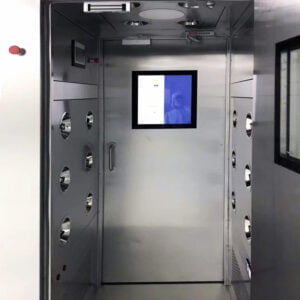
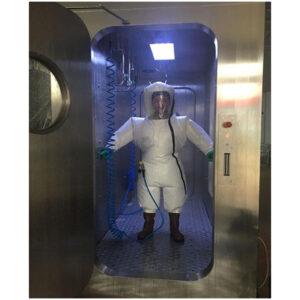
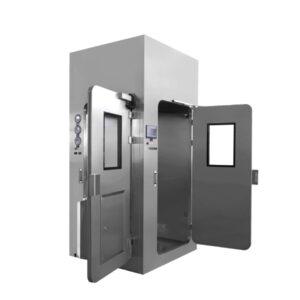
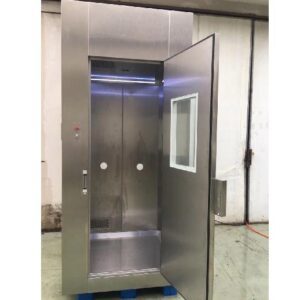
The conditions under which air shower effectiveness degrades are mostly behavioral and flow-dependent. When operators bypass the hold time because traffic queues have built up at a single entry point, the exposure duration is insufficient for meaningful surface particle removal. When door discipline breaks down—entry-side and exit-side doors opened simultaneously, or exit doors propped during shift changes—the pressure differential that supports directional airflow collapses. When gowning is inconsistent, an air shower acts on a garment surface that already carries contaminants from a poorly performed dressing sequence; it removes some surface-mobile particles but does not correct the underlying garment condition. The Reinraum-Schleuse serves a defined purpose within a controlled entry sequence, and that sequence is what protects the room, not the equipment in isolation.
The layout implication is that air shower placement and sizing should follow from traffic density and entry sequencing analysis, not precede it. A single-lane air shower feeding a production area with peak entry loads of eight to ten operators per shift change creates a queue pressure that generates every bypass and door-hold behavior described above. Identifying the actual entry load during layout review—not the nominal headcount, but the realistic simultaneous entry demand at shift overlap—determines whether the air shower configuration supports or undermines the flow it is meant to protect.
Observed Movement Checks Before Layout Approval
Layout approval based on drawing review alone systematically misses failure modes that only appear when operators perform realistic tasks in sequence. This is not a procedural refinement; it is a structural gap in how cleanroom layouts are typically validated before they are built or accepted. ISO 14644-1:2015 requires particle cleanliness verification in the operational state with at least one operator present, but that requirement addresses particle counts under realistic occupation, not the movement paths that generate those counts. Operational-state testing can confirm a particle excursion exists; it does not, by itself, identify which layout feature or behavior caused it.
Observed movement checks—distinct from ISO particle testing—involve walking an operator through the complete entry, work, and exit sequence under review, with a second person tracking the route against the layout drawing. This is not a formalized standard requirement; it is a practical layout review tool that surfaces crossing paths, bench configuration problems, ESD sequencing gaps, and air shower loading conditions before they are built into the structure. It costs nothing to conduct before fabrication and typically costs several weeks and significant rework budget to address after commissioning. The checks should be performed under representative shift conditions, not during a quiet site walk with full layout access; peak entry loads and simultaneous multi-operator movement reveal conditions that single-operator walkthroughs do not.
The audit defensibility consequence is worth naming directly. A facility that can demonstrate observed movement review as part of its layout approval record—including what was observed, what was adjusted, and when—presents a more credible operational qualification narrative than one that can only produce a drawing with approval signatures. When regulatory reviewers or internal QA audits probe how personnel flow was validated, a layout-only approval record is difficult to defend against any documented particle excursion that occurred post-commissioning.
The core judgment this article supports is distinguishing between layouts that look correct and layouts that perform correctly under real operating conditions. A floor plan that routes personnel cleanly from gowning to process to exit, provides adequate bench space for the actual dressing sequence, positions ESD contact points at natural pauses, limits crossing routes in critical zones, and sizes air shower entry capacity to realistic shift-change loads will hold up under operational observation. A layout that satisfies these requirements only on paper will typically surface its deficiencies at qualification—or later, in chronic particle excursions and audit findings that require forensic investigation to explain.
Before approving a layout, confirm that observed movement checks have been performed under representative conditions, that bench configuration has been reviewed against the specific garment sequence being performed, and that ESD verification placement has been tested against actual operator routing rather than assumed from proximity to entry doors. These are the checks that separate a defensible layout from one that generates rework after commissioning.
Häufig gestellte Fragen
Q: We’ve already built our modular cleanroom and are seeing particle excursions. Can these personnel flow principles be applied retroactively, or are they only useful at the design stage?
A: Many principles can be applied retroactively, but without physical layout changes you’ll likely need to adjust protocols, tighten gowning discipline, and reposition ESD contact points to reduce traffic and crossing risks. The most impactful corrections—like reconfiguring bench clean‑used separation or adding buffer airlocks—will require physical modifications. Start with an observed movement check during a live shift; it remains the best diagnostic for which specific flow paths are driving excursions.
Q: Once a personnel flow layout passes observed movement checks, what concrete steps should we take before construction to ensure the design holds up during qualification?
A: Freeze the layout in a set of “as‑validated” drawings that capture the observed movement exercise: the routes walked, any adjustments made to bench or ESD placement, and the peak‑shift occupancy conditions tested. Pair these with a brief flow validation record that documents what was reviewed and why. This record directly supports audit defensibility and provides the baseline for writing the operational qualification protocol, showing that movement behavior, not just static dimensions, was verified before build.
Q: Do these modular cleanroom personnel flow design principles apply equally to ISO 8 spaces in electronics assembly, or are they mainly needed for stricter classifications like ISO 5–7?
A: The core principles—clean‑used gowning separation, ESD checks at natural pauses, and avoiding high‑traffic cross‑routes—still apply to ISO 8 environments, but the rigor of implementation can be scaled back. At lower classifications the emphasis shifts from stringent particle loading limits to sustaining consistent operator discipline, because even moderate excursions from poor flow design can harm sensitive components. Keep the sequenced state‑change logic intact without necessarily investing in the level of physical barriers expected for ISO 5.
Q: If my floor space is too limited to separate all gowning and process routes, can I compensate by adding extra air showers and increasing air change rates?
A: No. Air showers remove surface‑mobile particles from garments but cannot correct contamination introduced by gowning lapses or particles released after crossing a dirty zone. Higher air change rates dilute airborne particles but do not stop the source—operators in motion. When space is tight, prioritize strict one‑directional flow with staggered entry times, use compact airlock buffers, and keep critical tasks out of transit areas; adding filtration alone does not fix a layout that forces repeated crossing.
Q: Is performing observed movement checks before layout approval truly worth the extra planning time, since we will already do ISO operational state testing after construction?
A: Yes, it is one of the highest‑value pre‑construction activities. Operational‑state particle testing confirms that an excursion exists but cannot identify which layout feature—a poorly placed gowning bench, an overlapping entry‑exit path, or an ESD contact point that forces a contamination risk—caused it. Observed movement checks reveal those root‑cause flaws while changes are still cost‑free, avoiding post‑commissioning rework that routinely costs weeks and significant budget to resolve.