Cleanroom teams routinely discover return air problems at commissioning — after panels are fabricated, benches are installed, and process equipment is positioned. At that stage, relocating a wall return grill that is blocked by a fixed workbench or a cart parking zone means cutting prefabricated panels, which compromises structural integrity and is rarely a clean fix. The downstream cost is not just rework: a poorly placed or undersized return path produces pressure cascade instability that only surfaces during pressure recovery testing, and an airflow pattern that short-circuits the occupied zone cannot be corrected by adjusting supply without solving the return geometry first. The decisions that determine whether a modular cleanroom can be validated at its target classification — return grill height, face velocity, distribution across walls, and capacity margin — need to be locked in at the concept stage, not resolved in the field.
Return Air as the Driver of Room Sweep
Supply air determines what clean air enters the room. Return air determines whether it actually works. In a displacement ventilation strategy, supplied clean air is meant to push particle-laden air down and out through low-level returns, maintaining a reasonably organized sweep across the occupied work zone. When the return path does not support this, supplied air takes the shortest available path back to the ceiling supply — bypassing the bench level entirely and leaving particles suspended in the zone where contamination actually matters.
This short-circuit pattern is a well-established failure risk in displacement ventilation design, and it is particularly consequential in ISO 5 through ISO 7 cleanrooms where particle concentration limits leave little tolerance for turbulent mixing. Research on return air placement suggests that low wall returns can reduce particle concentrations by roughly 12–33% compared to high-level returns, a range wide enough that the specific improvement in any room will depend on geometry, airflow rate, and obstruction patterns. That range is best treated as a design-guidance benchmark that justifies low-wall placement decisions, not as a guaranteed outcome from a formula.
The implication for modular cleanrooms is that return air placement is a room sweep decision, not an HVAC detail to be finalized after panel layouts are frozen. Once the panel design is set, the options for correcting return height or distribution narrow quickly. Teams that treat return air as a commissioning-phase adjustment — something to tune after the structure is built — regularly find that the geometry they need was never built in.
Wall Return Paths and Blockage Risks
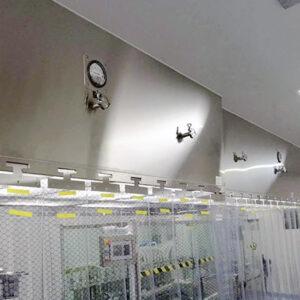
Low wall returns work on a straightforward principle: capture particles at or near floor level before they recirculate upward. The execution problem is that modular cleanroom layouts tend to fill perimeter wall space with benches, under-counter storage, carts, and process equipment, and low-level return grills end up physically blocked by the same items that generate the contamination the return is supposed to capture.
The standard placement target — 6 to 12 inches above finished floor, with 8 inches as a common reference — exists because returns positioned above 18 inches lose meaningful particle capture effectiveness. That height constraint is not arbitrary; it reflects where particle-laden air concentrates near floor level in a working room. The problem is that 8 inches above the floor is also exactly where a cart base, a cabinet kick panel, or a stacked material cart sits. Without clearance discipline in the layout plan, the return grill is present on paper and obstructed in practice.
Face velocity at the grill matters as much as position. The design range of 200 to 400 FPM is intended to draw air steadily without generating turbulence at the capture point. An undersized grill handling volume well beyond its designed capacity — a single 18×18 inch grille at 978 FPM, for example — will re-entrain particles rather than capture them, producing turbulence at the point where the airflow strategy depends on calm, low-velocity draw. That overspeed condition also creates pressure bottlenecks that propagate upstream and can destabilize the pressure cascade between adjacent zones. Placement errors compound this: a wall return positioned directly below a supply diffuser short-circuits the supply air before it crosses the occupied zone, and concentrating all returns on a single wall generates dead zones on the opposite side of the room regardless of face velocity.
| Parameter | Spezifikation | Konsequenz des Scheiterns |
|---|---|---|
| Grill height above floor | 6–12 inches (standard 8 inches) | Returns above 18 inches reduce particle capture; equipment or stored materials may block airflow |
| Face velocity at grill | 200–400 FPM | Overspeed (e.g. 978 FPM from undersized grill) causes turbulence, re-entrainment, and pressure bottlenecks |
| Position relative to supply diffusers | Do not place directly below supply air | Short-circuits supply air to return without sweeping the occupied zone |
| Return distribution | Distribute along at least two walls; avoid concentrating returns on one wall or in corners | Creates uneven airflow and dead zones where particles accumulate |
| Clearance around grill | Maintain unobstructed space behind process equipment | Blocked return path disrupts capture and reduces sweep effectiveness |
The practical consequence of getting this wrong in a prefabricated panel system is that there is no easy correction path. Field cutting panels to reposition return openings is structurally disruptive and may invalidate the panel manufacturer’s integrity ratings. The time to confirm grill height, quantity, position relative to supply diffusers, and clearance from process equipment is during panel specification — before fabrication, not during move-in.
Floor Return Benefits and Maintenance Burden
Some non-recirculating modular cleanrooms handle return air through a small gap below the wall panels — a construction shortcut that avoids panel penetrations entirely. The simplicity is real: no grills to specify, no panel cutting, no duct connections at floor level. The maintenance consequence is equally real: that gap becomes a collection point for debris, particles, and cleaning chemical residue, and it cannot be filtered, accessed, or serviced without lifting or removing panel sections.
The integrated low-level wall return — a prefabricated panel with a built-in grill and return path — addresses the maintenance burden of the gap approach while preserving the sweep advantage of low-level capture. Filter access at near-floor level is more straightforward than servicing ceiling-mounted returns, and the integrated grill reduces the likelihood of uncontrolled debris ingress that the under-wall gap creates. For modular systems where maintenance access is a recurring operational consideration rather than a one-time commissioning check, the prefabricated integrated approach is the more defensible practice.
| Return Path Method | Construction Requirement | Cleaning/Maintenance Burden | Zugang filtern |
|---|---|---|---|
| Under-wall gap (floor return) | Simplified; small gap below walls | High; debris collects in gap, requires regular cleaning | Not addressed (gap not designed for filter access) |
| Wall-mounted low-level return with integrated grill | Prefabricated panels with built-in low-level return and grill ease installation | Integrated grill simplifies maintenance; debris ingress less likely than floor gap | Convenient access for filter replacement compared to ceiling returns |
| Ceiling return | Walls must extend past ceiling to create return plenum, adding structural complexity | Cleaning of plenum may be difficult; burden not specified | Filter replacement more difficult than low-wall returns |
The trade-off that teams underestimate is not between the gap and the grill — most engineers recognize the gap as a compromise. The underestimated trade-off is between the performance advantage of low-level returns and the clearance discipline required to maintain them. A 24-inch service envelope in front of every return grill is a real layout constraint that competes with bench positioning, equipment placement, and aisle access. In many modular room designs, that clearance envelope has already been consumed by the time return air is considered.
Ceiling Return Limits in Modular Rooms
Ceiling returns are attractive in constrained modular builds precisely because they avoid the floor-level clearance problem. No grill positioned 8 inches above the floor means no conflict with benches or carts, and no panel penetrations near the floor means simpler panel fabrication. The performance trade-off is significant enough that these construction advantages often do not justify the choice in ISO-classified work zones.
The core problem is directional: ceiling returns pull air upward, opposing the natural settling of particles. A displacement ventilation concept depends on a downward or horizontal sweep that carries particles toward the return before they recirculate. When the return is at ceiling height, that organized sweep weakens — airflow patterns become turbulent and mixed, and dead zones develop in the occupied work zone below where air velocity is insufficient to carry particles to the capture point. The same 12–33% higher particle concentration associated with high-level returns reflects this directional mismatch, and the exact disadvantage in a specific room will depend on geometry and air change rate, but the directionality problem is consistent regardless of room size.
There is also a structural constraint that eliminates the simplicity advantage ceiling returns appear to offer in modular design. A ducted supply with ceiling return requires cleanroom walls to extend past the ceiling plane to create a return air plenum — adding structural height, coordination between the panel system and the ceiling structure, and construction complexity that a low-wall return with a panel-integrated grill avoids. In recirculating modular cleanrooms, return air is more commonly handled through wall chambers for this reason, and ceiling returns tend to surface as a workaround when low-wall paths are not planned early enough, not as a deliberate first-choice configuration.
Pressure Recovery and Airflow Visualization Checks
Return path geometry directly determines pressure cascade stability, and that connection only becomes visible during commissioning testing — not during layout review. Undersized or poorly distributed returns create elevated face velocities that generate resistance in the return path, which compresses the pressure differential available between adjacent zones. The design target for pressure differentials between adjacent cleanroom zones — typically 0.02 to 0.05 inches water column — leaves little margin for a return system that is bottlenecked. When that margin is consumed by return path resistance, pressure cascade integrity weakens, and under the wrong conditions, airflow direction between zones can reverse.
| Validation Item | Threshold/Target | Risk if Not Verified |
|---|---|---|
| Pressure differentials between adjacent zones | 0.02–0.05 inches water column | Loss of pressure cascade allows cross-contamination |
| Return air volume ratio | Return air equals 85–95% of supply CFM; 5–15% exhausted (positive pressure) | Imbalance disrupts pressure differentials, can reverse airflow direction |
| CFD modeling of flow patterns | Simulate to identify dead zones, turbulence, and confirm unidirectional flow | Unseen dead zones prolong recovery; hidden turbulence traps particles |
| Recovery time after disturbance | Confirm recovery time within 15–20 minutes | Prolonged recovery keeps particles suspended; example redesign shortened recovery from 28 to 16 minutes |
| Return path capacity check | Ensure return capacity avoids undersizing and high velocities | Pressure bottlenecks disrupt pressure cascades; can reverse airflow |
The volume balance is a related planning input: in positive pressure rooms, return air volume typically runs at 85–95% of supply CFM, with the remaining 5–15% exhausted to maintain outward pressure. That ratio is a planning criterion, not a regulatory rule, but deviating significantly from it — particularly by undersizing return capacity relative to supply — is a reliable path to the pressure instability described above. The calculation should be confirmed against the actual return grill sizes and quantities specified, not assumed from the supply-side airflow design alone. For detailed airflow volume calculations, the CFM methodology for modular cleanroom HVAC systems provides a working framework for confirming return capacity against supply rates.
CFD modeling adds a validation layer that pressure calculations alone do not provide. A redesign that eliminated identified dead zones in return placement shortened predicted recovery time from 28 to 16 minutes in one modeled case — a concrete illustration of what CFD surfaces that static calculation does not. Recovery time confirmation within the 15–20 minute range typically referenced for classified environments is one check; confirming unidirectional flow patterns and identifying turbulence zones that particle counting alone will not locate are others. ISO 14644-3:2019 provides the testing methodology framework for airflow pattern verification and recovery performance checks that should follow any CFD-informed design revision. CFD is a review and defensibility tool, not a mandatory step in every project, but in rooms where return path decisions were made late or under layout constraints, it is the most efficient way to identify problems before construction is complete.
Layout Rules That Protect the Return Path
Return grill distribution is the layout decision that most directly determines whether sweep is uniform or partial. Spacing grills along at least two perimeter walls — rather than concentrating them on the wall nearest the air handling unit — prevents the dead zones that form on the far side of a room when return draws are uneven. The 8–10 foot interval guideline for grill spacing is a practical recommendation derived from modular cleanroom design practice, not a standards-mandated dimension, but it provides a starting reference for distributing draw points before airflow modeling refines the actual positions. Modular Cleanroom Airflow Design and HVAC System Requirements covers the broader supply-side relationships that constrain where return positions can be placed effectively.
Positioning returns near contamination sources — sinks, pass-through chambers, anteroom transitions — captures particles near their generation point rather than allowing them to spread across the clean zone before reaching a remote grill. This is a strategic layout decision, not just a distribution formula. Conversely, placing return grills in corner positions concentrates draw in the corners and weakens capture across the room’s interior, and positioning grills within door swing paths creates pressure disruption every time a door opens.
| Layout Rule | Leitfaden | Warum es wichtig ist |
|---|---|---|
| Return grill distribution | Space grills at 8–10 foot intervals along at least two perimeter walls; avoid concentrating in corners | Uneven distribution creates dead zones and uneven particle removal |
| Placement near contamination sources | Position returns near sinks, anterooms to capture particles at the generation point | Without local capture, particles spread into the clean zone |
| Clearance from door swings and traffic | Keep return grills away from door swing paths and busy traffic areas | Door movement and traffic can block airflow and disrupt pressure integrity |
| Future-proof return capacity | Design with 15–20% margin for classification upgrades or process changes | Inadequate margin leaves no headroom for future needs |
| Early integration in panel design | Plan return paths during modular panel design; avoid field cutting later | Field cutting compromises panel structural integrity |
| Maintenance access clearance | Maintain at least 24 inches of clear space in front of return grills | Inadequate clearance prevents filter access and routine maintenance |
The two layout decisions with the most downstream consequence are capacity margin and panel integration timing. A 15–20% return capacity margin above calculated requirements provides headroom for future classification upgrades or process additions — headroom that disappears entirely if return capacity is sized exactly to current needs and future changes require field modifications to prefabricated panels. More immediately, integrating return path planning during panel design — confirming grill positions, quantities, heights, and maintenance clearance envelopes before panels are manufactured — is the only reliable way to avoid the field cutting problem. The wall and ceiling system configuration needs to account for return grill integration before fabrication; retrofitting penetrations after the fact is structurally disruptive and rarely produces the grill placement the airflow design actually requires.
The concrete implication of this article is that return air path decisions made at the concept and panel design stage either support or prevent validation at the intended ISO classification. Grill height, distribution, face velocity range, capacity margin, and the 24-inch maintenance clearance envelope are not commissioning-phase adjustments — they are design inputs that determine what the fabricated room can and cannot do. A room with returns positioned above 18 inches, concentrated on one wall, and blocked by benches installed before anyone checked clearance will not sweep the occupied zone reliably, and correcting that geometry after fabrication is rarely a clean fix.
Before finalizing panel layouts, the return air path deserves the same coordination discipline as supply diffuser positioning: confirmed grill locations marked against the process equipment plan, face velocities calculated against actual return quantities, pressure differential targets checked against the volume balance, and maintenance access envelopes flagged as protected zones in the furniture and equipment layout. Teams that treat return air as something to tune during commissioning are solving a panel design problem with airflow adjustments — and those adjustments have limits.
Häufig gestellte Fragen
Q: Does the 12–33% particle concentration improvement from low wall returns still apply if the room runs significantly higher air change rates than a standard ISO 7 configuration?
A: Not necessarily at the same magnitude. That range is a design-guidance benchmark derived from displacement ventilation research, not a formula that scales linearly with air change rate. At very high ACH, increased turbulence intensity can reduce the organized sweep advantage that low-wall returns depend on, meaning the directional benefit narrows even when placement is correct. The specific improvement in any room depends on geometry, obstruction patterns, and airflow rate together — which is precisely why CFD validation becomes more important, not less, in high-ACH configurations where the interaction effects are harder to predict from static calculations alone.
Q: If CFD modeling identifies dead zones after panels are already fabricated, what options remain for correcting the return path without cutting panels?
A: Options exist but are constrained. Auxiliary low-level return grills can sometimes be added at door frames or pass-through openings where panel penetrations are already planned. Adjusting supply diffuser positions or flow rates can partially redirect airflow toward existing returns, reducing but rarely eliminating dead zones. Furniture and equipment repositioning to unblock obstructed grills is the lowest-disruption correction when blockage rather than placement is the root cause. None of these fully substitute for correct grill distribution built into the panel design. CFD after fabrication is most useful for confirming that available corrections are sufficient — not for recovering the full performance that a correctly designed return geometry would have delivered.
Q: At what point does the maintenance burden of floor-level returns outweigh their sweep performance advantage, and is a hybrid approach ever justified?
A: The maintenance burden becomes the deciding factor when cleaning protocols require frequent disassembly access or when the process generates high volumes of liquid or particulate debris that accumulate at floor level faster than scheduled maintenance intervals can address. In those conditions — common in wet pharmaceutical processing or certain biotech applications — the practical uptime cost of floor-proximate returns can exceed the 12–33% particle concentration benefit. A hybrid approach, using low wall returns at 6–12 inches on the cleaner perimeter walls while using integrated panel returns with tighter grill spacing near high-contamination sources, is a legitimate design response. It requires confirming that the mixed return heights do not create competing draw patterns that undermine the sweep across the occupied zone, which is a CFD validation question before it is a fabrication decision.
Q: How should the 15–20% capacity margin for future classification upgrades be sized when the upgrade path is not yet defined?
A: Size it against the next classification tier, not an undefined future state. If the room is designed for ISO 7, calculate the return capacity required for ISO 6 — which will demand higher air change rates and correspondingly higher return CFM — and use that figure as the margin target. This gives the 15–20% guideline a concrete anchor rather than treating it as an arbitrary buffer. If an ISO 6 upgrade is genuinely not on the planning horizon, the margin still provides headroom for process additions that increase contamination load without a formal reclassification. The constraint is that panel-integrated return openings cannot be enlarged after fabrication without structural compromise, so the margin must be built into grill quantity and sizing before manufacturing, not added later.
Q: Is there a point at which a room’s footprint or aspect ratio makes it impractical to achieve adequate return distribution along two perimeter walls?
A: Yes. Very long, narrow rooms — corridor-style cleanrooms with high length-to-width ratios — present a genuine distribution problem because two long walls may be separated by a distance that exceeds the effective draw radius of the specified grill spacing. In those configurations, concentrating returns on the two short end walls produces dead zones along the center of the room length regardless of face velocity. The practical response is to increase grill density along the long walls even when that conflicts with equipment placement, or to introduce intermediate return points at structural break locations in the panel system. ISO 14644-4:2022 provides layout guidance for controlled environment design that addresses atypical room geometries, and airflow visualization testing under ISO 14644-3:2019 is the verification step that confirms whether the distribution strategy actually produces the intended sweep pattern before the room enters routine operation.
Verwandte Inhalte:
- Wandmontierter HEPA-Gehäusekasten für begrenzte Platzverhältnisse
- How FFU Coverage Affects Modular Cleanroom Cleanliness and Airflow Stability
- Modularer Reinraum mit starren Wänden: Wenn starre Paneele und langfristige Kontrolle entscheidend sind
- Modulare BIBO-Konstruktionen: Flexibilität für Ihre Einrichtung
- Leitfaden für Reinräume: Normen, Ausrüstung, Planungshinweise und Fragen an Lieferanten
- Spezifikationen für FFU- und ULPA-Filter für modulare Halbleiter-Reinräume
- Modularer Reinraum für die sterile Fertigung: Anhang 1, Klassen A/B/C/D und Lieferantenunterstützung
- Bedienfelddesign für Sterilitätstestisolatoren
- Abnahme der modularen Reinraumhülle: Türen, Fenster, Wandpaneele, Decken und abgedichtete Schnittstellen