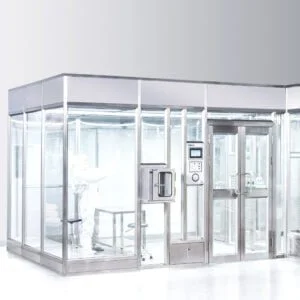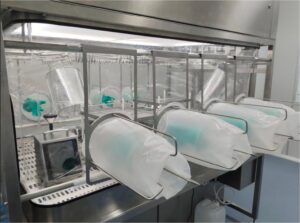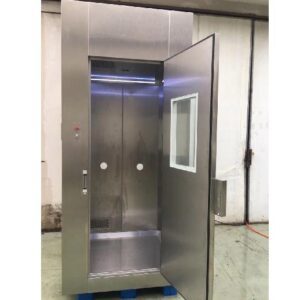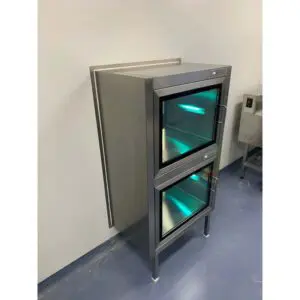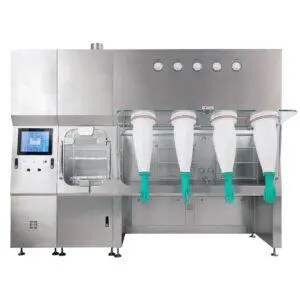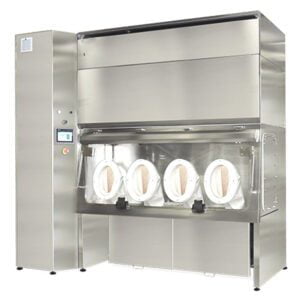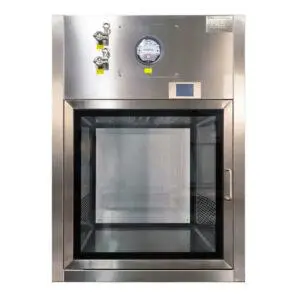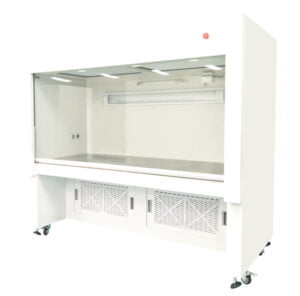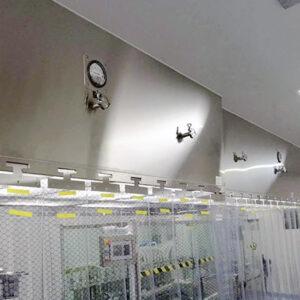
When teams treat a sampling booth as a procurement line item rather than a workflow integration decision, the first sign of trouble usually appears during commissioning — operators are opening containers outside the protected zone because the booth was positioned where the material flow didn’t reach it, or the booth interior wasn’t deep enough to keep the sampling device inside the protected airstream. By that point, layout changes are expensive, schedule pressure is real, and the audit trail is already incomplete. The user requirements specification is the document that prevents that outcome, but only if it maps the container path, operator reach, and cleaning method before any equipment is ordered. What follows will help you define those requirements with enough precision that QA, warehouse, and production teams can reach alignment before commissioning rather than at it.
Raw Material Intake Workflow the Sampling Booth Must Support
A sampling booth that doesn’t fit the material intake sequence creates contamination risk before a single container is opened. If the booth is positioned downstream of where operators naturally handle incoming containers, the protected zone becomes a formality — materials arrive pre-opened, partially accessed, or handled in areas with no airflow control. The URS must describe the intake workflow first, then derive booth placement and configuration from it.
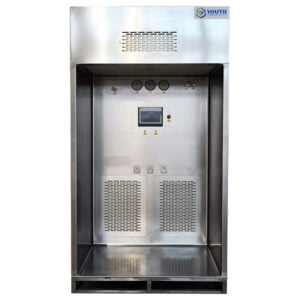
Three planning criteria carry the most structural weight at this stage. Laminar airflow inside the booth must be stable before sampling begins, and in practice that means the blower should be started at slow speed and given approximately one hour to stabilize before any container is opened. This is an operational planning figure, not a codified GMP mandate, but ignoring it means the airflow regime during the first sampling events of the day is not the regime the booth was qualified at. For temperature- and humidity-sensitive materials such as APIs, the booth must also be capable of maintaining the environmental conditions those materials require — if that capability isn’t specified in the URS, it will not be engineered in, and there is no retrofit path once the booth is installed. Automated material flow is a third constraint: where conveyor systems or high-speed roll-up doors are part of the intake area, the booth must be compatible with that infrastructure or operators will improvise transitions that defeat containment.
| Vereiste | Risk if Unmet | What to Clarify in the URS |
|---|---|---|
| Stabilise laminar airflow before sampling | Airflow disruption compromises sample integrity | Blower slow‑start period of 1 hour before sampling begins |
| Integrate with automated material flow | Operators may open materials outside the protected zone, creating cross‑contamination | Compatibility with conveyor systems and high‑speed roll‑up doors |
| Control environment for sensitive materials | Degradation or contamination of APIs and moisture‑sensitive raw materials | Temperature and humidity control capability inside the booth |
The consequence logic here runs upstream, not downstream. An intake workflow that hasn’t been mapped before the URS is written means the booth will be specified for an abstract sampling task rather than the actual sequence of material movement, operator positioning, and container handling in that facility. Catching that misalignment at the URS stage costs a conversation. Catching it during commissioning costs weeks, sometimes a layout redesign, and often a deviation record.
Container Opening, Sampling Tool and Waste Removal Requirements
The URS must specify what happens inside the booth at each step of the sampling event — not just that sampling occurs there, but how the container arrives, how it is opened, how the sample is taken, how the sample is secured, and how waste exits the zone. Each of those steps is a contamination exposure point if the workflow and the booth configuration don’t match.
Three procedural disciplines define the baseline. The sampling device must remain inside the booth throughout the sampling event; removing it to handle it at a bench outside the airstream introduces an uncontrolled contamination step that undermines the entire purpose of the protected zone. A separate, clean sampling device must be used for each distinct material — carryover between raw material lots is a direct cross-contamination risk, and a sampling procedure that relies on a single device being cleaned between uses requires confidence in that cleaning process that may not be warranted in a high-throughput intake environment. Once a sample is drawn, polybags or sample containers must be closed and sealed while still under laminar airflow before they are removed from the booth — this preserves sample integrity and prevents contamination during transfer to QC.
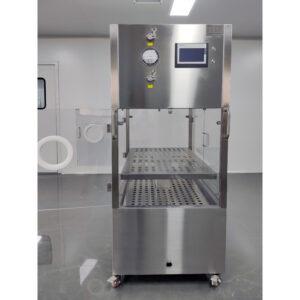
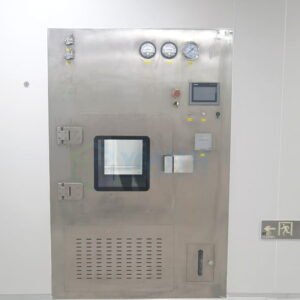
These are process controls, not equipment specifications in isolation, but they have direct implications for booth configuration. A booth too shallow to keep the sampling device inside the airstream during use will routinely produce the contamination exposure it was meant to prevent. A booth without a defined work surface arrangement for incoming containers, active sampling, and capped outgoing samples forces operators to improvise positioning — and improvised positioning under time pressure produces errors. The URS should describe the spatial workflow explicitly enough that the booth’s interior dimensions, surface layout, and pass-through provisions can be evaluated against it.
Ergonomic load matters here as a reliability factor. Repetitive sampling tasks with poor reach geometry, awkward container positioning, or inadequate surface height generate operator fatigue that translates into procedural shortcuts. Designing for operator reach and minimising physical strain during routine sampling is a planning criterion for error reduction, not a comfort provision.
Cross-Contamination Failures Caused by Poor Booth Placement
Booth placement is the most common approval blocker that does not appear in the URS until it is too late to resolve cheaply. Warehouse, QC, and production teams typically do not align on material intake flow until commissioning, and by then the booth location is fixed. The result is a booth that is technically compliant as installed equipment but operationally non-compliant because the actual material path doesn’t run through it.
The most direct failure mode is operators opening containers outside the protected zone. If the booth is positioned at a point the material doesn’t reach until after initial unpacking — or if the booth opening faces the wrong direction relative to incoming material flow — sampling events will routinely begin outside the airstream. This is not an operator discipline problem; it is a workflow planning failure that the URS should have caught. A practitioner insight worth preserving here: if the intake workflow is not mapped before the URS is written, the booth placement decision defaults to what fits the floor plan rather than what fits the process.
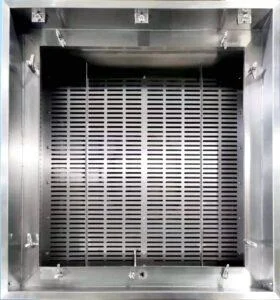
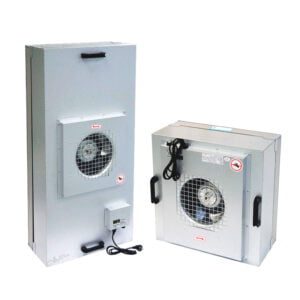
Filtration integrity is a placement-related risk that operates on a different timescale but follows from the same planning gap. Where a booth is located in an area with higher particulate load — near loading dock entries, for example, or adjacent to material staging areas without adequate separation — the prefilter and HEPA filter will load faster than the design assumed. The differential pressure across the HEPA filter is the quantifiable indicator: a reading above 15 mm water column is a design figure used in practice as a replacement trigger, at which point the filter must be replaced and a PAO integrity test performed before operations resume. If the booth was not positioned with that load in mind, filter replacement intervals will be shorter than planned, and any delay in executing the PAO test after a replacement means the booth cannot re-enter GMP use without generating a deviation.
The practical lesson from cases where soft-wall portable cleanrooms were used for raw material sampling is instructive: inadequate containment solutions tend to produce findings during regulatory review that require costly structural upgrades. A properly positioned, correctly specified booth eliminates that risk at the design stage. A booth positioned as an afterthought introduces it at the audit stage.
Cleaning Access and Handover Evidence for QA Review
QA acceptance of a sampling booth at handover depends on the booth generating defensible evidence — not just performing to specification at one point in time, but being constructed and instrumented in a way that allows that performance to be verified, cleaned, and re-verified repeatedly over its service life. Booths that cannot be cleaned to a validatable standard, or that lack the monitoring infrastructure to document environmental conditions, are difficult to accept into GMP use regardless of their initial qualification results.
Interior construction in seamless stainless steel — typically Inox 304 or 316 with fully radiused corners — is a design planning criterion for cleanability, not a regulatory material specification in isolation. Its relevance to handover is practical: a booth with welded joints, exposed fasteners, or sharp internal corners creates cleaning validation challenges that QA will need to resolve before accepting the booth. If those challenges are identified during IQ, they require corrective action before OQ can proceed. Specifying the construction standard in the URS avoids that sequence.
| QA Requirement | Specification / Trigger | Purpose for Handover Evidence |
|---|---|---|
| Seamless interior construction | Inox 304 or 316, rounded corners | Enables effective cleaning and prevents microbial growth |
| Drukverschilbewaking | 7–15 mm water; clean prefilter when reading drops; replace HEPA when >15 mm then PAO test | Provides quantifiable cleaning and replacement triggers with verifiable action |
| DOP filter‑test ports | Installed on the booth | Allows on‑site HEPA integrity testing as part of QA documentation |
| PLC environmental monitoring | Sensors for air velocity, temperature, humidity | Generates continuous data retrievable for GMP compliance reviews |
Each item in the monitoring and construction specification generates a specific type of handover evidence. The differential pressure window and its action triggers create a documented, repeatable maintenance protocol with defined response steps. DOP ports built into the booth allow HEPA integrity testing to be performed on-site rather than requiring filter removal or external test equipment rigging — without them, integrity testing is harder to conduct consistently and harder to document. PLC-based environmental monitoring with sensors for air velocity, temperature, and humidity produces continuous data retrievable for QA review; a booth with manual-only monitoring relies on operator log entries, which are harder to defend as continuous compliance evidence under EudraLex Annex 15’s qualification and validation framework.
The handover package is only as strong as the evidence it contains. A booth that was built to perform but not built to be verified produces a qualification dossier with gaps that QA must either accept on trust or resolve through additional testing. Neither outcome is preferable to getting the construction and monitoring requirements right in the URS.
Approval Trigger Before Sampling Operations Move Into GMP Use
GMP approval of a sampling booth is a cumulative gate, not a single-test pass. The booth must meet particle count thresholds, viable count limits, airflow performance criteria, and filter integrity standards simultaneously — and each must be supported by documented verification before operations begin. A booth that passes particle counting but has not had its HEPA filter PAO-tested after installation, or that meets airflow velocity but lacks a viable count result, is not ready for release to GMP use regardless of how well it performs on the criteria that were tested.
The acceptance thresholds for a GMP Class A environment align with EU GMP expectations: particulate counts at or below 3,520 particles per m³ at ≥0.5 µm and 20 particles per m³ at ≥5.0 µm, with a viable count below 1 CFU. Laminar air velocity in the work area should be 0.45 m/s ±20%. HEPA filter performance is anchored to H14 per EN 1822, which requires at least 99.99% efficiency for 0.3 µm particles — factory certification establishes the baseline, but a PAO integrity test must be performed after any on-site installation or replacement before the booth re-enters service. ISO 14644-4:2022 and EudraLex Annex 15 provide the design and qualification framework within which these criteria operate.
| Approval Criterion | Acceptance Threshold | Verificatiemethode |
|---|---|---|
| Cleanliness class A (particulates) | ≤3,520 (≥0.5 µm) and ≤20 (≥5.0 µm) particles per m³ | Deeltjes tellen |
| Cleanliness class A (viable) | <1 CFU | Active air and settle plate monitoring |
| Laminar air velocity | 0.45 m/s ±20 % in the work area | Luchtstroommeting |
| Efficiëntie HEPA-filter | H14 per EN 1822, ≥99.99 % for 0.3 µm particles | Factory certification; PAO test after any replacement |
| Naleving van regelgeving | EU standards and required GMP handover documentation | Documentatie |
What the cumulative pass of these criteria means operationally is that the booth has demonstrated it can maintain the environment it was designed to provide, and that the evidence for that demonstration is structured well enough for QA to close the qualification dossier and release the booth to production use. Any gap in the evidence chain — a missing PAO test record, an airflow measurement taken outside the qualified range, a viable count result that was never obtained — reopens the qualification and delays the release. Building the approval trigger sequence into the URS from the start means the commissioning and qualification teams know exactly what evidence they need to generate, in what order, before handover is even requested.
For teams specifying a booth at the URS stage, understanding how sampling containment requirements differ from active powder transfer requirements is also worth clarifying early. The dispensing booth and sampling booth serve related but distinct functions — dispensing demands stronger capture at active transfer points, while sampling prioritizes stable airflow and representative containment at the source container. Specifying one where the other is needed produces a booth that underperforms at its intended function and may not satisfy either QA or production at qualification.
A URS that reaches equipment selection without first mapping the container path, operator reach, cleaning method, and handover test sequence has deferred the real specification work rather than completed it. The booth that results may be correctly built to an underspecified document — which means the misalignment between the booth and the workflow surfaces during commissioning, when corrective action is expensive and the audit trail for that correction becomes part of the qualification record.
Before finalising the URS, confirm that the intake workflow has been walked through step by step with warehouse, QC, and production teams; that the booth location has been validated against actual material flow rather than floor plan availability; and that the handover evidence package — differential pressure records, PAO test results, environmental monitoring data, and cleaning validation documentation — has been defined as a deliverable rather than assumed. Those four confirmations close the gap between a booth that was specified and a booth that can actually be qualified, accepted, and operated without generating the deviations and rework the specification was meant to prevent.
Veelgestelde vragen
Q: Does the sampling booth URS need to change if raw materials arrive pre-palletised on automated conveyors rather than as individual containers handled by operators?
A: Yes, the URS must reflect the actual delivery mechanism, not a generic container-handling scenario. When automated conveyors or high-speed roll-up doors are part of the intake infrastructure, the booth configuration must be compatible with that system — otherwise the transition point between automated handling and the protected zone becomes an uncontrolled contamination step. Booth opening dimensions, pass-through provisions, and the orientation of the airstream relative to the conveyor path all need to be derived from the real intake sequence. A URS written against manual container handling will produce a booth that fits a workflow that doesn’t exist in that facility.
Q: Once the qualification dossier is closed and the booth is released to GMP use, what triggers re-qualification rather than routine maintenance?
A: Any HEPA filter replacement is an automatic re-qualification trigger — a PAO integrity test must be completed and recorded before the booth re-enters service, regardless of how recently the previous test was performed. Beyond filter replacement, a significant change in booth location, a modification to the interior configuration that alters airflow geometry, or a sustained differential pressure exceedance above 15 mm water column that results in filter replacement should each be treated as change-control events requiring re-qualification evidence. Routine maintenance within normal operating parameters — prefilter cleaning when the differential pressure drops within range, for example — does not require re-qualification, but the maintenance record must be retained as part of the ongoing compliance evidence.
Q: At what point does specifying a sampling booth become the wrong answer, and a dispensing booth the right one?
A: The decision point is whether the primary contamination risk is at the source container during sample extraction, or at an active powder transfer point during material dispensing. A sampling booth prioritises stable laminar airflow and representative containment at the container — its design assumption is that the operator is withdrawing a small quantity for QC, not transferring bulk material. A dispensing booth is engineered for stronger capture at active transfer points where powder becomes airborne during weighing or batching. Specifying a sampling booth for a task that involves active powder transfer means the containment is likely insufficient at the moment of highest exposure risk, which will surface as either a performance gap during qualification or an operator exposure concern during operation.
Q: What happens to the approval timeline if the viable count result is not obtained before the particle count and airflow tests are already closed?
A: The qualification dossier cannot be closed, and the booth cannot be released to GMP use. All three evidence types — particulate counts, airflow velocity, and viable count — must be present simultaneously in the qualification record before QA can accept the booth. A missing viable count result does not allow the other passing results to carry the approval; it reopens the qualification sequence and requires the viable count testing to be completed, reviewed, and appended to the dossier before handover is re-requested. In practice this delays production release and, if the gap is discovered after commissioning resources have been stood down, it may also require re-mobilising the validation team — a cost and schedule consequence that the URS-stage requirement definition was meant to prevent.
Q: Is a sampling booth still the right specification if the raw materials being handled are non-potent, low-dust solids with no API content?
A: The classification of the material affects the containment engineering level required, but it does not remove the need for a sampling booth if the facility operates under GMP and the samples will be used for QC release decisions. A GMP Class A environment during sampling is required to protect the sample from contamination, not only to protect the operator from the material — even low-hazard raw materials can fail QC testing if the sampling environment introduces particulate or microbial contamination into the sample. Where materials genuinely carry no cross-contamination risk and are handled outside GMP scope, a less controlled environment may be justified, but that determination belongs in the URS as a documented risk assessment conclusion, not as an assumed default.