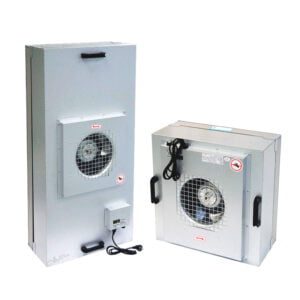
When an FFU shows a fault, the immediate question is not whether the equipment failed but what that failure means for the zone it serves. A single unit dropping output in a room with multiple FFUs operating in parallel does not carry the same consequence as the same fault in a zone where one unit sustains the entire protected process. Deciding how to respond starts with understanding which relationship applies before any recovery step is chosen.
Connect each FFU failure scenario to the affected zone and protected process
An FFU failure is not a single category of event. The same fault condition — reduced airflow, a stopped fan, a triggered alarm — produces different operational consequences depending on how the zone is configured around it. Where a zone relies on several FFUs working together to maintain the intended air pattern, a fault in one unit may leave the surrounding units able to sustain the zone’s condition for a defined period, or it may not, depending on how the units are arranged and how the zone’s air balance depends on each one. Where a zone depends on a single FFU, or where the affected unit sits directly over a defined critical work area rather than a general background zone, the same fault removes the protection that the process at that location was relying on.
This is why failure planning has to begin with the zone-to-process link rather than with the equipment itself. A protected process located under or near an FFU has a direct dependency on that unit’s continued performance; a process located elsewhere in the same room may depend on the room’s overall air balance rather than on any one unit. Treating every FFU fault as equivalent, regardless of which process sits beneath it, produces a response plan that is either overcautious in low-consequence zones or insufficient in high-consequence ones.
The practical task is mapping, for each zone in the facility, which FFU or group of FFUs supports which process, and what that process requires in terms of continuity. A process that tolerates a brief interruption while a fault is assessed is different from one that cannot tolerate any interruption at all. This mapping also needs to account for multi-unit failure scenarios distinctly from single-unit ones, since a shared cause affecting several units at once — a common utility or control input, for example — changes the affected footprint in a way that a single isolated fault does not. Understanding this relationship in advance, rather than during an active fault, is what allows the response plan to be scaled to the actual consequence rather than applied uniformly. Related zone-mapping work for FFU, LAF, and HEPA selection frames this same protected-process-first logic at the design stage, and the same logic carries forward into failure response.
Set control and operator responses from intended use and site risk
Once the zone-to-process link is established, the next judgment is what should happen operationally when a fault occurs — and this cannot be fixed generically across all rooms. The intended use of the zone and the site’s own risk assessment are what determine whether a fault should trigger an immediate operator notification, a hold on activity in the affected area, an automatic control response, or some combination of these, and in what sequence.
Where the protected process is sensitive to any interruption in air delivery, the appropriate response may involve halting activity at the affected location until the fault is assessed, regardless of how brief the fault appears to be. Where the process has more tolerance for short-term variation, the response may allow continued activity while the fault is investigated, with notification serving as the primary action rather than an immediate hold. Neither approach is inherently correct; each follows from what the site’s own risk assessment has already established about that zone’s tolerance.
Control response also depends on how the FFUs in that zone are actually controlled. A zone with centralized monitoring can generate an alarm and route it to a defined point of response, while a zone without that layer depends on local indication and manual observation to detect the same fault. This distinction changes how quickly a fault becomes known and how the operator response can be structured. Questions about local or central control in a mixed air-delivery system are relevant here, because a site combining both approaches needs a defined response path for each control type rather than one generic procedure applied to a system that is not uniform underneath.
Predefining these responses before a fault occurs — rather than deciding operator action during the event itself — is what allows the response to match the actual risk instead of defaulting to either an unnecessary hold or an insufficient one. The site risk assessment, not the equipment specification alone, is what should set this sequence.
Preserve safe service access for filter, motor, and full-unit interventions
Recovering from an FFU fault eventually requires physical access to the unit — whether to the filter, the motor, or the unit as a whole — and this access has to be achieved without creating a new contamination pathway or disturbing the zones around it. This is a distinct concern from the control and notification questions already addressed, because even a well-managed response can be undermined by an access method that opens the zone in an uncontrolled way.
The core issue is that any physical intervention on an FFU creates a potential opening between the served zone and whatever is on the other side of the unit — a ceiling void, an adjacent room, or an external service space. Where the unit’s design and the surrounding structure allow the intervention to occur from outside the served zone, or through a controlled access point, the zone itself can remain closed during the work. Where access is only possible from within the zone, the intervention itself becomes an event that the zone’s control strategy has to account for, separate from the original fault.
This distinction matters differently depending on whether the intervention involves the filter, the motor, or the full unit. A filter-related intervention and a motor-related intervention may call for different levels of access and different durations of exposure, and a full-unit replacement is a larger event than either. What stays constant across all three is the requirement that the access route not compromise the zone boundary or the condition of adjacent zones sharing the same structure. A site with modular ceiling or wall construction may have been designed with this kind of access in mind from the outset; a site without that provision has to treat every intervention as a boundary risk to be separately managed.
Confirming, in advance, how each type of intervention will be physically carried out — and what it does to the zone boundary while it is happening — is what keeps the recovery process from introducing a new deviation on top of the original fault. Maintenance planning that addresses access, replacement, and testing together is the reference point for working through this in detail for modular cleanroom configurations.
Choose particle, airflow, pressure, alarm, and visual checks for recovery
Once a fault has been addressed and access has been safely completed, the zone cannot simply be returned to use — some form of recovery check is needed to confirm that the condition the zone is supposed to maintain has actually been restored. The category of check that applies depends on what the original fault affected and what the protected process actually depends on.
Particle-based checks confirm the airborne cleanliness condition directly, and are relevant where the concern is whether the fault allowed a change in particle concentration within the zone. Airflow checks confirm that the unit or units are again delivering the air pattern the zone design assumes, which is a different question from particle concentration — a unit can be running within an acceptable airflow range while the zone’s particle condition still needs separate confirmation, or vice versa in the period immediately following an intervention. Pressure checks address whether the zone’s relationship to adjacent spaces has been maintained, which matters most where the fault or the access intervention created a potential for that relationship to shift. Alarm checks confirm that the control and notification path itself is functioning again, which is distinct from confirming the zone’s physical condition. Visual checks address physical completeness of the intervention — correct reassembly, seating, or restoration of the unit — before any instrumented check is even attempted.
Which of these checks applies, and in what combination, depends on the nature of the original fault and the intervention performed. A fault resolved through a filter-related intervention raises different confirmation needs than one resolved through a motor-related intervention or a full-unit replacement, because each changes a different aspect of the unit’s performance. The applicable tests and their acceptance limits belong to the project’s own approved plan rather than to a generic checklist, since the zone’s classification and the process’s tolerance determine what evidence is sufficient. Test methods relevant to these parameters, including recommended apparatus and procedures for cleanroom and clean-zone performance, are addressed in ISO 14644-3, and monitoring plans built around parameters that measure or affect airborne particle concentration are addressed in ISO 14644-2 — both of which inform what a project’s recovery-check plan draws on, without either source establishing a universal acceptance limit on its own. The project’s approved plan is what turns these check categories into specific, applicable tests.
Document release evidence and unresolved deviations before the zone returns to use
The final judgment before returning a zone to use is whether the evidence gathered actually closes the deviation the fault created, or whether something remains open. This is a documentation decision as much as a technical one, and it determines whether the zone can be released with confidence or whether it is being returned to use with an unresolved question attached.
Where every applicable recovery check has been completed and each result falls within what the project’s plan defines as acceptable, the deviation record can be closed and the zone released on that evidence. Where a check could not be completed, produced an ambiguous result, or falls outside the defined limit, the deviation remains open regardless of how much other evidence supports release. Returning a zone to use with an open deviation is a distinct decision from returning it with a closed one, and the record needs to state clearly which condition applies rather than implying closure through the volume of evidence collected.
This documentation also needs to capture what was actually tested, under what conditions, and against what limit, since a release record that only states an outcome without the supporting check details cannot be evaluated later if a related question arises. The information a project team assembles at this stage — which checks were performed, what results were obtained, and what remains unresolved — is also the kind of detail that becomes relevant when the same zone’s configuration or equipment is later reviewed for quotation or replacement, since a documented history of prior faults and their resolution informs what the next configuration needs to address.
Where the unresolved item is minor relative to the zone’s tolerance, the project’s own change-control or deviation process may allow conditional release with a defined follow-up action. Where the unresolved item touches the protected process directly, release without closure is not a defensible position regardless of schedule pressure, and the documentation should reflect that the zone remains under the deviation until the outstanding check is completed.
Часто задаваемые вопросы
Q: Should every FFU failure trigger the same room-wide response?
A: No universal response is supported. Map the specific single-unit or multi-unit scenario to the affected zone and protected process, then use the intended use and site risk assessment to define the control response, operator notification, and any activity hold.
Q: Can work continue in a zone that is not directly served by the failed FFU?
A: Do not decide from the number of failed units alone. Confirm how the affected zone relates to the protected process and adjacent zones, then apply the predefined response and the relevant project-approved checks before treating another zone as usable.
Q: What should an FFU failure notification tell operators?
A: Identify the failure scenario, affected zone, protected process, required control response, and any activity hold. The notification should also point operators to the evidence required by the approved project plan before use resumes.
Q: How should a project choose recovery checks after an FFU failure?
A: Select only the particle, airflow, pressure, alarm, and visual checks that apply to the affected performance and process risk. Keep the exact test methods and acceptance limits in the approved project plan rather than treating every check category as mandatory for every event.
Q: What service-access details should be settled before a failure occurs?
A: Confirm how the spare unit, filter, or motor can be reached and replaced without creating an uncontrolled opening or disrupting adjacent zones. Record which intervention route applies so the response does not depend on an improvised access decision during the event.
Q: What evidence is needed before the zone returns to use?
A: Record the applicable recovery-check results, the control and alarm response, and any unresolved deviations. Release the zone only through the project-approved decision path, using its defined tests and limits rather than a generic FFU recovery rule.