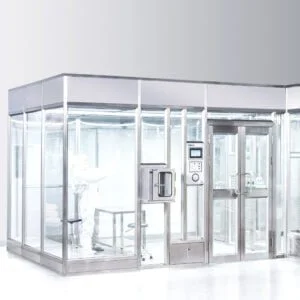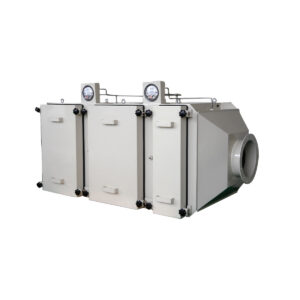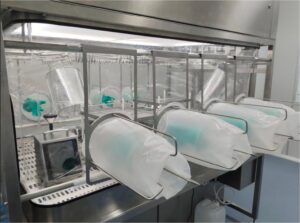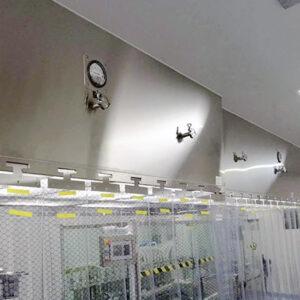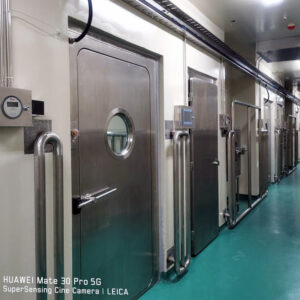
Specifying filtration for a modular cleanroom without first mapping process particle risk to ISO classification targets is one of the most common points where design decisions create downstream commissioning problems. Teams that default to ULPA across every zone often find the mismatch during airflow balancing and classification testing—after fan selections have been finalised, ducting has been sized, and the structure is already built. The retrofit cost is rarely just a filter swap; it involves fan replacements, structural penetration rework, and delayed IQ/OQ execution. The decision that prevents this is straightforward: define the smallest harmful particle size your process actually generates or needs to exclude, set that against your ISO classification target, and let those two constraints drive filter grade selection before any mechanical design is committed.
Process Risk Behind HEPA and ULPA Selection
Filtration grade selection starts with contamination risk, not with filter efficiency ratings. The core question is what a particle exceedance event actually means for your product or process—whether that is a sterility failure in an aseptic fill line, a potency deviation in an OEB4 suite, or a yield loss in a semiconductor step. Those consequences are not equivalent, and they do not all demand the same filter grade.
For pharmaceutical applications, viable particle control often carries more weight in the selection argument than total particle count alone. A design target such as less than 1.5 CFU per 10 cubic feet—drawn from cGMP-aligned benchmarking rather than a single universal FDA rule—reflects the expectation that your filtration and airflow system must suppress microbial settlement, not just move particles through a rated medium. HEPA filtration, when correctly specified and maintained, is capable of supporting that target in many pharmaceutical environments. The assumption that ULPA is categorically more suitable for cGMP spaces is not supported by the risk logic; it is a specification habit.
Where ULPA selection is genuinely justified, the driver is usually a process that generates or is sensitive to sub-0.3 µm particles—certain nanotechnology processes, high-potency API milling operations, or advanced semiconductor lithography—combined with an ISO classification target that cannot be achieved with HEPA under the room’s anticipated contamination load. ISO 29463-1 and ISO 29463-5 provide the classification and testing framework for both filter grades, but they describe filter performance under standardised test conditions, not a risk assessment methodology. Translating those efficiency ratings into a process-appropriate filter choice still requires a process-level contamination analysis.
Particle Sensitivity Versus ISO Class Target
The efficiency difference between HEPA and ULPA is precise, but the implication for room classification depends on which particle sizes your process is actually sensitive to. HEPA is rated at 99.99% efficiency against its most penetrating particle size at 0.3 µm; ULPA reaches 99.999% at 0.12 µm. That one-order-of-magnitude improvement in efficiency at a smaller particle size is only meaningful when your process risk sits in the sub-0.3 µm range and when your ISO classification target cannot be reliably achieved with HEPA under the room’s actual contamination generation rate.
For ISO 6 and ISO 7 environments—where particle count limits under ISO 14644-1 are set at larger size fractions and airflow dilution is doing significant classification work alongside filtration—HEPA is often sufficient. The 10,000 particles per cubic foot at 0.5 µm design example for an ISO 7 room illustrates a classification criterion that sits well above the range where ULPA’s sub-0.12 µm advantage is architecturally relevant. Specifying ULPA to achieve ISO 7 adds pressure drop and energy burden without improving classification outcome at the particle sizes that determine ISO 7 compliance.
| Характеристика | HEPA-фільтр | Фільтр ULPA |
|---|---|---|
| Ефективність | 99.99% at 0.3 µm | 99.999% at 0.12 µm |
| Найбільш проникаючий розмір частинок | 0,3 мкм | 0.12 µm |
| Cleanroom Class Example | Often sufficient for ISO 6–7; ISO 7 requires ≤10,000 particles/cf at 0.5 µm | Typically specified where sub-0.3 µm control is critical; capable of supporting ISO 5 and below |
The table comparison is useful as a filter-grade snapshot, but the operative procurement question is narrower: does your process generate or require exclusion of particles below 0.3 µm in concentrations that HEPA cannot suppress to your ISO target? If the answer is no, ULPA coverage at room scale is an overspecification that carries real mechanical and energy consequences. Where the answer is yes—for specific operations within an otherwise standard room—local protection at those points is often a more defensible and operable design than full ULPA ceiling coverage.
Pressure Drop Fan and Energy Consequences
ULPA filters carry a higher pressure drop than HEPA filters of equivalent face area and airflow rating. That pressure drop difference is not absorbed silently—it propagates into fan selection, motor sizing, structural loading of the ceiling grid, energy draw, and heat rejection into the space. In a modular cleanroom where ceiling panels, structural rails, and mechanical services are often pre-engineered to a defined load and airflow envelope, substituting ULPA for HEPA late in design can require fan filter unit upgrades, revised electrical circuit sizing, and additional HVAC cooling capacity to offset increased motor heat.
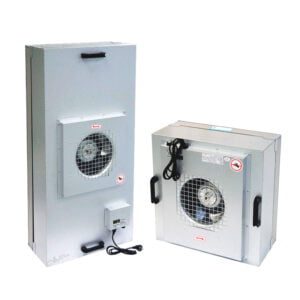
ECM-driven fan filter units partially offset this penalty by offering higher static pressure capability and a wider flow range, while generating less heat than equivalent AC motor units. A published design point of 280 W at 109 FPM for an ECM FFU—a single-manufacturer figure, not a generic benchmark—illustrates that motor technology choice compounds with filter grade to determine total energy load per FFU position. Across a ceiling grid with dozens of units, the accumulated difference between HEPA-plus-ECM and ULPA-plus-conventional-AC motor configurations can be substantial in both energy and cooling load terms.
| Атрибут | ECM FFU | Conventional AC FFU |
|---|---|---|
| Енергоспоживання | 280W at 109 FPM | Typically higher for equivalent airflow |
| Виробництво теплової енергії | Lower heat output | Higher heat output |
| Flow Range | 110–1117 CFM | Narrower flow range |
| Дотримання нормативних вимог | California Title 24, EU ErP 2015, LEED points | May lack these certifications |
| Static Pressure Capability | Suitable for high static pressure applications | Limited capability |
The lifecycle cost implication is rarely captured at the filtration specification stage. First cost comparisons between HEPA and ULPA filter media are visible; the downstream fan resizing, energy draw difference over a ten-year operational period, and increased replacement frequency for higher-loading ULPA elements are not. Where regulatory energy codes—California Title 24, EU ErP 2015—are relevant to your project, ECM FFU selection becomes a procurement differentiator rather than a preference. These references signal energy-code alignment and are worth confirming in the FFU submittal, but they are not universal minimums for every cleanroom jurisdiction.
Local Protection as an Alternative to Full ULPA Coverage
Full ULPA coverage across a modular cleanroom ceiling assumes that every point in the room carries equivalent particle risk. That assumption rarely holds in practice. Most cleanroom operations have one or two steps where sensitive exposure actually occurs—an open container transfer, a weighing operation, a vial filling point—and the surrounding room volume exists to support classification and prevent external contamination ingress, not to provide the same filtration intensity as the critical zone.
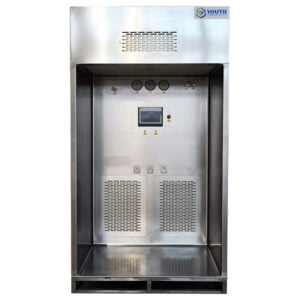
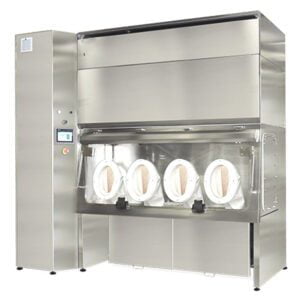
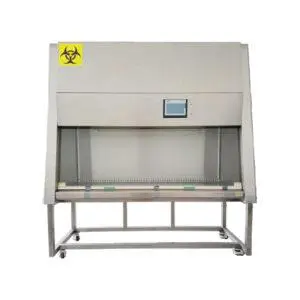
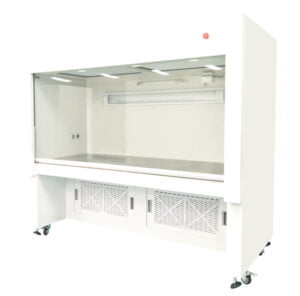
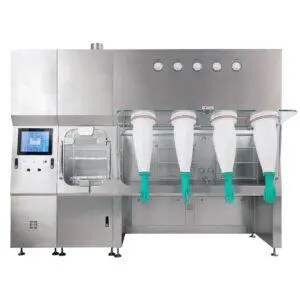
Concentrating ULPA-grade filtration at those sensitive operations—through a laminar flow workstation, an isolator, or a local ULPA-filtered enclosure—while maintaining HEPA at room level is a defensible design strategy when the room ISO classification target is achievable with HEPA. It avoids propagating ULPA pressure drop and energy consequences across the full ceiling array, and it isolates the validation scope for the highest-specification filtration to the equipment units where process risk is actually concentrated. This is not a compromise on protection; it is a risk-proportionate layout decision that is often more auditable because the filtration boundary aligns with the process boundary.
The condition that makes this strategy inappropriate is when the room-level ISO classification itself requires sub-0.3 µm particle control—which is uncommon for ISO 6 and ISO 7 spaces but may apply in ISO 4 and ISO 5 environments depending on process contamination generation rates. In those cases, local protection supplements room-level ULPA rather than replacing it. The layout decision must be made before ceiling grid design is finalised; retrofitting local protection equipment into a room built for HEPA-only coverage is straightforward, but redesigning a ULPA ceiling grid back to HEPA after commissioning has started is not.
Filter Scan Testing and Replacement Records
Filter integrity verification is a recurring operational event, not a one-time commissioning activity. ISO 14644-3 describes the testing methods and acceptance criteria for in-situ filter leak testing, but the equipment configuration that makes that testing practical—or difficult—is determined at procurement. Two FFU design features have a direct effect on how reliably and efficiently scan testing and filter replacement can be executed across the operational lifecycle.
Challenge ports allow test aerosol to be introduced upstream of the filter without dismantling the unit or compromising room classification during the test. This simplifies in-situ leak scanning as required by ISO 14644-3 procedures and reduces the risk of introducing contaminants during test setup. Challenge ports are an optional FFU feature, not a mandatory specification, but omitting them when scan testing frequency is high or when schedule pressure makes disruption costly is a maintenance planning oversight that is difficult to remedy after installation. Roomside filter replacement access—via easy-open clips and gel-sealed filter seats rather than topside access requiring above-ceiling entry—reduces the contamination risk and personnel exposure associated with filter change events, and it allows replacement to be scheduled without coordinating ceiling access or disrupting adjacent operations.
| Особливість | Функція | Операційна вигода |
|---|---|---|
| Challenge Port | Allows introduction of test aerosol for leak scanning | Simplifies in-situ filter integrity testing without process disruption |
| Roomside Replaceable Access | Filter change from cleanroom side via easy-open clips | Reduces contamination risk and maintenance downtime |
| Gel-Sealed Filter Seat | Provides air-tight seal without gasket compression | Ensures leak-free installation, supports reliable scan testing |
The practical consequence of not specifying these features upfront is that routine compliance activities—periodic leak testing and filter change-outs—become disproportionately disruptive. That disruption is not just an operational nuisance; it weakens audit readiness by creating gaps in maintenance scheduling, compressing the time available for proper documentation, and increasing the likelihood that scan testing is deferred rather than completed on cycle. Specifying challenge ports and replacement access as named requirements in the FFU procurement document, rather than as preferred options to be evaluated post-delivery, ensures these features are present when lifecycle compliance begins.
Procurement Evidence for Filtration Decisions
A filtration specification that states only “HEPA” or “ULPA” without defining filter grade, efficiency, test standard, and scan test expectation leaves significant room for misalignment between what was designed, what was procured, and what was installed. The submittal package is the mechanism that closes that gap before equipment arrives on site.
Filter grade and efficiency ratings—HEPA H14 versus ULPA U15, for example—must appear in the product data submittal alongside the dimensional specifications and housing configuration. Shop drawings should confirm that the FFU layout within the modular ceiling grid allows for the maintenance access mode specified (roomside or topside), and that filter housing design is consistent with the challenge port configuration if testing access was specified. Manufacturer’s certificates referencing applicable standards—ISO 14644-1 as the classification criterion, IEST-RP-CC001 as a filter handling and installation reference, FDA/cGMP alignment where applicable—provide the documented basis for performance claims. These references are common specification language in pharmaceutical and biotech cleanroom procurement; they are not a complete regulatory checklist, and their presence in a submittal does not substitute for confirming that the specific filter grade and test data match your URS.
| Submittal Item | Key Details to Confirm | Чому це важливо |
|---|---|---|
| Product Data / Filter Specifications | Filter grade (HEPA/ULPA), efficiency, dimensions | Ensures correct filter performance matches process risk |
| Shop Drawings | FFU configuration, filter housing, access type | Verifies fit within modular cleanroom layout and maintenance access |
| Manufacturer’s Certificates | Compliance with ISO 14644-1, IEST-RP-CC001, FDA/cGMP | Provides documented evidence of performance standards |
| Closeout & Maintenance Instructions | Filter replacement procedures, scan test documentation, spare parts | Supports ongoing compliance and traceability after handover |
Closeout documentation—replacement procedures, scan test records, spare parts references—should be treated as a commissioning deliverable and audit asset, not as administrative handover paperwork. When a regulatory inspection reviews filtration maintenance records or a requalification event triggers a full filter integrity test, the traceability of what was installed, when it was last tested, and what acceptance criteria applied starts with what was captured at handover. Procurement teams that treat the submittal package as a pre-payment checkpoint rather than an ongoing compliance foundation typically discover the gap when they need those records under audit pressure rather than before it.
The filtration decision for a modular cleanroom has consequences that extend well beyond the filter itself—into fan sizing, energy load, maintenance scheduling, qualification scope, and audit defensibility. None of those consequences are hypothetical; they surface predictably at balancing, classification testing, and first maintenance cycle when the filter grade was chosen without mapping it to process particle risk, ISO target, and mechanical constraints simultaneously.
Before committing to a filter grade, confirm three things: the smallest particle size that creates a process or classification risk in your specific operations, whether that risk is room-wide or confined to specific process steps, and whether the FFU configuration you are procuring includes the scan test access and replacement features needed to maintain compliance across the equipment’s operating life. Those three confirmations—not the filter efficiency number alone—are what make a filtration specification defensible at commissioning and beyond.
Поширені запитання
Q: Does the HEPA/ULPA selection logic change if I’m building a traditional stick-built cleanroom instead of a modular system?
A: The particle-risk mapping and pressure-drop considerations remain the same. However, modular cleanrooms often pre-engineer ceiling grids and airflow envelopes, so a late filter-grade substitution can trigger structural, electrical, and HVAC rework that is harder to absorb than in a conventional build. The same decisions apply; the cost of mis-specification is just more immediate and harder to correct in a modular environment.
Q: What practical methods can I use to determine the smallest harmful particle size my process requires?
A: Start with existing process-characterisation data, equipment specifications from vendors, or published studies for similar operations. If none exist, run a short-term particle monitoring study across critical steps using optical particle counters that size down to 0.1 µm. The objective is a defensible, documented threshold that directly informs filter grade, not absolute precision in every scenario.
Q: At what ISO class does HEPA typically become insufficient for full-room coverage?
A: For ISO 5 (Class 100) and cleaner spaces, particle-count limits at 0.1 µm and 0.2 µm are low enough that HEPA often cannot maintain classification under normal operational contamination loads. In those cases, full-room ULPA becomes the default, with local protection as a supplement. ISO 6 and ISO 7 rooms generally achieve their targets with HEPA unless a specific sub-0.3 µm process risk overrides that.
Q: How do I decide between roomside and topside filter replacement access for my FFUs?
A: Roomside access minimises contamination risk during filter changes and avoids the need to coordinate above-ceiling entry, making it the stronger choice for high-uptime or tightly classified spaces. Topside access can be acceptable when the ceiling void is spacious, non-critical, and easily accessed, and where filter replacements are infrequent. The choice should be fixed before ceiling grid design, as it influences FFU housing configuration and maintenance workflow.
Q: Is the energy-savings investment in ECM fan filter units justified if my modular cleanroom operates only intermittently?
A: The payback from energy savings is longer with intermittent use, but ECM fans still offer advantages: softer startup reduces electrical stress, and the wider flow range allows the same unit to serve evolving airflow demands without replacement. If future operating hours may increase or energy-code compliance matters, ECM units provide headroom. For very low-duty-cycle rooms, run a lifecycle cost comparison based on your actual usage profile before deciding.