Most teams finalize a room format based on the cleanest ISO class listed in the RFQ, then discover during commissioning that the actual risk point sits in a processing step two zones over that was never mapped to the configuration. The cost of that mismatch isn’t limited to a redesign conversation—it often means panel rework after utilities are already routed, ceiling filter positions that no longer align with the revised airflow model, and a validation baseline that can’t be defended when test results first diverge from design assumptions. The decision that changes outcome quality is locking room format to the most contamination-exposed process step, not to the cleanest ISO target in the project document. Working through the inputs below gives procurement, engineering, and QA teams a clearer basis for evaluating format, scope, and supplier accountability before configuration approval.
Decision Inputs That Change the Room Format
Room format is rarely a neutral starting point. The format that gets selected early—often based on budget category or a ballpark ISO class—tends to hold even when process mapping later reveals a step that demands more than the selected format can deliver. That mismatch is the most common source of late-stage redesign in modular cleanroom projects.
The input that carries the most weight is process exposure: specifically, which step within the room presents the highest contamination risk, and whether that step requires stable environmental conditions or just physical separation from surrounding areas. A process step that tolerates ambient humidity swings is a different design problem from one where temperature drift or particulate reintroduction can produce yield loss or quality failures. Recirculating configurations are better suited to the latter because they support tighter temperature and humidity control than single-pass designs—not because any regulation mandates the format for a given ISO class, but because the recirculation path gives the system a mechanism for maintaining stability that single-pass designs lack by construction.
The second input that changes format is adjacency. A cleanroom that shares a wall or interlock with an uncontrolled or lower-classification area carries a different pressure management requirement than a freestanding isolated room. That adjacency condition is frequently underdocumented in early RFQs and only surfaces when someone asks what’s on the other side of each planned panel face. Resolving it before format selection avoids a class of problems that are expensive to fix once panel layout is committed.
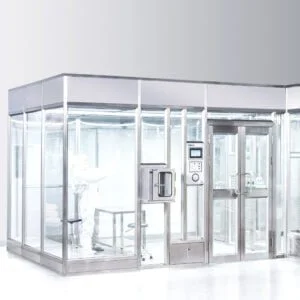
Softwall Hardwall and Full Modular Room Tradeoffs
The functional boundary between softwall and hardwall is pressure control, and the decision consequences of crossing that boundary in the wrong direction are significant. Softwall formats cannot maintain meaningful positive pressure differentials because the flexible panel perimeter doesn’t provide the sealing integrity needed to hold and measure a stable differential against adjacent uncontrolled space. That limitation is acceptable when the protected zone is stable, access patterns are simple, and no adjacent area introduces uncontrolled contamination risk. It becomes a structural problem when the process requires a validated envelope or when a quality audit expects pressure differential records as evidence of containment integrity.
Hardwall formats carry a higher upfront cost and less flexibility for post-installation reconfiguration, but they resolve the pressure and envelope integrity questions that softwall formats can’t answer reliably. For recirculating hardwall designs, there’s an additional operating benefit: the recirculation path reduces the total contaminant loading on ceiling-mounted HEPA filters compared to single-pass designs that draw unfiltered or partially filtered air continuously from outside the room. Lower loading typically translates to longer filter service intervals, which affects both maintenance scheduling and lifecycle cost. Neither outcome is guaranteed—both depend on how well the design is executed and what contaminant sources exist inside the room—but they represent expected directional advantages that inform the selection.
| Особливість | Softwall | Hardwall |
|---|---|---|
| Internal pressure capability | Lower; limited containment when adjacent areas are uncontrolled | Higher; enables stable positive pressure and minimizes entry of dirty air |
| Contamination control integrity | Adequate for stable, low‑exposure zones | Required when pressure integrity, security or validated envelope integrity matters |
| HEPA filter service life (recirculating designs) | Typical contaminant loading on filters | Reduced contaminant load extends filter life, lowering replacement frequency |
Choosing a softwall format to reduce cost when the process step requires pressure integrity or a validated envelope doesn’t reduce cost—it defers a more disruptive and expensive correction to a point in the project when panel removal affects installed utilities, ceiling filter placement, and the airflow model the ISO classification test depends on.
ISO Class and Airflow Strategy by Process Exposure
Airflow strategy and ISO class are related but not equivalent. ISO 14644-1:2015 provides the classification framework for air cleanliness by particle concentration—it defines what the room must demonstrate at the point of testing, not which airflow architecture must produce that result. The choice between recirculating and single-pass design is an engineering decision driven by process sensitivity and environmental stability requirements, not a direct regulatory mandate from the classification standard.
The trade-off is straightforward in principle but frequently misjudged in practice. Single-pass designs cost less to build and are adequate for processes that don’t require tight temperature or humidity control. Recirculating designs carry a higher initial investment but provide the environmental stability that processes with narrower tolerance windows need. The mistake pattern is selecting a single-pass format based on construction budget, then encountering process instability downstream because the format can’t maintain the environmental conditions the process actually requires. By the time the instability is traced to the airflow architecture rather than equipment settings or operator practice, reconfiguration is disruptive and expensive.
| Вимір | Recirculating (Return/Supply) | Non‑Recirculating (Single‑Pass) |
|---|---|---|
| Стабільність температури та вологості | Strong control; format of choice when environmental stability is critical | Limited control; prone to swings in ambient conditions |
| Upfront construction cost | Вищі початкові інвестиції | Lower initial cost to build |
| Typical process exposure fit | Processes demanding tight environmental control (commonly higher ISO classes) | Cost‑sensitive processes with modest stability needs (lower ISO classes) |
Where ISO classification interacts with this decision is in the implied contamination recovery expectation. A room classified to a tighter ISO class is expected to recover from a contamination event within a defined period, and that recovery rate is a function of air change rate and airflow architecture, not just the filter grade. If the airflow strategy selected during design can’t support the recovery time the validation protocol will test against, the configuration approval and the test protocol are in conflict before a single panel is installed. Confirming the recovery expectation as part of airflow strategy selection—rather than leaving it to the commissioning team—avoids that conflict.
Utility Maintenance and Expansion Constraints
Utility routing is the constraint that gets deferred most often and costs the most to correct after panel layout is finalized. The reason is structural: the cleanroom panel layout and ceiling filter grid are developed together as an integrated system. Once panel positions are committed, the ceiling plenum geometry, filter module spacing, and return air path are effectively fixed. Any utility—compressed air, process gas, power drop, HVAC connection—that arrives late or lands in a position that wasn’t accounted for in the panel layout creates a conflict that can only be resolved by moving either the utility or the panel, and both options disturb the airflow model.
The specific risk from late HVAC coordination is the most consequential. If the recirculation path clearances or the supply/return duct connections haven’t been resolved against the facility’s existing HVAC infrastructure before panel layout is drawn, the commissioning team may find that airflow distribution in the installed room doesn’t match the design assumptions. Resolving that after installation often requires repositioning ceiling modules, which reopens the sealing and filter placement questions the initial layout was designed to answer.
Modular panel systems support maintenance access through removable panel design, which is a genuine advantage for future utility or equipment changes. But that advantage only materializes if the panels designated for removal access are identified before layout is locked and the clearances required for removal are accounted for in the room plan. If access isn’t mapped during design, maintenance teams may find that the panel that needs to come out for a utility repair sits behind installed equipment with no practical removal path.
| Utility / System | Що потрібно підтвердити | Ризик, якщо його не помітити |
|---|---|---|
| Power and control drops | Routing and clearance before panel layout is finalized | Disturbance of ceiling‑mounted HEPA filter placement and airflow patterns |
| Compressed air and process gases | Connection points and distribution paths aligned with existing infrastructure | Late piping changes force panel rework and compromise pressure integrity |
| HVAC connections and ducting | Integration with facility HVAC and recirculation path clearances | Airflow disruption and non‑compliance during commissioning |
| Panel removal access for maintenance | Designate removable panels and clearance for future equipment swaps | Extended downtime and higher cost when quick access is later needed |
The practical standard is to treat utility routing as a design prerequisite for panel layout, not a parallel workstream. Coordination that happens after layout is approved is rework by another name.
Scope Items That Make Supplier Quotes Non-Comparable
Two quotes for the same room footprint and ISO class can differ by a significant margin and still both be technically accurate representations of what each supplier intends to deliver. The difference lives in scope exclusions that aren’t always visible unless someone asks for them directly.
The most consequential scope variable is prefabrication level. Suppliers who ship panels pre-cut with embedded electrical, controls, and window frames are delivering a different product than suppliers who ship generic panel stock that requires on-site cutting, fitting, and field installation of those elements. The first approach concentrates fabrication labor and dust generation off-site and in controlled conditions. The second generates significant on-site cutting activity that requires containment, clean-up, and additional site labor that may or may not be captured in the quoted price. Neither approach is inherently deficient—but they are not equivalent in cost, timeline, or site impact, and a quote comparison that doesn’t surface this difference is not a valid comparison.
| Атрибут | Pre‑Fabricated Panels (Embedded Utilities) | Generic Panels (On‑Site Cutting) |
|---|---|---|
| On‑site cutting and fitting required | Ні. | Так. |
| Embedded electrical, controls, windows | Включено | Not included; field‑installed |
| Графік монтажу | Shorter, less site labour | Longer, more site labour |
| Dust, noise and clean‑up | Minimal at point of assembly | Significant, requiring containment and cleaning |
| Quote comparability | Scope clarity high; fewer hidden costs | Scope must be explicitly listed; otherwise costs vary widely |
Beyond prefabrication level, the exclusions that most commonly distort quote comparisons are flooring, electrical drops, drain connections, controls integration, and commissioning tests. These items appear in some quotes as included scope and in others as explicitly excluded or simply absent. A project team that selects the lowest quote without surfacing every exclusion across all proposals will encounter the missing scope as change orders during or after installation, at a point when negotiating leverage is gone. The review standard before any quote is evaluated is a complete exclusions matrix, not a headline price comparison. For buyers evaluating модульне чисте приміщення options across multiple suppliers, that matrix is the baseline document that makes the comparison defensible.
Pre-RFQ Evidence to Lock Before Configuration Approval
Configuration approval that precedes complete documentation creates a project without a defensible baseline. When commissioning results first diverge from design assumptions—and they frequently do at some point—the team needs a documented basis for evaluating whether the divergence is within expected tolerance, requires rework, or reflects a gap in the original configuration decision. Without that documentation, the investigation starts from a disputed premise.
The evidence that needs to be locked before approval covers four areas. Supplier fabrication methods and quality checkpoints need to be confirmed off-site, before delivery, because a panel that arrives with dimensional deviation or embedded utility errors is not efficiently corrected on a construction site. The on-site assembly plan needs clear assignment of labor, sequencing, and environmental controls responsibility, because ambiguity about who owns those elements produces timeline disputes and quality gaps during installation. The final testing protocol needs defined pass/fail thresholds for particle counts, airflow validation, and recovery testing aligned with ISO 14644-4:2022, because a test that doesn’t specify acceptable results doesn’t produce a defensible outcome. And the boundary between buyer-owned facility work and supplier scope needs to be explicit in the drawings, because a configuration approval that doesn’t define that boundary leaves the handover risk open until commissioning, which is the worst possible time to resolve it.
| Evidence Item | Чому це важливо | What to Verify Before Approval |
|---|---|---|
| Off‑site fabrication details | Material quality, QC, and schedule certainty | Supplier’s off‑site methods, inspection criteria, and delivery milestones |
| On‑site assembly plan | Sequence and responsibilities affect total timeline | Clear assignment of who provides labour, lifts, and environmental controls during assembly |
| Final testing protocol | Defines acceptable performance and compliance | Particle counts, airflow validation, and recovery test methods with pass/fail thresholds |
| Accelerated depreciation eligibility | Classifies cleanroom as 7‑year tangible personal property | Documentation supporting classification; impacts total cost of ownership and investment justification |
One additional factor worth confirming with a qualified tax advisor before finalizing the investment structure: modular cleanrooms may qualify for accelerated depreciation as tangible personal property under a seven-year depreciation schedule. That classification depends on how the asset is documented and structured, and it can meaningfully affect the total cost of ownership calculation. It’s a financial planning input, not a procurement checklist item, but it belongs in the configuration approval conversation before the project structure is finalized.
The clearest signal that a configuration approval is premature is the absence of process exposure mapping, utility routing confirmation, and a complete scope exclusions matrix. Format decisions made without those three inputs tend to produce configurations that are optimized for the cleanest ISO target on paper rather than for the highest-risk process step in practice—and the corrections required after panel layout is committed are more disruptive and more expensive than the additional pre-approval work would have been.
Before issuing an RFQ, confirm that the room format decision is tied to the most exposed process step, that utility routing is resolved against the actual facility infrastructure, and that every supplier quote will be evaluated against a common exclusions list that includes flooring, electrical drops, drain connections, controls, and commissioning tests. Those inputs don’t eliminate configuration risk, but they remove the most predictable sources of late-stage rework and quote miscomparison that consistently create cost and schedule problems in modular cleanroom projects.
Поширені запитання
Q: What happens if our process involves multiple steps at different ISO classes — which one should drive the room format decision?
A: The most contamination-exposed step drives the format, not the cleanest or most prominent ISO target. If one step carries meaningful contamination risk or requires tight environmental stability, the room format must be capable of protecting that step. Designing to a cleaner but less risky step elsewhere in the sequence leaves the actual risk point unaddressed, which typically surfaces as a compliance or yield problem at commissioning rather than during planning.
Q: We’re leaning toward softwall to keep costs down — at what point does that decision become a liability?
A: Softwall becomes a liability the moment the process requires a measurable and recordable pressure differential against an adjacent uncontrolled area, or when a quality audit will expect envelope integrity as documented evidence of contamination control. Softwall formats cannot hold or measure a stable positive pressure differential because the flexible perimeter doesn’t provide the sealing integrity needed. If either condition applies to your process or regulatory context, the cost saving is not real — it’s a deferred correction that will be more disruptive to execute after utilities and ceiling filters are already installed.
Q: After configuration approval is issued, what should the first coordination step with the supplier actually be?
A: The first step is confirming off-site fabrication checkpoints before any panels are shipped. Dimensional deviations, embedded utility errors, or missing window frames are far more efficiently corrected at the supplier’s facility than on a construction site where rework generates contamination, disrupts sequencing, and creates timeline disputes. Aligning on what gets verified before delivery — and who signs off on those checks — sets a defensible quality baseline before the installation phase introduces new variables.
Q: Does the recirculating versus single-pass decision change if the room will be expanded in a future phase?
A: Yes, and it’s a consideration the article doesn’t fully resolve. A recirculating design sized for the current room footprint may not scale cleanly to a larger configuration without changes to the recirculation path, duct connections, and HVAC capacity — all of which intersect with the panel layout in ways that can be disruptive if expansion wasn’t modeled during initial design. If a future expansion phase is anticipated, the recirculation architecture and the utility routing plan should be scoped to accommodate the final footprint, not just the first phase, before panel layout is locked.
Q: How do we know if the ISO recovery expectation in our validation protocol is actually achievable with the airflow strategy we’ve selected?
A: Confirm the recovery rate the protocol will test against before configuration approval, and verify that the selected air change rate and airflow architecture can meet it under realistic contamination event conditions. ISO 14644-4:2022 provides the framework for design and start-up requirements, but the recovery expectation needs to be explicitly reconciled with the airflow design — not left to the commissioning team to discover after installation. If the protocol specifies a recovery window the airflow architecture cannot support at the designed air change rate, the configuration and the test are in conflict before a single panel is installed.