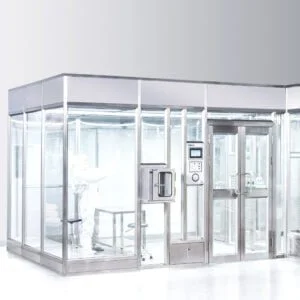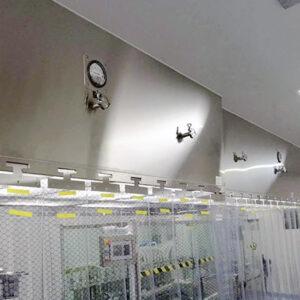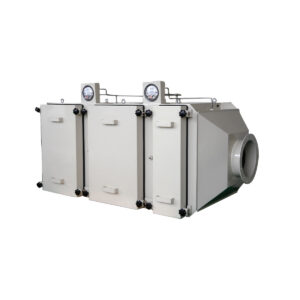
Specifying a transfer hatch after the room layout is fixed is one of the more common points where a cleanroom project accumulates quiet rework. The unit gets procured against a general description—”pass box between gowning and Grade B”—without the pressure cascade, material risk profile, or decontamination requirement having been formally resolved. What follows is either a static hatch installed on a differential-grade boundary where HEPA airflow was operationally assumed, or a VHP-capable chamber procured for a same-grade route that will never run a biodecontamination cycle, locking the site into cycle development, cycle validation, and six-monthly requalification for zero contamination-control benefit. The decision that prevents both outcomes is fixing material type, room grade relationship, and decontamination expectation before the equipment type is selected. Working through those three inputs first is what this article is structured to support.
Transfer risk before choosing pass box type
The grade relationship between the two rooms a pass box connects is the first planning variable, but it is not the only one. A transfer between two Grade C rooms carrying non-sensitive packaging components presents a different risk profile than a transfer between a Grade D corridor and a Grade B filling suite, even though both involve a grade differential. What changes is not just the pressure direction but whether the act of opening a door in one room and closing it before the other can open is sufficient contamination control, or whether active airflow inside the chamber is required to manage the particle and bioburden exposure window.
The market convention—static units for same-grade transfers, dynamic units for transfers between different grades or between a cleanroom and an unclassified area—reflects a practical contamination-control logic that aligns with the underlying principles of pressure cascade and cleanliness grade separation in ISO 14644-4 and EU GMP Annex 1. It should not be read as a regulatory prescription about equipment type, but it is a useful planning heuristic because it connects the selection to the actual risk being managed. Where the rooms share a cleanliness grade, the transfer chamber does not need to generate a local airflow cascade; it needs to prevent simultaneous door opening and maintain the existing differential. Where the grades differ, a passive chamber may not be defensible if an inspector or a QA review asks what prevents the lower-grade environment from communicating through the chamber during transfer.
The failure mode worth fixing early is the assumption that interlock logic alone resolves the risk on a differential-grade boundary. It prevents simultaneous opening, but it does not supply clean air to the chamber during the dwell period. For transfers where that dwell-period particle exposure matters—because the material is aseptically processed, because the transfer frequency is high, or because the room differential is steep—a static unit creates an SOP that is difficult to defend through batch release review. Catching that mismatch at specification rather than at qualification or, worse, at inspection avoids a procurement restart.
Static, dynamic, VHP, and biosafety functions compared
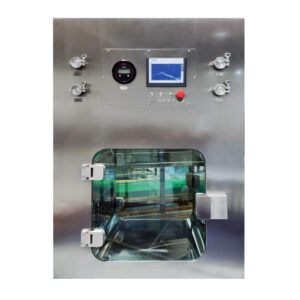
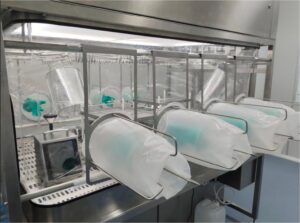
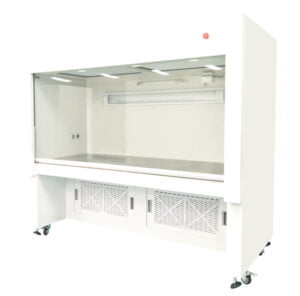
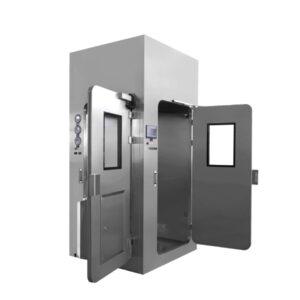
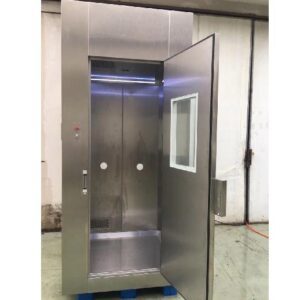
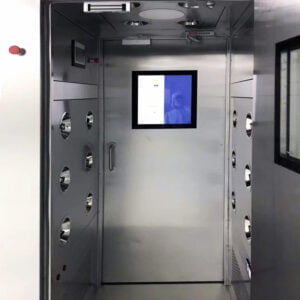
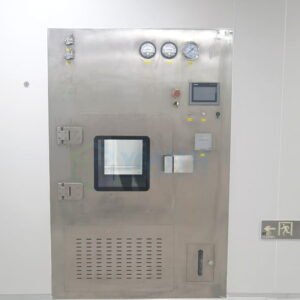
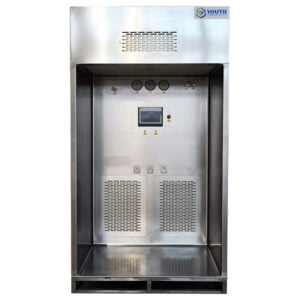
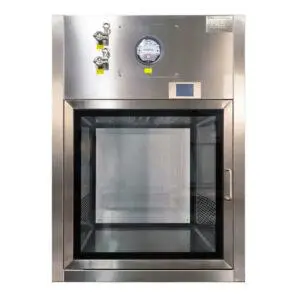
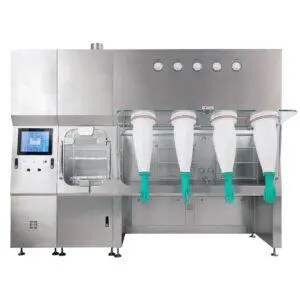
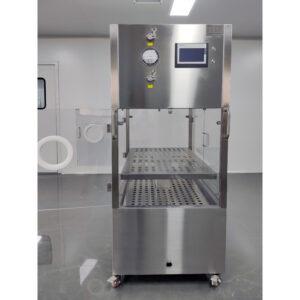
Each pass box type solves a different problem, and the differences are not primarily about quality of construction—they are about what risk the unit is designed to address. A static unit is a controlled physical barrier with interlock logic. A dynamic unit adds a local HEPA-filtered supply air environment inside the chamber, creating a clean airflow cascade during the transfer window. A VHP unit adds a validated chemical decontamination cycle as the primary function, with or without HEPA supply. A biosafety rapid transfer port (RTP) solves a different problem entirely: it maintains sealed containment integrity at the interface between two environments, where the risk is operator or product exposure to hazardous or high-potency material, not particulate contamination between grades.
The practical implication of these distinctions is that the types are not interchangeable upgrades on a quality spectrum. A VHP chamber procured because “it does everything the dynamic does plus more” is over-specified if the transfer route has no biodecontamination requirement. It commits the site to cycle development, cycle validation, aeration validation, and periodic requalification of the decontamination cycle—none of which adds contamination-control value on a route that only needed HEPA-filtered airflow. The upgrade logic that seems cost-neutral at procurement creates years of operational and audit exposure.
Each type carries specific design features—HEPA grade, interlock mechanism, decontamination method, airflow supply—that define what qualification activities it requires and what it can or cannot be used to claim.
| Тип скриньки для перепусток | Ключовий механізм | Airflow & HEPA Filtration | Метод знезараження | Типовий випадок використання |
|---|---|---|---|---|
| Статика | Passive transfer chamber; mechanical or electronic interlock | No active airflow; no HEPA filtration | None (wipe-down only) | Same-cleanliness-grade rooms, non-sensitive materials |
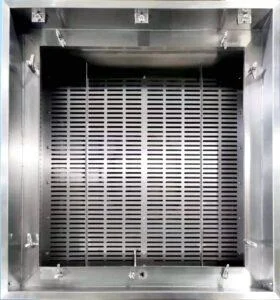
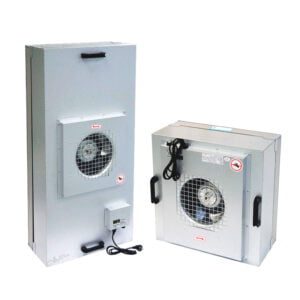
| Динамічний | Forced HEPA-filtered air supply via centrifugal fan; electronic interlock with time-delay purge | H13/H14 HEPA + G4 prefilter; ISO Class 5 / Grade A supply | None (relies on clean airflow cascade) | Different cleanliness grades, cleanroom-to-non-cleanroom, or aseptic enhancement for same-grade transfers |
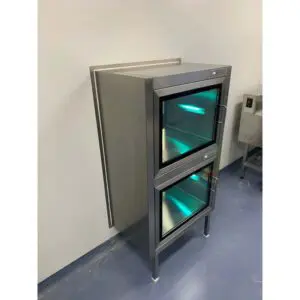
| VHP | Integrated vaporized hydrogen peroxide generator; sealed chamber with cycle control | May include HEPA supply; primary function is biodecontamination | Vaporized H₂O₂ decontamination cycle | High-risk materials, larger equipment, situations requiring validated bioburden reduction |
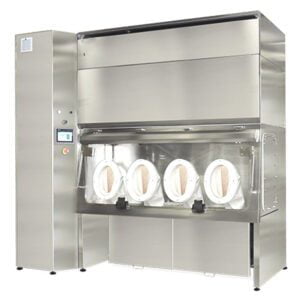
| Biosafety (RTP) | Rapid transfer port with alpha-beta flange; sealed containment transfer | None or minimal; relies on sealed port interface | Maintains containment during transfer (no active decontamination in the pass box) | Hazardous or high-potency goods requiring sealed transfer between containment zones |
One point the table does not resolve is where a dynamic unit is used on a same-grade boundary to “enhance aseptic transfer.” That configuration is technically valid and may be appropriate where process risk justifies it, but it adds the full dynamic qualification burden—HEPA integrity testing, particle counts, air velocity verification, six-monthly requalification—for a route where a static unit would be sufficient. The question for the QA team is whether that qualification overhead is justified by a genuine contamination-control need or whether it is inherited from a default specification that was never challenged.
Door interlocks, airflow, and decontamination requirements by route
Interlock design is the point where the transfer route’s pressure logic becomes a physical constraint on the unit. A static pass box can use either a mechanical or electronic interlock; a dynamic unit requires an electronic interlock to coordinate the time-delay purge. The purge sequence matters operationally: after one door closes, both doors lock for a defined period during which the chamber is purged with HEPA-filtered air before the second door can be released. That sequence exists to prevent a door release cycle that bypasses the clean-air establishment period. If the purge time is not validated against the chamber volume and the airflow rate, the interlock sequence becomes a procedural formality rather than a contamination-control mechanism.
The verification check that matters for both types—and that should be a standard item in the OQ protocol—is confirming that both doors cannot be opened simultaneously under any operating condition, including power interruption or control system fault. EU GMP Annex 1 does not prescribe a specific interlock technology for pass boxes, but it establishes that pressure differentials between adjacent grade areas must be maintained. An interlock that fails open on a power fault on a differential-grade boundary is a direct risk to that principle, and it is the kind of failure mode that is straightforward to test but is sometimes absent from commissioning checklists. For VHP units, the interlock logic must also integrate with the decontamination cycle controller: no door should release during or immediately after a cycle before aeration to a safe H₂O₂ residual level has been confirmed.
Airflow direction inside the chamber interacts with the room pressure cascade in a way that is easy to misspecify. A dynamic unit that supplies air into a chamber installed between a higher-pressure Grade B and a lower-pressure Grade C should be oriented so that chamber exhaust exits toward the lower-grade side, reinforcing rather than opposing the existing differential. If the unit is installed without confirming airflow direction relative to the cascade, it can create a local pressure inversion during the transfer window. This is worth confirming at FAT against the room pressure map, not after installation when the cascade has been measured and the defect is structural.
Validation burden from over-specifying or under-specifying transfer equipment
The validation burden a pass box generates is not proportional to its cost—it is proportional to its active systems. A static unit has no HEPA filter, no fan, no decontamination cycle, and no purge timer. Its qualification scope is correspondingly narrow: door interlock function, chamber surface integrity, and dimensional confirmation against the URS. A dynamic unit adds HEPA filter integrity testing, particle count verification, and air velocity measurement to that scope, and then repeats all of it on a six-monthly cycle regardless of whether anything has changed. A VHP unit adds cycle development, cycle validation against a defined log-reduction target for a relevant biological indicator, aeration profile validation, and residual H₂O₂ measurement before door release.
The hidden cost of over-specifying is not the capital expenditure—it is the recurring qualification programme that the site must sustain for the lifetime of the equipment. A dynamic pass box installed on a same-grade corridor transfer because the specification defaulted to “dynamic for all pass boxes” commits the site to roughly two full requalification events per year, per unit, plus prefilter replacement every six months and HEPA replacement on a rolling basis guided by differential pressure monitoring. Across a facility with multiple low-risk same-grade transfer routes, that is a measurable QA resource commitment with no corresponding contamination-control benefit.
The cost of under-specifying is different in kind: it is a compliance defect that may not be visible until a deviation investigation or an inspection. A static unit on a non-sterile-to-aseptic transfer route, or on a boundary where the grade differential requires an active airflow cascade, is an equipment qualification that cannot demonstrate the contamination control its SOP implies. That creates a batch release defensibility problem that is structurally harder to resolve than a maintenance schedule.
| Діяльність | Criteria / Requirement | Частота / Тригер |
|---|---|---|
| Тест цілісності HEPA-фільтра | Penetration <0.01% (PAO/DOP) | Per qualification protocol; part of re-qualification |
| Кількість частинок | ≥0.5 µm: ≤100 particles/ft³; ≥5 µm: 0 particles/ft³ | During qualification and re-qualification |
| Випробування на швидкість повітря | 90 ±20 ft/min, measured 6 in. from grill at five locations | During qualification and re-qualification |
| G4 Prefilter Replacement | Manufacturer recommendation | Кожні 6 місяців |
| Заміна фільтра HEPA | Manufacturer recommendation, guided by differential pressure | Кожні 6-12 місяців |
| Differential Pressure Check | Monitor gauge to confirm filter loading | Regularly, per SOP |
| Повна перекваліфікація | All performance tests above | Every 6 months (±15 days), and after any failure, breakdown/maintenance, or relocation |
The table’s six-month requalification trigger also applies after failure, breakdown, maintenance intervention, or relocation. Sites that track pass box maintenance under a general equipment maintenance programme without linking those events to a requalification trigger are a common audit finding. The dynamic unit that was serviced in Q2 and not requalified before returning to service is the specific failure pattern worth building into the change control and preventive maintenance procedures from commissioning.
Selection trigger after material type and contamination risk are clear
Selection should not begin with the pass box—it should begin with three fixed inputs: the grade relationship between the two rooms, the material’s sensitivity and bioburden risk, and whether the transfer route requires validated decontamination. Once those three are confirmed, the equipment type that satisfies the contamination-control requirement without generating unnecessary validation burden becomes straightforward to identify.
The threshold that most commonly changes the recommendation is the shift from a same-grade to a different-grade transfer. For same-grade transfers with non-sensitive materials, a статична прохідна коробка is the appropriate baseline: it adds no recurring HEPA qualification burden and satisfies the contamination-control requirement. Using a dynamic unit on that route is technically permissible and may be justified where aseptic enhancement is required by process risk assessment, but the decision should be deliberate and documented against a specific contamination-control rationale, not a default. For different-grade transfers, or transfers between classified and unclassified areas, a динамічна перепустка provides the local clean-air environment that a passive barrier cannot. For routes where validated bioburden reduction is required—high-risk materials, biological agents, situations where surface contamination must be demonstrated to have been addressed before entry—VHP becomes the functional requirement, not an upgrade. Biosafety RTP transfer is a different category: it addresses containment integrity at the interface, and its selection trigger is operator or product exposure risk, not cleanroom grade classification.
The selection table below provides a structured summary of the key differentiators; it should be read as a tool for narrowing options, not as a decision that removes the site’s obligation to confirm the choice against its own contamination control strategy and regulatory context.
| Тип скриньки для перепусток | Cleanroom Grade Relationship | Чутливість до матеріалів | Decontamination Need | Cost / Complexity |
|---|---|---|---|---|
| Статика | Same grade to same grade | Low (non-sensitive) | Wipe-down only | Most affordable; minimal validation |
| Динамічний | Different grades, or cleanroom to non-cleanroom (also enhances aseptic transfer for same-grade) | Moderate to high (sensitive, exposure risk) | HEPA-filtered airflow cascade; no chemical decontamination | Higher cost than static; added validation and maintenance |
| VHP | High-risk transfers regardless of grade differential | High; bioburden-critical materials | Validated vaporized H₂O₂ biodecontamination cycle | Highest cost and validation burden; suitable for larger equipment |
| Biosafety (RTP) | Sealed containment interfaces; no classical grade distinction | Hazardous or high-potency goods | Maintains containment integrity; no active pass-box decontamination | Specialised; suited only for sealed-port containment transfer |
One procurement pattern worth flagging: facilities that specify pass box type after room layout is finalised but before pressure cascade design is confirmed often discover that the interlock direction, chamber orientation, or exhaust path assumed during equipment procurement conflicts with the measured cascade. That conflict is resolvable, but it delays installation qualification and sometimes requires physical modification to the installed unit. Fixing pressure direction, room grade differentials, and transfer frequency before procurement—not during FAT—is the condition that makes the selection table a useful tool rather than a retrospective rationalisation.
For projects where material risk classification is still in flux during facility design, the lowest-risk procurement approach is to confirm the static-versus-dynamic boundary first, specify chamber dimensions and interlock type against that decision, and treat VHP or biosafety options as a separate specification track with its own validation planning requirements. Buying a VHP unit as a hedge against an unresolved material risk question inherits the full cycle validation programme before the risk question is answered.
Pass box selection is a decision that appears simple at the equipment level but carries validation, maintenance, and compliance consequences that extend across the facility’s operational life. The practical judgment that protects against both over-specification and under-specification is fixing the grade relationship and the material risk profile before the equipment type is chosen—not after the room is built and the procurement has been placed.
Before finalising a specification, the questions worth confirming are: whether the two rooms share a cleanliness grade or differ; whether the material being transferred requires HEPA-filtered dwell-period air, validated chemical decontamination, or containment integrity at the interface; what the transfer frequency implies about purge cycle and operator interaction burden; and whether the qualification programme the selected unit generates is sustainable against the site’s QA resource and audit exposure. A mismatch on any one of those inputs produces an equipment selection that looks correct on the datasheet but fails at qualification, at inspection, or at the first deviation investigation that asks why the SOP cannot be substantiated by the equipment’s validated performance.
Поширені запитання
Q: If I’m transferring sterile components between two Grade B rooms, can I use a static pass box, or do I need a dynamic unit?
A: A static pass box may be acceptable only if a documented contamination control risk assessment confirms that the dwell time and interlock logic alone maintain sterility assurance. In most aseptic processing environments, a dynamic unit with HEPA-filtered air is the expected choice to minimise airborne contamination risk during the transfer window.
Q: After reading, what document should I prepare first to lock in the pass box selection rationale?
A: Begin with a User Requirement Specification (URS) that clearly states material sensitivity, room grade relationship, decontamination requirement, desired chamber size, and the qualification scope you are prepared to sustain. This document links the selection to your contamination control strategy and provides the basis for supplier technical proposals.
Q: When does a transfer between different-grade rooms require a VHP pass box instead of a dynamic pass box?
A: VHP becomes the requirement when your contamination control strategy demands validated surface biodecontamination with a measurable log reduction, not just HEPA air cleanliness. If the risk is limited to airborne particles and the material can be adequately protected by active HEPA airflow, a dynamic pass box suffices. The threshold is whether a chemical kill step must be demonstrated before the material enters the higher-grade area.
Q: If a VHP pass box also has HEPA filtration, can I use it in place of a dynamic unit to avoid buying both?
A: Yes, a VHP pass box can operate in HEPA-only mode for routine transfers, but you still inherit the full validation lifecycle of the decontamination system—cycle development, biological indicator qualification, aeration validation, and periodic requalification—even if you never run a decontamination cycle. This adds long-term QA overhead that a standalone dynamic unit does not carry.
Q: Is it worth upgrading to a dynamic pass box for a same-grade transfer if my materials are non-sterile but I want an extra safety margin?
A: Usually not, because a static pass box with electronic interlock already meets the contamination control need for non-sensitive same-grade transfers. The extra HEPA filtration and six-monthly requalification of a dynamic unit add cost without a clear contamination-control benefit unless your risk assessment identifies a specific particle exposure vulnerability that passive transfer cannot manage.