Ceiling grid fabrication is often already scheduled before the FFU specification is fully resolved — and that sequencing mismatch is where most modular semiconductor cleanroom projects accumulate rework. When FFU footprint, plenum depth, and structural bay dimensions are not locked together before module fabrication begins, installers may face ceiling modifications that push classification testing back by weeks. The critical judgment is not simply which filter class to specify, but how filter class, replacement access method, motor control strategy, and ceiling grid layout form a single coordinated decision rather than four separate ones. What follows will help engineers and procurement teams identify where those dependencies intersect and what to confirm before the RFQ closes.
Map The Ceiling Grid Around FFU Coverage And Service Access
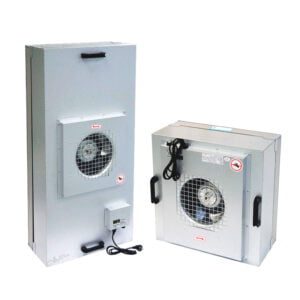
FFU footprint determines ceiling grid geometry — and if the grid is dimensioned independently, it often cannot be corrected without fabrication rework. Standard FFU sizes (2×4 ft, 2×2 ft, 4×4 ft) each imply a specific bay dimension, and the total unit count follows directly from air change rate targets and room volume. For ISO 5 spaces, typical design targets run 500–750 ACH; ISO 7 spaces commonly target 60–90 ACH; ISO 8 spaces typically fall in the 15–25 ACH range. A 2×4 ft FFU delivering approximately 480 CFM is a common planning figure for count estimation, but the unit count that results from that calculation also defines how many ceiling bays must align with the FFU module boundary — including the blank panels that fill non-FFU positions and the access panels that serve pre-filter and maintenance paths.
Plenum depth is the constraint that surfaces latest and costs the most when it is wrong. FFU modules typically require at least 13 inches for the unit itself, plus 12–24 inches of clear plenum above for service and, in many designs, for pressure management. In a negative plenum configuration — where the plenum is held negative relative to the cleanroom — the ceiling grid sealing requirements become tighter, and any panel misalignment creates a contamination bypass risk that is difficult to resolve without disturbing the grid. Projects that start with a ceiling height budget derived from architectural drawings rather than FFU mounting plus plenum service requirements frequently discover this gap during rough-in coordination rather than during design.
For projects where fewer than approximately 20 FFUs are needed, a fan-powered FFU ceiling system is generally more cost-effective than a centralized ducted supply. That threshold is a planning comparison point, not a fixed rule, but it signals that the ceiling grid decision carries budget implications that grow as FFU count increases. Locking FFU size, count, and access configuration before structural fabrication is not a scheduling preference — it is a condition for avoiding the classification testing delays that follow from ceiling rework on a commissioned timeline.
Select HEPA Or ULPA Around The Process Sensitivity
Filter class selection for a semiconductor cleanroom is primarily a process sensitivity question, but it becomes a ceiling system and operating cost question the moment ULPA enters the specification. HEPA filters (H14 under EN 1822 / ISO 29463-1:2024) achieve ≥99.97% efficiency at the most penetrating particle size near 0.3 µm. ULPA filters (U15–U17) achieve ≥99.9995% efficiency at 0.12 µm and address particle sizes that HEPA does not fully capture. For ISO 3–5 process zones — lithography, deposition, and similar critical-path semiconductor operations — that efficiency difference at sub-0.2 µm particles is what drives ULPA selection.
The pressure drop and operating cost consequences deserve more weight than they typically receive early in specification. A ULPA FFU operating at approximately 90 Pa pressure drop carries meaningfully higher fan load than a HEPA-based unit, and that load is sustained continuously across every unit in the ceiling array. Shorter filter service life compounds the replacement cost across a modular ceiling with many units. Specifying ULPA across an entire cleanroom footprint when only specific process zones require it will overload the system energy budget and accelerate replacement cycles in areas where HEPA would have been adequate.
| السمة | فلتر HEPA | فلتر ULPA |
|---|---|---|
| كفاءة الترشيح | ≥99.97% at 0.3 µm | ≥99.9995% at 0.12 µm |
| MPPS Range | ~0.3 µm | 0.1–0.2 µm |
| Required for ISO Class | ISO 5–8 | ISO 3–5 |
| انخفاض الضغط النموذجي | أقل | Higher (≈90 Pa for ULPA FFU) |
| Energy Consumption / Fan Load | أقل | Higher due to increased resistance |
| عمر المرشح | أطول | أقصر |
The practical approach is to zone filter class by process sensitivity — ULPA where the particle size and ISO classification demand it, HEPA where they do not — and to confirm that the ceiling grid and FFU motor specification can accommodate different pressure drop profiles across those zones without compromising room pressure uniformity. Mixed-class ceiling arrays are structurally straightforward but require the controls layer to account for the different resistance characteristics of each zone. That coordination should be in the specification before the RFQ, not resolved during commissioning.
For reference on how filter classification and performance testing are formally structured, ISO 29463-1:2024 covers the classification, performance testing, and marking framework that underpins both H14 and U15–U17 designations.
Coordinate FFU Controls With Pressure And Monitoring Requirements
Face velocity at the filter face is a measurable, specifiable quantity — a typical design target of 90–100 FPM is used as a planning figure for laminar flow maintenance — but what matters operationally is whether that velocity holds as filter resistance increases over the service life. A filter that is within classification at commissioning but drifts below the velocity target at month 18 creates a pressure and airflow problem that will appear first in monitoring data and second in classification testing. The control strategy the FFU uses to compensate for that resistance change determines whether the room holds classification over time or requires early intervention.
ECM motors configured for constant-flow operation adjust fan speed to maintain target airflow as filter loading increases, which is the configuration most relevant to stable room pressure. Constant-torque configuration maintains motor torque rather than flow, which is appropriate for some applications but does not compensate for the airflow drop that occurs as resistance rises. The distinction matters more than the motor type label. ECM motors also consume roughly 30–50% less energy than PSC motors and support variable-speed control via ModBus, PLC, or BMS integration — figures that represent design planning targets rather than guaranteed performance in all installations, but that carry real consequence for long-term operational cost in a ceiling with many units.
BMS integration and room pressure strategy are not independently specified items. In a negative plenum design, the FFU is part of what maintains positive room pressure relative to adjacent less-clean areas, and the pressure relationship is held by the interaction between FFU airflow, room exhaust, and plenum conditions. Specifying the motor control protocol without resolving how it connects to the building management system and the room pressure monitoring loop leaves a coordination gap that typically surfaces during commissioning rather than during design. ISO 14644-3 air velocity and volume testing provides the verification framework for assessing whether airflow targets are being met, but the specification must define what the monitoring system will do with that data — when it flags an anomaly, what threshold triggers a maintenance response, and how filter status connects to the replacement scheduling defined in the access plan.
Check Replacement Access Before Module Fabrication
The choice between room-side replaceable (RSR) and benchtop-replaceable FFU configurations is a ceiling grid design decision, not a maintenance convenience preference. RSR units allow filter changes from within the cleanroom without disturbing the ceiling; benchtop-replaceable units require removal and top-side access through the plenum. Making that choice after module fabrication means the ceiling grid has already been dimensioned and sealed for one access method, and retrofitting the other is structural rework.
| السمة | قابلة للاستبدال من جانب الغرفة (RSR) | Benchtop Replaceable |
|---|---|---|
| Filter Access Location | From within cleanroom | From plenum side (above ceiling) |
| Ceiling Disturbance | لا يوجد | Requires removal; grid must allow top access |
| Filter Area | قياسي | ~25% greater filter area |
| تعقيدات الصيانة | Simplified; no ceiling disassembly | More involved; ceiling panel removal needed |
Benchtop-replaceable configurations offer approximately 25% greater filter area, which affects pressure drop and service life, but they require the ceiling grid to accommodate panel removal and plenum access. RSR configurations simplify the maintenance sequence and eliminate the need for classified personnel to enter the plenum, but they do not provide the filter area advantage. Neither configuration is universally preferable — the correct choice depends on plenum accessibility, personnel access protocols, and whether the filter area difference materially affects the pressure drop budget for that zone.
Pre-filter replacement is the maintenance event that drives ceiling access frequency more than primary HEPA or ULPA replacement. Planning figures commonly used for semiconductor cleanrooms suggest pre-filter changes approximately six times per year to protect downstream filters and extend their service life. HEPA and ULPA filters typically run 3–5 years before reaching end of service life under normal operating conditions, though early replacement may be warranted if pressure loss limits are reached or if contamination risk is identified. Both figures are planning inputs, not service warranty terms — actual intervals depend on upstream contamination load and operating conditions. The point is that access path design must account for the high-frequency event (pre-filter) as the primary driver, with the low-frequency event (final filter) as the secondary constraint.
Discovering during installation that the access panel locations don’t align with the pre-filter maintenance path, or that the RSR mechanism requires more clearance than the ceiling grid allows, is a fabrication-stage problem with commissioning-stage consequences. The access configuration must be confirmed as part of the ceiling coordination drawing review — before fabrication, not as a punch-list item.
For a closer look at how وحدات تصفية المروحة are configured for semiconductor applications, reviewing supplier module drawings alongside ceiling coordination drawings is the most reliable way to identify clearance conflicts before they become structural constraints.
Supplier Data Needed For Final FFU Approval
An FFU RFQ that closes without a ceiling grid coordination drawing from the supplier is not complete. Supplier-quoted units, motor types, and filter classes may all be technically correct in isolation while still creating misalignments when they are integrated into the actual ceiling layout — wrong blank panel counts, missing access panel positions, or a pressure sequencing approach that does not match the room design. Those misalignments do not appear in a line-item specification review; they appear during installation, at which point the ceiling is already built.
Individual filter certification per EN 1822 at H13 and above is a minimum review check for filter class and leak-free performance before installation. EN 1822 certification confirms separation efficiency and leak performance at the unit level, but it does not substitute for project-level classification testing under ISO 29463-1:2024, which governs classification and marking of the installed system separately. Both are needed, and neither replaces the other.
| المتطلبات | ما أهمية ذلك | What to Confirm Before Approval |
|---|---|---|
| Individual filter certification per EN 1822 (H13 and above) | Proves leak-free performance and separation efficiency | Supplier provides certification for each filter |
| Complete FFU specification: filter class (H14, U15–U17), housing material, motor type, control method, seal material, pressure drop, power consumption, noise level | Ensures all parameters support ceiling grid integration, control, and energy planning | All data points listed and verified against project needs |
| Ceiling grid coordination drawing: FFU locations, blank panels, access panels, room pressure strategy | Prevents misalignment that could lead to rework and classification testing delays | Drawing reviewed with structural, electrical, and cleanroom designer before module fabrication |
The coordination drawing is where the structural, electrical, and cleanroom design teams can identify conflicts before they become rework. FFU locations, blank panel placements, access panel positions, and the room pressure strategy must be shown together in a single layout that reflects the actual ceiling configuration — not described separately in datasheets. The specification data items in the table (filter class, housing material, motor type, control method, seal material, pressure drop, power consumption, noise level) are each individually necessary, but their combined review against the ceiling grid drawing is what makes the approval defensible. If the supplier cannot produce that drawing before RFQ close, treat it as an open coordination item that needs to be resolved before fabrication commitments are made.
إن Mini Pleat HEPA/ULPA Air Filter datasheet format illustrates the level of filter-level specification data — efficiency, pressure drop, class designation — that should appear as a baseline in any FFU approval package, alongside the system-level coordination drawing.
The most defensible position at project handover is one where FFU count, filter class by zone, motor control configuration, access method, and ceiling grid geometry were all locked together before fabrication began — not reconciled against each other during commissioning. That sequencing is what keeps classification testing on schedule and prevents the maintenance access problems that compound over the first replacement cycle.
Before the RFQ closes, confirm that the supplier has provided a ceiling coordination drawing that shows FFU positions, blank panel layout, access panel locations, and pressure sequencing as an integrated layout. Verify that filter class assignments match process zone sensitivity rather than applying a single class across the entire ceiling. And confirm that motor control specification — constant-flow or constant-torque, ECM integration with BMS — is resolved as part of the pressure strategy, not specified independently of it. Those three confirmations cover the decision dependencies most likely to create rework if they are left open.
الأسئلة الشائعة
Q: What happens if the cleanroom already has a fixed ceiling height that doesn’t meet the plenum depth requirement for the specified FFU?
A: The FFU selection must be revised to fit the available plenum before fabrication proceeds, not after. If the ceiling height budget cannot accommodate at least 13 inches for the FFU module plus 12–24 inches of clear plenum above it, the options are to reduce FFU module depth by selecting a shallower unit profile, compress the plenum to the minimum serviceable clearance for the chosen access method, or raise the ceiling — each of which carries structural and cost implications. The worst outcome is discovering the conflict during rough-in coordination, at which point architectural drawings have already driven fabrication commitments the cleanroom specification cannot override without rework.
Q: If a mixed HEPA/ULPA ceiling array is specified across different process zones, what controls coordination problem does that create?
A: A mixed-class array means the ceiling system is operating with meaningfully different pressure drop profiles across zones simultaneously, and the motor control layer must compensate for both without destabilizing room pressure uniformity. A ULPA zone running at approximately 90 Pa and an adjacent HEPA zone at lower resistance will produce unequal airflow velocities unless the FFU motors are individually trimmed — or configured for constant-flow operation that adjusts fan speed per unit based on local resistance. If all units share a single control signal or are set to a common torque reference, the lower-resistance HEPA units will run at higher face velocity than intended and the ULPA units may fall short of target. This control relationship must be resolved in the specification before the RFQ, not balanced during commissioning after the ceiling grid is closed.
Q: At what point does increasing FFU count make a centralized ducted supply system worth reconsidering instead?
A: The crossover point is roughly 20 FFUs, above which the installed and operating cost comparison shifts and a centralized ducted system becomes increasingly competitive. Below that threshold, the fan-powered FFU ceiling avoids the ductwork, balancing, and central air handling infrastructure that a ducted system requires. Above it, the cumulative motor count, electrical feeds, and individual unit maintenance cycles in a fan-powered system begin to offset the flexibility advantage. The threshold is a planning comparison point rather than a fixed rule — room geometry, energy pricing, and maintenance access constraints all affect where the break-even actually falls for a specific project — but projects that begin ceiling grid design without running that comparison risk committing to a system architecture that is more expensive to operate than the alternative would have been.
Q: Once the FFU specification is finalized, what is the first coordination output that needs to exist before module fabrication can be released?
A: The supplier must produce a ceiling coordination drawing that shows FFU positions, blank panel layout, access panel locations, and room pressure sequencing as a single integrated layout — not as separate datasheets. That drawing is the document against which the structural, electrical, and cleanroom design teams can identify conflicts before they become rework. RFQ close without that drawing means fabrication will proceed against incomplete coordination, and the misalignments that result — wrong blank panel counts, access panels that don’t align with pre-filter maintenance paths, pressure sequencing that doesn’t match the room design — will surface during installation rather than during design review, at which point the ceiling is already built.
Q: Is ULPA filtration worth the higher pressure drop and replacement cost for an ISO 5 zone if the process doesn’t involve sub-0.2 µm particle sensitivity?
A: No — if the process does not require efficiency at 0.12 µm, ULPA adds sustained fan load, higher replacement cost, and shorter filter service life without delivering a classification or contamination benefit that HEPA at H14 does not already provide. ULPA selection is justified when the specific process — lithography, deposition, or similar critical-path semiconductor operations — generates or is sensitive to particles below 0.2 µm where HEPA efficiency is insufficient. For ISO 5 zones where the contamination sensitivity sits at the 0.3 µm range that HEPA captures at ≥99.97%, specifying ULPA across the zone inflates the energy budget and accelerates replacement cycles in exchange for efficiency margin the process does not require. The correct question before specifying ULPA is not whether the room classification supports it, but whether the specific process at that location actually demands sub-0.2 µm capture.