Most cleanroom expansion projects encounter their worst problems not during construction, but during qualification—when teams discover that the return air path cannot support the added FFU load, or that the only practical wall for a new pass-through is already occupied by a process line that was installed without reference to any future layout plan. The retrofit cost at that stage is rarely just a construction bill; it includes requalification delays, production interruptions, and in regulated environments, the risk of a deviation that requires documented justification before restart. The decision that separates recoverable expansions from expensive ones is made at the time of the original design: whether the room was built with defined breakpoints or simply with empty floor area. What follows is a set of planning criteria that will help engineering, QA, and procurement teams distinguish between those two conditions before a build is approved and before a supplier is selected.
Expansion Breakpoints in Walls Ceiling and Controls
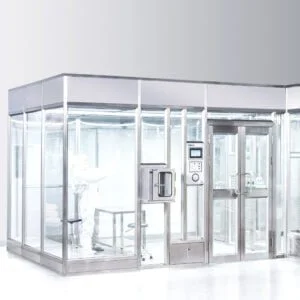
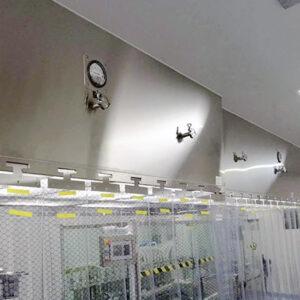
A modular cleanroom that can expand without demolition is not the same as one that will. The difference lies in whether the original design explicitly identifies and protects the structural, mechanical, and control interfaces that a future phase will need to connect to. In well-planned modular systems, wall panels can be removed and replaced with new sections, ceiling grids can accept additional interlocking components, and utility stubs are pre-positioned at the expansion boundary. Where those reservations are absent, even a modular enclosure can require partial disassembly to accommodate growth—particularly at the ceiling grid, where adding structural support after the fact often means disturbing the filtration and lighting layout that qualification testing was performed against.
The control system is the least visible and most frequently neglected breakpoint. A building management or cleanroom monitoring system with no reserved I/O capacity, no spare communication channels, and no defined architecture for adding sensor loops will not fail visibly during Phase 1 operation. It will fail at the moment Phase 2 requires integration, at which point the choice is between a full controls replacement and a parallel workaround that makes unified monitoring harder to validate and harder to defend during an inspection. Specifying expandable I/O capacity and reserved communication slots during the original procurement is a straightforward requirement; recovering from the absence of that specification after installation is not.
Each area of the room has a specific type of breakpoint risk, and the consequences of missing any one of them scale differently depending on how far into construction the project has advanced.
| System Area | Expansion Feature to Reserve | Risk if Not Defined |
|---|---|---|
| الجدران | Removable panels or designated knock-out sections | Later expansion may require demolition, increasing cost and downtime |
| Ceiling Grid | Interlocking grid tie-in points and spare structural supports | Adding ceiling components becomes complex and may need partial disassembly |
| المرافق | Pre-installed stubs or spare capacity for power, data, and piping | Retrofitting utilities after the build can be expensive and disruptive |
| عناصر التحكم | Modular control system with expandable I/O and reserved communication slots | Control system may need full replacement or major reprogramming to accommodate growth |
ISO 14644-4:2022 frames cleanroom design as a process that should account for intended use across the facility’s operational life, which includes anticipated changes in layout and classification scope. That framing supports treating expansion breakpoints as a first-design requirement, not a retrofit option.
FFU Return Air and Monitoring Capacity for Growth
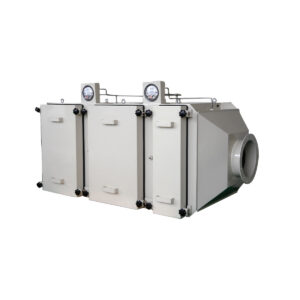
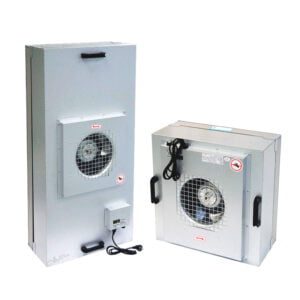
Reserving floor area for an expansion zone without sizing the FFU grid and return air infrastructure to serve that zone produces a room that looks expandable but cannot support the airflow specifications of the additional classification area without significant rework. The fan filter unit count required for a given cleanliness class depends on ceiling coverage, air change rate, and room geometry—none of which scale linearly from Phase 1 to Phase 2 unless the return air path, plenum capacity, and recirculation infrastructure were designed with Phase 2 dimensions in mind.
The practical planning criterion is to confirm, at the time of original design, what cleanliness class the expansion zone will need to achieve, and whether the return air path serving the current room can be extended or independently served without creating a pressure cascade conflict between the two zones. In some configurations, a shared return plenum can accommodate expansion by adding FFUs at the new ceiling sections; in others, the return path geometry means that each phase requires its own recirculation loop. Neither outcome is inherently wrong, but discovering the answer after Phase 1 is built makes the second condition significantly more expensive to resolve. The غرف التنظيف المعيارية systems designed for phased deployment should document which return air architecture is assumed in the Phase 1 build.
Monitoring infrastructure follows the same logic. ISO 14644-2:2015 defines the sampling point requirements for ongoing classification monitoring, and those requirements change when the classified area changes. A monitoring system installed for Phase 1 needs reserved sensor loops, cable routes, and software architecture that can incorporate Phase 2 sample points without replacing the data acquisition layer. Practitioners who have managed expansion projects often recommend identifying spare monitoring capacity as a line-item requirement in the original URS, specifically because it is invisible to the budget until it is absent. What that spare capacity looks like in practice—number of reserved channels, physical conduit routes, software licensing headroom—is a project-specific calculation, not an industry-wide fixed percentage.
Reserved Routes for Doors Pass Boxes and Materials
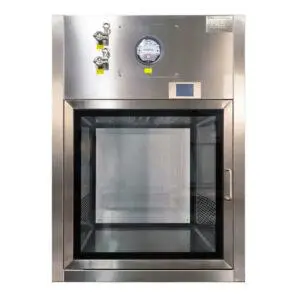
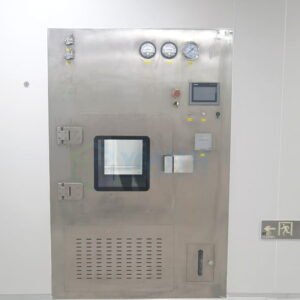
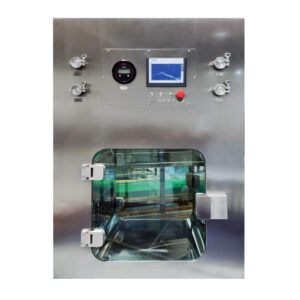
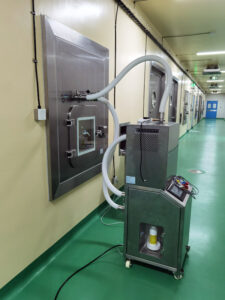
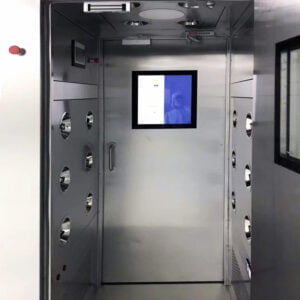
Material flow through an expanded cleanroom does not automatically resolve itself once walls are moved. The routes that people and materials will use—airlocks, interlocking doors, pass-through boxes—require dedicated wall sections that can be opened at a future phase without disrupting equipment, utilities, or structural members that were installed in the interim. When those routes are not identified and protected in the original layout, the sequence of equipment placement during Phase 1 operation tends to fill them, not through carelessness but through the ordinary logic of optimizing current workflow.
The failure pattern is consistent: a team identifies the intended Phase 2 connection point on a drawing, but does not formally restrict equipment placement near that zone during Phase 1 fit-out. Over eighteen months of operation, a process line migrates to the most efficient location, which happens to be adjacent to the only structurally feasible wall for the future pass-through. By the time Phase 2 is funded, relocating that equipment carries a production impact that the expansion budget did not anticipate, and the alternative—placing the pass-through in a suboptimal position—creates a material flow path that conflicts with the room’s pressure cascade or contamination control logic.
Reserving a route means more than marking it on a floor plan. It means specifying, in the facility’s layout control documentation, that no permanent equipment or utility connection will be installed within a defined clearance zone around each future opening. That restriction should be reviewed at each stage of Phase 1 fit-out and confirmed in the handover package that procurement or engineering teams use to brief operational staff. For projects where the pass-box position intersects with a controlled pressure boundary, the reserved zone should also account for the airlock depth or interlocking door sequence that the future configuration will require.
Equipment Placement That Protects Future Openings
Current production efficiency and future reconfigurability are not automatically compatible goals. Equipment is typically positioned to minimize operator travel, reduce cross-contamination risk, and make maintenance access practical—all of which are legitimate criteria. The conflict emerges when the optimal position for a large process unit in Phase 1 is immediately adjacent to a wall section that Phase 2 will need to remove, or when utility connections for that unit are routed through the only available path for a future structural tie-in.
The relevant trade-off is not between good and bad placement, but between placement optimized for current operations and placement that accounts for the cost and complexity of future relocation. In most cases, the difference in current-phase efficiency is modest—a meter of additional travel distance, a slightly less intuitive workflow sequence. The difference in reconfiguration cost can be substantial if the equipment in question requires reconnection of process piping, ductwork, or validated instrumentation, each of which triggers a change control record and potentially a partial requalification.
A practical approach is to identify, during the Phase 1 layout review, which pieces of equipment are most difficult to relocate—by mass, utility dependency, or qualification status—and apply a placement constraint that keeps them clear of documented future openings. This is a layout trade-off that engineering teams can evaluate explicitly, rather than a rule that applies uniformly to every room configuration. For hardwall modular cleanroom builds where wall panels are structural and the ceiling grid carries significant load, the constraint zone around future openings may also need to account for temporary shoring requirements during panel replacement.
Requalification Scope After Each Expansion Phase
Expansion is a change event, and in a regulated cleanroom environment, change events have defined qualification consequences. The scope of requalification after a physical expansion is not a negotiation between the operator and the contractor—it is determined by the extent of the physical change, the classification of the affected zones, and the testing framework that governs the facility’s ongoing compliance posture.
ISO 14644-2:2015 defines the monitoring and verification requirements that apply to classified environments, and those requirements extend to areas that are newly added or modified. At minimum, particle counting and airflow uniformity tests must be repeated in any zone affected by the expansion, including areas adjacent to the new boundary where pressure relationships or air distribution patterns may have changed. Practical guidance from cleanroom engineering practitioners also typically includes filter integrity testing at new HEPA installations, pressure differential verification across all affected boundaries, and a review of monitoring sample point adequacy against the revised room geometry. These steps are verification requirements, not optional reviews, though the specific test sequence should be defined in the facility’s validation master plan rather than adopted verbatim from any single external source.
The procurement-stage implication is that requalification scope should be documented in advance for each planned phase, not determined after the phase is built. When the Phase 2 requalification scope is defined at the time Phase 1 is approved, the cost and timeline are predictable, the production continuity risk can be managed, and the qualification documentation package has a clear structure. When requalification scope is left undefined and resolved after construction, it frequently becomes a dispute over what changed, what was tested previously, and what the regulatory expectation actually requires. For project teams working under IQ/OQ/PQ frameworks, the expansion phase should be treated as a defined change control event with its own qualification plan, linked explicitly to the breakpoints and tie-in points documented in the original design package.
Pricing Real Expansion Instead of Generic Flexibility
A supplier who describes a modular cleanroom as “expandable” has made a statement about material properties. A supplier who provides a fixed price and lead time for Phase 2 based on a defined square footage and documented breakpoint set has made a contractual commitment. The distance between those two positions is where most expansion budget problems originate.
Generic flexibility is not without value—modular construction does make reconfiguration materially easier than a poured concrete or stick-built equivalent, and that advantage is real in lifecycle terms. The problem is that flexibility without a defined expansion plan cannot be priced, cannot be scheduled, and cannot be incorporated into a capital budget with any reliability. When Phase 2 funding is approved and the team returns to the supplier for a quote, the absence of a documented phase plan means starting from a new engineering exercise, with new lead times, new pricing conditions, and potentially a different interpretation of what “expandable” meant at the time of Phase 1 procurement.
Planned expansion, by contrast, means that the Phase 1 design package includes the breakpoint locations, tie-in specifications, and utility stub positions that Phase 2 will use. It means the Phase 2 footprint is defined, even if the build date is not. And it means the supplier can provide a cost basis for Phase 2 that is grounded in known quantities rather than speculative estimates. One documented case in the modular cleanroom sector involved a manufacturer that planned two equal expansion phases at the outset; the supplier provided a fixed price and lead time for the first phase with the second already engineered. That approach is not universally available, but it illustrates what becomes possible when expansion is treated as a design input rather than a future option.
The distinction between planned and generic has documentation consequences beyond pricing.
| أسبكت | Planned Expansion | Generic Flexibility |
|---|---|---|
| Pricing Approach | Fixed price for the initial phase; future phases priced predictably based on defined square footage | Vague promise of expandability; future pricing uncertain and likely requires new quotes |
| المهلة الزمنية | Established lead time per phase (e.g., 8 months for a 6,000 sq ft phase) | No timeline guarantees; schedules may shift after re-evaluation |
| التوثيق | Engineering plans include expansion breakpoints, tie-in points, and phased layout | No documented expansion plan; intent may be verbal or aspirational |
| قابلية إعادة التشكيل | Reconfiguration is already accounted for in the design of breakpoints and utilities | Modular system remains reconfigurable, but each change may require unforeseen engineering |
Modular systems do support scale-out strategies—adding capacity in increments aligned with actual demand rather than building to peak capacity from the start. The وحدة تصفية المروحة grid is one of the components that enables incremental scaling when the ceiling architecture supports it. But realizing that advantage requires that the scale-out sequence be defined early enough that each phase builds on documented infrastructure, not on assumptions about what the previous phase left available.
The clearest sign that an expansion plan is real rather than aspirational is that it can be documented: breakpoint locations in the structural drawings, utility stub positions in the MEP package, reserved monitoring channels in the controls specification, and a qualification scope defined for each phase before the first phase is built. If any of those elements exist only as verbal commitments or general intent, the expansion plan cannot be priced, cannot be scheduled, and cannot support a change control process that regulators or internal QA teams will accept without challenge.
Before approving a Phase 1 build that includes expansion intent, procurement and engineering teams should confirm that the design package explicitly addresses each future phase as an engineering deliverable, not as a commercial option. That confirmation is the point at which a supplier’s claim of modularity either becomes a documented capability or remains a marketing position.
الأسئلة الشائعة
Q: What if our modular cleanroom was already built without expansion breakpoints—can we still expand?
A: You can, but the cost and disruption escalate sharply. Without pre-planned wall breaks, spare FFU capacity, or reserved I/O channels, any addition will require partial demolition, controls rework, and a full requalification scope similar to a new build—often consuming the budget that planned expansion would have saved. The most cost-effective path is to treat the project as a retrofit, not an extension, and to define the breakpoints that don’t exist before construction begins.
Q: What is the first document we should produce to make expansion planning concrete, not aspirational?
A: A phase-specific User Requirement Specification (URS) that defines the Phase 2 footprint, cleanliness class, utility tie-in points, and monitoring capacity, linked directly to the Phase 1 design deliverables. This document turns expansion from a marketing label into an engineering input, giving procurement and validation teams a verifiable basis for supplier commitments, cost estimates, and qualification scopes long before Phase 2 is funded.
Q: At what point does expanding a modular cleanroom become impractical compared to building a separate, standalone unit?
A: When the existing building’s central utilities—chilled water, make-up air, electrical supply, or structural floor loading—cannot support the expanded load without a major infrastructure upgrade. At that threshold, adding a physically separate cleanroom with its own dedicated utilities often becomes cheaper and less disruptive than forcing a larger expansion that strains site-level systems the original design never anticipated.
Q: How much more does it cost to plan a modular cleanroom for expansion compared to a generic one without defined phases?
A: The upfront engineering premium is typically modest—extra design hours for breakpoint documentation, reserved I/O, and a Phase 2 concept layout—often a low single-digit percentage of the Phase 1 build cost. The real financial difference emerges at Phase 2: planned expansions avoid six-figure rework, requalification delays, and production downtime that generic “expandability” cannot prevent because no tie-in specifications were locked in.
Q: Is it worth paying for expansion planning if Phase 2 might never happen?
A: For most regulated environments, yes—because the breakpoints that enable expansion (reserved wall sections, spare monitoring channels, documented utility stubs) also simplify routine reconfiguration, maintenance access, and partial requalification tasks, whether or not a full Phase 2 is ever executed. The only clear case to skip expansion planning is when the facility lease, product lifecycle, or certification scope has a defined endpoint shorter than the time it would take to fund, build, and qualify a second phase.