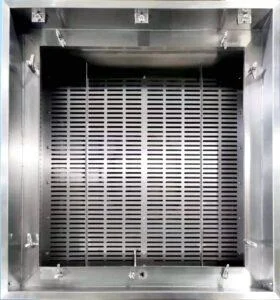
Specifying a transfer device before defining what moves through it is one of the most consistent sources of qualification delay in aseptic facility projects. Teams commit to a static or basic dynamic pass box at the concept stage, then discover during commissioning that the items in question require documented decontamination evidence — a gap that surfaces as audit nonconformance and blocked material flow rather than a simple equipment swap. Resolving it at that stage means re-procurement, extended cycle development, and in some cases re-layout of the transfer zone. The decision that prevents this is not a device comparison; it is a pre-procurement characterisation of item type, transfer direction, contamination status, and the evidence standard required to release the material on the receiving side.
Transfer Equipment Starts With Item Risk
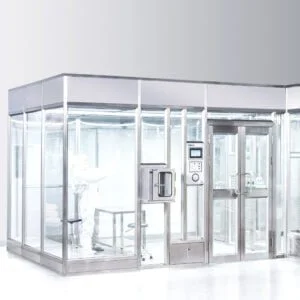
EU GMP Annex 1 identifies the transfer of equipment and materials into and out of cleanrooms and critical zones as one of the greatest potential sources of contamination. That framing matters because it positions transfer as a contamination event to be controlled, not a logistics step to be accommodated. The device selected is only one element of that control; the risk is defined by what is moving, where it is going, and what state it is in when it arrives.
The practical implication is that device selection cannot precede item characterisation. Before any equipment is specified, each item in scope should be categorised: is it clean, sterile, decontaminated, a liquid, a waste stream, a sample, or a piece of equipment? That categorisation determines whether the transfer device needs to provide contamination exclusion only, active decontamination, or a validated sterility-maintaining interface. Conflating these categories — or leaving them undefined — means the device may be technically incapable of meeting the evidence standard required for the receiving grade.
Items that cannot be sterilised — lubricant containers, certain electronic instruments, calibration tools — require a different planning response altogether. For these items, a validated disinfection process must be in place before each entry. Where feasible, keeping such equipment permanently within the aseptic processing area reduces the cumulative transfer risk and removes the need to run a validated disinfection cycle each time. This is a planning criterion for item categorisation and pre-procurement workload analysis, not a feature of any transfer device.
Static, Dynamic, VHP And SLTP Roles
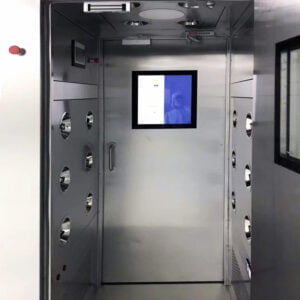
The regulatory position on static pass-through chambers is unambiguous under EU GMP Annex 1: static chambers with no air supply are no longer permitted for pharmaceutical aseptic processing. This is a compliance threshold, not an engineering preference, and it removes a category of equipment from consideration for Grade A and Grade B transfers without further analysis.
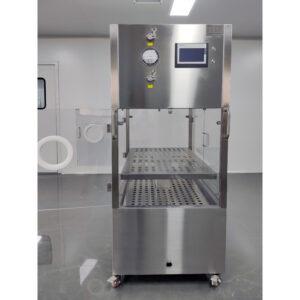
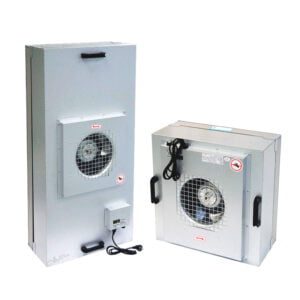
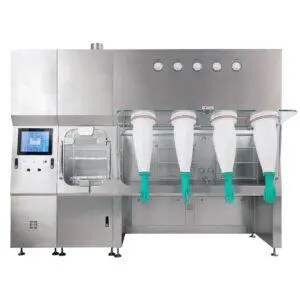
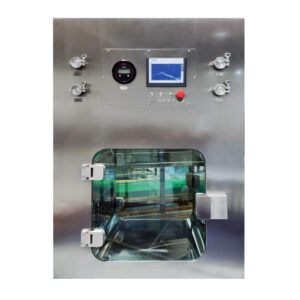
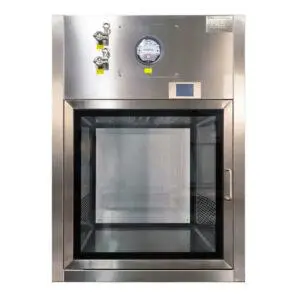
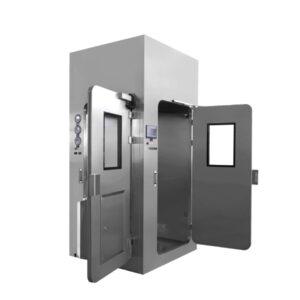
What replaces the static pass box depends on what the item requires and which grade it is entering. Annex 1 describes a practical hierarchy for transferring items into Grade A areas: sterilisation through autoclaves or depyrogenation tunnels takes precedence where the item can tolerate it; automated decontamination chambers — including VHP chambers — are the preferred route for items that need decontamination evidence; dynamic pass-through hatches with HEPA-filtered air supply represent a lower-priority option where decontamination is not required; and rapid transfer port technology should also be considered for Grade A interfaces, particularly where the transfer zone connects to an isolator or restricted access barrier. This hierarchy is drawn from Annex 1 guidance and should be treated as a practical planning framework rather than a ranked compliance requirement with discrete pass/fail conditions.
ISO 14644-4:2022 provides design criteria relevant to HEPA-filtered air supply in separative devices, which supports the design basis for dynamic pass boxes. It functions as a supporting reference for design teams, but the regulatory obligation in pharmaceutical aseptic processing flows from Annex 1.
| Gerätetyp | EU Annex 1 Status | Air/Decontamination Control | Grade A Transfer Role (Hierarchy) |
|---|---|---|---|
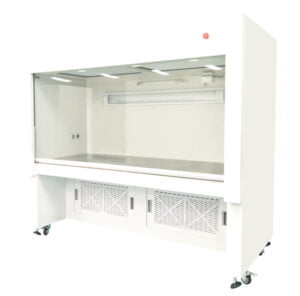
| Statische Pass Box | Not permitted (no air supply) | None (passive transfer) | Not acceptable for aseptic processing |
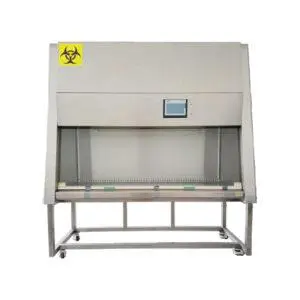
| Dynamische Passbox | Permitted (HEPA-filtered air supply) | HEPA-filtered air; no active decontamination | Lower-priority option for Grade A, after automated decontamination chambers |
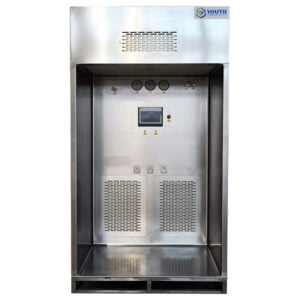
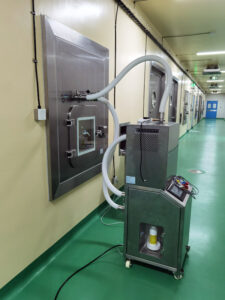
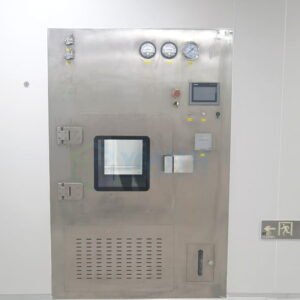
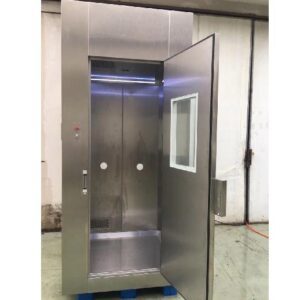
| VHP Pass Box (Automated Decontamination Chamber) | Permitted; validated decontamination cycle required | VHP decontamination with parameter control and validation | Preferred method for decontaminated items before Grade A, per hierarchy |
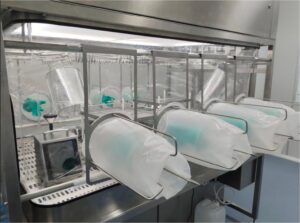
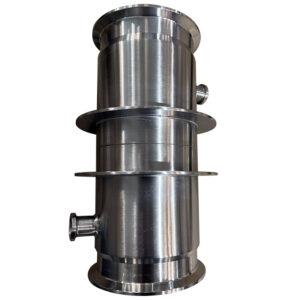
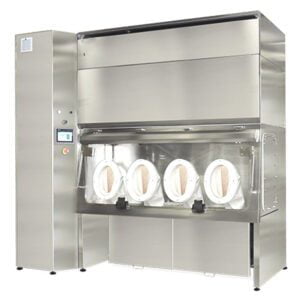
| Sterile Transfer Port (Rapid Transfer Port) | Considered for enhanced control | Rapid transfer interface, often used with isolators | Recommended consideration for Grade A transfers; reduces manual handling |
The hierarchy is relevant not just for device selection but for how transfer routes are documented in the URS and for how qualification scope is bounded. A facility that installs dynamic pass boxes for items that should have gone through an automated decontamination chamber has not made an engineering error — it has created a gap between the evidence available and the evidence required to release material into Grade A, which is an audit defensibility problem.
Decontamination Evidence Changes The Device Choice
Manual spray-and-wipe disinfection is not equivalent to validated automated decontamination. The distinction is not procedural preference; it is the difference between a defined and auditable evidence standard and an undefined one. For hydrogen peroxide vapour decontamination, the evidence standard is a six-log reduction demonstrated using Geobacillus stearothermophilus biological indicators. That threshold requires an automated VHP chamber with controlled parameters — temperature, humidity, biocide concentration, and contact time — because manual application cannot deliver the consistency and parameter traceability needed to produce repeatable, defensible results.
The consequence is that if an item entering Grade B or Grade A requires documented sporicidal decontamination evidence, a dynamic pass box without an active decontamination cycle does not satisfy that requirement. Selecting a dynamic pass box for that application is not a cost-saving decision; it is a classification error that will be challenged at inspection.
Process qualification for a VHP decontamination chamber requires at least three simulations of worst-case load transfers, combined with surface environmental monitoring. This is a procurement and project-planning criterion: the qualification scope must be defined before the acceptance test programme is written, and the worst-case load must be identified before qualification can begin. Teams that defer this to post-installation qualification discover that cycle development and worst-case load testing extend timelines beyond what the project schedule anticipated.
| Decontamination Aspect | Manual Spray-and-Wipe | Automated VHP Chamber |
|---|---|---|
| Decontamination Level | Limited microbial inactivation (undefined log reduction) | Six-log reduction demonstrated with Geobacillus stearothermophilus biological indicators |
| Evidence of Efficacy | Subjective; no standardized biological indicators | Quantitative BI results; validated cycle data |
| Process Qualification | Typically no worst-case simulations | At least three worst-case load transfer simulations with surface environmental monitoring |
| Parameter Steuerung | Manual application; no automated control of contact time, temperature, humidity | Automated control of temperature, humidity, biocide concentration, and contact time |
| Prüfpfad | Typischerweise abwesend | Validated cycle records support regulatory inspections |
Without automated parameter control and a validated cycle record, the audit trail needed to support regulatory inspection is absent. Manual methods may be defensible for lower-grade transfers where the evidence standard is less demanding, but for automated VHP chambers serving Grade A or Grade B transfers, the validated cycle record is not supplementary documentation — it is the primary evidence of decontamination efficacy. For more on how this qualification process should be structured, Youth Filter’s pass box qualification guide covers the procedural sequence in practical terms.
Load Definition As The Main Procurement Bottleneck
Chamber dimensions, interlock logic, and the validated decontamination cycle all depend on what is actually placed inside the chamber. This is the point where most VHP pass box procurements encounter their most significant friction, and it consistently arrives later than it should.
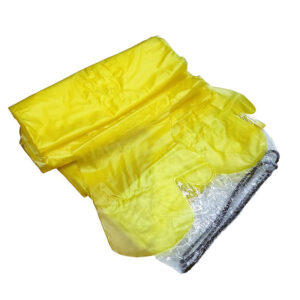
For VHP decontamination, items must be hung so that vapour can circulate around each item. Items must also be multi-wrapped because VHP only decontaminates outer surfaces — the vapour does not penetrate packaging layers. This means cycle validation must be performed against a defined, standardised load configuration, including the densest and most complex arrangement that will be used in routine operation. If load types are not standardised before procurement, cycle validation cannot be completed consistently. If worst-case loads are not identified before the qualification programme is written, simulations may later be challenged as insufficiently conservative.
The procurement failure pattern is deferring load definition until after equipment is ordered or installed. At that stage, if actual item dimensions exceed the usable internal volume, or if the worst-case load configuration does not allow adequate vapour circulation, the options are costly: re-procure a larger chamber, re-validate with a revised load, or restrict which items can transfer through that route. All three outcomes delay the opening of the material flow path and may require additional deviation documentation.
| Load Factor | Anforderung | Risiko bei Unklarheit |
|---|---|---|
| Item Geometry and Hanging | Items must be hung to allow vapour circulation around each item | Poor circulation leads to decontamination failure |
| Verpackung | Items must be multi-wrapped because vapour only decontaminates outer surfaces | Single-wrapped items may have decontamination gaps between wraps |
| Konfiguration laden | Define worst-case load for qualification (densest, most complex arrangement) | Inadequate worst-case simulation can invalidate validation |
| Load Standardisation | Standardise load types to allow repeatable cycle validation | Without standardisation, cycles cannot be validated consistently |
| Cycle Validation Scope | Perform cycle validation for all required load types before procurement | Unvalidated loads lead to blocked material flow and audit nonconformance |
Load characterisation should be treated as a pre-procurement deliverable, not a post-installation qualification task. That means identifying every item type expected to pass through the chamber, confirming its dimensions and packaging configuration, determining whether it can be hung, and defining which combination of items represents the worst-case load for validation purposes. Chamber sizing, racking design, and cycle parameters cannot be responsibly specified without that information.
A VHP-Pass-Box sized and configured around actual item data at the URS stage eliminates the most common source of cycle development delay.
Selection Requires Direction, Item Status And Evidence
Transfer direction is not a background detail — it specifies the disinfectant class, the wrapping configuration, and the evidence standard required at each boundary. The treatment required for a material moving from Grade C to Grade B differs from what is required to move the same material from Grade B to Grade A, and the transfer device must be capable of accommodating both the item and the evidence requirement at the target grade.
For Grade C to Grade B transfers, a sporicidal disinfectant is required. Items should be multi-wrapped, with the outer layer removed at the point of entry into Grade B. For items entering Grade A, sterility is required — typically achieved by radiation or ethylene oxide sterilisation — and the outer surfaces must be decontaminated in a validated chamber before the final layer is removed in Grade A. These are process specifications that define what the transfer device must accommodate; they are not features intrinsic to the device.
Before any device is specified, a list of approved items for each transfer route should be established. This list should cover everything from primary packaging to tools and cables, and for each item, the transfer route and evidence requirement should be documented. Unapproved items should not pass through without a formal deviation that includes a specific sanitisation and monitoring regime defined by QA and microbiology. Treating this as a pre-procurement screening step — rather than a post-installation gap to close — ensures that the device selected is capable of handling every item on the approved list under the required evidence conditions.
| Transfer Direction | Required Treatment of Items | Wrapping Layers | Device Evidence Requirement |
|---|---|---|---|
| Grade C to Grade B | Sporicidal disinfectant application | Multi-wrapped; outer layer removed at entry | Validated disinfection procedure |
| Grade B to Grade A | Items must be sterile (typically radiation or EtO sterilisation); outer surfaces decontaminated in validated chamber | Multi-wrapped with layer removal at each stage; final layer removed in Grade A | Validated decontamination chamber cycle plus sterility certification |
| Unapproved Items Entering Grade A/B | Deviation required; specific sanitisation and monitoring regime defined by QA and microbiology | Determined per deviation | Case-by-case validation evidence |
The failure risk in this step is partial mapping: defining the approved list for the most common items but leaving edge cases — tools, cables, electronic instruments — uncharacterised until they are needed. When an unapproved item is encountered without a defined deviation protocol, the material flow stalls while QA and microbiology determine the sanitisation regime. If the transfer device was not selected with those item types in mind, the deviation may require a different decontamination method than the installed equipment supports. That gap is difficult to defend at inspection and expensive to resolve under operating conditions. A Anschluss für sterile Flüssigkeiten addresses a specific subset of this — liquids and fluid lines that cannot pass through a standard pass box without compromising container integrity — and should appear on the approved-item list review before the transfer route for liquid transfers is finalised.
The most reliable way to avoid transfer equipment rework is to sequence the decisions correctly: item characterisation before device selection, load definition before chamber sizing, transfer direction mapping before the evidence standard is set. Each of these steps is genuinely upstream of the device specification, and compressing or skipping them does not eliminate the work — it relocates it to the qualification phase, where it is harder and more expensive to resolve.
Before procurement is finalised, confirm that every item on the approved transfer list has been mapped to a device capable of meeting its evidence requirement, that worst-case load configurations have been defined and documented, and that the decontamination cycle to be validated matches the item geometry and packaging of the actual loads. If any of those three inputs is still open, the device selection is premature.
Häufig gestellte Fragen
Q: Our facility operates under non-EU regulations that do not mandate Annex 1. Do these selection criteria still apply?
A: Yes, the core principle of matching transfer equipment to item risk, decontamination evidence, and load characteristics remains valid outside EU jurisdiction. While Annex 1 provides the strictest reference, the hierarchy of transfer methods and the need for validated decontamination evidence are grounded in contamination control logic that also appears in ISO 14644-7. Even if your local code permits static pass boxes for sterile product transfer, you should evaluate whether the absence of active air filtration and documented decontamination will hold up under customer or partner audit.
Q: What is the first document I should create to kick off cleanroom transfer equipment procurement?
A: Create a transfer-route item matrix listing every material, tool, or equipment type, its contamination status on entry, the destination cleanroom grade, required decontamination method, and evidence standard. This document forces the cross-functional decisions — involving QA, microbiology, and operations — that must happen before chamber size, interlock logic, or cycle parameters can be specified. Without it, procurement conversations will float on assumed loads that collapse during qualification.
Q: At what point does a dynamic pass box with manual disinfection become an audit liability?
A: As soon as the receiving grade requires documented sporicidal decontamination evidence. Manual spray-and-wipe cannot produce a repeatable, parameter-controlled cycle record. If your quality system or the applicable regulation expects a six-log reduction or a validated cycle printout for material release into Grade B or A, a dynamic pass box without an automated decontamination cycle is insufficient. For Grade C to D transfers, or non-sterile applications, manual disinfection through a dynamic hatch may be defensible, but the threshold is the evidence standard, not merely the grade number.
Q: How do I balance the higher validation burden of a VHP pass box against the compliance risk of a simpler dynamic unit?
A: The balance shifts decisively toward VHP when the consequence of a failed inspection or blocked material flow outweighs the upfront cycle development effort. A dynamic pass box with manual disinfection carries recurring risk of human error and undocumented variability. A VHP chamber frontloads the validation work — worst-case load testing, BI studies, cycle development — into a defined project phase, after which routine operation produces a consistent, auditable record. If the transfer route is critical to production throughput, the validation burden is a one-time cost against an ongoing operational risk.
Q: When does it make financial sense to purchase a dedicated sterile liquid transfer port instead of using a VHP pass box with bagged fluids?
A: A sterile liquid transfer port becomes the more cost-effective choice when you transfer liquids frequently enough that the recurring consumables, manual handling, and cycle time of bag-in-chamber decontamination exceed the port’s higher initial capital. If your process requires multiple sterile fluid transfers per shift or involves bulk containers impractical to hang and multi-wrap for VHP, a purpose-built port — such as Youth Filter’s sterile liquid transfer port — reduces per-transfer operating cost and human intervention, often justifying the investment within the first year of operation. For infrequent transfers, a VHP chamber with validated fluid bag loads may remain the lower total cost.