La descontaminación del personal en entornos de alto riesgo se enfrenta a un reto persistente: lograr la eliminación completa de contaminantes de la piel y los EPI. Las duchas tradicionales se basan en el flujo de agua en línea recta, por lo que a menudo los contaminantes no se eliminan en las sombras, pliegues y partes inferiores. Esta laguna deja al personal vulnerable y las operaciones expuestas a riesgos de contaminación cruzada.
La ducha de nebulización electrostática representa un cambio tecnológico dirigido. Al aplicar la física fundamental a un proceso de seguridad crítico, va más allá del enjuague pasivo hacia la encapsulación activa de partículas. Comprender sus principios operativos, limitaciones y requisitos de aplicación es esencial para los responsables de seguridad y los ingenieros de instalaciones que evalúan los protocolos de descontaminación de próxima generación.
El principio básico: la atracción electrostática explicada
Definición del mecanismo electrostático
La eficacia del sistema no reside únicamente en la niebla, sino en la carga deliberada que se le aplica. Muchas partículas peligrosas, como el polvo tóxico y las esporas biológicas, tienen una carga superficial natural o inducida. El proceso de encapsulación aprovecha esta circunstancia generando una fina niebla en la que cada gota recibe una carga eléctrica positiva a través de un electrodo de alta tensión y baja corriente. Esto crea una atracción potente y selectiva hacia los contaminantes conectados a tierra o cargados negativamente.
Aplicación a la descontaminación del personal
Esta interacción electrostática forzada es el factor crítico. La niebla cargada envuelve activamente las superficies, buscando contaminantes en la piel y en la parte inferior de los EPI y en las grietas. Los expertos del sector recomiendan este enfoque para las partículas con las que los métodos tradicionales tienen dificultades, ya que garantiza que la solución de descontaminación entre en contacto directo con el contaminante en lugar de depender de la gravedad y el azar.
Impacto en la eficacia de la descontaminación
El efecto “envolvente” cambia radicalmente los parámetros de cobertura. Comparamos la aplicación tradicional y la electrostática y descubrimos que esta última elimina las zonas de sombra habituales detrás del equipo, debajo de los brazos y en la espalda. Esta focalización activa es la razón fundamental de los índices superiores de descontaminación de primer paso de la tecnología, un detalle que se pasa por alto fácilmente cuando se centra la atención únicamente en la eficacia química.
Componentes clave del sistema y fases operativas
La plataforma multietapa
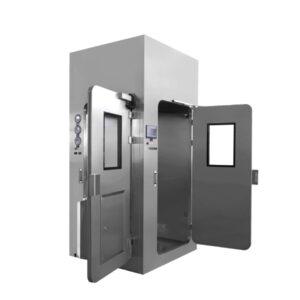
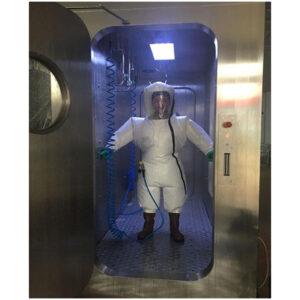
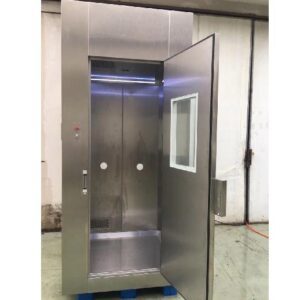
La descontaminación eficaz es un proceso, no un acto aislado. Un sistema conforme integra varias etapas. Suele comenzar con un prelavado para eliminar la contaminación grave. El núcleo es la cámara de aplicación electrostática, un recinto con múltiples boquillas que envuelven al personal en la niebla de descontaminación cargada durante un tiempo de permanencia controlado.
Integración e interoperabilidad
Este enfoque por etapas pone de relieve una implicación estratégica clave. Las organizaciones deben adquirir y mantener sistemas interoperables, no unidades independientes. La integración de estaciones lavaojos, duchas de emergencia conformes con ANSI/ASSE Z358.1-2014, y la propia tecnología de encapsulación no son negociables para un protocolo de respuesta integral. Si no se planifica esta integración, se crean silos operativos y lagunas de seguridad.
Parámetros técnicos: Tamaño de gota, tensión y solución
Ingeniería de la niebla
El rendimiento del sistema depende de parámetros técnicos precisos. El tamaño de las gotas de niebla se diseña para equilibrar la adherencia a la superficie y la seguridad del personal. Si las gotas son demasiado pequeñas, suponen un riesgo de inhalación; si son demasiado grandes, pierden su capacidad envolvente. La carga electrostática se genera a altos voltajes pero a un amperaje extremadamente bajo y seguro para garantizar la seguridad eléctrica intrínseca.
El papel fundamental de la química de soluciones
La formulación de la solución descontaminante es una limitación común. El agua pura no puede mantener una carga suficiente, por lo que las soluciones requieren electrolitos añadidos para una conductividad adecuada. Además, la estabilidad de la formulación dicta la logística operativa. Algunas soluciones mixtas tienen una vida útil limitada, lo que crea una dependencia crítica entre la programación del tratamiento y la gestión del inventario para evitar costosas pérdidas de eficacia.
Validación del rendimiento del sistema
En la tabla siguiente se describen los parámetros técnicos clave que definen el funcionamiento del sistema y sus implicaciones prácticas. Es fundamental validar el tamaño de gota de niebla diseñado, para lo que a menudo se utilizan métodos como los de ISO 21501-4:2018.
| Parámetro | Gama típica / Especificación | Implicaciones clave |
|---|---|---|
| Tamaño de gota | 50 a 150 micras | Equilibrio entre cobertura y seguridad |
| Tensión electrostática | Decenas de miles de voltios | Crea una fuerte fuerza de atracción |
| Conductividad de la solución | Requiere electrolitos añadidos | El agua pura es ineficaz |
| Vida útil de la solución | Puede ser limitado | Impacto en la gestión del inventario |
Fuente: ISO 21501-4:2018. Esta norma proporciona el método para determinar la distribución del tamaño de las partículas, que es fundamental para validar el tamaño de las gotas de niebla (50-150 micras) generadas por el sistema de encapsulación.
Ventajas sobre las duchas de descontaminación tradicionales
Aumento de la eficacia y la eficiencia
Esta tecnología ofrece claras ventajas operativas. El efecto electrostático elimina las sombras y las zonas que no se ven, habituales en las duchas convencionales. Esta atracción forzada también mejora la eficacia de los productos químicos y puede reducir el volumen total de la solución al minimizar el exceso de pulverización y la escorrentía. El proceso suele acortar el tiempo total de descontaminación gracias a una aplicación de primera pasada más eficaz.
Perspectiva estratégica de costes
Un análisis completo del ciclo de vida suele favorecer este tipo de medidas preventivas. El gasto de capital de un sistema avanzado debe sopesarse frente al elevado coste de una reparación a gran escala, las multas reglamentarias o la respuesta a una crisis. Esto sitúa a la tecnología como un seguro operativo para entornos en los que la contaminación acarrea graves consecuencias.
Métricas comparativas de rendimiento
La siguiente tabla cuantifica las diferencias de rendimiento entre las duchas electrostáticas nebulizadas y los sistemas tradicionales, proporcionando un marco claro para la evaluación.
| Métrica | Ducha nebulizada electrostática | Ducha tradicional |
|---|---|---|
| Eficacia de la cobertura | Efecto envolvente superior | Aplicación con visibilidad directa |
| Volumen de solución Uso | Exceso de pulverización minimizado | Mayor consumo |
| Tiempo de descontaminación | Menor tiempo total de proceso | A menudo se necesitan ciclos de aclarado más largos |
| Sombras“ contaminantes” | Eliminados activamente | Áreas comunes omitidas |
Fuente: ANSI/ASSE Z358.1-2014. Esta norma establece los requisitos mínimos de rendimiento de las duchas de emergencia, proporcionando la base de referencia para evaluar la eficacia y la cobertura de los sistemas electrostáticos avanzados.
Limitaciones y consideraciones operativas
Restricciones materiales y de seguridad
La tecnología no es de aplicación universal. La compatibilidad de superficies y materiales es una limitación innegociable. La solución de descontaminación debe validarse para su uso con materiales de EPI específicos para evitar una degradación que comprometa la seguridad. La seguridad del personal también define la viabilidad de la aplicación. Los protocolos operativos deben exigir una protección respiratoria y ocular adecuada durante el uso, lo que puede afectar a la velocidad de despliegue en situaciones de emergencia.
Factores logísticos y de la cadena de suministro
La necesidad de soluciones especializadas y conductoras crea una dependencia en la cadena de suministro. Las organizaciones deben garantizar un acceso fiable a estos productos químicos, que pueden no estar tan fácilmente disponibles como los detergentes estándar. Esta limitación exige una planificación previa y una evaluación de riesgos exhaustivas, teniendo en cuenta los plazos de entrega y los requisitos de almacenamiento de los agentes químicos.
Implantación: Espacio, personal y gestión de residuos
Integración de instalaciones y flujos de trabajo
El despliegue práctico requiere un espacio dedicado para un recinto multietapa, con espacio suficiente para el movimiento seguro del personal y la puesta en escena. La formación del personal va más allá del simple funcionamiento e incluye protocolos de seguridad integrados específicos para el proceso electrostático y los productos químicos utilizados. Según mi experiencia, subestimar la curva de formación para este protocolo integrado es un error de implementación frecuente.
Tratamiento de efluentes y residuos
La gestión de residuos es una consideración operativa importante. Toda la escorrentía que contenga materiales peligrosos encapsulados debe recogerse y tratarse como efluente contaminado. Esto se cruza con la especialización de la cadena de suministro. Las organizaciones deben decidir si gestionan internamente la logística de múltiples proveedores para productos químicos, equipos y manipulación de residuos o buscan un proveedor de soluciones integradas, cambiando cierta optimización del rendimiento por la responsabilidad de una única fuente y un cumplimiento simplificado.
Seguridad, validación y cumplimiento de la normativa
Diseño de seguridad intrínseca
Los sistemas se diseñan con la seguridad eléctrica como prioridad, funcionando a alta tensión pero con niveles de microamperaje. Deben cumplir las normas aplicables a los equipos eléctricos. Sin embargo, la seguridad va más allá del hardware y se extiende al proceso químico y sus resultados.
El cambio hacia la validación de la eficacia
El escrutinio normativo está evolucionando hacia la validación de las propias declaraciones de encapsulación. Es probable que en el futuro se exijan parámetros normalizados de “tasa de captura”, durabilidad de la encapsulación y estabilidad de los residuos encapsulados. Los criterios de adquisición deben exigir ahora datos de validación del rendimiento de terceros, no sólo la revisión de las fichas de datos de seguridad. Estas pruebas son cruciales para demostrar a los auditores la verdadera eficacia operativa.
Normas de validación
El cuadro que figura a continuación resume la evolución del panorama de la conformidad, que va desde la seguridad básica hasta la eficacia probada de los procesos.
| Área de interés | Requisito clave / Métrica | Pruebas necesarias |
|---|---|---|
| Seguridad eléctrica | Bajo amperaje, alto voltaje | Certificación de diseño de seguridad intrínseca |
| Eficacia de la encapsulación | Tasa de captura“ normalizada” | Datos de validación del rendimiento de terceros |
| Estabilidad de los residuos | Durabilidad del contaminante encapsulado | Datos de ensayo en forma de residuos |
| Prueba reglamentaria | Más allá de las fichas de datos de seguridad | Declaraciones de eficacia específicas del proceso |
Fuente: ASTM E2197-17. Esta norma proporciona un método de ensayo cuantitativo para determinar la eficacia de los productos químicos líquidos en las superficies, constituyendo la base para validar científicamente el rendimiento antimicrobiano de la solución de descontaminación utilizada en el proceso de encapsulación.
Seleccionar el sistema adecuado: Un marco de decisión
Evaluación previa al tratamiento
El primer paso es una evaluación rigurosa de los contaminantes primarios y las superficies (EPI, piel) que se van a tratar. La incompatibilidad en esta fase invalida toda la inversión. Para ello es necesario revisar las fichas de compatibilidad de los materiales e, idealmente, realizar pruebas piloto con contaminantes reales.
Evaluación de las reclamaciones de los proveedores
Evalúe a los proveedores en función de los datos de eficacia sólidos y de terceros que proporcionen para su proceso de encapsulación específico. Busque informes de pruebas que utilicen metodologías reconocidas, tales como ASTM E2197-17, para justificar las afirmaciones de rendimiento frente a sus contaminantes objetivo.
Aprovisionamiento estratégico y garantía de futuro
Considere la tendencia hacia la convergencia tecnológica. Los sistemas futuros integrarán probablemente la química antimicrobiana con la encapsulación electrostática para una “limpieza y captura” unificadas. Evalúe a los proveedores que desarrollan estas soluciones híbridas para garantizar las inversiones futuras. Por último, alinee su postura de abastecimiento estratégico con las capacidades internas: gestione a los mejores especialistas para obtener el máximo rendimiento o seleccione a un proveedor integrado para simplificar la rendición de cuentas.
Datos de apoyo a la toma de decisiones
Un marco de decisión estructurado requiere datos específicos, como se indica a continuación.
| Factor de decisión | Cuestión crítica | Tipo de datos requerido |
|---|---|---|
| Evaluación previa al tratamiento | ¿Compatibilidad con contaminantes y superficies? | Fichas de seguridad y compatibilidad de materiales |
| Evaluación de proveedores | ¿Prueba de eficacia de la encapsulación? | Informes de pruebas de validación de terceros |
| Aprovisionamiento estratégico | ¿Proveedor integrado o especialistas? | Análisis del coste total de propiedad |
| A prueba de futuro | ¿Capacidad híbrida de “limpieza y captura”? | Hoja de ruta para soluciones convergentes |
Fuente: Documentación técnica y especificaciones industriales.
La implantación de un sistema de ducha de nebulización electrostática es una decisión estratégica que da prioridad a la contención preventiva frente a la limpieza reactiva. El éxito depende de tres prioridades: validar por adelantado la compatibilidad de materiales y productos químicos, obtener pruebas de terceros sobre la eficacia de la encapsulación y planificar la gestión integrada de residuos desde el principio. La elección entre gestionar proveedores especializados o un único socio integrado definirá la complejidad operativa a largo plazo.
¿Necesita asesoramiento profesional sobre descontaminación de personal y soluciones para salas blancas? El equipo técnico de YOUTH puede proporcionar especificaciones detalladas y datos de validación de equipos avanzados de descontaminación, incluidos sistemas integrados de duchas de nebulización diseñados para entornos críticos. Póngase en contacto con nosotros para hablar de sus retos específicos de contención y de los requisitos de sus instalaciones.
Preguntas frecuentes
P: ¿Cómo mejora la atracción electrostática la cobertura de descontaminación en comparación con una ducha estándar?
R: Los sistemas electrostáticos aplican una carga positiva a la niebla de descontaminación, creando una fuerza dirigida que atrae activamente las gotas hacia los contaminantes de la piel y los EPI que están conectados a tierra o cargados negativamente. Este efecto “envolvente” garantiza la cobertura de partes inferiores y grietas que las duchas convencionales con línea de visión no alcanzan. Esto significa que las instalaciones que tratan con partículas finas y adherentes deben dar prioridad a esta tecnología para lograr una eficacia de primer paso y reducir el riesgo de recontaminación.
P: ¿Cuáles son los parámetros técnicos críticos para una niebla electrostática eficaz?
R: La eficacia depende del control preciso del tamaño de las gotas, el voltaje y la química de la solución. El tamaño de la niebla es de 50-150 micras para una adherencia a la superficie y una seguridad óptimas, mientras que los electrodos de alto voltaje y baja corriente imparten la carga. La solución debe contener electrolitos para la conductividad, ya que el agua pura no puede mantener la carga. En cuanto a la planificación de las operaciones, hay que prever la gestión de inventarios de soluciones especializadas con una vida útil limitada, lo que repercute directamente en la programación de los tratamientos y la logística de los residuos.
P: ¿Qué normas de seguridad se aplican a los sistemas de duchas de descontaminación del personal?
R: Todos los equipos de descontaminación de emergencia, incluidas las fases de aclarado de estos sistemas, deben cumplir los requisitos de funcionamiento e instalación de ANSI/ASSE Z358.1. Además, los organismos reguladores exigirán cada vez más datos validados sobre la eficacia de la encapsulación en sí, no sólo sobre el registro químico. Si va a adquirir un sistema, prevea exigir datos de rendimiento de terceros en relación con normas como ASTM E2197-17 para las solicitudes de desinfección de superficies.
P: ¿Cuáles son las principales limitaciones o restricciones para implantar esta tecnología?
R: Las principales limitaciones son la compatibilidad de los materiales, ya que la solución conductora no debe degradar los EPI, y los protocolos de seguridad del personal, que pueden requerir respiradores en espacios confinados. La tecnología también crea una dependencia de la cadena de suministro de productos químicos especializados. Esto significa que las instalaciones deben realizar evaluaciones exhaustivas previas al tratamiento de los contaminantes y los materiales de los EPI; una incompatibilidad en este caso invalida toda la inversión en el sistema.
P: ¿Cómo debemos evaluar a los proveedores a la hora de seleccionar un sistema de encapsulado electrostático?
R: Vaya más allá de las especificaciones básicas de los equipos y exija datos sólidos de validación de terceros para el proceso y la solución de encapsulación específicos del proveedor. Evalúe su hoja de ruta para soluciones integradas, ya que es probable que los sistemas futuros combinen la química antimicrobiana con la captura electrostática. Esto significa que debe elegir una postura estratégica: gestionar a los mejores especialistas de su categoría para obtener el máximo rendimiento o seleccionar a un único proveedor integrado para simplificar la rendición de cuentas, en consonancia con sus capacidades operativas internas.
P: ¿Qué consideraciones de gestión de residuos son exclusivas de este método de descontaminación?
R: Toda la escorrentía que contenga la solución gastada y los materiales peligrosos encapsulados debe recogerse y gestionarse como efluente contaminado. Este requisito se cruza con la necesidad de productos químicos especializados, creando una cadena logística de múltiples proveedores. Para los proyectos en los que la gestión de residuos es una limitación, hay que decidir entre gestionar proveedores distintos para los equipos, los productos químicos y los residuos o buscar un proveedor que ofrezca una solución integrada de una sola fuente.
P: ¿Por qué es importante la caracterización del tamaño de las gotas para la validación del sistema?
R: La distribución del tamaño de gota de la niebla (normalmente 50-150 micras) es fundamental para su rendimiento, equilibrando la cobertura de la superficie con la seguridad de inhalación. La validación de este parámetro requiere métodos de medición estandarizados. Las instalaciones que lleven a cabo la cualificación del rendimiento deben utilizar normas establecidas de análisis de partículas, tales como ISO 21501-4:2018 para los contadores de partículas por dispersión de luz, para verificar objetivamente que la generación de aerosoles cumple las especificaciones de diseño.
Contenidos relacionados:
- Principios de funcionamiento de la ducha de nebulización: Cómo la tecnología de nebulización ultrasónica logra la descontaminación de gotas de 5-10 micras en salas blancas
- Filtros de aire que cumplen las GMP | Requisitos de la FDA Validación de salas blancas
- Eliminación de residuos microbiológicos: Métodos seguros
- Sistemas de tratamiento de residuos en aisladores de pruebas de esterilidad
- Gestión de residuos de laboratorio: Prácticas respetuosas con el medio ambiente
- Guía completa de duchas de nebulización para la descontaminación farmacéutica y de salas limpias: normas industriales 2025 e implementación
- Validación del sistema BIBO: Requisitos reglamentarios
- Validación de VHP Passbox: Garantizar la eficacia de la esterilización
- Duchas de descontaminación que cumplen las GMP | Guía de requisitos de la FDA