Treating a filter certificate as installation evidence is one of the most common acceptance errors in cleanroom commissioning, and the cost is rarely visible until it becomes unavoidable. A filter classified H14 under EN 1822 or ISO 29463 at the factory has already passed a rigorous scan — but that scan has no jurisdiction over what happens to the unit during shipping, handling, or installation. By the time a gasket leak or frame bypass surfaces during an ISO 14644-3 in-situ test, the ceiling may already be closed, equipment may be in place, and scheduling a compliant retest inside a live or near-live room creates delays that compress directly into qualification timelines. The decisions that prevent this — separating evidence types, defining the installed test method before construction, and planning access before finishes are complete — are the ones that determine whether commissioning is routine or disputed.
Leak Testing Must Be Split By Evidence Type
Factory scan evidence, installed leak testing, and periodic requalification serve three distinct acceptance functions that cannot be substituted for one another. The factory scan, performed under EN 1822 or ISO 29463, confirms that the filter element met its efficiency class and had no media defects at the point of manufacture. The installed leak test, performed under ISO 14644-3, confirms that the assembled unit — filter, gasket, frame, and housing — introduces no leaks into the airstream after installation. Periodic requalification confirms that the installed condition is maintained over time. Each evidence type answers a different question, and documentation from one category cannot close an acceptance gap in another.
The consequence of mixing these evidence types is false assurance of installed integrity. Teams that accept factory scan results as evidence of installation quality have already excluded the failure modes that matter most in a completed room: transport damage, improper gasket seating, frame distortion, and bypass around the filter perimeter. None of these can be detected by a test performed before the unit leaves the manufacturing facility.
Periodic requalification introduces an additional method-selection risk that is less commonly planned for. When vapor-condensation aerosols are used near the filter’s most penetrating particle size (MPPS), bleed-through can produce false failure readings — not because the installation has degraded, but because the test conditions are poorly matched to the filter’s efficiency profile. This risk is not inherent to requalification testing; it is a consequence of failing to confirm aerosol selection relative to filter performance before the test is scheduled.
| Evidence Type | Wat het verifieert | Key Risk When Misused |
|---|---|---|
| Factory scan (EN 1822/ISO 29463) | Filter efficiency and media integrity at manufacture | Gives false assurance of installed integrity; misses transport and installation damage |
| In-situ installed leak test (ISO 14644-3) | Installation integrity: seals, gaskets, frame, pinholes | Misinterpreted as a filter efficiency test; does not verify filter class |
| Periodic requalification leak test | Continued installed performance over time | Bleed-through false failures if vapor condensation aerosol near MPPS is used; can trigger unnecessary repairs or disputes |
When an acceptance document treats these three evidence types as interchangeable, it is difficult to defend the commissioning record during audit or regulatory review — not because a standard was violated, but because the documentation cannot demonstrate that each failure mode was actually addressed.
Filter Certificates Do Not Prove Installed Integrity
A filter certificate issued under EN 1822 or ISO 29463 confirms one thing precisely: the filter element passed its factory efficiency test at the time of manufacture. That confirmation is genuinely useful — it establishes that the filter media met the specified class under controlled conditions. What it structurally cannot confirm is anything that occurs after the unit leaves the test bench.
Shipping, storage, and installation each introduce risk patterns that the certificate cannot detect. Filter media can be stressed during transit; gaskets can be displaced or compressed unevenly during fitting; frames can be distorted if a housing is not level or if installation torque is applied inconsistently. These are not inevitable outcomes in every delivery, but they are failure modes that have no diagnostic signature in a factory document. An H14 certificate accompanying a filter with a compromised gasket still reads as H14.
ISO 14644-3 in-situ leak testing is the mechanism that addresses this gap — but it is important to understand what it confirms and what it does not. The in-situ test verifies installation integrity: it detects leaks at the filter face, gasket interface, and frame perimeter. It does not re-verify filter efficiency class. A filter that passes the in-situ test may still be operating below its rated efficiency if media degradation is occurring; conversely, a filter with a gasket bypass may carry a valid certificate. Neither document substitutes for the other’s acceptance criterion.
| Evidence | Standaard | Wat dit bevestigt | What It Misses |
|---|---|---|---|
| Filter certificate | EN 1822 / ISO 29463 | Filter efficiency class and factory scan pass | Shipping damage, gasket leakage, installation bypass, structural defects |
| In-situ installed leak test | ISO 14644-3 | No leaks at filter face, gasket, and frame sealing | Filter efficiency degradation not caused by leaks; cannot validate efficiency class |
The practical implication for QA and validation teams is that both evidence types should be present in the acceptance package, and the commissioning protocol should explicitly require the in-situ test result rather than treating the certificate as sufficient. Accepting on certificate alone creates an audit exposure that is difficult to close retrospectively once the room is operational.
Factory Scan Evidence Versus Site Leak Testing
The distinction between these two test approaches is not a matter of rigor or thoroughness — it is a matter of jurisdiction. The factory scan operates on the filter element in isolation, under controlled conditions, at the point of manufacture. Site leak testing operates on the installed assembly — filter, housing, gasket, frame sealing, and all interfaces — after construction is complete. These two conditions test fundamentally different things, and site testing is the only point at which installation-related leak modes can be identified.
The specific failure modes that site testing addresses — pinholes introduced during installation, frame seal gaps, gasket leaks from uneven compression, and filter structure defects that manifest under installed airflow conditions — are not visible to factory scanning because they do not exist at the time of manufacture. A pinhole caused by contact with a sharp edge during fitting leaves no trace in factory documentation.
On site, the standard approach under ISO 14644-3 uses an aerosol challenge — typically PAO or DOP — introduced upstream, with the downstream face scanned using an aerosol photometer or particle counter. For gel seal HEPA/ULPA filters, the scan must cover not only the filter face but the gel seal channel and housing interface, since gel-sealed assemblies depend on the mechanical integrity of the seal as much as the filter media itself.
| Aspect | Factory Scan | Site Leak Testing |
|---|---|---|
| When performed | During manufacturing | Na installatie |
| Defects detected | Media defects, pinholes, efficiency class conformance | Pinholes, frame seal leaks, gasket leaks, filter structure defects affecting installed performance |
| Typical equipment | Particle counter scan | Aerosol photometer or particle counter with PAO/DOP challenge |
| Standaard | EN 1822 / ISO 29463 | ISO 14644-3 |
| Key limitation | Cannot detect installation-related leaks | Does not verify filter efficiency class |
Factory scan results should be retained as upstream manufacturing evidence. They support the filter’s acceptance into the project and confirm the efficiency class before installation. Once installation is complete, the factory scan has no further role in confirming installed condition — that role belongs exclusively to the site leak test.
Access Planning For Terminal Filter Retesting
Terminal filter housings present a physical access problem that is rarely resolved after construction is complete unless it was planned before it began. Once ceiling tiles, mechanical services, and room finishes are in place, the space above terminal filter units may be inaccessible, poorly lit, or reachable only by partial room shutdown. This is not primarily a regulatory constraint — it is a project constraint that becomes a qualification constraint once it surfaces during commissioning or requalification scheduling.
The test itself requires cleanroom shutdown and controlled aerosol injection upstream of the filter. This means scheduling must account for production interruption, room decontamination if the space is live, and sufficient time for the aerosol challenge to stabilize before scanning begins. Teams that treat requalification as an incidental check rather than a planned operational event often discover at the first scheduled retest that none of these conditions were arranged in advance, turning a routine check into a cost and schedule dispute.
A specific aerosol behavior that affects test validity in certain installation geometries is dead-air accumulation behind filter housings. Where the housing geometry traps aerosol rather than distributing it evenly, the apparent concentration upstream of the filter face is not representative, and scan results can produce misleading indications. One practical field approach — redirecting airflow with a rigid plate or clipboard to force aerosol movement across the face — is worth knowing as a situational adaptation, though it should not be treated as a standardized procedure under any named standard. Its relevance is that if this kind of workaround is anticipated during design, housing geometry and access routes can be specified to reduce the likelihood of needing it.
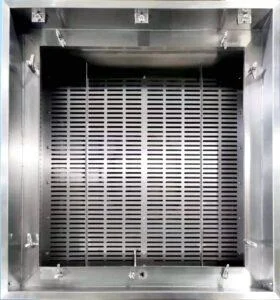
For housings where internal access is particularly constrained, such as ceiling-mounted HEPA box terminal diffuser units, the access pathway for future retesting should be confirmed during equipment specification — not after the unit is integrated into a finished ceiling assembly. The question to answer at that stage is not whether the filter can be installed, but whether the installed assembly can be retested without structural intervention.
Defining requalification triggers in advance — periodic intervals, post-maintenance events, filter replacement — closes the scheduling gap before the first retest becomes urgent. Without a defined trigger, requalification can be deferred until a regulatory event forces it, at which point access constraints that were manageable become critical.
Acceptance Requires A Named Installed Test Method
Accepting a HEPA filter installation without a named test method in the acceptance document creates a gap that is difficult to close after the fact. The gap is not only procedural: if the test method, acceptance criteria, and repair limits are not specified before the test is performed, there is no basis on which to evaluate whether a disputed result represents a true failure or a method artifact.
The core acceptance thresholds for installed leak testing — a 0.01% continuity reading as the leak threshold, a total repair area not exceeding 3% of the filter face, and a single repair length not exceeding 38 mm — are design figures that define pass/fail boundaries for the installed assembly. These figures should be treated as the reference values for specifying your acceptance criteria, with confirmation that they align with the governing specification for your application and jurisdiction rather than assumed to be universal regulatory requirements.
| Parameter | Acceptance Limit | Betekenis |
|---|---|---|
| Lekdrempel | Any continuity reading >0.01% is a leak; each filter must have zero leaks | Prevents acceptance of filters with small leaks that could compromise cleanroom classification |
| Total repair area | ≤3% of filter face area | Limits the amount of compromised media to maintain airflow uniformity and particle capture |
| Single repair length | ≤38 mm | Prevents oversized repairs that could create structural weakness or bypass |
The method-selection decision — photometer or particle counter — is not interchangeable, and selecting the wrong approach relative to the filter’s efficiency class or MPPS proximity can produce results that are difficult to interpret. IEST-RP-CC034 provides guidance on matching method to application; it should be referenced as a testing-framework input during protocol development, not consulted after a disputed result requires explanation. The bleed-through risk — where the leak acceptance threshold is close enough to the filter’s nominal efficiency that particle penetration through the filter media itself is mistaken for a leak signal — is particularly likely to surface when the aerosol selection and filter efficiency profile are not confirmed together before testing begins.
Voor mini-pleat HEPA/ULPA filters, where higher packing density can affect aerosol distribution across the face, confirming that the scan speed and challenge concentration are appropriate for the specific filter geometry is part of this method confirmation, not an afterthought. The acceptance document is the point at which all of these decisions — method type, aerosol selection, pass/fail threshold, repair limits, and access path — should be locked before the test is scheduled.
Cleanroom HEPA filter leak testing is defensible only when the evidence it produces is clearly matched to the question it is meant to answer. Factory scan documentation confirms what the filter was at manufacture; installed leak testing confirms what the assembly is after construction; periodic requalification confirms that the installed condition has been maintained. Treating any one of these as a proxy for another is the source of most commissioning disputes, audit exposures, and retest events that compress into qualification timelines.
Before accepting a HEPA filter installation, confirm that the acceptance package includes an in-situ test result under a named method, that the method was selected with reference to the filter’s efficiency class and MPPS profile, and that the access path for future requalification was defined before the ceiling was closed. If any of those three conditions is unresolved, the acceptance record may be technically complete in appearance but indefensible under review.
Veelgestelde vragen
Q: What happens if the cleanroom ceiling is already closed before an in-situ leak test is scheduled?
A: The test can still be performed, but the options narrow significantly and the cost rises. Access to upstream injection points and filter housing interfaces must be achieved through whatever pathways remain — partial ceiling removal, access panels, or room shutdown with equipment cleared. The practical consequence is that scheduling and access become negotiation points rather than routine arrangements. This is why the access path for both initial testing and future requalification should be confirmed during equipment specification, before construction closes off the options.
Q: If an installed filter passes the in-situ leak test, does that mean the filter is still performing at its rated H14 efficiency?
A: Not necessarily. The in-situ test confirms installation integrity — that the assembled unit introduces no leaks at the gasket, frame, or perimeter — but it does not re-verify filter efficiency class. A filter with gradual media degradation may pass an integrity scan while operating below its rated efficiency. Conversely, a filter with a gasket bypass may carry a valid H14 certificate. Both evidence types must be present in the acceptance package because they answer different questions; neither substitutes for the other.
Q: At what point does using a particle counter instead of a photometer for installed leak testing become the wrong choice?
A: Method selection depends on the filter’s efficiency class and its proximity to the most penetrating particle size. When the leak acceptance threshold is close to the filter’s nominal efficiency — a condition most likely with very high-efficiency filters — particle penetration through intact filter media can be misread as a leak signal, producing false failures. IEST-RP-CC034 provides application-specific guidance on matching method to filter performance. Choosing the method after a disputed result requires explanation is the wrong sequence; it should be locked in the acceptance protocol before the test is scheduled.
Q: Does EU GMP Annex 1 require a specific requalification interval for installed HEPA filter leak testing?
A: EU GMP Annex 1 mandates that installed HEPA filter integrity is maintained and verified, but it does not prescribe a fixed requalification interval as a universal rule. The interval is expected to be defined and justified within the facility’s contamination control strategy, with triggers that include periodic review, post-maintenance events, and filter replacement. Deferring that definition until a regulatory inspection forces the question is the failure mode — the requalification trigger should be documented before the room is operational, not after.
Q: Is cleanroom HEPA filter leak testing still required if the supplier provides factory scan results for every filter unit in the shipment?
A: Yes. Factory scan results, however complete, confirm only the filter element’s condition at manufacture. They have no evidentiary scope over shipping stress, gasket seating during installation, frame distortion from uneven housing alignment, or any other failure mode that arises after the unit leaves the test bench. ISO 14644-3 in-situ leak testing is required because it addresses the assembled condition after construction — a condition that factory documentation structurally cannot address. Both evidence types should appear in the acceptance package; one cannot close the acceptance gap that belongs to the other.