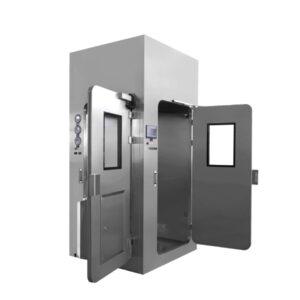
Selecting the wrong containment equipment for a pharmaceutical QC lab or cell culture workflow doesn’t usually announce itself at purchase — it surfaces during qualification testing, a regulatory inspection, or an incident investigation. A team that installs a recirculating cabinet in a room built without exhaust infrastructure, or that substitutes a clean bench for a biosafety cabinet because both sit under a HEPA filter, may not discover the problem until commissioning is underway or, worse, until an operator exposure event forces a process review. The decision that prevents this is not which cabinet model to order — it is whether the workflow, hazard level, and room constraints have been resolved clearly enough to determine which cabinet class is even eligible. What follows will help you evaluate those inputs in sequence and recognize the conditions under which a procurement decision should be paused until facility and process assumptions are confirmed.
What decisions a biosafety cabinet is actually supposed to solve
A biosafety cabinet exists to solve a containment problem — but containment means different things depending on what is being protected and from what. The equipment category covers a range of configurations that protect the operator, the product, the environment, or some combination of all three. Misreading which protection direction is required is where most selection errors start.
The most concrete wrong-choice pattern is the clean bench substitution. Clean benches supply HEPA-filtered air in a positive-pressure configuration, which protects samples from environmental contamination. That airflow direction also pushes any released aerosol, biological agent, or chemical vapor directly toward the operator and into the room. Using a clean bench for any work involving hazardous biological material or toxic compounds creates direct operator and environmental exposure risk — not as a theoretical edge case, but as a predictable consequence of how the airflow is engineered. The cabinet label does not prevent this; the protection model does, and the two are categorically different.
The practical decision a biosafety cabinet solves is: who or what needs containment, in which direction, under which conditions? Answering that question before comparing models prevents the class of error where a lab acquires a unit that satisfies one protection requirement while leaving another completely unaddressed. A cabinet that protects the operator from a biological agent does not automatically protect the product from environmental contamination, and a cabinet that delivers sterile working conditions does not automatically contain a hazardous chemical vapor. These are not ranked quality levels on the same axis — they are different protection architectures that serve different purposes.
Which inputs must be fixed before you compare cabinet classes
Cabinet class is only the correct answer when five inputs are known together: the type of work being performed, the risk group of the agent or material, the facility’s exhaust infrastructure, the operator loading pattern, and whether the process requires product sterility. Resolving any four of these while leaving the fifth open can produce a cabinet selection that fails on the missing dimension.
Two of these inputs have a particular tendency to be deferred. The first is whether volatile chemicals, radionuclides, or cytotoxic compounds are present in the workflow, even at trace concentrations. This single factor governs whether a recirculating cabinet is permissible at all, and it shapes which exhaust configuration the facility must support. A team that selects a cabinet before confirming whether volatiles are involved may need to replace or respecify the unit once the chemistry is documented downstream.
The second deferred input is the facility’s HVAC and exhaust capability — specifically, whether the room can support dedicated ductwork, what the supply and exhaust air balance looks like, and whether a thimble (canopy) connection or fully ducted exhaust can be physically accommodated in the planned location. This is not a minor procurement footnote. Facility exhaust capability functions as a constraint that governs which cabinet classes are eligible for consideration in that room. A cabinet that requires 100% dedicated exhaust cannot be installed in a room without that infrastructure, regardless of its other technical attributes. Discovering this after purchase — as often happens when facility interface review is deferred — converts a configuration decision into a change-order problem.
How operator protection product protection and environmental protection differ
The three protection directions — personnel, product, and environment — are not always present simultaneously in a given cabinet type. Understanding the specific profile of each configuration defines where it belongs and where it creates a gap.
A Class I cabinet draws room air through the front opening and exhausts it through a HEPA filter. This protects the operator and the environment from biological agents inside the cabinet, but it does not protect the product or sample from room air contamination. That profile makes it appropriate for workflows where the biological material is the hazard and sterility of the sample is not a process requirement. For sterile pharmaceutical QC work, where both the operator and the sample integrity matter, a Class I is structurally inadequate — it provides the wrong direction of product protection.
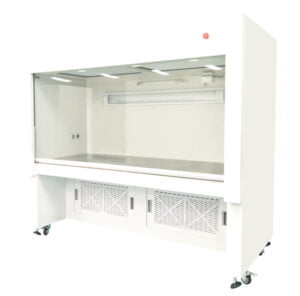
A clean bench, by contrast, delivers HEPA-filtered air across the work surface toward the operator, protecting the sample from contamination. It offers no personnel or environmental protection. The risk here is not that the clean bench is a lower-quality biosafety cabinet — it is that it operates on a fundamentally different protection principle. Substituting it in a workflow that involves any biological agent or hazardous compound removes the containment barrier entirely while maintaining the appearance of controlled work. For workflows that require only particulate-free air and involve no hazardous materials — certain electronic assembly applications, for example — a clean bench serves its intended purpose. Anywhere a biological or chemical hazard is present, the substitution becomes a safety liability.
The practical implication for pharmaceutical QC and cell culture work is that most workflows require a cabinet that provides at least dual protection — personnel and product — which limits the eligible class to Class II configurations and, in specific high-risk scenarios, Class III. Defining the required protection directions first makes the eligible class set obvious before any model comparison begins.
For a more detailed breakdown of how biosafety cabinets relate to other purification equipment, this comparison of biosafety cabinet vs purification equipment covers the distinction in practical terms.
When Class I Class II and Class III cabinets belong in different workflows
Matching a cabinet to a workflow is not a matter of selecting the most capable option available — it is a matter of matching the protection architecture to what the process actually requires. Over-specifying a cabinet adds cost, facility burden, and operational complexity without adding meaningful protection for the actual hazard. Under-specifying it creates containment gaps that may not be visible until a failure occurs.
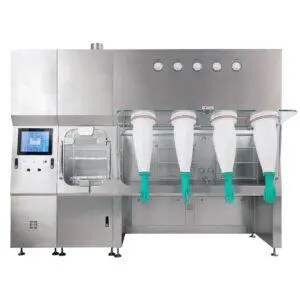
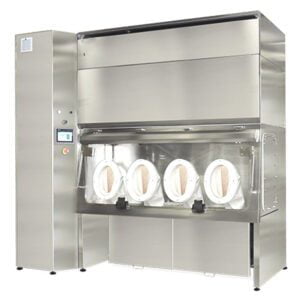
A Class III cabinet, for example, is the appropriate choice when a BSL-3 or BSL-4 pathogen is involved or when the hazard requires complete isolation from the operator and room environment. That level of containment is necessary in those workflows, but its glove-box design, pressure isolation, and decontamination requirements are unnecessary burdens in a standard pharmaceutical QC or mammalian cell culture environment. Selecting it for a lower-risk workflow is not conservative — it is a misalignment that makes routine operation more difficult without improving safety outcomes.
The more consequential matching decisions occur within the Class II sub-types. A Class II Type A2 cabinet serves the broadest range of pharmaceutical and cell culture workflows because it provides simultaneous personnel, product, and environmental protection. Its eligibility boundary is the presence of volatile or toxic chemicals: the cabinet may only be used with minute quantities of such compounds, and only when connected to a thimble exhaust that allows contaminated air to exit the building rather than recirculate. Without that exhaust connection, it is not appropriate for chemical work. A Class II Type B2 applies when the chemical or radionuclide hazard is more significant — but it demands 100% dedicated exhaust and the full facility coordination that entails. The workflow-to-cabinet mapping for each class is summarized below.
| Typ obudowy | Recommended Workflow | Key Requirements / Notes |
|---|---|---|
| Klasa I | General microbiology where product sterility is not required | Provides personnel and environmental protection; no product protection. |
| Klasa II Typ A2 | Workflows with minute volatile chemicals | Must be connected to a thimble (canopy) exhaust. |
| Klasa II Typ B2 | Higher levels of toxic chemical or radionuclide applications | Requires 100% dedicated exhaust (no recirculation). |
| Klasa III | High-risk pathogens (BSL-3/4) or hazardous particulates | Highest level of containment and isolation. |
The consequence of a mismatch is rarely visible at the point of selection. A Class II Type A2 installed without the required thimble connection in a workflow involving volatile compounds may operate within normal parameters on all cabinet-level tests while still failing to contain chemical exposure at the room level. The gap appears not in the cabinet’s performance but in the facility interface that was never completed.
How exhaust strategy and room utilities change the cabinet choice
Exhaust strategy is where cabinet classification and facility engineering intersect, and it is the dimension most consistently underweighted during procurement. The decision between a recirculating and a fully exhausted cabinet is not primarily a cabinet-performance decision — it is a facility commitment decision with long-term operational and cost consequences.
A Type A2 cabinet recirculates the majority of its air through an internal HEPA filter while exhausting a smaller fraction to the room or, when connected, through a thimble to the building exhaust system. This configuration simplifies installation — the cabinet can function in a room without dedicated ductwork — and reduces the energy load required to replace conditioned exhaust air continuously. For facilities without existing high-volume exhaust infrastructure, this is a meaningful practical advantage. The trade-off is that this recirculation model limits the chemical work the cabinet can support, even with a thimble connection, and it is not appropriate where volatile or toxic compound exposure must be fully controlled at the exhaust point.
A Type B2 cabinet exhausts all of its air through dedicated ductwork with no internal recirculation. This requires the facility to supply and condition replacement air at the same rate the cabinet exhausts it — a significant HVAC load that must be engineered into the room’s supply-exhaust balance. The operational cost of continuously replacing conditioned air is ongoing, not a one-time commissioning expense. Teams that select a Type B2 based on upfront cost comparisons with a Type A2 often inherit those downstream utility and maintenance costs without having budgeted for them.
Both cabinet types share a minimum inflow velocity requirement as a containment performance criterion — the specific threshold and its testing conditions are verified during certification. The full comparison of recirculation ratios, exhaust fractions, inflow velocity thresholds, and facility implications is captured below.
| Typ obudowy | Recirculation % | Exhaust % | Minimum Inflow Velocity | Facility Implications |
|---|---|---|---|---|
| Klasa II Typ A2 | ~70% | ~30% | ≥100 fpm | Impacts energy use, heat load, and complexity of exhaust connections. |
| Klasa II Typ B2 | 0% | 100% | ≥100 fpm | Requires significant facility utility support and increases operational costs. |
One downstream consequence that rarely surfaces during procurement is the effect of building exhaust system variation on Type B2 performance. A fully exhausted cabinet depends on the building’s dedicated exhaust maintaining consistent negative pressure and airflow. If that system is shared with other laboratory equipment or subject to seasonal HVAC adjustments, the cabinet’s containment performance can be affected in ways that are not apparent from the cabinet specification alone. Confirming exhaust system stability and isolation is part of the facility interface review — and it belongs before, not after, the purchase order is issued.
Which compliance and certification checks belong in buyer evaluation
Certification documentation for a biosafety cabinet serves two functions in buyer evaluation: it confirms that the cabinet as manufactured meets the performance attributes required by the applicable standard, and it provides the defensible record needed during facility qualification, regulatory inspection, or incident review. Both functions depend on the cabinet being engineered to meet the right standard for the intended application.
For pharmaceutical and hazardous drug work in most markets, the primary engineering standard is NSF/ANSI 49, which defines the performance requirements — including face velocity, downflow velocity, and air split — that a Class II cabinet must meet to qualify for its rated containment class. These are not design targets the buyer sets; they are testable attributes that certification must confirm. A cabinet that meets NSF/ANSI 49 has had those attributes verified under defined test conditions. A cabinet without that certification documentation has not, and relying on manufacturer claims in its place creates a defensibility gap that becomes visible during audit or qualification.
For pharmaceutical QC and hazardous drug compounding workflows specifically, USP \<797> and USP \<800> establish additional requirements governing the equipment used in sterile preparation and hazardous drug handling. These standards reference the type of primary engineering control required for a given risk level and drug category. A biosafety cabinet selected for hazardous drug compounding must be evaluated against those requirements, not only against the cabinet’s internal certification attributes. The WHO Laboratory Biosafety Manual and the CDC’s Biosafety in Microbiological and Biomedical Laboratories (BMBL) provide relevant frameworks for understanding cabinet performance in the context of biological containment — particularly when the workflow involves classified biological agents — and are useful references for validating that certification logic is correctly applied to the hazard level in question.
The practical buyer check is straightforward: request certification documentation that explicitly confirms the performance attributes relevant to your workflow, verify that the cabinet is engineered to meet the applicable standards for your application and jurisdiction, and confirm that the certification testing was conducted on the cabinet configuration you are purchasing, not a representative unit from a different configuration or size. Certification that does not match the purchased specification provides limited assurance.
What to confirm before drawings FAT and installation begin
The facility interface review is the stage most reliably responsible for project delays when it is deferred until after procurement. The issues it surfaces — exhaust routing conflicts, insufficient sash clearance, blocked test access ports, utility coordination problems — are not rare complications. They are the predictable result of evaluating a cabinet specification without evaluating the room it must occupy.
Exhaust routing is the most common friction point. A cabinet that requires a thimble connection or dedicated ductwork must have a clear, code-compliant exhaust path from its discharge point to the building system. That path must be confirmed against the room’s existing penetrations, ceiling plenum conditions, shaft access, and exhaust fan capacity before drawings are finalized. Discovering a routing conflict after the cabinet is on order typically means either re-engineering the exhaust path — a change that ripples through mechanical drawings, validation documentation, and installation schedule — or accepting a substitution that may not match the original workflow requirement.
Sash clearance and test access are less dramatic but equally capable of causing commissioning delays. Annual field certification of a biosafety cabinet requires physical access to specific test points on the cabinet face and exhaust. If the cabinet is positioned against a wall, inside a fume hood enclosure, or adjacent to fixed casework in a way that blocks instrument placement, certification cannot be completed without moving the cabinet. Confirming clearance dimensions and test access geometry before final layout drawings are approved prevents this from becoming a post-installation discovery.
The full pre-procurement confirmation list for a biosafety cabinet installation should address at minimum:
- Exhaust routing path from cabinet discharge to building system, including penetration locations, duct sizing, and balance with room supply air
- Sash clearance for operator ergonomics and compliance with the cabinet’s rated working opening
- Physical access clearance on all sides required for field certification and filter replacement
- Utility rough-in locations for electrical supply, and any required connections for alarms or building management system integration
- Floor load capacity if the cabinet weight, particularly for Class III units, approaches the structural limit of the installation area
- FAT (factory acceptance testing) scope confirmation — specifically which performance attributes will be tested at the factory versus verified in the field after installation
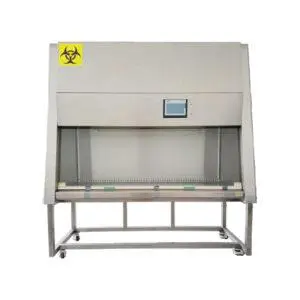
A szafa bezpieczeństwa biologicznego that passes factory testing but is installed in a room that cannot support its exhaust requirement or cannot accommodate field certification has not been successfully commissioned — it has been placed. The distinction matters at every subsequent qualification and inspection event.
For installations involving sterile drug compounding or high-potency compounds where decontamination between campaigns is a process requirement, confirming how the cabinet interfaces with room decontamination protocols — including compatibility with VHP or other sporicidal agents — belongs in this same pre-procurement review, not in the validation phase.
A biosafety cabinet selection that is made before the five core inputs are resolved — work type, agent risk group, exhaust capability, operator loading pattern, and product sterility requirement — is not a conservative choice or an early decision that can be refined later. It is a procurement commitment made without the information needed to confirm the cabinet class is correct, and reversing it after purchase is a change-order problem, not a specification update. The majority of project delays and post-installation rework traced back to cabinet selection can be attributed to that sequence: cabinet chosen, inputs confirmed later, conflict discovered at facility interface review.
Before comparing models, resolve the inputs. Before issuing a purchase order, confirm the exhaust path, sash clearance, and test access in the planned room location. The cabinet specification and the room specification must be evaluated together, because a cabinet that performs correctly in isolation but cannot be correctly installed, certified, and maintained in its actual location has not solved the containment problem — it has deferred it.
Często zadawane pytania
Q: What happens if a Class II Type A2 cabinet is already installed in a room that has no thimble exhaust connection and the workflow involves volatile compounds?
A: The cabinet cannot be used for that work without adding the exhaust connection — recirculating volatile or toxic chemical vapors through an internal HEPA filter does not eliminate chemical exposure risk at the room level. If the building cannot accommodate a thimble or dedicated ductwork in that location, the workflow either needs to move to a room that can support the required exhaust, or the cabinet class must be reconsidered based on what the facility can actually support. Proceeding without the connection is not a reduced-compliance workaround; it voids the cabinet’s suitability for chemical work entirely.
Q: If the biosafety cabinet passes factory acceptance testing, is the facility interface review still necessary before installation begins?
A: Yes — factory acceptance testing confirms the cabinet performs to specification under controlled factory conditions, but it says nothing about whether the room can support it. Exhaust routing conflicts, insufficient sash clearance, blocked certification access points, and supply-exhaust air balance problems are not visible at the factory. They appear at the installation site, and discovering them after the unit is on-site or already placed converts pre-procurement planning decisions into post-installation change orders. FAT scope and facility interface review address different things and must both be completed.
Q: At what point does specifying a Class III cabinet become the right decision rather than an overcautious one for pharmaceutical work?
A: A Class III cabinet is appropriate when the workflow involves a BSL-3 or BSL-4 classified pathogen, or when the hazard genuinely requires complete physical isolation between the operator and the work environment — not as a general precaution for high-potency compounds or sensitive cell lines. For standard pharmaceutical QC, sterile drug compounding, or mammalian cell culture, a Class III introduces glove-box operation, pressure isolation management, and decontamination requirements that add operational burden without improving safety outcomes relative to the actual hazard. The decision should be driven by the agent risk group classification and regulatory requirement, not by risk aversion applied to a lower-risk workflow.
Q: How does selecting a Type B2 cabinet over a Type A2 change the long-term operational cost picture beyond the initial purchase price?
A: A Type B2 exhausts 100% of its air through dedicated ductwork continuously, which means the facility must supply and condition replacement air at the same rate — an ongoing HVAC energy cost that persists for the life of the installation. A Type A2 recirculates the majority of its air internally, so the net conditioned air consumed per hour is substantially lower. The upfront cabinet cost difference between the two types is often smaller than the cumulative utility cost difference over several years of operation. Teams comparing purchase prices without modeling the HVAC load and energy replacement cost are comparing an incomplete cost picture, and the gap typically widens in facilities where conditioned air is expensive to produce or exhaust systems require dedicated infrastructure maintenance.
Q: Is annual field certification achievable if the biosafety cabinet is already installed in a fixed casework configuration with limited side clearance?
A: Not reliably, and in some configurations not at all without moving the cabinet. Field certification requires physical instrument placement at specific test points on the cabinet face, sash opening, and exhaust. If fixed casework, an adjacent wall, or ceiling-mounted equipment blocks those positions, the certifier cannot complete the required measurements. This means the cabinet cannot be confirmed as performing to its rated class — a problem that appears at every annual certification event, not just the first. Clearance geometry must be confirmed against the certification access requirements before the final room layout is approved, not after installation is complete.
Powiązane treści:
- Szafy bezpieczeństwa biologicznego klasy I: Cechy i zastosowania
- Szafy bezpieczeństwa biologicznego klasy II A2: Cechy i zastosowania
- Przepływ powietrza w szafie bezpieczeństwa biologicznego: Zrozumienie wzorców
- Instalacja szafy bezpieczeństwa biologicznego: Kluczowe kwestie
- Szafy bezpieczeństwa biologicznego klasy II: Kompleksowy przewodnik
- Okap laminarny a BSC: mądry wybór
- Rodzaje szaf bezpieczeństwa biologicznego: przewodnik po bezpieczeństwie w laboratorium 2025
- Szafy bezpieczeństwa biologicznego klasy III: Maksymalna ochrona
- Poruszanie się po klasach szaf bezpieczeństwa biologicznego: Kompletny przegląd