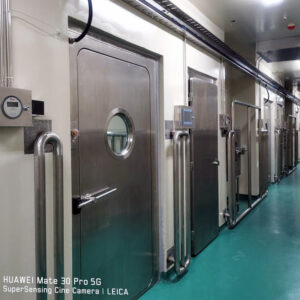
Choosing the wrong transfer device at a cleanroom boundary is rarely obvious during design review — it becomes obvious during process validation, when environmental monitoring data shows particle counts inside the exchange zone running 10 to 50 times above Grade A limits, and the team must begin a retrospective product impact assessment on batches already released. That sequence of events is avoidable, but only if the selection decision is anchored to the right criterion: whether the transfer involves open liquid contact crossing an aseptic boundary, or a closed container crossing a differential-pressure boundary. The two scenarios require fundamentally different hardware, and no amount of HEPA filtration in a pass box closes the gap for the first one. What follows will help you identify which transfer scenario applies to your process, where each device type reaches its application boundary, and what structural and validation consequences follow from that choice.
Static Pass Box: Mechanical Interlock, UV Sterilization, and ISO 7/8 Application Boundaries
The static pass box has a clearly defined application scope, and the most common compliance failure associated with it is not a maintenance lapse — it is placing it where it does not belong.
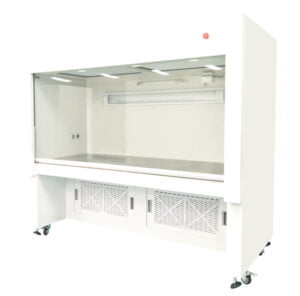
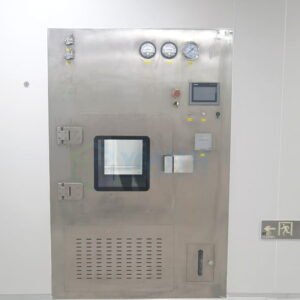
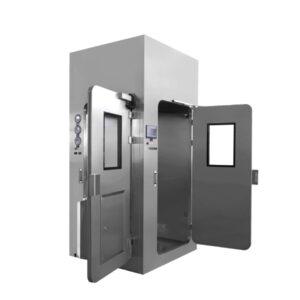
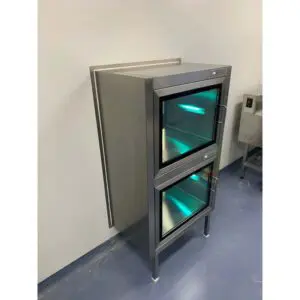
A static pass box is designed for material transfer between two areas of equivalent ISO classification. ISO 8 to ISO 8 is the textbook application. The mechanical interlock prevents both doors from opening simultaneously, reducing the risk of direct air exchange between the two zones. A UV disinfection lamp mounted inside the chamber provides surface decontamination between transfers. Neither of these features creates a pressure differential, introduces filtered airflow, or produces a higher-classification environment inside the chamber itself. The interior of a static pass box, during a transfer cycle, reflects the ambient conditions of the connected rooms — which is exactly why it cannot be used to bridge rooms of different classifications without creating an uncontrolled contamination pathway.
UV lamp maintenance deserves specific attention during commissioning planning. UV germicidal lamps in static pass boxes are typically rated for 1,000 to 3,000 hours of use before output degrades below effective disinfection levels. This is not a regulatory maintenance interval — it is a design parameter that should feed directly into your preventive maintenance schedule. A lamp that has exceeded its useful life is still illuminated, still appears functional, and will pass a visual check during an audit walkthrough. The failure is invisible until microbial monitoring produces an anomaly. Building replacement intervals into the facility maintenance program before commissioning, rather than treating it as a post-occupancy calibration task, eliminates that gap.
The more consequential planning criterion is the equal-classification requirement. If your facility layout has evolved since concept design — a common occurrence in phased construction — verify that the rooms on both sides of every static pass box installation still carry the same ISO classification in the current design. Reclassifying one room without flagging the transfer device serving it is the kind of detail that creates audit exposure without any obvious physical change to the cleanroom.
For specifications on static pass box configurations suited to ISO 7 and ISO 8 boundary applications, Youth Filter’s static pass box product page covers available interlock and UV configurations.
Dynamic Pass Box: HEPA Airflow, Pressure Differentials, and ISO 5/6 Suitability
A dynamic pass box is the appropriate device when a transfer must cross a boundary between areas of different ISO classifications — but its suitability has a ceiling that is frequently underestimated.
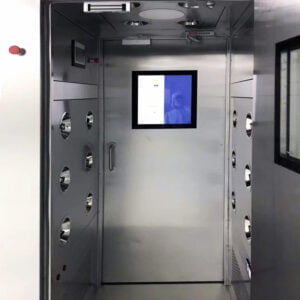
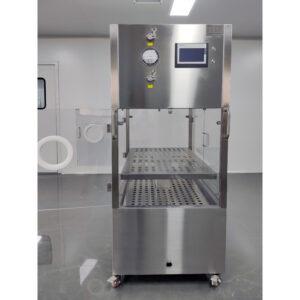
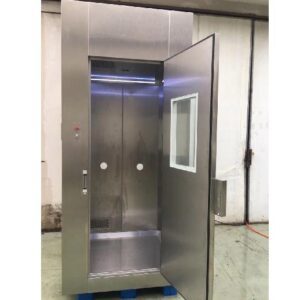
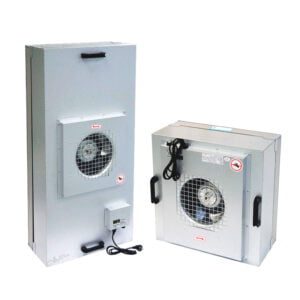
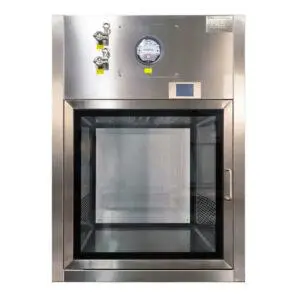
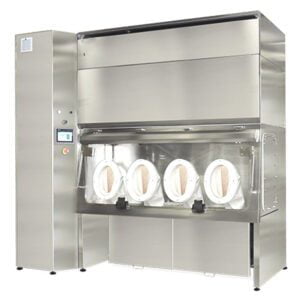
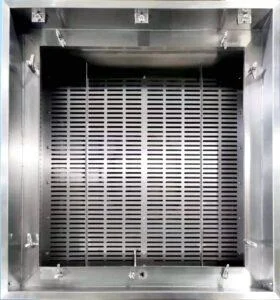
The core mechanism is HEPA-filtered unidirectional airflow inside the transfer chamber, combined with a pressure differential that biases contamination away from the higher-classification side. The HEPA filter operates at 99.997% efficiency at 0.3 microns, and the chamber achieves its rated internal classification only after a clean-down cycle — typically in the range of 2 to 5 minutes — during which the interlock holds both doors closed. That residence time requirement matters operationally: facilities that size their transfer frequency based on physical throughput without accounting for clean-down dwell time routinely find the dynamic pass box becomes a bottleneck during peak production hours.
| Considerações | Detalhes | Por que é importante |
|---|---|---|
| Aplicativo | Transfers across different ISO classifications | Required to maintain separation with HEPA-filtered air (99.997% efficiency at 0.3 micron) |
| Residence Time | 2-5 minutes clean-down cycle | Achieves higher internal air classification before interlock release |
| Cronograma de validação | Adds weeks to commissioning | Due to HEPA integrity, air velocity, and recovery tests per ISO 14644-3 |
The validation requirement is the detail most often underestimated at the procurement stage. Qualifying a dynamic pass box requires HEPA filter integrity testing, air velocity uniformity measurement, and recovery testing — all referenced under ISO 14644-3 as the applicable test framework. Depending on the facility’s validation master plan and the availability of qualified personnel, this work can add two to four weeks to commissioning compared to a static unit. That delta is predictable and should be built into the construction schedule at concept stage, not discovered during the pre-qualification walkthrough.
The ceiling on dynamic pass box application is the open liquid contact scenario at a Grade A boundary. During the exchange cycle — even with HEPA airflow — the chamber undergoes a brief period of air disturbance and pressure recovery that is incompatible with maintaining Grade A conditions at an open liquid surface. Pass box particle counts during this cycle have been documented to exceed Grade A limits by an order of magnitude or more. This is not a marginal exceedance that can be resolved through additional monitoring — it is a fundamental consequence of how the device operates. Recognizing that ceiling before device selection, rather than after process validation sampling, is the practical value of understanding what a dynamic pass box can and cannot do.
For a side-by-side comparison of static and dynamic pass box design principles and selection triggers, this overview of static vs. dynamic pass box differences provides additional context on the operating distinctions between the two types.
Sterile Liquid Transfer Port (SLTP): Design Principle and Grade A Application Scope
Where a dynamic pass box reaches its application limit — open liquid transfer across an aseptic Grade A boundary — the Sterile Liquid Transfer Port is the purpose-built alternative.
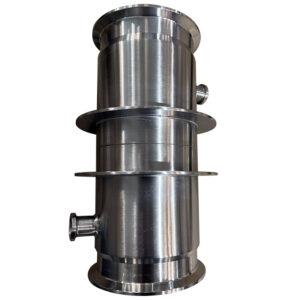
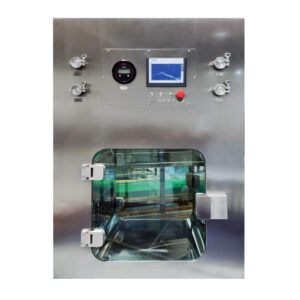
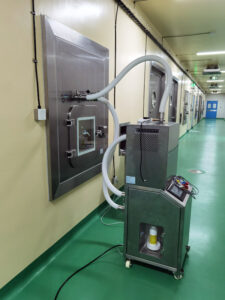
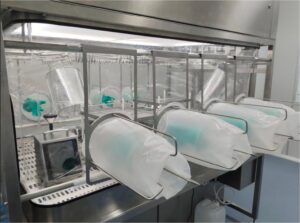
The SLTP operates on a double-o-ring seal mechanism that maintains a continuous aseptic connection between the inner and outer containers throughout the transfer. There is no exchange cycle, no air-disturbance period, and no brief interval during which the liquid surface is exposed to ambient conditions. The transfer path remains closed and sealed from initiation to completion. This is the design principle that distinguishes it from every form of pass box: the boundary is never interrupted. EU GMP Annex 1 (2022 revision) positions rapid transfer port technology as the recommended consideration for validated transfers into Grade A zones, reflecting precisely this property — not as a blanket prohibition on alternative approaches in every conceivable scenario, but as clear regulatory guidance that device selection for Grade A liquid boundary transfers should be supported by a validated risk assessment that takes the SLTP seriously as the reference solution.
The cost premium is real and should be understood in context. An SLTP typically costs three to five times a comparable dynamic pass box unit price. Framing this as a cost comparison, however, obscures the more accurate comparison: the dynamic pass box carries its own cost burden in HEPA certification, airflow recovery testing, and interlock qualification — work that adds weeks to commissioning — while the SLTP carries a different cost profile centered on o-ring maintenance at intervals of roughly six to twelve months and a structural installation requirement that catches construction teams by surprise more often than any other single factor in SLTP procurement.
That structural requirement deserves explicit attention at concept stage. An SLTP flange requires 150 to 200 millimeters of rigid substrate around the wall penetration to support the installation properly. Softwall cleanroom panel systems — which are common in phased and modular facility builds — do not provide that substrate inherently. Local hardwall inserts must be specified and built into the panel system at the appropriate location. When this detail is not identified until mechanical rough-in is already complete, the remedy is expensive rework: panels must be removed, hardwall backing installed, and the panel system restored before the SLTP can be mounted. This is not a rare edge case. It is a documented, recurring problem in new facility construction that appears consistently when SLTP placement is treated as a mechanical installation decision rather than a structural design decision requiring early coordination between the cleanroom envelope contractor and the process equipment team.
The validation criterion that governs device selection at this boundary is practical and defensible: any transfer crossing an aseptic Grade A boundary with open liquid contact should be designed around an SLTP. Pass boxes — including HEPA-equipped dynamic types — are appropriate for closed container transfers or for ISO 7 and ISO 8 boundary crossings where Grade A exposure at an open liquid surface is not part of the process.
Comparative Decision Matrix: Transfer Frequency, Sterility Assurance Level, and Maintenance Load
The choice between these three devices is not primarily a cost decision or a feature comparison. It is a question of which application boundary applies to your specific transfer, followed by a secondary evaluation of operational and maintenance consequences.
| Tipo de dispositivo | Aplicativo principal | Principais considerações | Maintenance / Validation Note |
|---|---|---|---|
| Caixa de passe estática | Transfers between equally classified ISO areas (e.g., ISO 8 to ISO 8) | Must not be used for transfers across different classes; relies on UV disinfection | UV lamps require replacement after 1000-3000 hours |
| Caixa de passe dinâmica | Transfers across different ISO classifications | Requires HEPA-filtered air and pressure differentials; minimum residence time 2-5 minutes | Validation adds weeks to commissioning due to HEPA integrity and recovery tests |
| Porta de transferência de líquido estéril (SLTP) | Transfers crossing Grade A boundary with open liquid contact | Required for validated transfers into Grade A zones per regulatory guidance (e.g., EU GMP Annex 1) | Not specified in extracted research |
The failure mode that produces the most expensive downstream consequence is not choosing a static pass box where a dynamic one is required — though that misapplication is a severe compliance deficiency that auditors will identify immediately and that is very difficult to explain away. The more costly failure is using a dynamic pass box for liquid reagent transfer into an ISO 5 zone under the assumption that HEPA filtration is sufficient. That assumption surfaces during process validation, not during design review, because the particle count exceedance only becomes visible when environmental monitoring is running under actual process conditions. By that point, batches may have been produced, and the facility must conduct a retrospective impact assessment. Catching the device selection error at concept stage costs nothing compared to what it costs at that phase.
Transfer frequency introduces a secondary trade-off that is genuinely worth modeling. A dynamic pass box with a 2 to 5 minute clean-down cycle imposed between each transfer creates a hard throughput ceiling. If your process requires frequent reagent or component transfers across an ISO 5/6 boundary, the pass box cycle time will become the rate-limiting step in the production schedule. An SLTP, by contrast, does not impose a cycle-time penalty between transfers — but it is a fixed installation serving a fixed penetration point, which means transfer routing must be planned around its location rather than adjusted as production needs evolve. Neither characteristic is inherently better; both should be reflected in the facility’s transfer frequency model before the device selection is finalized.
Maintenance load comparison also deserves realistic assessment rather than summary dismissal. Dynamic pass boxes require periodic HEPA filter integrity recertification and interlock functional testing as part of the ongoing qualification program. Static pass boxes require UV lamp replacement based on accumulated use hours and door seal inspection. SLTPs require o-ring inspection and replacement on a defined interval, with o-ring condition directly tied to the sterility assurance level of every transfer the device performs. An o-ring that has exceeded its service interval is not a cosmetic issue — it is a potential breach in the aseptic boundary at the most critical point in the process. Maintenance intervals for SLTPs should be treated as quality-critical events, not routine facility upkeep.
EU GMP Annex 1 and FDA Compliance Considerations for Transfer Device Selection
Regulatory compliance in transfer device selection is not a documentation exercise performed after the hardware is installed. It is a design input that, if deferred, produces compliance gaps that are expensive to close retroactively.
EU GMP Annex 1 (2022 revision) introduced the most significant regulatory pressure point in current facility compliance for sterile manufacturing: the transfer risk assessment. Annex 1 requires that material transfer processes be supported by a documented risk assessment addressing packaging layers, disinfectant validation at each step, and environmental monitoring data covering the transfer boundary. This assessment directly informs device selection — not by prescribing a single device in every situation, but by requiring that the selection be defensible against specific contamination control criteria. Facilities that selected transfer devices prior to the 2022 revision and have not revisited those decisions through this framework carry an active compliance exposure, particularly where the original selection was made on cost grounds without a formal sterility risk analysis.
The Annex 1 revision also phased out static pass-through chambers with no active air supply for certain applications, with the compliance deadline at August 2023. This is not a prospective risk — it is a past-due compliance gap for any facility still operating affected configurations. Facilities in this position should treat audit readiness for this specific finding as urgent. The remediation path varies: in some cases, a dynamic pass box retrofit is sufficient; in others, the transfer boundary classification or the product contact risk profile may require an SLTP. That determination should follow a documented risk assessment, not an informal equipment substitution.
The FDA’s guidance on aseptic processing reinforces the principle that contamination control measures at transfer boundaries must be demonstrably effective under the specific conditions of production, not just under ideal or theoretical conditions. This framing has direct implications for how transfer device qualification is structured: air velocity, recovery time, particle count, and pressure differential data collected under representative process conditions carry more regulatory weight than static commissioning tests conducted in an unloaded chamber. Where dynamic pass boxes are used at ISO 5/6 boundaries for closed container transfers, ensuring that qualification testing reflects realistic transfer loads and frequencies is the difference between defensible validation documentation and a finding during an FDA inspection.
The material transfer risk assessment is the document that connects device selection to the regulatory framework. It should be initiated early enough in the design phase to influence hardware specification — not written after construction to justify decisions already made. If it identifies open liquid contact at a Grade A boundary, the device selection consequence follows directly. If it confirms that all transfers at a given boundary involve closed containers at an ISO 7 or ISO 8 classification differential, the dynamic pass box remains a compliant and practical solution. The risk assessment does not make the decision arbitrary — it makes the decision traceable and defensible, which is what regulators are looking for when they review transfer process qualification packages.
The practical threshold this decision turns on is narrow and clear: open liquid contact at a Grade A boundary requires an SLTP; everything else — closed container transfers, ISO 7/8 boundary crossings — falls within the operating range of a properly qualified pass box. Where that threshold applies in your process, the structural and maintenance implications of SLTP installation should be in the design package from the earliest layout stage, not identified during construction. Where a dynamic pass box is the right device, its commissioning timeline and throughput constraints should be modeled before procurement, not absorbed as schedule surprises during qualification.
Before finalizing transfer device selection, confirm three things against your current design: the ISO classification on both sides of every transfer boundary, whether any transfer involves open liquid contact at that boundary, and whether your wall panel system at each SLTP candidate location has been reviewed for substrate adequacy. Those three checks, done early, eliminate the scenarios that consistently produce the most expensive rework.
Perguntas frequentes
Q: Can an SLTP be retrofitted into an existing softwall cleanroom panel system, or does it require new construction?
A: Retrofitting is possible but frequently requires significant rework that makes it more disruptive than early-stage installation. An SLTP flange needs 150–200mm of rigid substrate around the wall penetration — something softwall panel systems do not inherently provide. If hardwall backing was not specified when the panel system was built, panels must be removed, a local hardwall insert installed, and the panel system restored before mounting can proceed. The cost and schedule impact of that sequence in a live facility is substantially higher than coordinating the structural requirement during initial construction. If you are evaluating an SLTP retrofit, get a substrate assessment from your cleanroom envelope contractor before the procurement decision, not after.
Q: Once an SLTP is installed and qualified, what is the immediate next maintenance commitment the facility must plan for?
A: O-ring inspection and replacement on a defined 6–12 month interval is the primary ongoing commitment, and it should be treated as a quality-critical event rather than routine facility upkeep. The o-ring seal is the mechanism that maintains the aseptic boundary during every transfer — a degraded or overdue o-ring is a potential sterility breach at the most critical point in the process, not a cosmetic deficiency. This interval should be entered into the facility’s preventive maintenance program before the SLTP is placed in service, with o-ring condition tied explicitly to sterility assurance level in your qualification documentation.
Q: If all transfers at an ISO 5/6 boundary involve closed containers — no open liquid contact — is a dynamic pass box still compliant under the 2022 EU GMP Annex 1 revision?
A: Yes, a dynamic pass box remains a compliant and practical solution for closed container transfers at an ISO 5/6 boundary, provided the device is properly qualified and the transfer process is supported by a documented risk assessment under Annex 1’s contamination control framework. The SLTP requirement is triggered specifically by open liquid contact crossing a Grade A aseptic boundary. Where that condition is absent and containers remain sealed throughout the transfer, the dynamic pass box — with HEPA integrity certification, air velocity qualification, and interlock testing in place — satisfies the regulatory criteria. The key deliverable is a traceable risk assessment that confirms closed-container status and documents the contamination control rationale for the device selected.
Q: How does the dynamic pass box’s clean-down cycle time affect the decision when transfer volume is high?
A: At high transfer frequencies, the 2–5 minute clean-down cycle becomes a hard throughput ceiling that can make the dynamic pass box the rate-limiting step in the production schedule. If the process requires frequent component or reagent movements across the boundary, that dwell time compounds quickly. An SLTP does not impose a per-transfer cycle-time penalty, but it is a fixed installation at a fixed penetration point — transfer routing must be planned around its location rather than adjusted as production needs change. The right approach before finalizing device selection is to model your peak transfer frequency against the clean-down interval and assess whether the resulting throughput ceiling is compatible with your production schedule, not to discover the bottleneck during commissioning.
Q: Is there a scenario where neither device type is clearly correct, and how should that ambiguity be resolved?
A: The clearest ambiguous scenario is a transfer involving a liquid in a closed, validated container crossing an ISO 6 boundary — it does not meet the open-liquid-contact threshold that mandates an SLTP, but it sits closer to the Grade A application boundary than a straightforward ISO 7/8 passage. In these cases, the resolution mechanism is the material transfer risk assessment required under EU GMP Annex 1: it must document packaging integrity through each transfer step, disinfectant validation, and environmental monitoring data at the boundary. If that assessment can demonstrate that the container’s closure system maintains sterility throughout the dynamic pass box exchange cycle under realistic process conditions — and qualification data collected under representative transfer loads supports it — a dynamic pass box can be the defensible choice. If the risk assessment surfaces uncertainty about container integrity during the air-disturbance phase, that finding should drive the selection toward an SLTP regardless of the absence of open liquid contact.
Conteúdo relacionado:
- Caixa de passagem estática versus caixa de passagem dinâmica: 8 principais diferenças no design, na aplicação e no desempenho do controle de contaminação
- Previsão do mercado de caixas de passagem VHP: Análise de crescimento 2025-2030
- Validação da caixa de aprovação do VHP: Lista de verificação de conformidade IQ/OQ/PQ
- Controle de pressão da caixa de passagem VHP: Conformidade com a ISO 14644
- VHP versus caixas de passe tradicionais: Comparação das principais diferenças
- Guia completo de seleção e implementação de caixas de passagem para controle de contaminação de salas limpas: Edição 2025 com estrutura de conformidade com GMP e ISO 14644
- Requisitos de diferencial de pressão da caixa de passagem: Como manter o fluxo de ar ideal entre as zonas da sala limpa
- Tabela de tamanhos de caixas de passagem VHP: Opções de capacidade para salas limpas
- Transferência de material para salas limpas: Melhores práticas