Contamination failures in cell culture rarely trace back cleanly to a single defective component. More often, a batch loss investigation surfaces an accumulation of small decisions: a crowded work surface, a wipe-down skipped at changeover, an arm movement pattern that repeatedly broke the protective airflow zone without anyone recognizing it as a risk. By the time the pattern becomes visible, it spans multiple batches and cannot be attributed to any single event. The judgment that actually matters is not which cabinet to purchase, but whether the chamber layout, operator habits, and cleaning sequence can preserve the protection the cabinet is designed to provide. Working through each of those factors in order is what allows a lab to distinguish an equipment problem from a workflow problem before it becomes an audit problem.
Which cell culture steps depend most on stable first-air protection
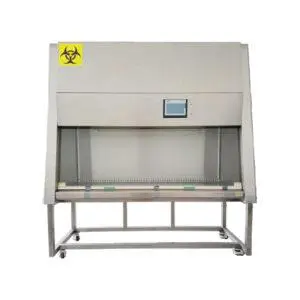
A Class II biosafety cabinet generates its protective zone through the interaction of inflow and downflow air patterns. Inflow air enters at the front opening and flows toward the rear grille, creating a barrier that limits the passage of contaminants from the room into the work zone. Downflow air descends from the HEPA filter above, passes across the work surface, and splits between the front and rear grilles. Together, these two currents establish what is commonly called the first-air zone: the region of uninterrupted HEPA-filtered air directly above the work surface, ahead of any object or obstruction.
The steps that depend most on that zone are the ones that require open vessels. Media changes, cell passaging, and reagent additions all expose culture flasks, pipettes, or transfer containers to the ambient air within the cabinet. During any of these manipulations, the culture or reagent is momentarily unprotected by a physical barrier and relies entirely on the air column above it remaining undisturbed. If the first-air zone has been compromised by an object placed upstream, or by an arm entry that cuts across it at the wrong angle, the effective protection at the vessel mouth drops without any visible signal to the operator.
Some cabinet designs include a V-shaped front grille intended to help redirect airflow when an operator’s arms enter the work zone. This design feature helps maintain the air curtain during active manipulation, which matters most at the exact moment when contamination risk is highest. It is a review consideration worth confirming during cabinet evaluation, particularly for workflows that involve frequent vessel-opening steps, though it is not a universal design standard across all cabinet classes or manufacturers.
The practical implication for planning is that media changes and passaging should be treated as the highest-risk steps in any cell culture protocol, not because they are inherently difficult, but because they are the points where first-air protection must hold precisely when the operator’s presence is most disruptive to airflow. The protection margin is thinnest exactly when the work demands the most movement.
How chamber loading and operator movement affect aseptic protection
A cabinet that passes airflow certification on an empty work surface does not perform at that same specification once the chamber is loaded for a routine cell culture session. Bottles, flask racks, waste containers, and pipette tips collectively change how air moves through the work zone. Objects placed toward the rear of the cabinet block the return airflow path; objects placed near the front can redirect inflow air in ways that break the curtain before it reaches the critical zone. Neither effect is immediately visible, and neither registers on the cabinet’s own indicators.
The failure pattern that appears most consistently in contamination investigations is not a single large obstruction but an accumulation of small ones. A media bottle placed slightly off-center, a waste container pushed to a convenient corner, a pipette holder clipped to the front grille — each one individually may have minimal impact, but together they can substantially alter the effective first-air coverage over the open flask. This matters because the failures that result tend to be intermittent. They track with how a session was loaded rather than with any stable feature of the cabinet, which makes them difficult to reproduce or attribute during root cause analysis.
Operator arm movement introduces a related but distinct risk. Each arm entry to the work zone temporarily displaces air at the front of the cabinet. Slow, deliberate entries partially parallel to the work surface disturb airflow less than rapid or perpendicular entries. When operators work with arms moving frequently across the front opening — reaching across vessels, repositioning bottles mid-procedure, or handling waste while a flask is open — the cumulative disruption to the air curtain during those minutes can be considerable. The relevant discipline is not just how items are placed before work begins, but how often the operator’s presence interrupts first-air coverage while open vessels are present in the zone.
This is a workflow issue before it is an equipment issue. A cabinet cannot compensate for arm movement patterns that repeatedly compromise the protective curtain it generates.
Which setup habits most often create contamination in routine work
The arrangement decisions that cause the most contamination problems tend to be made once and then repeated without review. A technician sets up the work zone in a pattern that feels efficient — waste container within easy reach, pipette tips toward the front, a large media bottle centered on the surface — and that pattern becomes the default for every session. The convenience logic is straightforward, but the arrangement was optimized for reach, not for airflow preservation.
The most common friction point in routine setup is incubator transfer combined with ongoing manipulation. When a flask is brought from the incubator and placed on the work surface while another vessel is still open, the transfer movement crosses the front air curtain at the moment when contamination risk is highest. If the waste container is positioned toward the front of the cabinet — where disposal is easiest — it occupies space that would otherwise support unobstructed downflow over the critical zone. Pipette storage placed at the front edge of the cabinet creates a similar problem: the operator reaches forward to access pipettes while an open flask sits downstream of that movement.
These arrangements are not unusual. They emerge naturally when setup is organized around task sequence rather than airflow geometry. The contamination risk they create is cumulative and session-dependent, which is why it surfaces as an intermittent failure pattern rather than a consistent one. A batch processed with a slightly different arrangement — fewer items on the surface, waste container repositioned, flask placement adjusted — may show no contamination, which makes it harder to connect the outcome to a specific setup choice.
Addressing this requires treating chamber layout as a protocol element, not an informal operator preference. Confirming the position of each item relative to the first-air zone before work begins, and maintaining that arrangement throughout the session, is the setup discipline that actually controls risk. Convenience-driven arrangement is one of the more reliable predictors of contamination accumulation across batches in otherwise well-maintained labs.
For labs evaluating whether their current cabinet de securitate biologică configuration actually supports their cell culture protocol, the chamber layout during a live session is a more informative starting point than the cabinet’s certification status.
What cleaning and changeover practices matter between batches
Cleaning between batches is where physical construction either supports or constrains the operator’s ability to do the job thoroughly. A work surface with recessed screws, welded seams, or sharp interior corners creates zones where liquid can pool or where a wipe cannot reach flush contact with the surface. Over multiple batch changeovers, residue accumulates in those areas. The cleaning step is performed, but it does not fully address those locations, and the risk carried forward into the next batch is difficult to quantify.
Construction choices at the time of cabinet selection determine how much that problem exists in practice.
| Caracteristică de design | Ce trebuie să confirmați | Why It Matters for Cleaning |
|---|---|---|
| Liquid-retaining stainless steel worksurface | Raised edges designed to contain spills | Minimizes cross-contamination risk by containing spills and simplifying cleaning between procedures. |
| Single-piece stainless steel work zone | Radiused cove corners and absence of screws or seams | Ensures thorough cleaning and decontamination by eliminating hard-to-clean crevices, a key practice for batch changeover. |
Beyond the physical surface, the cleaning sequence itself determines whether contamination risk transfers between batches. A wipe-down that starts at the rear of the cabinet and works forward preserves clean conditions over the work zone until the operator is ready to exit. Reversing that sequence — cleaning near the front first and then reaching back over the already-cleaned surface — reintroduces particulate risk at the point most critical to the next batch’s protection. This sequencing discipline is independent of surface construction but interacts with it: a surface that is easy to wipe thoroughly makes sequence discipline easier to execute correctly.
Decontamination agents and dwell time are a separate consideration. Some protocols use 70% ethanol; others require sporicidal agents depending on what organisms have been handled. The cabinet’s internal material specification should be confirmed as compatible with the agents being used, particularly if the protocol includes stronger disinfectants at defined intervals. Surface degradation from incompatible agents does not fail immediately — it accumulates over time and creates the same crevice and residue problems that poor construction introduces from the start.
When a biosafety cabinet supports cell culture well and when workflow discipline is the real issue
A properly configured Class II cabinet creates conditions for clean manipulation that are not achievable on an open bench. It removes a meaningful contamination risk from the environment by providing HEPA-filtered air over the work zone and an air curtain that limits room-air ingress. That is a real and substantial baseline. The mistake is treating that baseline as sufficient on its own, because the baseline holds only when the workflow inside the cabinet preserves the conditions the equipment was designed to maintain.
The trade-off is specific: the cabinet sets a ceiling on protection, and workflow discipline determines how close to that ceiling the actual session operates. A lab that runs a Class II Type A2 cabinet with verified airflow, functional filters, and a clean work surface can still accumulate contamination events if operators crowd the chamber, disrupt the air curtain with frequent and aggressive arm entries, and clean inconsistently between batches. Conversely, a lab with strong workflow discipline operating in a well-configured cabinet can achieve consistent sterility outcomes across routine cell culture work. The equipment and the discipline are not interchangeable — both are required — but the failure patterns that appear in practice are more often traceable to discipline gaps than to equipment faults.
The downstream consequence of misattributing failures is significant. When a lab investigates a contamination event and attributes it to the cabinet — submitting a service request, arranging recertification, or evaluating cabinet replacement — without examining the workflow, the root cause remains unaddressed. The next batch runs in the same or a replacement cabinet with the same layout patterns, the same arm movement habits, and the same wipe-down gaps. The contamination recurs. At that point, the investigation is more complicated because the equipment has been changed, which now has to be ruled out again as a variable.
Înțelegerea how airflow patterns actually behave inside a Class II cabinet is a useful foundation for diagnosing whether a failure is more likely airflow-related or workflow-related — especially before deciding whether a service call or a workflow review is the right first step.
Which configuration checks should be completed before lab release
Confirming a cabinet’s configuration before it enters routine use establishes the starting condition for everything else. It does not guarantee the protection that reaches the culture flask during a live session, but it confirms that the equipment’s protective mechanisms are functioning as specified at the moment of release. That distinction matters: a cabinet that fails a pre-release check has a known deficiency; a cabinet that passes can still fail in use if the workflow undermines the conditions the checks were designed to verify.
The two checks that carry the most consequence for cell culture use are airflow velocity and filter integrity. For a Class II Type A2 cabinet, design figures typically target inflow velocity around 100–105 fpm and downflow velocity around 60–65 fpm. These figures reflect the balance required to maintain the protective air curtain at the front opening while ensuring adequate HEPA-filtered air across the work surface. A cabinet operating below these thresholds may not maintain that curtain reliably under the airflow disruption created by normal arm entries and chamber loading. A cabinet operating significantly above them may create turbulence that compromises the very zone it is intended to protect. These are design references for the Class II Type A2 configuration specifically — not universal benchmarks applicable across all cabinet classes.
Each of these checks addresses a distinct failure mode, and both must be confirmed before the cabinet is considered ready for aseptic work.
| Checkpoint | Ce trebuie să confirmați | Why It Matters for Protection |
|---|---|---|
| Viteza fluxului de aer | For a Class II Type A2 cabinet, confirm average inflow velocity is ~100-105 fpm and downflow velocity is ~60-65 fpm. | These are the specific benchmarks required for compliance and to maintain the first-air protective curtain over the work zone. |
| Integritatea filtrului | HEPA and/or ULPA filters must be tested for efficiency and safety before installation and cabinet release. | This is a foundational, mandatory check for filter performance, which is critical for contamination control. |
Filter integrity testing, referenced within frameworks like ISO 14644-7 for separative devices and associated controlled environments, establishes that the HEPA or ULPA filter is free of bypass leaks and performing at rated efficiency. A filter that has been installed without verification may perform adequately or may have a pinhole leak at the frame seal that is undetectable by visual inspection. The consequences of a compromised filter are not intermittent — they persist across every session until the deficiency is identified, which typically does not happen until a contamination pattern triggers investigation.
Pre-release documentation of both checks creates a baseline that is useful later. If a contamination event occurs three months after lab release, having verified airflow and filter integrity records allows the investigation to focus on workflow and environmental variables rather than reopening the question of whether the cabinet was ever correctly configured. That traceability is procedurally valuable independent of whether the cabinet itself is the source of the problem.
For labs that have not conducted a systematic biosafety cabinet maintenance review recently, the pre-release configuration checks are a reasonable starting point for evaluating whether the current baseline is still valid, particularly in high-frequency cell culture environments where filter loading and work surface wear accumulate faster than in lower-throughput applications.
The cabinet creates a starting condition; the workflow determines what the culture actually experiences. Before attributing a contamination pattern to the equipment, confirm that airflow velocities are within their design range, filter integrity has been verified, the work surface construction supports thorough cleaning, and the chamber layout during live sessions preserves first-air coverage over open vessels. If all four are in order and contamination persists, the investigation is more likely to find its answer in arm movement habits, cleaning sequence, or vessel-opening frequency than in any cabinet specification.
The practical judgment a lab needs before releasing a cabinet for routine cell culture use is not just whether the equipment is certified, but whether the workflow that will operate inside it was designed with the same care as the cabinet itself. Configuration checks establish a floor; process discipline is what holds the protection above it.
Întrebări frecvente
Q: Can a laminar flow unit serve the same purpose as a biosafety cabinet for cell culture work?
A: No — a laminar flow unit protects the product but not the operator, while a Class II biosafety cabinet protects both. For cell culture work involving human-derived cells or biological reagents with any exposure risk, a laminar flow unit is not an appropriate substitute regardless of how cleanly it maintains the work zone, because it exhausts unfiltered air toward the operator rather than recirculating or exhausting it through a HEPA filter.
Q: After identifying a contamination pattern traced to workflow rather than equipment, what should the lab actually change first?
A: Start with chamber layout before addressing arm movement habits or cleaning sequence. Layout is a single correctable decision that holds across sessions once established, whereas movement and cleaning habits require repeated reinforcement to change. Confirm the position of every item on the work surface relative to the first-air zone before the next session runs, and lock that arrangement into the written protocol so it is not re-optimized informally for convenience.
Q: At what point does a cell culture workflow become too complex for a single cabinet to support without compromising aseptic conditions?
A: When the number of open vessels, transfer steps, and concurrent manipulations in a single session requires the operator to cross the first-air zone repeatedly while vessels remain open, a single cabinet can no longer reliably maintain protection across the full task. The practical threshold is not a fixed item count but the point at which task sequence cannot be arranged to keep open vessels consistently downstream of arm entries. At that point, splitting the workflow across sessions or cabinets is a more reliable control than attempting to optimize movement within a single overloaded chamber.
Q: Is a Class II Type A2 cabinet always the right choice for cell culture, or are there conditions where a different cabinet type performs better?
A: A Type A2 is appropriate for most routine cell culture work, but it recirculates a portion of exhaust air internally, which makes it unsuitable when volatile chemicals or radionuclides are used in the same workflow. If the protocol includes cytotoxic reagents, solvent-based tracers, or any chemical with inhalation risk, a Class II Type B2 cabinet — which exhausts 100% of air to the outside — provides the correct separation. Choosing a Type A2 for those applications on the basis of cost or availability creates a risk the cabinet class cannot address regardless of how well it is configured.
Q: How often should airflow velocity be re-verified after initial lab release to confirm the cabinet is still operating within its design range?
A: Annual recertification is the standard minimum, but high-frequency cell culture environments warrant more frequent checks because filter loading accumulates faster with continuous use. In practice, any event that physically disturbs the cabinet — relocation, HEPA filter replacement, maintenance access to the plenum, or a significant change in room HVAC balance — should trigger a re-verification of inflow and downflow velocities before the cabinet returns to routine use, regardless of where it falls in the scheduled certification cycle.
Conținut înrudit:
- Dulapuri de biosecuritate clasa I: Caracteristici și utilizări
- Dulapuri de biosecuritate clasa II A2: Caracteristici și utilizări
- BSC cu front deschis vs BSC cu front închis: Alegere înțeleaptă
- Cum să alegeți un cabinet de biosecuritate pentru QC farmaceutic, cultură celulară și medicamente periculoase
- Fluxul de aer al cabinei de biosecuritate: Înțelegerea modelelor
- Sisteme Bag-In/Bag-Out (BIBO): Ghid de operare și întreținere
- Dulapuri de biosecuritate clasa II: Ghid cuprinzător
- LAF vs cabinet de biosecuritate | Când să utilizați fiecare tip
- Hota cu flux laminar vs BSC: alegerea înțeleaptă