Procurement teams ordering a BIBO exhaust housing often treat isolation dampers, pressure gauges, and test ports as line items to revisit later — and later usually means after the system is installed, commissioned, and already failing its pre-release qualification. The direct cost is not just money. A missing PAO scan port means in-situ leak testing cannot proceed, which holds up system release. A missing shut-off valve means filter replacement requires exposure management that was never planned. These gaps are rarely caught at the design review stage because responsibility for dampers and gauge pipework sits ambiguously between the housing supplier and the HVAC contractor, and neither party confirms scope until commissioning makes the problem visible. By the end of this article, you will be better positioned to define accessory scope before ordering, assign responsibility clearly across trades, and avoid the retrofit problems that follow when these items are treated as optional additions rather than functional requirements.
Accessory Functions Across Isolation, Monitoring And Test Access
Every accessory in a BIBO exhaust system serves one of three distinct functions: containment isolation before service, pressure monitoring across filtration stages, or physical access for integrity testing. Treating them as a single undifferentiated group is where specification errors begin, because each function requires different components, different siting decisions, and different confirmation steps before the order is placed.
Isolation is the most safety-critical function. A bio-sealed isolation damper must provide bubble-tight shut-off to allow filter changeout without exposing maintenance personnel to contaminated exhaust air. In hazardous discharge applications, the relevant design threshold from housing specification is an isolation performance of 10 inches of water — a figure that should appear explicitly in the damper specification rather than being assumed from general HVAC damper performance. If the damper is specified without a referenced isolation standard, you have no basis for acceptance testing at commissioning.
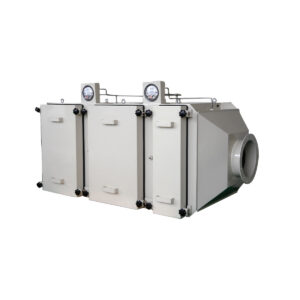
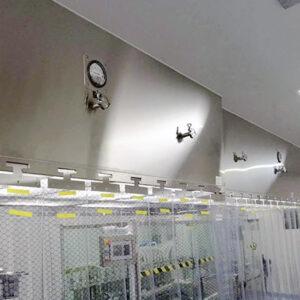
Pressure monitoring requires more than ordering a gauge. Each filtration stage should have its own differential pressure gauge, and the supporting hardware — tool racks, connectors, and connecting pipes — must be included in the same order. Pressure gauge lines also require mini-HEPA or equivalent high-efficiency in-line filters to prevent gauge-line contamination from affecting reading accuracy. Ordering gauges without their supporting pipework and line filters is a coordination failure that routinely surfaces during installation when the gauge cannot be connected or read reliably.
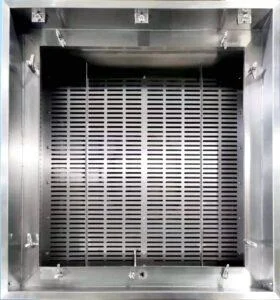
Test access for in-situ filter integrity testing requires a PAO scan segment, specified as either manual or automatic before the order is placed. Upstream and downstream disinfection ports serve a separate but equally forward-planned function: they allow gas sterilization of the container interior without requiring system teardown. Both items share the same failure pattern — they are physically impossible to retrofit without disrupting installed ductwork, so their absence after installation is not a minor inconvenience but a constraint on what the system can do operationally.
| الإكسسوار | الوظيفة الأساسية | What to Specify Before Ordering |
|---|---|---|
| Bio-sealed isolation damper | Bubble-tight isolation for filter replacement in hazardous exhaust | 10-inch head of water isolation performance requirement |
| Pressure gauge package | Differential pressure monitoring per filtration stage | Include tool racks, connectors, and connecting pipes—not just gauges |
| Mini-HEPA gauge line filters | Keep differential pressure lines clean for accurate readings | Filter specification to prevent gauge contamination |
| PAO scan segment | Filter leak testing (manual or automatic) | Must be specified before ordering to enable in-situ testing |
| Upstream/downstream disinfection ports | Gas sterilization of container interior | Location and access provisions for sterilization protocol |
The planning implication across all five accessory types is the same: each one must be specified against a defined function before ordering, because the decision about which accessories to include is also the decision about what the system will be capable of doing once installed.
Damper And Gauge Placement Before Maintenance Planning
Where an accessory is placed in the system is as consequential as whether it is included at all. A damper positioned downstream of a filter stage rather than upstream creates an isolation sequence that may not be maintainable safely. A pressure gauge tapping located in a section of ductwork that is inaccessible after insulation is applied provides readings that cannot be corroborated or serviced. Placement decisions that look minor during design become fixed constraints once the system is installed.
For pressure gauge pipework, the airtight isolating valve on the gauge pipeline is a functional requirement, not an accessory detail. Without it, the gauge line cannot be isolated during maintenance, which means the gauge itself cannot be serviced or calibrated without affecting system integrity. Both upstream and downstream gauge lines should include sterilization ports so that gauge pipework can be treated independently without requiring a full system shutdown. These are not add-ons to confirm later — they are part of the gauge line assembly and should be confirmed in the design package before installation begins.
Material specification matters at the procurement stage rather than during installation. Pressure gauge pipes and associated accessories should be SUS 304 stainless steel, a requirement that affects procurement lead times and compatibility with other installed components. If this is not confirmed before the order is placed, substitution of incompatible materials during installation introduces both a compliance gap and a practical maintenance problem.
The enclosure’s own pressure resistance rating defines the boundary within which all damper and gauge selections must operate. A standard BIBO enclosure pressure resistance of ±3 kPa, factory tested at ≥2.5 kPa for airtightness, is a design threshold from enclosure specification — not a regulatory limit — but it sets the ceiling for what the damper and gauge package must be designed to handle. Selecting dampers or gauge assemblies rated below this threshold undermines the enclosure’s tested integrity.
| المتطلبات | Why It Matters for Maintenance | What to Confirm Before Installation |
|---|---|---|
| Airtight isolating valve on pressure gauge pipeline | Enables safe gauge isolation during service | Valve is included in gauge line design and accessible |
| Sterilization ports on upstream and downstream lines | Allows sterilization of gauge lines without system shutdown | Ports present on both sides of the pressure line |
| Pressure gauge pipes and accessories in SUS 304 stainless steel | Material compatibility and durability in cleanroom environments | Material specification confirmed in procurement documents |
| Enclosure pressure resistance ±3 kPa (factory tested ≥2.5 kPa) | Defines design limits for damper and gauge selection | Enclosure rating aligns with system pressure requirements |
Maintenance planning that does not account for these placement and material requirements will encounter friction at every service interval. The question to resolve before installation is not just whether an isolating valve is present, but whether it is sited where a technician can reach it, operate it safely, and confirm closure before beginning work on the filter.
Optional Extras That Become Validation Requirements Later
The procurement category labeled “optional” deserves scrutiny in any BIBO project with a formal validation scope. Three items in particular follow a consistent failure pattern: they are listed as optional at the time of ordering, they are deferred to control costs or simplify the initial scope, and they surface as requirements during validation sign-off — by which point retrofitting them into an installed system is disruptive and often structurally difficult.
A differential pressure gauge rated 0–750 Pa, listed as optional per filtration stage, becomes necessary for pressure trending the moment the facility’s maintenance protocol includes filter replacement criteria based on differential pressure readings. Without a gauge at each stage, there is no continuous basis for determining when a filter has loaded to the point of replacement. Validation protocols that require demonstrated pressure trending across the filter life cycle will not accept a system where gauges are absent from one or more stages. The omission is not caught during procurement review; it is caught during protocol execution.
The HEPA filter PAO scan section presents the most binary consequence of the three. In-situ integrity testing, which is typically required before a BIBO system is released for operation in pharmaceutical or high-containment environments, depends on physical access ports that allow aerosol introduction upstream and scanning downstream. If no scan section was specified, that test cannot be performed at all — not with difficulty, but not at all. ISO 14644-3:2019 provides the testing methodology framework for installed filter leak testing, and a system without scan access cannot be tested to that methodology regardless of how well the filter itself performs.
A differential pressure transmitter for central monitoring is the third item in this pattern. Projects that include BMS integration, remote alarming, or centralized data logging in their validation scope will require a transmitter rather than a local gauge. The transmitter is frequently listed as an add-on because not every project includes centralized monitoring at handover — but the moment a validation protocol specifies remote data capture or alarm set-points tied to differential pressure, the local gauge is insufficient and the transmitter becomes a compliance requirement rather than a convenience.
| Optional Extra | متطلبات التحقق من الصحة | المخاطر في حالة حذفها |
|---|---|---|
| Differential pressure gauge (0–750 Pa) per filtration stage | Pressure trending needed for maintenance and compliance | Missing gauge prevents monitoring and can delay validation sign-off |
| HEPA filter PAO scan section (manual/automatic) | In-situ leak testing mandatory before system release | Without scan section, integrity testing cannot proceed, causing release delays |
| Differential pressure transmitter for central monitoring | Centralized data collection required for compliance | Lack of transmitter prevents remote monitoring and alarm functions |
The check at specification stage is straightforward: review the draft validation protocol against the accessory list before the order is placed. If the protocol references pressure trending, in-situ leak testing, or remote monitoring, the corresponding accessories are not optional for that project regardless of how they are categorized in the product specification.
Installation Friction From Missing Ports Or Pressure Indicators
Omissions made during scope definition do not stay in scope definition. They reappear at installation, at commissioning, and at every maintenance event for the life of the system. The pattern is consistent: an item that would have cost relatively little to include in the original order becomes expensive and logistically difficult to add after the housing is installed and connected to ductwork.
Missing PAO sampling and scan ports are the most consequential installation omission because they directly block the integrity testing required before system release. Unlike a missing gauge that might be read from a nearby tapping, there is no workaround for absent scan access — the test physically requires the port to introduce aerosol upstream and scan downstream. A BIBO system without this access cannot be verified as leak-tight in service, which is not a documentation problem but an operational one: the system should not be released until integrity is confirmed. For guidance on what filter testing and verification involves across the maintenance lifecycle, the practical steps are detailed in اختبار مرشح مروحة غرف الأبحاث وصيانتها - استبدال مرشح HEPA واستكشاف الأعطال وإصلاحها.
Missing upstream and downstream pressure tapings make continuous pressure drop tracking impossible, which means filter loading cannot be monitored and replacement timing is based on schedule rather than condition. In practice, this creates two risks that run in opposite directions: filters replaced too early because there is no pressure data to justify extending service life, and filters replaced too late because there is no signal that loading has exceeded design limits. Neither outcome is acceptable in a controlled environment where filter condition has direct implications for containment.
A missing shut-off valve removes the primary means of airflow isolation before filter changeout. Without isolation, the filter replacement procedure must either rely on the upstream process being shut down entirely — which may not be operationally feasible — or accept that maintenance personnel are working in an airstream that cannot be stopped at the housing level. This is not a minor procedural inconvenience; it is an exposure control gap that affects both personnel safety and the containment integrity of the bag-in bag-out procedure itself.
| Missing Accessory | Consequence During Installation | What to Confirm in Scope |
|---|---|---|
| PAO sampling and scan ports | In-situ integrity tests and validation cannot be performed | Ports are specified for upstream and downstream access |
| Upstream/downstream pressure tapings | Continuous pressure drop tracking is not possible | Tapings are included in housing or duct design |
| Shut-off valve | Airflow isolation for safe filter replacement is unavailable | Valve is part of the damper assembly or clearly defined as contractor scope |
The practical implication is that scope review for a BIBO accessory package should be conducted against what the system must do operationally, not against what the base housing specification includes by default. Items confirmed as contractor scope — rather than housing supplier scope — must be confirmed as explicitly assigned, not assumed.
System Readiness Checks Before Exhaust Service
Before any BIBO exhaust system undergoes filter replacement, the installed accessory set determines what checks are possible. Post-replacement verification is not a documentation step; it requires physical access points, calibrated instrumentation, and isolation capability that must have been specified before installation.
After filter replacement, the system must undergo PAO or DOP aerosol leak testing to confirm that the new filter is seated correctly and the housing is free of bypass paths. It must also undergo airtightness verification to confirm that the enclosure integrity has not been compromised by the changeout procedure. ISO 14644-3:2019 provides the testing methodology for both procedures in installed cleanroom filter systems. Neither test is possible without the scan ports, pressure tapings, and isolation valve being in place before the filter is changed. If those accessories were not specified originally, the post-replacement readiness check becomes a problem of access before it becomes a problem of results.
Operational planning should also account for the condition of filters that have been stationary through extended system shutdowns. As an operational guideline — not a regulatory interval — filters should be assessed for replacement when a system has been offline for more than approximately one month, because media retention during shutdown can create secondary contamination risk when airflow resumes. This means that isolation and test access become relevant not only during planned maintenance cycles but also after unexpected outages or facility shutdowns. A system that lacks isolation capability or scan access is equally unprepared for an unplanned service event as it is for a planned one.
The readiness check before service is, in effect, a backward audit of the original accessory specification. If the damper is present and rated correctly, isolation is achievable. If pressure tapings are installed and gauges are connected, the pre- and post-replacement differential pressure baseline can be documented. If the PAO scan segment is in place, integrity testing can proceed to completion. Every step in the readiness sequence maps directly to an accessory that had to be specified before the housing was ordered. Where any of those items is missing, the readiness sequence cannot be completed, and the system cannot be returned to service with confidence.
For a structured view of how BIBO operation and maintenance integrates across the full system lifecycle, the procedural detail is covered in the أنظمة إدخال الأكياس في الأكياس/إخراجها (BIBO): دليل التشغيل والصيانة.
The most useful moment to define accessory scope for a BIBO exhaust system is before the housing order is placed — not because late additions are impossible, but because they are structurally constrained by what the installed housing can accommodate and disruptive to a system that may already be integrated into ductwork and building services. The three functional categories — isolation before service, pressure monitoring across filtration stages, and physical access for in-situ integrity testing — each require specific accessories, confirmed material specifications, and clear scope ownership across the housing supplier and HVAC contractor.
Before finalizing a BIBO accessory order, confirm that the isolation damper carries a defined bubble-tight performance rating, that the pressure gauge package includes its supporting pipework and line filters rather than gauges alone, that scan sections and disinfection ports are specified for the access functions the system will need in service, and that any item described as optional in the product specification has been reviewed against the facility’s validation protocol. The friction from missing items is predictable. The point at which it becomes expensive is after installation.
الأسئلة الشائعة
Q: Who is responsible for supplying the isolation damper and gauge pipework — the BIBO housing supplier or the HVAC contractor?
A: This must be confirmed explicitly before ordering, because neither party will assume it by default. In most projects, the BIBO housing supplier provides the housing with mounting provisions, while the HVAC contractor is expected to supply and install the damper and gauge pipework as part of the duct system — but this split is rarely documented clearly. The result is that both parties assume the other has covered it, and the gap surfaces at commissioning. Resolve scope ownership in writing during the design package stage, not during installation.
Q: If a BIBO system is already installed and the PAO scan port is missing, is there any way to perform in-situ filter integrity testing without retrofitting?
A: No practical workaround exists. In-situ aerosol leak testing requires a physical port to introduce the challenge aerosol upstream of the filter and a scan access point downstream. Without those ports, the test cannot be performed regardless of what instrumentation is available elsewhere in the system. Retrofitting scan access into an installed housing that is already connected to ductwork is structurally disruptive and may not be feasible depending on the installation configuration. This is why scan section specification must be resolved before the housing order is placed.
Q: Does every BIBO exhaust system need a differential pressure transmitter, or is a local gauge sufficient?
A: A local gauge is sufficient only when no centralized monitoring, BMS integration, remote alarming, or electronic data capture is required by the facility’s validation protocol or operational specification. If any of those requirements apply — including alarm set-points tied to differential pressure or data trending submitted as validation evidence — a transmitter is required rather than a gauge. The decision point is the validation protocol, not the product specification. Review the protocol before finalizing the accessory order to determine which output type the system actually needs.
Q: Does the one-month shutdown guideline for filter assessment apply even if the exhaust system passed its last integrity test before going offline?
A: Yes, because the concern is not the filter’s tested condition at shutdown but what happens to the filter media during an extended period without airflow. Media retention during a prolonged shutdown can create secondary contamination risk when airflow resumes, independent of how recently the filter passed a leak test. A previously verified filter is not exempt from this assessment. The implication for accessory readiness is that isolation capability and scan access must be available for unplanned service events following unexpected outages, not only for scheduled maintenance cycles.
Q: At what point does adding more accessories create more coordination risk than operational benefit?
A: The coordination overhead increases meaningfully when accessories require confirmed scope across multiple trades — for example, when stainless steel gauge pipework, sterilization ports, and transmitter wiring each involve different contractors without a single party confirming the assembled system. The accessories themselves do not create the risk; unassigned scope does. The practical threshold is this: each accessory added beyond the base housing spec should have a named responsible party, a confirmed material specification, and a place in the commissioning checklist before the order is placed. Accessories with all three confirmed add operational capability without meaningful coordination risk. Accessories without them add friction regardless of how straightforward the component itself is.