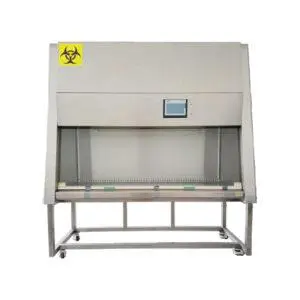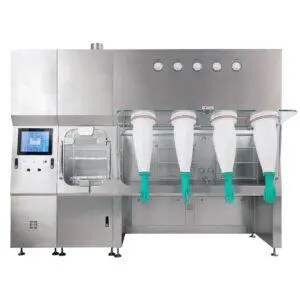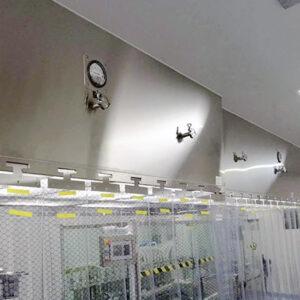
Specifying a modular room structure before GMP grade, room boundary, and transfer flow logic are fixed is one of the more common sources of late-stage rework in cleanroom projects. The consequence is not a minor adjustment — it is layout revision at commissioning, unassigned qualification protocols, and a QA team that cannot release the room because no one owns the contamination control strategy. The decision that prevents this is agreeing on grade relationship, segregation logic, and document ownership before any supplier scope is written. What follows will help engineers, QA teams, and procurement leads identify where the boundaries of a modular room package end and where GMP readiness work begins.
GMP process risk before pharmaceutical modular room scope
Grade assignment is not a detail to refine after the modular room is specified. It is the planning input that determines airflow direction, segregation architecture, which transfer points belong inside the vendor scope, and how qualification boundaries are drawn. Getting it wrong at the specification stage pushes rework into commissioning, when design changes are significantly more expensive.
EU GMP Annex 1 establishes that cleanliness standards and segregation requirements differ by grade — A, B, C, and D each carry different airflow and environmental monitoring obligations. A room specified for Grade C work that is later reassigned to Grade B fills does not just require different filter performance; it may require a fundamentally different room geometry, additional pressure cascade stages, and requalification of every adjacent space. The modular format does not compress that consequence.
The process risk map should precede the room specification in this sequence: identify the manufacturing activity, assign the required grade for that activity, determine which adjacent grades are needed for segregation, then define the room boundary and transfer logic. Only at that point does a supplier scope become meaningful. A غرفة نظيفة صيدلانية ذات تصميم معياري package can deliver a well-integrated structure efficiently — but the structural envelope cannot substitute for the upstream decision about what grade environment that structure is intended to maintain.
Incorrect grade assignment at this stage is a compliance risk, not a performance trade-off. If the grade is wrong, the contamination control logic built around it is wrong, and validation protocols written against that logic will not survive regulatory scrutiny.
Panels, FFUs, transfer points, and gowning flow in one package
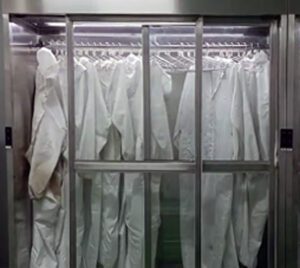
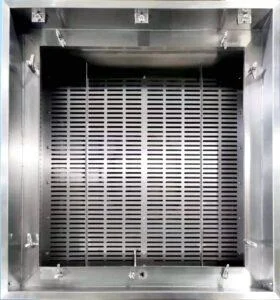
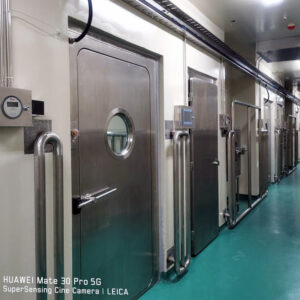
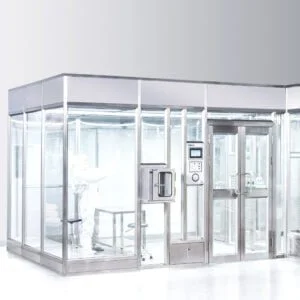
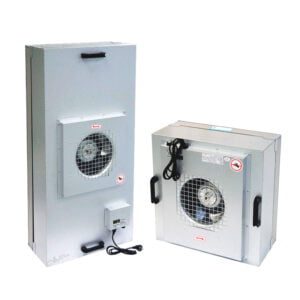
A modular cleanroom package typically consolidates panels, ceiling grid, fan filter units, pass-through or transfer points, and gowning anteroom flow into a single supply scope. The structural advantage is layout delivery speed — the integration of these elements is pre-engineered rather than resolved on site. The compliance work that follows the structure, however, is not part of that package.
Within the physical scope, the airflow architecture choice carries downstream consequences that extend beyond upfront cost. A recirculating system routes return air through wall chambers back to ceiling-mounted HEPA filters, reducing the particulate load on those filters and extending service intervals. A non-recirculating single-pass system eliminates the return path by exhausting through wall gaps or grilles, reducing capital cost but placing full particulate load on each air change and generally limiting suitability for higher-grade requirements.
| نهج التصميم | الميزة الرئيسية | Limitation / Trade-Off | Typical Application Context |
|---|---|---|---|
| إعادة التدوير (HEPA-filtered return via wall chambers) | Reduced filter contamination load; extended HEPA filter life; lower maintenance frequency | Requires installation of return ductwork/chambers; may involve higher initial system cost than single-pass | Pharmaceutical cleanrooms where filter longevity and maintenance reduction are prioritized |
| Non-recirculating (single-pass, exhausted via wall gaps/grills) | Lower upfront capital cost (no return ductwork) | Higher energy and filter load; may not suit higher-grade cleanroom requirements | Lower-grade applications with capital cost sensitivity |
The airflow architecture choice is not purely a cost decision — it affects grade suitability, maintenance frequency, and HVAC integration requirements. A single-pass design that suits a Grade D support area may not reliably maintain the air change rates and pressure cascade needed for Grade B or C manufacturing. That boundary should be established before the system architecture is selected, not after installation.
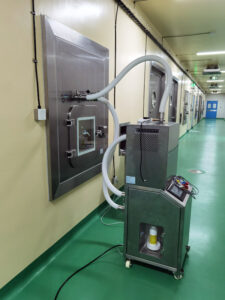
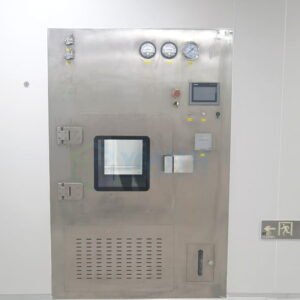
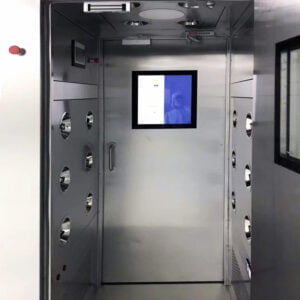
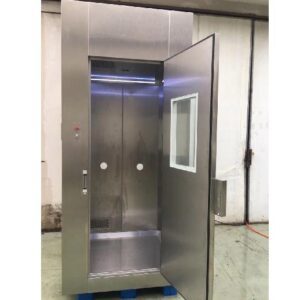
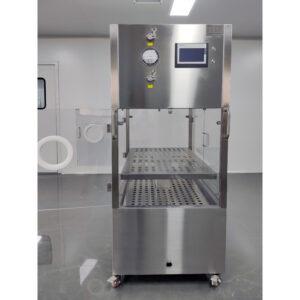
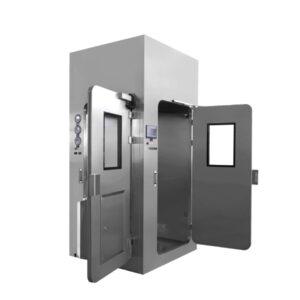
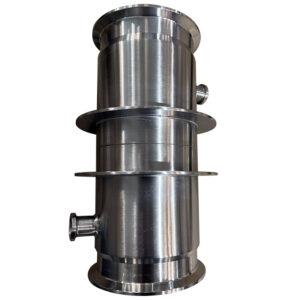
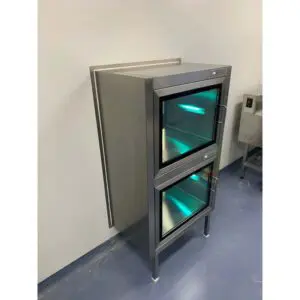
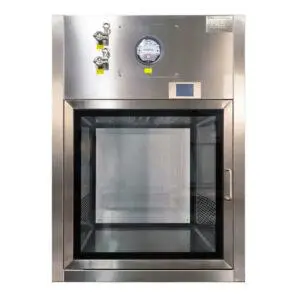
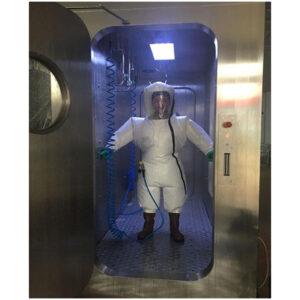
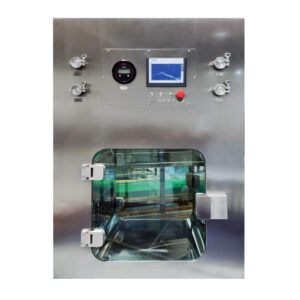
Where combined GMP and biosafety requirements apply, gowning flow logic becomes more constrained. A three-anteroom arrangement with a dedicated sink is one design response to the conflict between outward GMP cascade and inward BSL-2 containment airflow — not a universal GMP requirement, but a documented approach to resolving a specific directional conflict that cannot be addressed by panel geometry alone. Transfer points, including pass boxes and غرف التمرير من نوع VHP, need to be positioned in the room layout with decontamination cycle access, validation port access, and interlocking door logic already accounted for — not added as afterthoughts to a finalised panel drawing.
Supplier evidence and validation-boundary questions
A modular room supplier can demonstrate panel construction, FFU performance data, and material washdown suitability. What they cannot provide is evidence that the room, as installed on a specific site, meets the grade requirements the QA team will qualify against. That gap is where validation boundary questions need to be asked before purchase, not at IQ.
The sharpest version of this gap emerges when GMP and biocontainment requirements coexist. A cascading pressure profile — required for GMP grade separation — runs outward from the cleanest zone. BSL-2 containment requires inward airflow, drawing air from the corridor into the containment zone. These two requirements are directionally opposed, and a modular room’s geometry cannot resolve the conflict on its own. The design must address it explicitly, and the supplier must be able to demonstrate how.
| متطلبات الاحتواء | Airflow Direction Requirement | Conflict with GMP Cascading Flow | Validation Boundary Concern |
|---|---|---|---|
| GMP only (no BSL) | Outward cascade from higher to lower grade | No inherent conflict | Standard GMP grade separation validation |
| BSL-2 Containment | Inward airflow from low to high containment area | Cascading outward flow cannot simultaneously satisfy inward containment; pure cascade design fails | Modular room must resolve the directional conflict (e.g., via three-ante-room with sink) to avoid non-compliance |
| BSL-3 Containment | Two inward doors (sink); stronger inward flow | Intensified conflict; two inward airflow steps complicate maintaining GMP grade separation | Higher validation complexity; requires dedicated design solution and thorough qualification |
BSL-3 intensifies this further. Two inward door steps and stronger negative pressure requirements make it significantly more difficult to maintain any meaningful outward GMP pressure cascade. The validation boundary complexity in this scenario is not a supplier scope problem — it is a design problem that must be resolved before the room is specified, and it requires documented agreement between engineering, biosafety, and QA.
ISO 14644-4:2022 provides a framework for cleanroom design, construction, and start-up qualification that is relevant here, not as a rule governing containment airflow direction, but as a reference for what commissioning and qualification testing scope looks like. Where validation boundary questions are unresolved at the time of supplier engagement, testing against that framework will surface the gaps — but at a project stage where correction is costly. The better use of the standard is as a pre-specification checklist, not a post-installation diagnostic.
Compliance risk from treating modules as standalone GMP solutions
The failure pattern is consistent: a modular room is purchased with panels, FFUs, and a pass-through, the structure is installed, and the QA team then asks who owns the qualification protocol. No one has a clear answer. The contamination control strategy has not been written. HVAC balancing has not been confirmed against the room’s pressure requirements. SOPs for cleaning, gowning, and transfer procedures have not been assigned to an owner. The room cannot be released.
This is not a failure of modular construction as a format. It is a failure of scope definition at the procurement stage. A modular room package accelerates layout delivery; it does not compress any of the compliance work that follows. CCS integration, HVAC balancing, qualification protocols, and operating procedures are not supplier deliverables — they are site responsibilities that need to be assigned before the purchase is made, not after the room arrives.
The HVAC integration gap is where this most often surfaces in practice. A modular room unit with internal recirculation still depends on site-supplied makeup air, exhaust connections, and pressure differential management across the room boundary. If the HVAC contractor’s scope does not include commissioning those connections against the room’s pressure cascade requirements, and if no one has confirmed who balances and documents the result, then airflow cascade validation is unsupported regardless of how well the panels are manufactured.
Multidisciplinary alignment — engineering, QA, and EPC or HVAC contractor — is not a regulatory mandate, but it is a defensibility condition. When an inspector asks how the contamination control strategy was validated against the installed room, the answer needs to trace through design intent, commissioning records, and qualification data. A modular room package delivered without that chain of ownership leaves a gap that is difficult to close retrospectively. For teams working through the documentation requirements at this stage, a detailed review of GMP-compliant cleanroom equipment documentation and validation responsibilities can help clarify which records belong to the supplier and which must be generated by the site.
Purchase trigger after grade, flow, and document owner are fixed
Premature purchase — before grade, airflow architecture, containment requirements, and document ownership are agreed — does not save project time. It creates mismatched equipment and unresolved validation boundaries that become visible at commissioning, when the cost of correction is highest.
The four requirements that need to be fixed before a purchase order is raised are interdependent. Grade determines airflow direction and segregation logic. Airflow architecture determines HVAC integration requirements and filter maintenance scope. Containment requirements determine whether the airflow direction is even resolvable within a standard GMP cascade design. And document ownership determines whether the qualification, CCS, and SOPs that the room depends on have a named responsible party.
| Requirement to Finalize | Why Critical Before Purchase | Risk if Not Fixed |
|---|---|---|
| GMP Grade (A, B, C, D) | Cleanliness and segregation standards drive room specification; incorrect grade assignment can compromise contamination control | Non-compliance with GMP, potential contamination, costly redesign |
| تصميم تدفق الهواء (cascading, recirculating, single-pass) | Determines air path, filter load, energy use, and HVAC integration; must align with grade and process needs | Mismatched airflow leads to higher operational cost, inadequate cleanliness, or validation failure |
| Containment Requirements (BSL-2, BSL-3, etc.) | Affects door/ante-room layout and airflow direction; conflict with GMP cascade must be resolved in design | Inability to satisfy both GMP and containment standards; validation boundary not met |
| Document Owner (qualification protocols, contamination control strategy, SOPs) | Clarifies who delivers and owns validation documents, contamination control strategy, and operating procedures | Unsupported qualification, missing CCS/SOPs, delays in release to operation |
Document owner assignment is not a supplier deliverable. No modular room manufacturer can determine who, within the buyer’s organisation or EPC arrangement, is responsible for authoring qualification protocols or maintaining the contamination control strategy. That is a planning decision the buyer must make internally. Leaving it unresolved means the room can be physically complete and still unable to enter OQ because the protocol has no owner.
The practical implication is that the purchase decision functions as a scope-lock event. Once the modular room is ordered to a fixed specification, changes to grade requirements, airflow architecture, or room boundary become structural changes — not document revisions. Teams that use the pre-purchase window to confirm all four requirements reduce the probability of commissioning-stage rework and give QA a defensible qualification basis before the first protocol is written.
A modular room format speeds the physical delivery of a controlled environment — it does not speed the compliance work surrounding it. The equipment scope can be well-integrated and efficiently delivered while the site remains unable to operate the room because CCS, HVAC balancing, qualification protocols, and SOPs are unassigned. The distinction between what the supplier hands over and what GMP readiness actually requires is the boundary that project teams need to map before engaging any vendor.
Before proceeding to procurement, confirm that grade relationship between all adjacent spaces is fixed, that airflow architecture is chosen against grade and containment requirements rather than capital cost alone, and that a named owner exists for each qualification and operating document the room will depend on. If those conditions are not met, the modular format will accelerate delivery of a structure that QA cannot release.
الأسئلة الشائعة
Q: What happens if GMP grade requirements change after the modular room has already been ordered to a fixed specification?
A: A grade change after purchase becomes a structural problem, not a document revision. Because grade determines airflow direction, pressure cascade stages, and room geometry, a reassignment — for example from Grade C to Grade B — may require changes to panel layout, additional anteroom stages, and requalification of every adjacent space. The modular format does not compress that consequence. This is why grade relationship across all adjacent spaces must be locked before a purchase order is raised, not refined during commissioning.
Q: If a facility already has a capable HVAC system, does that reduce what needs to be resolved before specifying the modular room?
A: Not significantly. An existing HVAC system establishes available makeup air and exhaust capacity, but it does not automatically satisfy the pressure differential management requirements across the modular room boundary. Someone still needs to confirm that the HVAC contractor’s commissioning scope explicitly covers balancing those connections against the room’s pressure cascade, and that the results are documented in a form QA can qualify against. Without that confirmation in writing before procurement, the HVAC integration gap remains open regardless of how capable the existing system is.
Q: Is a recirculating airflow design always the right choice for higher-grade pharmaceutical manufacturing, or are there conditions where single-pass is acceptable?
A: Single-pass is generally limited to lower-grade support areas such as Grade D. For Grade B or C manufacturing, the air change rates, pressure cascade reliability, and particulate control requirements that regulators and ISO 14644-4:2022 expect are more consistently maintained by a recirculating architecture. The lower capital cost of single-pass is a genuine trade-off, but it should be evaluated against grade suitability and long-term filter load rather than treated as a neutral cost decision. Choosing single-pass for a higher-grade application to reduce upfront spend risks an airflow architecture that cannot support qualification.
Q: Once the modular room is installed and HVAC is balanced, what is the immediate next step before QA can begin qualification?
A: The contamination control strategy must be documented and owned before qualification protocols can be written. IQ, OQ, and PQ each need to be traced back to a CCS that assigns responsibility for cleaning, gowning, transfer procedures, and environmental monitoring. If no named owner has been assigned for those documents during the pre-purchase planning stage, the room will be physically complete but unable to enter OQ — because there is no protocol author and no approved baseline document to qualify against. Annex 15 of EudraLex Volume 4 is the relevant reference for what that qualification chain needs to demonstrate.
Q: Does the complexity of combining GMP and biocontainment requirements make a modular format impractical, or is it still a viable approach?
A: A modular format remains viable for combined GMP and BSL-2 environments, but only if the directional airflow conflict is resolved explicitly in the design before the room is specified — not managed afterwards through commissioning adjustments. The three-anteroom arrangement with a dedicated sink is one documented response to that conflict. Where BSL-3 is involved, the negative pressure requirements make outward GMP cascade significantly harder to maintain, and the validation boundary complexity increases to a point where engineering, biosafety, and QA must reach documented agreement before any supplier scope is written. The modular structure cannot substitute for that upstream design resolution.