Most procurement teams enter vendor conversations with a working assumption: the company presenting the proposal owns what they’re selling. That assumption breaks down often enough in cleanroom procurement that the downstream cost deserves to be named directly — missing material certificates, absent FAT records, or drawing revisions that no one can authorize because the vendor was aggregating from a factory they don’t control. The consequence isn’t a paperwork inconvenience; it’s a re-qualification cycle that wasn’t in the project budget or timeline. Understanding whether the entity across the table controls fabrication, owns documentation, and can respond to design changes is the judgment that separates a manageable procurement from one that stalls at commissioning.
Manufacturer capability versus supplier support responsibilities
The first conversation to have with any cleanroom vendor is about fabrication scope — not product catalog breadth. A manufacturer discussion should confirm what the facility actually builds: whether they can achieve the ISO classification your application requires, whether they control the production process for structural and filtration components, and whether design changes go through their own engineering team or get routed back to a source factory you never speak with directly. A supplier discussion has a different scope: what they source, from where, whether configuration support is included, and how documentation and after-sales handoff are handled once equipment ships.
The practical difference matters because ISO 14644 defines cleanroom classifications from ISO 1 through ISO 9 based on airborne particulate concentration limits, and the equipment required to reach and hold a given classification — filtration efficiency, materials, sealing, and air change rates — varies significantly across that range. A vendor who can quote you an ISO 7 room is not automatically capable of reliably delivering an ISO 5 environment. Verification of classification capability is a direct question about fabrication and engineering depth, not a catalog check.
One planning detail that teams routinely underestimate is the qualification window. Evaluating a new manufacturer or supplier triggers a qualification process that, depending on complexity and your internal procedures, can run anywhere from 30 to 180 days. That range isn’t a regulatory requirement — it’s a planning criterion, and underestimating it compresses the project schedule in ways that create pressure on acceptance testing and documentation review.
| Was zu überprüfen ist | Warum es wichtig ist | Detail/Timing |
|---|---|---|
| ISO classification capability (ISO 1–9 per ISO 14644) | Ensures the cleanroom meets intended contamination control requirements | Confirm the vendor can provide cleanrooms matching the required ISO class |
| Cleanroom-compliant packaging (e.g., IEST-standard double-bagging) | Confirms the supplier can provide properly packaged items for controlled environments | Request product samples and inspect packaging |
| Qualification process duration | Affects project lead time and resource planning | Account for 30–180 days when evaluating new manufacturers or suppliers |
Packaging is a secondary but practical signal: a vendor serving controlled environments should be able to supply cleanroom-compliant packaging, such as IEST-standard double-bagging, as a routine capability. If that’s a special request rather than a default, it reflects how deeply cleanroom logic is embedded in their operations.
Drawings, materials, and test records buyers should verify
The gap between what a vendor promises and what arrives at commissioning is almost always a documentation gap, not a hardware gap. Equipment can be physically present and still fail to clear regulatory review because the material certificates, dimensional drawings, or factory acceptance test records are incomplete, formatted incorrectly, or — in supplier-aggregated scenarios — simply not available from the source factory.
The specific records to request before shortlisting are: dimensional and fabrication drawings tied to the configuration you ordered, material certificates for cleanroom-wetted or structural components, and FAT records that demonstrate the equipment was tested against agreed acceptance criteria before shipment. The testing procedures behind those FAT records should align with recognized international test method standards — not because that’s automatically a legal obligation in every jurisdiction, but because non-standard test records are difficult to defend during regulatory review under frameworks like EudraLex Annex 15, which governs qualification and validation documentation for pharmaceutical environments.
Audit and testing frequency is a consistency check, not just a compliance exercise. ISO 14644 testing practice generally treats stricter ISO classes — where contamination limits are tighter — as requiring requalification every six months, while less demanding classifications are typically reviewed annually. Framing this correctly in a vendor conversation means asking not just whether they test, but whether their records reflect that cadence and whether those records are available to you as the buyer. A vendor who produces results on request but cannot supply historical records across audit cycles is offering a snapshot, not a traceable performance history.
| Was zu bestätigen ist | Warum es wichtig ist | Frequency/Standard |
|---|---|---|
| Testing procedures comply with international test method standards | Avoids missing FAT records or material certificates that can delay approval | Per applicable international test method standards |
| Continuous particulate monitoring system detects threshold exceedances | Provides real-time data and documented environmental control | Ongoing; system should detect exceedances in real time |
| Audit and testing frequency is appropriate for the ISO class | Ensures test record consistency and regulatory compliance | Every 6 months for stricter ISO classes, annually for others |
Continuous particulate monitoring is worth asking about separately from audit records. Real-time environmental monitoring systems that detect threshold exceedances provide ongoing documented control, not just periodic compliance snapshots. Whether this is the vendor’s responsibility or yours depends on the scope agreement — but if the vendor is providing a turnkey controlled environment, clarifying that boundary up front prevents a design gap from surfacing during commissioning.
For more detail on what documentation to request and how to structure a supplier evaluation, the Beschaffung von Reinraumausrüstung | Leitfaden zur Lieferantenbewertung covers the assessment framework in practical terms.
Custom fabrication advantages and traceability tradeoffs
Direct manufacturers can respond to design change requests faster because the engineering authority and the fabrication floor are in the same organization. When a drawing revision is needed — a module dimension adjusted for a facility constraint, a filtration configuration changed for classification requirements — the change goes to the same team that builds the equipment. There is no relay through an intermediary who then contacts a factory in a separate time zone.
The traceability consequence of that structure is more significant for regulated buyers than it might initially appear. A direct manufacturer with documented lot traceability can connect the specific materials used in your equipment back to their origin — batch records, supplier certificates, and inspection results from the factory floor to your facility. That chain matters most when something goes wrong: a contamination event or performance failure that requires identifying what materials were used, when, and from which source. In a supplier-aggregated model, that chain often passes through multiple source factories, and the aggregator may not hold the underlying records. The recall risk is not theoretical — it’s a function of how many hands the traceability chain passes through.
The trade-off is real in the other direction too. Suppliers who aggregate across multiple manufacturers can offer broader product options, which may serve buyers with diverse or rapidly changing requirements. The cost is accountability diffusion: when a design question arises after delivery, the communication path back to the engineering source becomes unclear, and the supplier may have limited authority to authorize changes or clarify specifications.
| Aspekt | Direct Manufacturer | Supplier (Aggregator) | Tradeoff/Risk |
|---|---|---|---|
| Customization speed | Faster customization capabilities | Aggregates multiple options, which may delay custom orders | Speed vs breadth of product options |
| Lot traceability | Documented traceability from factory floor to buyer facility | Traceability often relies on multiple sources, increasing recall difficulty | Traceability advantage for manufacturer; higher recall risk for supplier |
| Communication path | Direct engineering communication possible | Additional communication layers, potential for delays or misconfigurations | Communication and traceability risk introduced by supplier aggregation |
The downstream consequence that teams underestimate is that traceability gaps don’t surface until they’re needed — and when they’re needed, they’re urgent. Building lot traceability requirements into the purchase agreement, rather than assuming they’re standard, is the practical way to close that gap before it becomes a post-delivery problem.
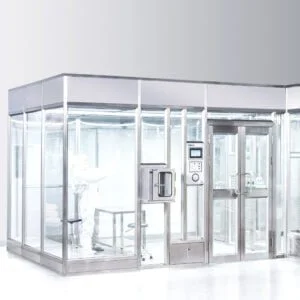
For enclosed fabricated environments where dimensional customization and panel system traceability intersect, Modularer Reinraum und Wall & Ceiling System configurations illustrate what manufacturer-controlled design and fabrication looks like at the system level.
Handoff risk after delivery, warranty, and replacement parts
Delivery is the point at which accountability most commonly goes silent. While the vendor relationship is active — during quoting, order confirmation, and shipment — most questions get answered. The risk window opens once equipment is installed and the project transitions to operation, because that is when warranty response speed, design change authority, and replacement part availability become load-bearing.
Warranty response is a direct function of who owns the design. A direct manufacturer can authorize repairs, replacement components, and configuration adjustments from within the same organization that built the equipment. A supplier acting as intermediary may need to route warranty claims back to the source factory, introducing response delays that are difficult to predict and harder to contractually enforce. The practical question to ask before signing is: if a performance problem surfaces six months after installation, who makes the technical decision about the resolution, and how long does that path take?
Replacement parts expose the same ownership question in a different form. HEPA and ULPA filters are consumable components — they degrade over time and require replacement to maintain cleanroom performance. Replacement intervals are not a fixed regulatory deadline; they vary by ISO classification, usage intensity, and the manufacturer’s own specifications. But the planning consequence is fixed: if a replacement part is unavailable, the cleanroom either operates out of specification or goes offline. The question to ask in procurement is not just whether a vendor can supply the initial equipment, but whether they can reliably source or manufacture the replacement filters and components specific to your configuration across a multi-year operational horizon. A supplier aggregating from multiple factories may have no reliable answer to that question for components sourced from a factory they don’t control.
Design ownership after delivery is the third element of handoff risk and the one most often left unresolved. If your facility layout changes, if regulatory requirements shift, or if a performance problem requires a configuration adjustment, who has the authority and the engineering records to make that change? Leaving that question unanswered at purchase creates a situation where you own equipment but have no clear technical path to modify or re-qualify it.
Die Installation, Betrieb und Wartung von Reinraumanlagen: Ein umfassender Leitfaden provides useful framing for how maintenance scope and operational responsibilities should be defined before installation begins.
Supplier model choice after ownership and communication path are fixed
The choice between sourcing from a direct manufacturer or a supplier should be made after three ownership questions are answered — not before. Who owns the fabrication and design authority? Who owns the documentation and can produce or revise it on request? Who is the technical contact for engineering questions, warranty claims, and replacement parts after delivery? If those three questions don’t have clear answers, the vendor model choice is premature, regardless of how the company characterizes itself.
Once those questions are resolved, the supplier model choice becomes a risk calibration exercise rather than a capability question. Using a direct manufacturer concentrates accountability and simplifies the communication path but may limit product breadth for buyers with diverse sourcing requirements. Using a supplier aggregator extends product options but requires deliberate effort to maintain documentation integrity, traceability standards, and clear escalation paths for post-delivery support.
When a distributor or aggregating supplier is the chosen model, two practical measures reduce supply risk meaningfully. Setting clear expectations on order volume and frequency gives the distributor the information needed to allocate inventory appropriately — without that alignment, stockouts and allocation gaps become predictable rather than surprising. Qualifying a primary and secondary manufacturer, with spend distributed between them, reduces the exposure created by any single-source dependency. Neither of these is a regulatory requirement; both are operational judgments that translate directly into supply stability.
The threshold condition that changes the recommendation is project complexity. For a straightforward procurement of standard configurations at a single ISO class, a well-qualified supplier with strong documentation practices may carry limited additional risk. For multi-phase projects, highly custom configurations, or applications governed by frameworks like ICH Q9(R1) — which structures quality risk management around the probability and detectability of failure — the accountability clarity of a direct manufacturer relationship is harder to replicate through an intermediary model.
The verification that matters most happens before a vendor is shortlisted, not after a purchase order is placed. Asking whether a company calls itself a manufacturer or a supplier is the wrong starting question. The right questions are: who owns the fabrication decisions, who can produce and revise the documentation, and who is technically accountable for warranty response and replacement part availability once the project closes. Those three ownership questions are independent of each other, and none of them are answered automatically by a vendor’s self-description.
Before committing to a shortlist, confirm that you can get direct answers to design change requests, that material certificates and FAT records exist and are transferable to you, and that the path to replacement components is clear for the operating life of the equipment. If any of those answers routes through an intermediary who routes back to a factory you never speak with, that is the accountability gap to resolve — in the contract, in the qualification scope, or by choosing a different vendor entirely.
Häufig gestellte Fragen
Q: What should we do if the qualification window runs longer than expected and it compresses our commissioning timeline?
A: Build the qualification window into the project schedule before vendor conversations begin, not after shortlisting. A 30–180 day qualification range means that a delayed start on vendor evaluation has a direct, non-recoverable effect on acceptance testing and documentation review. If compression is unavoidable, prioritize parallel-tracking documentation collection — material certificates, FAT records, and dimensional drawings — so that regulatory review doesn’t have to wait for hardware acceptance to complete.
Q: If a supplier aggregates from multiple source factories, how do we contractually protect traceability before placing an order?
A: Write lot traceability requirements explicitly into the purchase agreement rather than assuming they are standard. Specify that material certificates, batch records, and inspection results from the source factory must be transferable to you as the buyer, and that the supplier is contractually obligated to obtain and deliver those records — not just forward what happens to be available. If the supplier cannot commit to that obligation in writing, that is a signal that the traceability chain passes through a factory they do not control closely enough to guarantee compliance.
Q: Does the direct manufacturer model still carry an advantage for straightforward, single-ISO-class procurements, or is a well-qualified supplier sufficient?
A: For standard configurations at a single ISO class, a supplier with strong documentation practices and confirmed traceability commitments carries limited additional risk compared to a direct manufacturer. The advantage of direct manufacturer accountability becomes harder to substitute as project complexity increases — multi-phase builds, custom configurations, or applications governed by quality risk management frameworks like ICH Q9(R1) place a higher burden on accountability clarity that an intermediary model is structurally less equipped to provide.
Q: Once the cleanroom is installed and the project closes, who should be the named technical contact for design change authority and warranty response?
A: Identify and document that contact — by name and role, not just by company — before the purchase order is signed. Warranty response speed and design change authority are functions of who owns the engineering records, and a supplier intermediary may have no authority to make technical decisions without routing back to a source factory. If the answer at procurement is “we’ll work that out after delivery,” the accountability gap is already open. Resolve it contractually, including escalation timelines and a defined path for configuration adjustments if regulatory requirements or facility layouts change post-installation.
Q: Is qualifying a secondary manufacturer worth the additional qualification effort when the primary source is already performing well?
A: Yes, particularly for components with fixed replacement cycles such as HEPA and ULPA filters. A single-source dependency on a vendor you do not control creates an exposure that only becomes visible when availability fails — at which point the cleanroom either operates out of specification or goes offline. The qualification cost of a secondary source is bounded and one-time; the operational cost of an unplanned downtime event or a stockout on a critical consumable is neither. Spread spend between primary and secondary sources once both are qualified to maintain inventory allocation alignment with each.
Verwandte Inhalte:
- Bewertung von Anbietern von Biosicherheitsausrüstung | Due Diligence | Auswahlverfahren
- Anbieter von Reinraumausrüstung für GMP-, Biotech-, Biosicherheits- und kritische Fertigungsprojekte
- GMP-Reinraumausstatter für pharmazeutische, biotechnologische und sterile Herstellungsprojekte
- FDA cGMP Reinraumausrüstung für aseptische Verarbeitung: Was Zulieferer unterstützen können
- Anbieter von Reinraumausrüstung für die Pharmaindustrie für GMP-, Biotech- und Sterilproduktionsprojekte
- Anbieter modularer Reinräume für Projekte in den Bereichen Pharmazie, Biotechnologie, Halbleiterindustrie und kritische Fertigung
- GMP-Reinraumausrüstung RFQ-Checkliste: Zeichnungen, Materialien, Luftströmung, Kontrollen und Dokumente
- NSF/ANSI 49 und EN 12469: Was Käufer von biologischen Sicherheitswerkbänken vor der Werksabnahme überprüfen sollten
- Leistungsumfang von Reinraumausrüstern: Welche Geräte, Filter und Unterlagen Käufer festlegen sollten