When a project team writes “cleanroom” into the early scope document before the process requirements have been tested against actual classification criteria, that single word can quietly commit the budget to HEPA filtration systems, specialized wall panels, validated cleaning protocols, and gowning infrastructure — none of which may be justified by the process itself. The mismatch rarely surfaces during planning, where it would be cheap to resolve; it tends to appear during procurement or commissioning, when walking back an over-specified scope carries real cost in redesign, delayed qualification, and supplier negotiations already underway. The practical question that determines which path is defensible is not whether the space needs to be “clean” in a general sense, but whether particle classification, continuous environmental monitoring, or documented qualification is actually required by the process or by a downstream customer. What follows gives buyers a working basis for making that determination before the RFQ is written.
Controlled Environment Needs Are Not Always Cleanroom Needs
Assuming cleanroom-grade controls for a space that only needs stable temperature, humidity, and pressure is a scoping error, not a conservative choice — and the difference has direct consequences on what you procure, how you build, and what you spend to maintain operations afterward.
A controlled environment manages physical parameters: temperature bands, relative humidity, pressure differentials between adjacent spaces, and physical segregation from uncontrolled areas. These are real engineering requirements, and meeting them takes real resources. What a controlled environment does not require is HEPA or ULPA filtration, ISO particle classification, certified particle-count testing, or the specialized wall, ceiling, and flooring systems that cleanroom construction demands. That distinction matters because each of those cleanroom-specific requirements carries both a capital cost and an ongoing operational cost that does not disappear after commissioning.
| Anforderung | Kontrollierte Umgebung | Reinraum |
|---|---|---|
| Filtrierung | No HEPA/ULPA required; basic air handling can suffice | HEPA or ULPA filtration required |
| Particle classification | No ISO class; no particle count limits | ISO classification (e.g., ISO 5, 7, 8) with certified limits |
| Construction & materials | Standard construction, lower-cost materials | Specialized cleanroom construction, higher-cost materials |
| Key control parameters | Temperature, humidity, pressurization, segregation | Temperature, humidity, pressurization, plus particle control and airflow patterns |
The procurement implication here is direct: if the process governing your space does not specify a particle class, does not involve products that require documented particle-exposure limits, and is not subject to audit expectations that require ISO classification evidence, then specifying cleanroom-grade construction and equipment does not make the facility more compliant — it makes it more expensive to build and more difficult to maintain, with no corresponding risk reduction. The upgrade to cleanroom grade is only justified when the process genuinely requires what a cleanroom delivers: certified and tested particle control, not just a clean-looking facility.
Tests That Separate Classification From General Control
Cleanroom classification is a certified, tested state — not a design intent or a label applied because a facility looks clean and controlled. That distinction is the boundary most commonly blurred at the planning stage.
Under ISO 14644-1:2015, cleanroom classification is determined by measured particle concentrations at defined sampling locations within the space. The standard sets specific maximum allowable concentrations per cubic meter: ISO Class 5 permits no more than 3,520 particles ≥0.5 μm per cubic meter, while ISO Class 8 permits up to 3,520,000 particles at the same size threshold. Those figures are not design targets that a facility passively achieves by choosing the right equipment — they are acceptance criteria that must be verified through formal particle-count testing conducted under defined occupancy states, using calibrated instruments, at sampling locations and quantities calculated according to the standard’s methodology.
A controlled environment, by contrast, carries no equivalent classification requirement. There is no particle-count test to pass, no certification to maintain, and no periodic recertification to schedule. If the space is managing temperature, humidity, or pressure without a particle control mandate, the absence of classification is not a gap — it is simply not a requirement the process imposes. The practical consequence is that anyone evaluating a facility against ISO 14644-1 criteria when the process does not invoke that standard is generating compliance overhead that serves no auditable purpose.
This also means the phrase “cleanroom-equivalent” used informally in project documents creates real risk. A space that was designed to look like a cleanroom but was never certified to an ISO class cannot be defended as classified in a regulatory or customer audit. The certification and the testing are the cleanroom, not the construction materials alone.
Cost And Maintenance Effects Of Over-Specification
Over-specifying a controlled environment as a cleanroom typically inflates costs in two ways that compound against each other: the initial procurement budget rises due to specialized construction and filtration requirements, and the ongoing operational cost rises because cleanroom-grade controls demand a different maintenance and personnel model indefinitely.
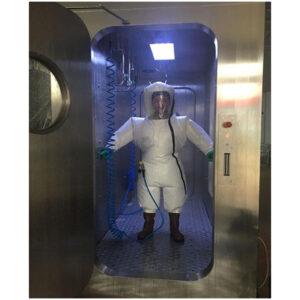
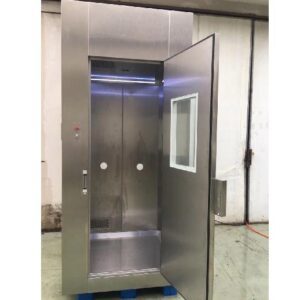
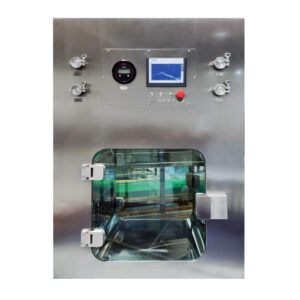
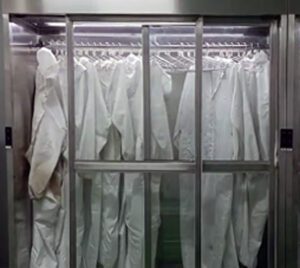
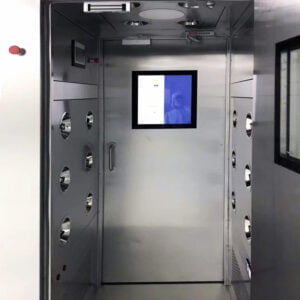
The capital side is visible early — HEPA filtration systems, cleanroom-rated panels and ceilings, air showers, and pass-through chambers all appear in the build cost. What tends to be underestimated is the operational model that follows. Cleanroom operations require formal gowning procedures, trained personnel who understand cleanroom behavior protocols, validated cleaning procedures using approved agents, and scheduled monitoring that generates records requiring review. None of those requirements disappears after qualification. They become recurring line items in labor, consumables, training renewal, and third-party certification.
| Operativer Faktor | Controlled Environment Standard | Cleanroom Grade (Over-Spec) | Impact on Cost & Maintenance |
|---|---|---|---|
| Gowning & attire | Less stringent, basic PPE | Full gowning, air showers | Higher garment cost, laundry, time, training |
| Anforderungen an die Ausbildung | Basic hygiene, process training | Extensive cleanroom behavior, quality control | Increased training burden, ongoing compliance cost |
| Equipment & construction | Standard materials, no HEPA/ULPA | Spezialisiert Reinraumausrüstung, HEPA/ULPA filtration | Inflated procurement budget |
| Maintenance complexity | Simpler, fewer protocols | Complex maintenance, cleaning protocols, monitoring | Higher ongoing operational cost |
The failure pattern here is not dramatic — it does not usually produce a single large budget overrun. Instead, it shows up as a consistently higher cost-of-operations for a process that never actually needed particle control, with maintenance complexity that makes routine interventions slower and more expensive than they would have been in a properly specified controlled environment. When those costs are recognized, retrofitting down to a lower specification is rarely practical; the infrastructure is already installed, the validation documentation already establishes cleanroom expectations, and any change to the controlled conditions creates a revalidation burden. The time to resolve the specification is before the URS is finalized, not after the facility is built.
URS Language That Prevents Scope Inflation
The user requirement specification is where the cleanroom-versus-controlled-environment decision either gets resolved cleanly or gets locked in incorrectly. Most scope inflation does not originate from a deliberate choice to over-specify — it originates from URS language that defaults to cleanroom terminology before the process requirements have been examined critically.
The friction point is predictable: a project team drafts the URS early, borrows language from a previous project or a template, and uses terms like “cleanroom,” “HEPA-filtered environment,” or “classified space” as shorthand for “clean.” By the time procurement begins, those terms have hardened into technical requirements. Suppliers quote against them, construction drawings reflect them, and the cost of backing out the cleanroom scope has grown substantially beyond what it would have cost to simply not include it in the first place.
Preventing that pattern requires the URS to answer specific questions before any cleanroom language enters the document.
| URS Element | What to Specify | Risk if Unclear or Defaulting to Cleanroom |
|---|---|---|
| Cleanliness class | Whether ISO classification is needed or only controlled conditions | Assuming cleanroom class leads to over-specification and inflated cost |
| Temperature/humidity ranges | Accurate required operating ranges, not unnecessarily tight tolerances | Unjustified tight tolerances increase HVAC complexity and cost |
| Druckunterschiede | Required pressure cascade values and direction, if any | Over-engineering pressurization for non-critical areas |
| Regulatorische Anforderungen | Applicable regulations (GMP, FDA, none) and documentation level | Adopting full cleanroom validation when not mandated |
| Materialverträglichkeit | Materials compatible with the actual process, not cleanroom-specific finishes | Paying for expensive cleanroom-compatible materials where standard alternatives suffice |
Each element in that table represents a decision the buyer must resolve explicitly, not a field that defaults to the more stringent option by omission. If the cleanliness class field cannot be answered with a specific ISO class backed by a process requirement or regulatory mandate, the correct entry is not “ISO Class 8” — it is “no classification required.” If the regulatory requirements field does not reference GMP, FDA, or an equivalent framework that actually applies to the process, the validation scope should not be written as if it does.
For facilities teams navigating the early stages of a project, the Complete Modular Cleanroom Guide for Facility Managers and Operations Directors covers how design decisions flow from specification inputs — which helps clarify what the URS is actually committing to before the document is finalized.
The practical standard for URS language is that every cleanroom-grade requirement should trace back to a stated process need, a named regulation, or an explicit customer expectation. If it cannot, it should not be in the document.
Cleanroom Procurement Triggers That Justify The Upgrade
Cleanroom-grade procurement is justified by specific, verifiable conditions — not by general cleanliness expectations, industry convention, or the assumption that a more controlled environment is always more defensible.
Five conditions, when present, provide a rational basis for cleanroom specification. If none of them apply to the process or the customer relationship, the controlled environment path is generally the more appropriate choice.
| Auslösende Bedingung | What It Typically Requires | Was zu klären ist |
|---|---|---|
| Particle classification | ISO class, certified particle-count testing, periodic recertification | Which ISO class, area coverage, sampling point locations |
| Kontinuierliche Überwachung | Installed particle counters, data logging, alert thresholds | Monitoring locations, parameters, alarm criteria, data retention |
| Reinigungsprotokolle | Validated cleaning procedures, approved agents, cleaning training | Cleaning frequency, allowable chemicals, residue limits |
| Specialized airflow | HEPA/ULPA filtration, pressure cascades, defined air velocities | Filter efficiency, air change rates, pressure differentials |
| Documented qualification | IQ/OQ/PQ protocols, formal test reports, compliance evidence | Scope of qualification, acceptance criteria, deliverables |
Each of those triggers carries a follow-on clarification requirement. “Particle classification” is not just a statement that a class is needed — it requires knowing which ISO class, how many sampling points the space demands, and what occupancy state the classification will be verified under. “Documented qualification” is not just a preference for paperwork — it requires knowing whether IQ/OQ/PQ protocols are contractually required, what the acceptance criteria are, and who is responsible for generating and approving the test reports.
Industry benchmarking can help calibrate where a process typically falls, though these are practitioner-level reference points rather than formal regulatory assignments.
| Space / Application | Typical Classification Need | Example Use |
|---|---|---|
| Pharmazeutische Herstellung | Cleanroom (ISO 5–8) | Aseptische Abfüllung |
| Herstellung von Halbleitern | Cleanroom (ISO 3–5) | Wafer lithography |
| Biotechnology production | Cleanroom (ISO 5–7) | Cell therapy production |
| Packaging rooms | Kontrollierte Umgebung | Clean but unclassified packaging area |
| CMM rooms | Kontrollierte Umgebung | Dimensional inspection |
| Stability chambers | Kontrollierte Umgebung | Drug stability studies |
Pharmaceutical aseptic filling, semiconductor wafer lithography, and cell therapy production routinely require cleanroom classification because the product risk and regulatory context demand documented particle control. Packaging rooms, coordinate measuring machine environments, and stability chambers typically do not — their primary requirements are environmental stability and segregation, which a controlled environment addresses without ISO classification overhead.
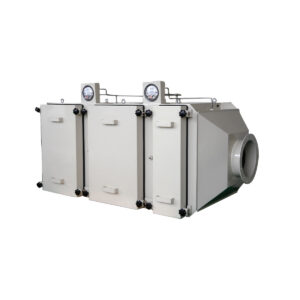
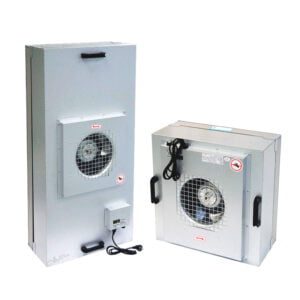
The practical check before issuing an RFQ is whether each trigger condition appears explicitly in the process documentation, the regulatory framework, or the customer contract. If a trigger appears only in a project assumption or a borrowed template, it warrants a direct question to the process owner or quality team before the specification is sent to suppliers. A Lüfter-Filter-Einheit or a modularer Reinraum procurement that turns out to be unnecessary is difficult to reverse once it has been written into a contract; confirming the trigger conditions beforehand costs a conversation, not a change order.
The most consequential step in this decision sequence is the one that happens before the RFQ: confirming whether any of the five trigger conditions — particle classification, continuous monitoring, validated cleaning, specialized airflow, or documented qualification — is actually required by the process, the applicable regulation, or a downstream customer. If none of those conditions can be traced to a concrete source, the controlled environment specification is not a compromise; it is the correct scope.
What buyers should carry into the pre-RFQ conversation is a short set of resolved questions: Does the process generate a particle exposure risk that requires certified limits? Does the regulatory framework governing this facility invoke ISO 14644-1 or an equivalent standard? Does a customer contract specify a classified environment? If the answers are no, uncertain, or “we’ve always done it this way,” the URS needs a cleanliness-class review before any supplier scope is finalized — because that review, done at the document stage, is the lowest-cost point at which a scope error can still be corrected without consequence.
Häufig gestellte Fragen
Q: Our process has no formal regulatory framework — does that mean a controlled environment is automatically the right choice?
A: Not automatically, but the absence of a regulatory mandate removes one of the strongest justifications for cleanroom-grade specification. The relevant check is whether a downstream customer contract, an internal quality agreement, or the product’s own risk profile independently requires particle classification or documented qualification. If none of those sources impose a particle class, a controlled environment is likely appropriate — but the determination should come from reviewing those three sources explicitly, not from assuming that “no regulation” equals “no classification required.”
Q: Once a URS has been finalized with cleanroom language, how difficult is it to walk the specification back before the RFQ goes out?
A: Correcting cleanroom language in a URS before the RFQ is issued is significantly easier than after — but it still requires a formal change, sign-off from the process owner and quality team, and a review of any downstream documents that referenced the original URS. The practical risk is that borrowed cleanroom terminology can propagate into design briefs, validation plans, and internal budget approvals before anyone flags the mismatch. The earlier the review happens — ideally at a structured URS checkpoint before any supplier contact — the fewer documents need to be revised and the lower the reversion cost.
Q: Is there a point at which a process grows complex enough that a controlled environment can no longer manage the risk, and cleanroom classification becomes necessary mid-project?
A: Yes. The threshold is reached when the process introduces a product risk or a customer requirement that demands certified particle limits, continuous monitoring records, or formal qualification protocols — conditions that a controlled environment was not designed to satisfy and cannot be audited against. In practice, this most often occurs when a facility transitions from development-scale work to commercial production under GMP, when a new customer contract specifies an ISO class, or when a regulatory inspection identifies unclassified areas that the applicable framework actually requires to be classified. Anticipating that transition at the design stage — by building a controlled environment with a layout and infrastructure that could support a cleanroom upgrade without full reconstruction — is a lower-risk approach than treating the two as permanently separate paths.
Q: How does the ongoing cost comparison between a cleanroom and a controlled environment typically play out over a three-to-five-year horizon?
A: The gap widens considerably over time because cleanroom operational costs — gowning consumables, periodic recertification, validated cleaning agents, monitoring system maintenance, and personnel training renewal — are recurring rather than one-time. A controlled environment carries lower initial capital cost and a materially simpler operational model with less stringent attire requirements, no scheduled particle-count recertification, and fewer documented protocols to maintain. For a process that never actually required particle classification, that recurring overhead represents cost with no corresponding compliance return. The article does not provide specific figures for this gap, but the structural difference in operational models means the total cost of ownership diverges from commissioning onward, not just at the build stage.
Q: If a project is genuinely on the boundary — some process steps seem to warrant classification and others do not — is it defensible to specify a cleanroom for part of the facility and a controlled environment for the rest?
A: Yes, and for borderline projects this is often the more defensible approach than applying cleanroom specification uniformly across the entire footprint. The practical requirement is that the boundary between the classified and uncontrolled zones be defined in the URS with explicit pressure differential, airflow, and gowning transition requirements, and that the classified zone’s ISO class be traceable to a specific process step or regulatory trigger rather than a general cleanliness preference. Applying ISO 14644-1 classification only to the areas where the trigger conditions are genuinely met limits both the capital cost and the ongoing operational overhead to the portions of the facility where that investment is actually justified.